预制菜

Search documents
罗永浩与西贝的预制菜争议引爆行业,消费者为何“谈虎色变”
Di Yi Cai Jing· 2025-09-12 14:53
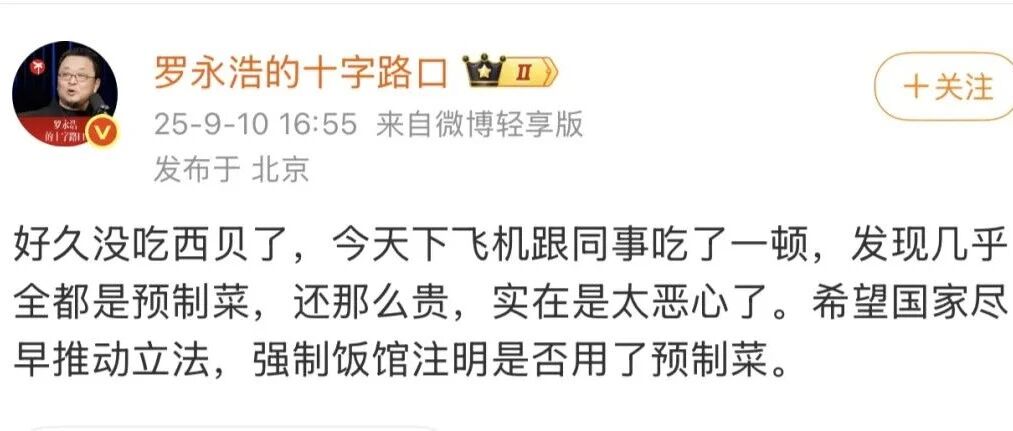
Core Viewpoint - The ongoing dispute between entrepreneur Luo Yonghao and the restaurant brand Xibei highlights differing perceptions of "pre-made dishes" and raises questions about consumer rights and industry standards in the pre-made food sector [1][2][5] Group 1: Dispute Overview - Luo Yonghao publicly criticized Xibei for serving pre-made dishes at high prices, emphasizing the importance of consumer awareness regarding the use of pre-made ingredients [2][5] - Xibei's response included a commitment to legal action against Luo and a public disclosure of their food preparation processes, asserting that their dishes are not pre-made but rather pre-processed [2][3] Group 2: Industry Context - The pre-made food industry in China has been developing for over 20 years, primarily known to B-end operators until recent years when consumer awareness increased due to market changes and the pandemic [4][5] - The industry is projected to grow significantly, with estimates suggesting a market size of 5 trillion yuan for B-end and 7 trillion yuan for C-end by 2030, assuming a penetration rate of 15%-20% [4] Group 3: Regulatory Environment - There is currently no national standard for pre-made dishes in China, leading to inconsistencies across regions, although there is a push for clearer labeling to protect consumer rights [4][6][7] - Recent government initiatives aim to promote transparency in the use of pre-made dishes in restaurants, aligning with consumer rights to know the nature of the food they purchase [6][7] Group 4: Consumer Perception and Safety - Consumers often conflate pre-prepared ingredients with pre-made dishes, leading to misunderstandings about what constitutes pre-made food [8][9] - The central kitchen model is increasingly adopted in the restaurant industry, enhancing food safety through standardized production and centralized sourcing, which helps mitigate risks associated with traditional kitchen operations [9]
16家预制菜相关公司的上半年财报,透露了哪些信息
Qi Lu Wan Bao Wang· 2025-09-12 14:51
Core Insights - The recent criticism of pre-prepared dishes by Luo Yonghao has brought significant attention to the industry, highlighting both its growth potential and the challenges it faces [1] Industry Overview - The pre-prepared dish market in China reached a scale of 485 billion yuan in 2024, with projections to grow to 749 billion yuan by 2026 [1] - The industry connects agricultural production with consumer markets, becoming a popular segment in the food sector [1] Company Performance - Over half of the top 20 pre-prepared dish companies reported revenue declines in their 2025 semi-annual reports, with some experiencing drastic drops in net profit [2] - Notable companies like Weizhi Xiang and Qianwei Yangchu faced significant challenges, with Weizhi Xiang's net profit down 24.5% and Qianwei Yangchu's net profit down 39.7% [2] - Conversely, companies like Gai Shi Food showed positive growth, with a revenue increase of 11.39% in the first half of 2025 [3] Challenges Facing the Industry - The industry is under pressure from fluctuating raw material prices, which have significantly impacted profit margins [4] - Increased competition and market saturation have led companies to adopt aggressive promotional strategies, further squeezing profit margins [4] - A heavy reliance on B-end clients, particularly in the restaurant sector, poses risks, as evidenced by a significant drop in the number of distributors for Qianwei Yangchu [4][5] Consumer Trust Issues - Consumer confidence in pre-prepared dishes has been shaken by various negative incidents, including health concerns and lack of transparency from businesses [5][6] - A significant portion of consumers actively seek information about pre-prepared dishes, indicating a demand for greater transparency and safety [6] Regulatory Developments - The industry is moving towards greater regulation and standardization, with new guidelines being introduced to enhance food safety and quality [7] - Companies are adjusting to stricter standards regarding food additives and labeling, which is expected to improve product safety [7] International Expansion - There is a growing trend of companies looking to expand into international markets, with Southeast Asia projected to lead in growth rates [8] - The emergence of a consumer group favoring frozen pre-prepared foods indicates a shift in acceptance and demand for these products [8]


专家:国家界定与公众认知存在差距 预制菜产业成熟仍需时间
Di Yi Cai Jing· 2025-09-12 13:38
Core Viewpoint - The recent dispute between Luo Yonghao and the restaurant group Xibei has cast a shadow over the "pre-prepared dishes" industry, highlighting the need for clearer definitions and standards in this sector [1] Group 1: Definition and Characteristics of Pre-prepared Dishes - The National Market Supervision Administration and five other departments have jointly issued a notice that clearly defines pre-prepared dishes, emphasizing their industrial pre-processing characteristics and the requirement that they must be heated or cooked before consumption [2] - Pre-prepared dishes must not include staple foods and should meet specific production and processing standards, including being packaged for storage, transportation, and sale [2][3] Group 2: Industry Context and Consumer Perception - The pre-prepared dish sector is currently driven by policy support, capital investment, and industry competition, but consumer acceptance remains low due to safety and nutritional concerns [4] - Many consumers associate pre-prepared dishes with a lack of quality and safety, leading to apprehension about their use in restaurant chains [4][5] - The industry faces challenges in balancing consumer expectations for freshly prepared meals with the operational realities of restaurant chains, which often rely on central kitchens for efficiency [4][6] Group 3: Recommendations for Industry Improvement - Experts suggest that the industry needs to respect consumer rights to information and choice, advocating for the establishment of national standards for pre-prepared dishes to alleviate consumer concerns [6] - There is a call for regulatory measures to ensure that pre-prepared products meet safety standards and that restaurants disclose their use of such products to consumers [6]
专家:国家已划定预制菜范围,预处理的食品原料不等同于预制菜
第一财经· 2025-09-12 13:15
Core Viewpoint - The article discusses the ongoing debate surrounding "pre-prepared dishes" in China, highlighting the need for clearer regulations and consumer understanding of this food category [3][4]. Definition of Pre-prepared Dishes - Pre-prepared dishes are defined as food products made from one or more edible agricultural products, processed industrially, and requiring heating or cooking before consumption. They do not include staple foods like frozen rice or sandwiches [4][5]. - The Chinese government has established a clear definition to distinguish pre-prepared dishes from other processed foods, emphasizing the importance of industrial pre-processing and the characteristics of a dish [5]. Industry Context - The pre-prepared dish sector is currently driven by policy support, capital investment, and competitive market dynamics, but consumer acceptance remains low due to safety and nutritional concerns [6]. - Many consumers associate pre-prepared dishes with lower quality, fearing that restaurants using them may compromise food safety [6][7]. Consumer Perception and Challenges - There is a significant gap between the industry's understanding of pre-prepared dishes and public perception, with many consumers still unclear about their safety and nutritional value [6][8]. - The article notes that while some restaurant chains use pre-prepared components to streamline operations, this practice can lead to consumer distrust if not communicated effectively [7][8]. Recommendations for Improvement - Industry experts suggest that restaurants must respect consumer rights to know about the use of pre-prepared dishes and that national standards should be established to regulate this sector [8]. - The establishment of national standards and licensing for pre-prepared dishes is recommended to alleviate consumer concerns and ensure compliance with safety regulations [8].


专家:国家界定与公众认知存在差距,预制菜产业成熟仍需时间
Di Yi Cai Jing· 2025-09-12 12:32
"国家已经划定了预制菜的范围。预处理的食品原料并不等同于预制菜。" 罗永浩与餐饮集团西贝的"预制菜纷争",让"预制菜"蒙上了一层阴影。 那么,到底什么是预制菜? 2024年3月18日,市场监管总局、教育部、工业和信息化部、农业农村部、商务部、国家卫生健康委等 六部门联合发布了《关于加强预制菜食品安全监管 促进产业高质量发展的通知》(下称《通知》), 首次明确界定了预制菜的范围: 预制菜,也称预制菜肴,是以一种或多种食用农产品及其制品为原料,使用或不使用调味料等辅料,不 添加防腐剂,经工业化预加工(如搅拌、腌制、滚揉、成型、炒、炸、烤、煮、蒸等)制成,配以或不 配以调味料包,符合产品标签标明的贮存、运输及销售条件,加热或熟制后方可食用的预包装菜肴。 不包括主食类食品,如速冻面米食品、方便食品、盒饭、盖浇饭、馒头、糕点、肉夹馍、面包、汉堡、 三明治、披萨等。 事实上,公众对"预制菜"的概念一直较为模糊。然而,《通知》已作出明确定义:预制菜应当兼具"预 制化"和"菜肴"的双重特征,突出工业化预加工的特点和菜肴属性,具备规模化、标准化、洁净化、规 范化的食品生产加工要求。同时,预制菜必须是加热或熟制后方可食用的预包装 ...
行业痛点与消费者悖论,预制菜需要的是进化,还是否定?
Sou Hu Cai Jing· 2025-09-12 12:27
Core Viewpoint - The debate surrounding pre-prepared meals highlights the industry's sharp contradictions, emphasizing that the issue lies not in the existence of pre-prepared meals but in the quality standards and transparency in their production [1][3]. Group 1: Nature of the Controversy - The essence of the debate is not whether pre-prepared meals should exist, but how to improve their quality [3]. - The viewpoint of industry leaders suggests that pre-prepared meals can standardize taste, enhance efficiency, and reduce operational costs, which are essential for scaling the restaurant industry [3]. - Consumer concerns focus on the potential over-reliance on additives, significant nutrient loss, and overall quality of these industrial products [3]. Group 2: Industry Pain Points - The primary issue in the pre-prepared meal industry is the lack of quality standards and inadequate supervision [5]. - Many companies compromise on quality by using inferior ingredients and excessive additives to mask defects, leading to a negative perception of pre-prepared meals [6]. - The safety and long-term effects of combined additive usage remain inadequately assessed, causing consumer skepticism about "compliant but unreasonable" practices [6]. - Nutritional quality is often compromised due to repeated heating and prolonged storage, resulting in significant nutrient loss and high levels of oil and salt, contrary to modern health dietary principles [6]. Group 3: Consumer Paradox - Consumers feel their right to know is being violated, as restaurants rarely disclose which dishes are pre-prepared [8]. - This information asymmetry leads to feelings of deception among consumers, fostering resistance towards the entire pre-prepared meal industry [9]. Group 4: Path to Resolution - For the pre-prepared meal industry to develop healthily, three core issues must be addressed: transparency, standardization, and quality enhancement [10]. - Transparency is fundamental; a mandatory labeling system should be established to inform consumers about pre-prepared meals on menus and delivery platforms [10]. - Standardization is crucial; industry quality standards should exceed national benchmarks, imposing stricter regulations on additive usage, nutritional content, and ingredient quality [10]. - Quality enhancement should be the goal, encouraging companies to invest in research and development to reduce reliance on additives and improve the healthiness of pre-prepared meals through innovative processes [10]. Group 5: Conclusion - The debate reflects the inevitable growing pains in China's restaurant industrialization process, where the value of pre-prepared meals should not be entirely dismissed [11]. - The future lies not in reverting to fully made-to-order models but in advancing pre-prepared meals towards greater transparency, healthiness, and quality [11]. - The end goal for the restaurant industry should be an open, transparent, and high-quality food experience, necessitating self-discipline from companies, industry regulations, and consumer oversight [11][12].

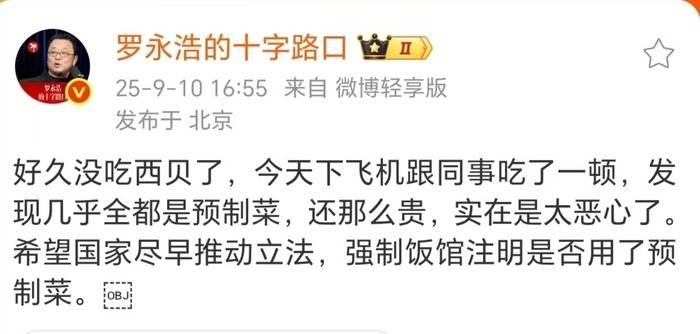
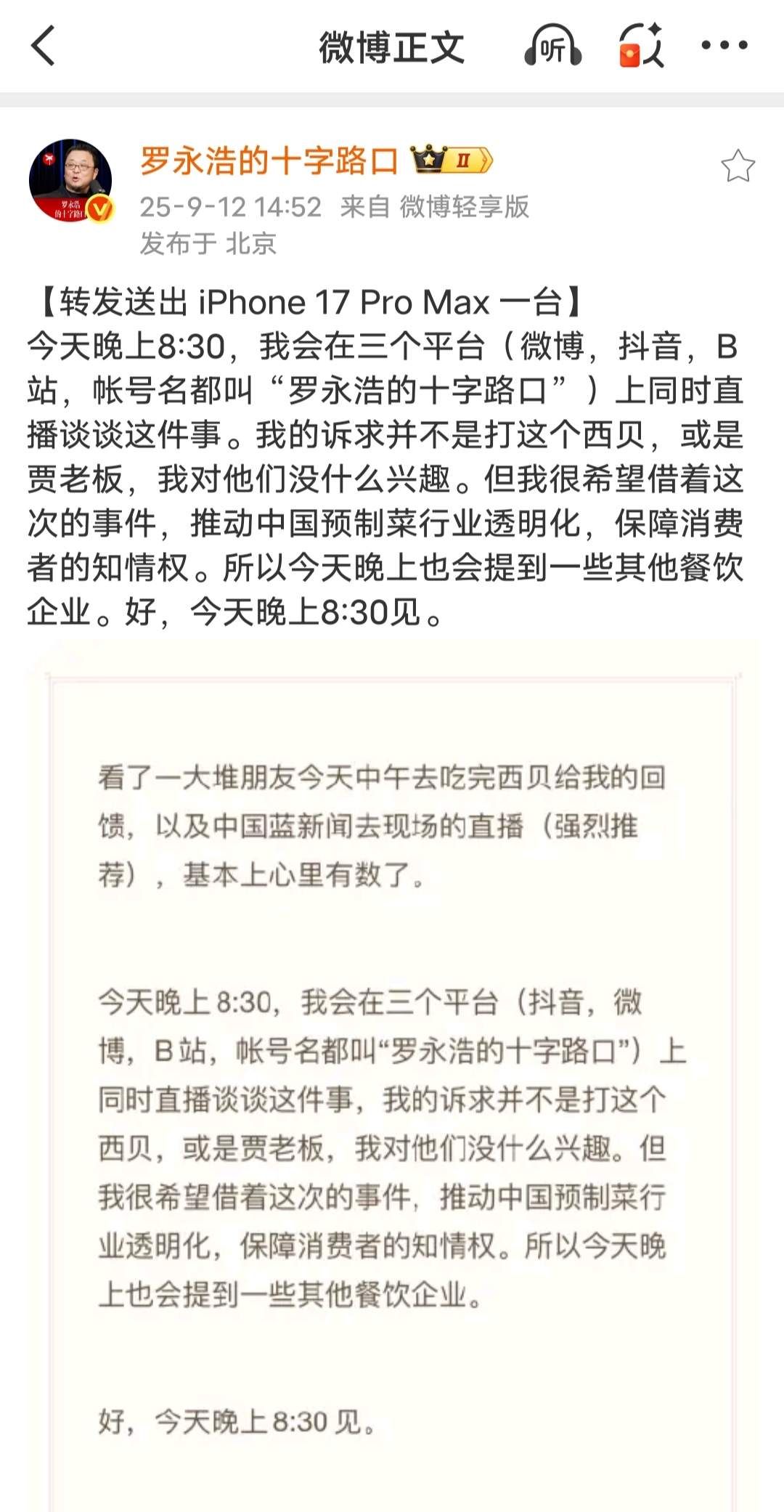
罗永浩预告今晚谈西贝预制菜事件 原则上不同意贾国龙上节目
Feng Huang Wang· 2025-09-12 11:50
Group 1 - The core viewpoint of the articles revolves around Luo Yonghao's intention to promote transparency in the Chinese prepared food industry and to safeguard consumer rights through a live broadcast [1][3]. - Luo Yonghao plans to discuss not only the incident involving Xibei but also other restaurant companies during his live stream [1]. - He expressed skepticism about the long-term viability of selling prepared dishes as freshly made, predicting that legislation will eventually ensure consumer awareness [3]. Group 2 - Luo Yonghao recently announced his entry into Bilibili with a video podcast titled "Luo Yonghao's Crossroads," which will feature in-depth discussions on various topics, including technology and humanity [5]. - The podcast episodes are expected to last between 3 to 5 hours and will include notable guests from the automotive industry [5].
观澜亭|餐厅不标注“预制菜”成通病?西贝风波拷问行业透明度
Da Zhong Ri Bao· 2025-09-12 10:27
Core Viewpoint - The controversy surrounding the use of pre-prepared dishes in restaurants highlights a significant industry issue regarding transparency and consumer trust, as exemplified by the public dispute between Luo Yonghao and Xibei's founder, Jia Guolong [3][5][8]. Group 1: Industry Practices - Xibei has launched a "Luo Yonghao Set Meal" priced at 666 yuan, allowing customers to choose from 13 dishes, with a guarantee of "not tasty, no charge" [1]. - The use of pre-prepared dishes has become widespread, with over 80% of chain restaurants in Guangzhou reportedly using them, yet many do not clearly label this on their menus [6][10]. - The lack of labeling for pre-prepared dishes has become an industry norm, with many restaurants opting to disguise these items as freshly cooked to maintain customer appeal and profit margins [6][10]. Group 2: Consumer Sentiment - A survey indicated that nearly 25% of consumers express distrust towards pre-prepared dishes, and over 70% want clear information on whether dishes are freshly made or pre-prepared [5][10]. - The disconnect between consumer concerns about transparency and restaurant claims about product quality reflects a deeper issue of trust in the industry [8][11]. Group 3: Regulatory Environment - The Chinese government is moving towards stricter regulations on pre-prepared dishes, with a directive set for March 2024 requiring clear labeling to protect consumer rights [10][11]. - Local standards are also being developed, such as those in Guangdong, which mandate the labeling of pre-prepared dishes and provide guidelines for terminology and packaging [10]. Group 4: Business Implications - Evidence suggests that transparency in labeling pre-prepared dishes can lead to a decrease in consumer complaints by approximately 15% and an increase in repurchase rates by nearly 10% [10]. - The long-term benefits of transparency may outweigh short-term risks, as it can help rebuild consumer trust and drive industry upgrades [10][11].
罗永浩大战西贝,聊聊预制菜行业
佩妮Penny的世界· 2025-09-12 09:41
Core Viewpoint - The article discusses the recent conflict between Luo Yonghao and Xibei regarding the pre-prepared food industry, highlighting the challenges and perceptions surrounding pre-prepared meals in China [1][2]. Industry Overview - The pre-prepared food industry gained popularity during the pandemic, with Xibei's attempt to enter the market through "Jia Guolong Kungfu Cuisine," which ultimately did not succeed [2][4]. - Pre-prepared food is an important part of food industrial development, with penetration rates in countries like the US and Japan reaching 60%, while China's penetration is only 10-15% but growing rapidly [5][6]. Market Trends - The growth of the pre-prepared food sector in China is driven by several trends: 1. Increased penetration of food delivery services, which require high efficiency and safety standards [6][8]. 2. The trend of restaurant chain development, which enhances food industrial and logistics capabilities [8][11]. Regulatory Changes - New regulations in 2024 will redefine pre-prepared food, excluding certain types of food processing from the category, which may impact market dynamics [13][16]. Consumer Perception - There is a significant consumer skepticism towards pre-prepared meals, especially when they perceive they are paying for freshly made food but receiving pre-prepared options instead [4][16]. - The article suggests that the current economic environment makes it difficult for the pre-prepared food industry to thrive, as consumers are not seeing price reductions despite lower costs for restaurants [16]. Investment Outlook - The article expresses a cautious outlook on investing in the pre-prepared food sector, suggesting that upstream companies focusing on standardized products may have a competitive advantage [16].
海量财经丨罗永浩将预制菜推向风口浪尖!数千亿预制菜市场谁在消费?
Sou Hu Cai Jing· 2025-09-12 09:14
Core Viewpoint - The controversy surrounding the definition of pre-prepared dishes has highlighted significant shifts in the contemporary dining industry, particularly in the context of rising consumer expectations and transparency demands [1][3]. Group 1: Company Responses - Xibei's founder, Jia Guolong, firmly denied the use of pre-prepared dishes in their restaurants, asserting that all 370+ locations do not serve any pre-prepared items [2]. - Jia Guolong introduced a "Luo Yonghao Menu" showcasing a meal for five costing over 800 yuan, emphasizing the quality of their offerings [2]. - In response to the controversy, Xibei has adopted a transparency strategy by allowing consumers to tour their kitchens starting September 12, 2025 [2]. Group 2: Market Growth and Consumer Trends - The pre-prepared dish market in China reached a scale of 485 billion yuan in 2024, with a year-on-year growth of 33.8%, and is projected to exceed 617.3 billion yuan in 2025 [6]. - The primary consumers of pre-prepared dishes are B-end clients, particularly restaurant businesses, which account for over half of the total consumption [6]. - C-end consumers, including busy office workers and young families, are increasingly turning to pre-prepared dishes for convenience, with examples of quick meal solutions becoming commonplace [6]. Group 3: Industry Dynamics - The use of pre-prepared dishes is driven by cost efficiency and operational effectiveness, with many restaurants adopting them to reduce expenses and ensure consistent food quality [7]. - Pre-prepared dishes can enhance the speed of service and reduce reliance on skilled chefs, making them attractive to chain restaurants [7]. - Despite the growth of pre-prepared dishes, the industry faces challenges related to health concerns and potential loss of culinary traditions, as well as the risk of market homogenization [9].