软件

Search documents
2016年以来最疯狂!高盛:上周暴跌期间,对冲基金大举做空美股
智通财经网· 2026-02-09 13:53
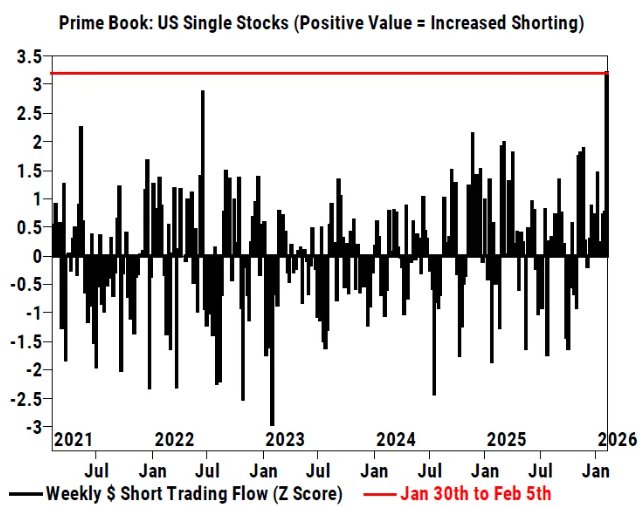
Group 1 - Concerns about artificial intelligence disrupting business models have led hedge funds to short U.S. stocks, with nominal short selling reaching the highest level since 2016 [1] - The sell-off was particularly severe in the software sector, which accounted for approximately 75% of the net selling in that sector, resulting in a total market value loss of $611 billion across 164 stocks in software, financial services, and asset management [1][3] - Hedge funds have net sold U.S. stocks for the fourth consecutive week, with the largest selling magnitude since April last year, particularly impacting the information technology sector [3] Group 2 - Defensive sectors are gaining attention from hedge funds, with healthcare becoming the most net bought sector last week, surpassing industrials in fund inflows for the year [4] - Despite a rebound in the market due to bargain buying, the Nasdaq 100 index recorded its worst weekly performance of the year [4] - Semiconductor stocks saw an increase last week, indicating a divergence between chip stocks and software stocks as investors continue to sell off industries perceived to be at risk from AI [3]


盘前:纳指期货跌0.33% 高盛称美股抛售未结束
Xin Lang Cai Jing· 2026-02-09 13:45
Market Overview - After a volatile week, the Dow Jones Industrial Average (DJIA) closed above 50,000 points for the first time, with futures slightly down on Monday [2][12] - The DJIA surged by 1,200 points, approximately 2.5%, while the S&P 500 and Nasdaq Composite rose by about 2% each [2][12] - Bitcoin prices rebounded above $70,000 after dropping below $61,000, reflecting a recovery in investor sentiment [2][12] Technology Sector Insights - The software sector experienced a much-needed rebound after eight consecutive days of decline, with significant buying activity returning [3][13] - Analysts emphasize that the technology sector's performance is crucial for sustainable market growth, particularly the software stocks [3][13] - Morgan Stanley's analysts predict further upside for U.S. tech stocks, driven by strong sales prospects fueled by AI trends [16] Economic Data and Reports - The U.S. non-farm payroll report for January, initially scheduled for release last week, is now set to be published on Wednesday, with expectations of a 55,000 increase in jobs [14] - The Consumer Price Index report for January is expected to show a year-over-year increase of 2.5% [14] Systematic Selling Pressure - Goldman Sachs warns that if the S&P 500 falls below 6,707 points, it could trigger up to $80 billion in systematic selling pressure from trend-following funds [18] - The firm estimates that approximately $33 billion in selling pressure could occur if the market declines further this week [18][19] Focus Stocks - Precious metals saw a pre-market rally, with Austin Gold up 7% and Namib Minerals up 6% [20] - Hims & Hers faced a significant drop of 17% after removing a generic weight loss drug from the market [20] - QuantumScape continued its upward trend, rising over 19% after starting solid-state battery pilot production [20]

还能涨!摩根士丹利:软件股跌出“极具吸引力”的买点
Xin Lang Cai Jing· 2026-02-09 13:11
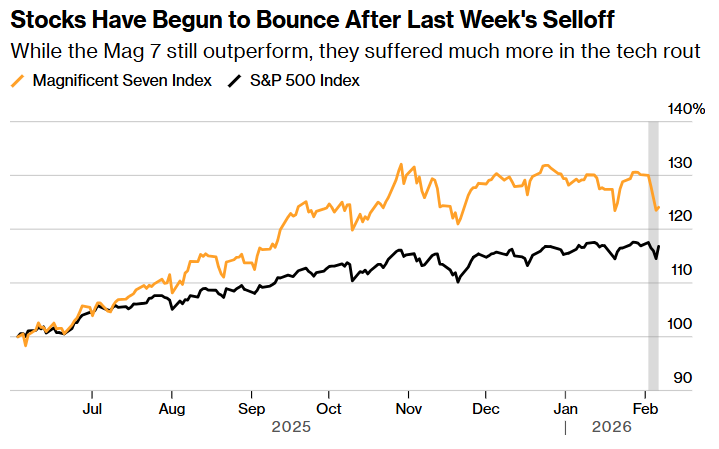
摩根士丹利的策略师表示,随着人工智能的热潮支撑起强劲的销售前景,美国科技股仍有进一步上涨的 空间。 由威尔逊(Michael Wilson)领导的团队指出,大型科技股的营收增长预期已达到"数十年来的高点", 而经过近期的市场波动,其估值已经有所下降。与此同时,软件股的暴跌为微软和Intuit Inc.等公司提 供了"极具吸引力的入场点"。 威尔逊在报告中写道:"在重大的投资周期中,上周那样的波动并不罕见。尽管如此,人工智能赋能型 企业的基本面利好依然存在,且我们认为人工智能采用者的交易价值仍被低估。" 对于那些开始质疑人工智能巨额投资回报的投资者来说,他的观点无疑是一种安慰。纳斯达克100指数 经历了自2025年12月以来最大的单周跌幅,而那些被认为可能受到人工智能冲击的公司股价在某些新工 具发布后也出现了下跌。 炒股就看金麒麟分析师研报,权威,专业,及时,全面,助您挖掘潜力主题机会! 来源:金十数据 来源:金十数据 摩根士丹利的策略师表示,随着人工智能的热潮支撑起强劲的销售前景,美国科技股仍有进一步上涨的 空间。 虽然美股"七巨头"的整体表现依然跑赢大盘,但在科技股的溃败中受损也更为严重。目前,彭博"七巨 ...
惊了,1月基金新开户54.63万户~2026年2月9日 市场温度
Xin Lang Cai Jing· 2026-02-09 13:07
Group 1 - The estimated profit for today is +70,000 (assets of 5.5 million), with a total profit of +119,000 across two accounts, resulting in a profit-loss ratio of +1.49% [1] - The Hang Seng Technology index has rebounded after a 20% correction from its peak, indicating a potential upward trend [1] - The recent surge in AI applications has led to significant gains, with the Media ETF rising over 4% and the Software ETF increasing over 3% [5] Group 2 - In January, there were 546,300 new fund accounts opened, representing a month-on-month increase of 123.8% and a year-on-year increase of 168.72% [6][9] - The increase in new fund accounts suggests a significant influx of retail investor capital into public funds [6] - The actual increase in fund shares will be assessed when the fund association releases data at the end of February [7][9] Group 3 - The surge in new fund accounts may be influenced by short-term arbitrage opportunities, particularly related to silver LOF [8] - If new account openings continue to rise in February, it would indicate a shift of household savings into financial products [9] - Conversely, a decline in new account openings would suggest that many new accounts were opened for short-term trading rather than long-term investment [9] Group 4 - The A-share market temperature is at 71.36, up 1.6 degrees from the previous trading day, while the Hong Kong market temperature is at 54.41, up 1.9 degrees [10][11] - The MACD golden cross signal has formed, indicating a positive trend for certain stocks [11]

三大股指期货齐跌 美国1月非农与CPI本周来袭
Zhi Tong Cai Jing· 2026-02-09 13:05
Market Movements - US stock index futures are all down ahead of the market opening, with Dow futures down 0.06%, S&P 500 futures down 0.17%, and Nasdaq futures down 0.33% [1] - European indices show mixed results, with Germany's DAX up 0.32%, UK's FTSE 100 down 0.13%, France's CAC40 up 0.03%, and the Euro Stoxx 50 up 0.21% [2] - WTI crude oil is up 0.44% at $63.83 per barrel, while Brent crude is up 0.41% at $68.33 per barrel [2] Economic Data and Events - Key economic data is expected this week, including December retail sales on Tuesday and the January non-farm payroll report on Wednesday, which is anticipated to show an addition of 70,000 jobs with an unemployment rate holding steady at 4.4% [3] - The non-farm payroll report will also include annual employment revision data, which is expected to show significantly lower job growth than previously reported [3] - On Friday, the Consumer Price Index (CPI) report is expected to show a month-over-month increase of 0.3% and a year-over-year increase of 2.5% [3] - Major companies such as Coca-Cola, McDonald's, Cisco, and ON Semiconductor are set to release their earnings this week [3] Company Insights - Morgan Stanley supports the tech sector, stating that the AI investment cycle's volatility does not change the strong fundamentals, with large tech companies seeing revenue growth expectations at their highest in decades [4] - Goldman Sachs warns of potential selling pressure in the S&P 500, estimating that a drop below 6707 points could trigger up to $80 billion in systematic selling [5] - Bank of America reports a rare synchronization between President Trump's approval ratings and the dollar's performance, indicating that market support may be lacking until his approval ratings recover [6] - Goldman Sachs is collaborating with AI startup Anthropic to automate various banking functions, focusing initially on transaction accounting and customer due diligence [9] - BHP plans to double its investment in its copper projects in Argentina to $800 million, aiming to address the global copper supply shortage [10] - NatWest is acquiring wealth management firm Evelyn Partners for £2.7 billion, marking a significant move to expand its coverage of high-net-worth clients [11] - Sohu reported a 6% year-over-year increase in Q4 revenue to $142 million, with online gaming revenue contributing $120 million [12]

百亿CEO自述:金钱买不来幸福
财富FORTUNE· 2026-02-09 13:05
Core Insights - The article highlights the unconventional perspective of Sami Inkinen, CEO of Virta Health, on wealth and success, emphasizing that true happiness is not derived from money but from a fulfilling life experience [2][3][4]. Group 1: Personal Journey and Philosophy - Sami Inkinen's sense of success was only realized when he paid off $100,000 in student debt in 2008, marking a significant moment in his life [2][3]. - Despite accumulating wealth through entrepreneurship, Inkinen does not prioritize his net worth and believes that financial security does not equate to happiness [4][5]. - He attributes his non-materialistic view of happiness to his upbringing in Finland, where education and healthcare are free, fostering a mindset that values quality of life over material possessions [5][6]. Group 2: Entrepreneurial Achievements - Inkinen co-founded three companies over his 20-year career, including two unicorns, with Virta Health currently valued at $2 billion [4][5]. - His first entrepreneurial venture was Matchem, a mobile software company he sold for millions before moving to the U.S. [3][4]. - He played a crucial role in the growth of Trulia, which was sold to Zillow for $3.5 billion in 2015, showcasing his ability to build successful companies [4][5]. Group 3: Broader Perspectives on Wealth and Happiness - The article discusses the notion that wealth can provide security but does not guarantee happiness, with experts suggesting a threshold income of around $500,000 where happiness levels plateau [6][7]. - Notable figures like Barbara Corcoran and Warren Buffett echo similar sentiments, emphasizing that their experiences with wealth have not significantly altered their happiness levels [7][8].



高盛:AI焦虑引发抛售潮 对冲基金创纪录做空美股
Xin Lang Cai Jing· 2026-02-09 13:01
来源:格隆汇APP 格隆汇2月9日|随着市场对人工智能颠覆商业模式的担忧持续发酵,对冲基金大举增加了对美国股票的 做空头寸。高盛集团大宗经纪业务团队在客户报告中表示,上周单只股票的名义卖空规模创下该行自 2016年有数据以来的最高纪录。该团队援引1月30日至2月5日期间的资金流向称,卖空交易规模是多头 买入的两倍。市场对AI如何重塑经济的焦虑在华尔街引发了动荡的一周。软件、金融服务和资产管理 领域的164只股票上周市值合计蒸发6110亿美元。总体来看,对冲基金已连续第四周净卖出美股,抛售 速度创下今年4月初所谓"解放日"以来最快。高盛团队指出,信息技术板块是抛售最严重的领域,净流 出规模创过去五年第二高。其中软件股主导了下跌行情,约占该板块净卖出量的75%。对冲基金对软件 股的总净敞口降至2.6%,多空比率下滑至1.3——两者均创历史新低。 ...
Dow Jones and Nasdaq set to retreat from highs after AI overreaction
Proactiveinvestors NA· 2026-02-09 12:59
US futures dropped into the red on Monday morning, reversing some of their strong relief rally gains from the end of last week, ahead of a new stack of economic data in the coming days. Apart from consumer inflation expectations, there is no data today, but later on in the week there will be retail sales, mortgage application and January's delayed non-farm payrolls release. Nasdaq futures were down 0.5%, with those for the S&P 500 and Dow Jones down 0.3% and 0.2%, retreating from the highs seen at the end o ...
大摩力挺科技股:AI投资周期波动不改强劲基本面,反弹仍有后劲
Zhi Tong Cai Jing· 2026-02-09 12:39
摩根士丹利策略师表示,由于人工智能的热潮支撑了强劲的销售前景,美国科技股还有进一步上涨的空 间。由Michael Wilson领导的团队表示,大型科技股的营收增长预期已达到"数十年来的最高水平",而 近期市场波动后,其估值有所下降。与此同时,软件股的暴跌也为微软(MSFT.US)和财捷(INTU.US)等 一些股票创造了"极具吸引力的买入机会"。 Wilson在一份报告中写道:"像上周那样的时期在重大投资周期中并不罕见。尽管如此,人工智能赋能 者行业的基本面依然强劲,我们认为人工智能采用者市场的价值仍然被低估了。" Wilson的观点或许能让那些开始质疑人工智能领域巨额投资回报的投资者感到安心。上周,纳斯达克 100指数遭遇了自去年12月以来最大的单周跌幅,那些被认为可能受到人工智能冲击的股票在Anthropic 新工具发布后纷纷下跌。 "七大科技巨头"指数目前的市盈率约为29倍,略低于五年平均水平。上周五有一些逢低买入者入场,但 市场走势表明这种情况可能只是暂时的,纳斯达克100指数期货周一下跌0.7%。 Wilson团队的分析显示,投资者尚未以更具结构性的方式加强对资本支出的约束。这位策略师表示,资 本支 ...


1万亿美元反弹是“死猫跳”?美股回升背后藏隐忧,市场信心疲软
智通财经网· 2026-02-09 12:11
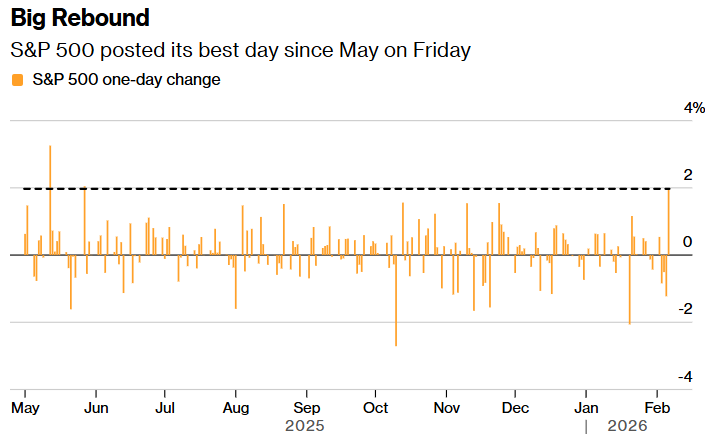
智通财经APP获悉,专家表示,他们对美国股市能否延续上周人工智能引发的暴跌后1万亿美元的反弹 势头信心有限。上周五的强劲反弹——标普500指数创下去年5月以来最佳单日表现——抹去了上周的大 部分跌幅。然而,投资者仍在努力定价不明朗的美国经济前景,并日益担忧人工智能将如何重塑各行各 业,尤其是本次动荡的中心——软件行业。 上周五的强劲走势背后,隐藏着市场对这波行情信心不足的迹象。标普500指数的预期波动率高于今年 平均水平,表明市场不安情绪依然存在。成交量也印证了市场缺乏热情,较五日平均水平低约13%。高 盛的做空头头寸组合上涨约9%,创下4月以来最佳单日表现,这表明部分反弹可能源于交易员平仓风险 较高的股票。 富国银行投资研究所全球股票和实物资产主管Sameer Samana表示:"人工智能的主题已经从惠及所有股 票转变为赢家通吃。在市场能够区分赢家和输家之前,将难以确定领头羊并创造新高。" 值得注意的是,上周的下跌并非完全与人工智能有关。还有疲软的美国劳动力市场数据引发了人们对经 济前景的担忧,加剧了股市、大宗商品和加密货币的下行压力。诚然,上周五公布的一份报告显示,美 国消费者信心指数升至六个月来的最高点 ...