银行业

Search documents
暴跌后,黄金又变脸!
Jin Tou Wang· 2026-02-25 10:20
Group 1: Market Movements - Significant pullback in spot gold, dropping nearly 2.5% to around $5094, closing at $5141.43, a decline of approximately 1.65%, interrupting a four-day upward trend [1] - Spot silver also saw a decline of 1.15%, closing at $87.18, with a slight recovery in European trading, currently around $90.63 [1] - U.S. stock indices collectively rose, with the Dow Jones Industrial Average, Nasdaq, and S&P 500 increasing by 0.76%, 1.04%, and 0.77% respectively [1] Group 2: Economic Data and Federal Reserve Commentary - Positive economic data and hawkish comments from the Federal Reserve boosted U.S. stock markets [3] - ADP reported an increase of 128,000 private sector jobs in the past week, exceeding previous values [3] - The consumer confidence index for February was reported at 91.2, better than market expectations [3] - Federal Reserve officials indicated that interest rates may remain unchanged for some time due to improved labor market data, despite ongoing inflation risks [3] Group 3: Political Developments - President Trump delivered a significant State of the Union address, stating that U.S. tariffs will continue to be effective based on other legal provisions [4][6] - Trump mentioned agreements with major tech companies regarding the costs of their AI data centers, which will not be borne by the public [6] - Recent setbacks in Trump's tariff and immigration policies were highlighted, including a Supreme Court ruling limiting his authority to impose large tariffs [6][8] Group 4: International Relations and Military Movements - The deployment of 11 U.S. F-22 fighter jets to Israel is reported, potentially in preparation for responses to Iranian missile threats [9] - Ongoing border clashes between Pakistan and Afghanistan were noted, with both sides using heavy weaponry [11] - The UN General Assembly passed a resolution calling for an immediate ceasefire between Russia and Ukraine, with 107 votes in favor [11]

全球股市立体投资策略周报2月第2期:关税、地缘与AI叙事扰动,春节多数资产收涨-20260225
GUOTAI HAITONG SECURITIES· 2026-02-25 09:40
Market Performance - Developed markets experienced a broad increase during the Spring Festival, with MSCI Global rising by 1.1%, MSCI Developed Markets by 1.2%, and MSCI Emerging Markets by 0.8% [8][14] - The strongest performance in developed markets was from the South Korean Composite Index, which rose by 5.5%, while the weakest was the Nikkei 225, which fell by 0.2% [8][14] - In the bond market, the U.S. 10Y Treasury yield saw the largest increase of 4.0 basis points, while Japan experienced the largest decrease of 9.3 basis points [8][16] Trading Sentiment - Trading volumes in major markets decreased during the Spring Festival, with the S&P 500's trading volume dropping to 3.6 billion shares and $503.7 billion [18] - Investor sentiment in Hong Kong declined, with the short-selling ratio rising to 20.2%, indicating a historical low in sentiment [18][21] - In contrast, the North American investment sentiment, as measured by the NAAIM Manager Exposure Index, increased to 82.9%, reflecting a historically high position [18][21] Earnings Expectations - The earnings expectations for U.S. stocks were revised upward, with the S&P 500's 2026 EPS forecast increasing from +12.7% to +12.9% [66] - In comparison, the earnings expectations for Hong Kong stocks remained flat, with the Hang Seng Index's 2026 EPS forecast at +11.1% [66] - European stocks saw a downward revision in earnings expectations, with the Eurozone STOXX50's 2026 EPS forecast adjusted from -3.1% to -3.0% [66][67] Economic Expectations - Economic indicators showed a notable recovery in Central and Eastern Europe, while the U.S. economic surprise index was downgraded due to lower-than-expected Q4 GDP growth and uncertainties surrounding tariffs [8][66] - The European economic surprise index increased, likely due to the rejection of tariff decisions and significant growth in German economic output [8][66] Fund Flows - There was a marginal tightening in overseas liquidity expectations, with the market anticipating the Federal Reserve to cut rates 2.2 times in 2026, a decrease from the previous week [50][51] - Global micro liquidity saw significant inflows into the U.S., Europe, South Korea, and Japan, while there was a net outflow from mainland China [58][61]
高盛示警:2026年美国经济最大隐患是股市回调!
Jin Shi Shu Ju· 2026-02-25 09:37
Group 1 - The core viewpoint is that Goldman Sachs identifies a significant risk to the U.S. economy as a potential stock market correction, which could dampen economic growth forecasts [1] - Goldman Sachs economist Pierfrancesco Mei predicts a 2.5% year-over-year GDP growth for Q4 2026, driven by fiscal stimulus, loose monetary policy, and easing tariff pressures [1] - A 10% stock market correction could reduce GDP growth forecasts by 0.5 percentage points to 2.0%, while a 20% decline could lower GDP by nearly one percentage point [1] Group 2 - The report highlights that no single factor is likely to push the economy into recession unless it is substantial or compounded by multiple risks, such as stock market sell-offs and AI-driven job displacement [2] - The U.S. economy is experiencing "K-shaped" economic pressures, where high-income consumers continue to spend while low-income groups struggle with essential purchases [2] - The top 10% of consumers contribute nearly half of total consumer spending, indicating a reliance on high-income households to support the economy [2]
【UNforex财经事件】政策鹰派与避险溢价交织 市场进入双线博弈
Sou Hu Cai Jing· 2026-02-25 09:30
Group 1 - The core viewpoint of the articles highlights the complex dynamics affecting gold prices, driven by geopolitical tensions, trade policy uncertainties, and shifting Federal Reserve interest rate expectations [1][2][3] - Gold is approaching the key resistance level of $5200, supported by strong demand for safe-haven assets amid ongoing geopolitical risks and trade tensions [1][3] - The U.S. military presence in the Middle East is creating a tense atmosphere ahead of the upcoming U.S.-Iran nuclear negotiations, which could lead to new sanctions or regional conflicts, further boosting gold's appeal as a safe haven [1][2] Group 2 - Technically, gold prices have found support around $5100, which has now become a defensive level, while the mid-term upward trend remains intact above the 200-day simple moving average [2] - The market's expectations for the Federal Reserve's interest rate policy have shifted to a more hawkish stance, with the probability of a rate cut in June dropping to 52%, the lowest for the year [2] - The yield on 2-year U.S. Treasury bonds has risen to 3.46%, reflecting increased expectations for sustained high policy rates, while the 10-year yield remains around 4.03% [2][3] Group 3 - The performance of major currency pairs shows divergence, with the euro and pound recovering, while the dollar struggles to maintain a strong upward trend due to macro risks from tariff policies and a recovering stock market attracting risk capital [3] - The market is experiencing a "dual-track game" where rising short-term yields favor the dollar, while ongoing geopolitical risks and trade tensions support gold and limit the dollar's upside potential [3] - Gold's strong performance above $5100 indicates that market sensitivity to risk variables is greater than to short-term interest rate fluctuations, suggesting limited upside for the dollar until uncertainties dissipate [3]
超两万亿资金集中回笼 节后首周资金面迎考
Di Yi Cai Jing· 2026-02-25 09:14
Core Viewpoint - The liquidity in the market is under significant pressure due to a large amount of reverse repos and MLF maturing, but the central bank's operations are expected to maintain overall liquidity stability [1][2][3][4]. Group 1: Market Liquidity and Central Bank Operations - From February 24 to 28, over 22,000 billion yuan in reverse repos are set to mature, including 8,524 billion yuan in 7-day reverse repos and 14,000 billion yuan in 14-day reverse repos, along with 3,000 billion yuan in MLF [1][2]. - The central bank has conducted significant reverse repo operations, including 5,260 billion yuan on February 24 and 4,095 billion yuan on February 25, to manage short-term liquidity [3]. - The central bank's increase in medium-term liquidity supply, including a 6,000 billion yuan MLF operation on February 25, aims to counteract the maturing amount and ensure a net injection of liquidity [3]. Group 2: Market Reactions and Expectations - The market has experienced fluctuations in funding rates, with the overnight Shibor rising by 4.64 basis points to 1.362% on February 24, while the 7-day Shibor increased by 22.97 basis points to 1.553% [2]. - Analysts believe that despite the short-term pressures, the overall liquidity environment will remain stable, supported by the central bank's interventions [4][5]. - The expected return of cash to the financial system post-holiday is anticipated to inject liquidity, leading to a decrease in funding rates, particularly for 7-day rates [5].
谢亚轩:也谈“存款搬家”
Xin Lang Cai Jing· 2026-02-25 09:07
Core Viewpoint - The article discusses the potential "migration" of bank deposits as a significant portion of household wealth matures in 2026, influenced by low deposit rates and an increasingly active capital market [1][7]. Group 1: Financial Asset Structure - As of the end of 2022, the financial assets of Chinese households were composed of cash and deposits (50.2%), bonds (8.8%), stocks and equity (19.5%), securities investment funds (11.7%), and insurance (9.8%) [2][8]. - The choice of whether to "migrate" deposits is fundamentally about the selection of financial assets based on risk, return, and liquidity considerations [2][8]. Group 2: International Comparisons - Research indicates that by 2024, the financial asset structure of U.S. households will be significantly different, with cash and deposits at 11.2%, bonds at 4.5%, stocks and investment funds at 55.3%, and insurance and pensions at 27.8% [3][9]. - The comparison with developed countries shows that cash and deposits in countries like the UK, Japan, and Germany remain above 30%, suggesting that the U.S. model may not be applicable to China [3][9]. Group 3: Demographic and Economic Influences - Aging population trends in China are expected to increase the preference for low-risk assets, as older individuals tend to favor safer investments [4][10]. - Low interest rates are prompting households to seek higher returns, but the method of achieving this—whether through direct stock investments or indirect methods like insurance and funds—remains uncertain [4][10][11]. Group 4: Market Performance Correlation - Historical data shows that the proportion of household stock holdings correlates with long-term stock market performance, with increases in stock fund holdings observed in the U.S., Japan, and Germany from 2013 to 2024 [5][11]. - The stability of stock and equity holdings among Chinese households is crucial for achieving a sustained bullish market [5][11].
泰国央行意外降息至1.0% 力抗泰铢升值与经济低迷
Xin Hua Cai Jing· 2026-02-25 08:11
Core Viewpoint - The Bank of Thailand unexpectedly lowered the benchmark interest rate by 25 basis points to 1.0%, breaking market expectations, to address weak economic growth, excessive appreciation of the Thai baht, and downside risks to inflation [1][2]. Group 1: Economic Context - The Thai baht's strength is harming exporters, with the central bank noting that the current economic growth rate is below potential levels and inflation faces greater downside risks, necessitating policy intervention [1][2]. - Exports account for nearly 60% of GDP, and the continued appreciation of the baht has severely squeezed corporate profits, while domestic demand remains weak and private investment is insufficient [2]. Group 2: Policy Measures - In addition to the rate cut, the central bank announced a series of accompanying measures, including new regulations on financial institution fees, requirements for banks to report cash withdrawals exceeding 500,000 baht, and plans to support small businesses in obtaining credit [1][2]. - The central bank aims to implement a "policy mix" that combines fiscal and monetary policies along with financial regulatory reforms to boost investment, support SMEs, and curb deflation risks [2]. Group 3: Growth Expectations - The central bank governor indicated a nuanced adjustment in growth expectations, projecting economic growth close to 2.7% for the year while also stating a more cautious estimate of approximately 1.9%, reflecting concerns over external demand and the impact of the baht's appreciation on exports [3]. - Despite a stable financial system, the export-oriented economy is under pressure from the strong baht, with the governor emphasizing that structural issues are the root cause of low economic growth, suggesting that monetary policy alone cannot resolve these challenges [3].
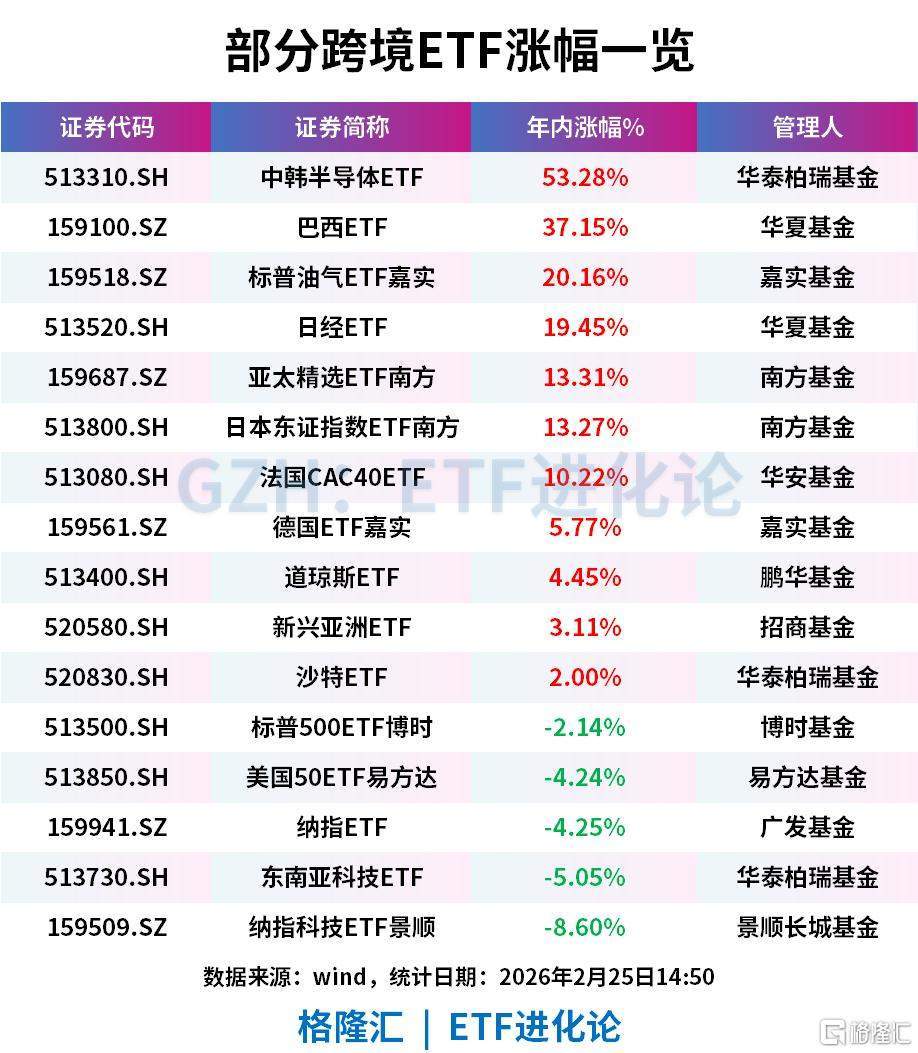
中韩半导体ETF年内涨幅超53%,巴西ETF年内涨超37%,纳指科技ETF、纳指ETF、美国50ETF年内下跌
Sou Hu Cai Jing· 2026-02-25 08:08
Group 1 - The South Korean stock market has experienced significant growth, with a cumulative increase of 75.63% in 2025 and an additional 45% from 2026 to the present, making it the top-performing market globally [1] - The total market capitalization of South Korea's stock market has risen to $3.76 trillion, an increase of approximately $2.23 trillion since the beginning of 2025, surpassing France's $3.69 trillion [1] - The surge in South Korea's market value highlights its growing importance in the global AI supply chain, particularly in sectors like memory chips and robotics [1] Group 2 - Over the past year, the South Korean Composite Index has increased by over 120%, significantly outperforming other indices such as Japan's Nikkei 225 and Brazil's IBOVESPA, which both rose over 50% [1] - In terms of ETFs, the South Korea-China Semiconductor ETF has seen a year-to-date increase of 53.28%, while other ETFs like the Brazil ETF and Japan's Nikkei ETF have also shown positive performance [3] - U.S. investors are withdrawing from domestic stock markets at the fastest rate in 16 years, with approximately $75 billion pulled from U.S. equity products over the past six months, indicating a shift towards global investment [5][6] Group 3 - The trend of "buy America" is shifting towards "bye America," as U.S. investors seek opportunities in emerging markets and Europe, with significant capital flowing into South Korea and Brazil [6][9] - Hedge funds and institutional clients are reducing their exposure to U.S. stocks, with active managers' stock exposure dropping to an eight-month low [8] - The appeal of U.S. tech stocks is declining amid the AI wave, prompting funds to explore new directions, particularly in emerging markets [9]
利率风向突变?外汇交易员开始押注:新鹰派时代将至!
Jin Shi Shu Ju· 2026-02-25 07:21
Core Viewpoint - The foreign exchange market is experiencing a significant shift as traders bet on a transition from declining global interest rates to rising rates, with the Australian dollar, Norwegian krone, and New Zealand dollar outperforming other major currencies this year [2][3]. Group 1: Currency Performance - The Australian dollar has risen nearly 6% against the US dollar this year, reaching a three-year high, driven by the Reserve Bank of Australia's anticipated new rate hike cycle to combat inflation [2][3]. - The New Zealand dollar has increased by nearly 4%, with traders expecting the country to initiate its first rate hike in the coming months [2]. - The Norwegian krone has appreciated over 5%, spurred by unexpected inflation increases that have led traders to price in potential rate hikes in the first half of the year [2][3]. Group 2: Economic Context - Analysts suggest that these currencies are indicative of a broader hawkish shift among major economies, moving away from years of rate cuts to focus on controlling inflation [3]. - The Australian economy is at the forefront of this rate hike wave, with the trimmed mean inflation rate reported at 3.4%, exceeding analysts' expectations and increasing the likelihood of further rate hikes [3][4]. - The performance of these currencies is also supported by rising prices of commodities such as oil and copper, which are significant for their economies [3]. Group 3: Investor Sentiment - Investors are diversifying away from US dollar assets due to concerns over the unpredictable policies of the Trump administration and rising government debt [4]. - The expectation of rate hikes in other regions has contributed to the weakening of the US dollar, as higher rates elsewhere erode the support for the dollar [4]. - Despite pressure from President Trump for lower borrowing costs, most traders believe the Fed's rate cut cycle is not yet over, with expectations of two to three 25 basis point cuts this year [4]. Group 4: Fiscal Health - The Australian dollar, Norwegian krone, and New Zealand dollar are favored by investors due to the relative fiscal health of their countries, contrasting with concerns over large government deficits and rising debt in currencies like the yen, dollar, and pound [4][5]. - The top-performing G10 currencies are characterized as fiscally sound and commodity-exposed, making them attractive destinations for capital as it rotates out of the US [5][6].
Thailand's Central Bank Surprises With Rate Cut
WSJ· 2026-02-25 07:21
Core Viewpoint - Thailand's central bank has unexpectedly cut its policy rate, marking the second consecutive easing to support early signs of economic recovery [1] Group 1 - The central bank's decision to lower the policy rate aims to stimulate economic growth amid tentative recovery signals [1] - This move reflects a proactive approach by the central bank to address economic challenges [1]