贸易

Search documents
贸易板块10月24日跌0.66%,东方创业领跌,主力资金净流出8418.55万元
Zheng Xing Xing Ye Ri Bao· 2025-10-24 08:27
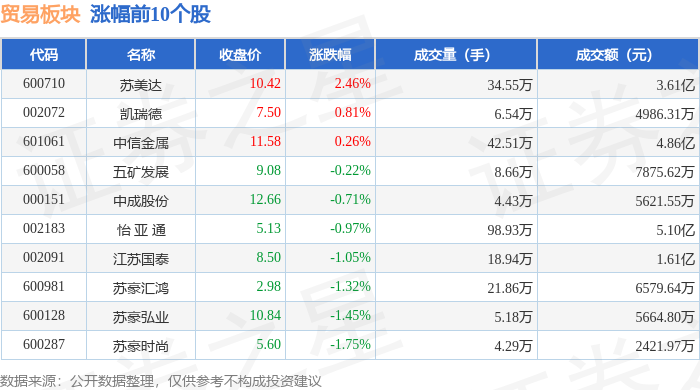
Core Viewpoint - The trade sector experienced a decline of 0.66% on October 24, with Dongfang Chuangye leading the drop, while the Shanghai Composite Index rose by 0.71% and the Shenzhen Component Index increased by 2.02% [1]. Group 1: Market Performance - The Shanghai Composite Index closed at 3950.31, marking an increase of 0.71% [1]. - The Shenzhen Component Index closed at 13289.18, reflecting a rise of 2.02% [1]. Group 2: Trade Sector Stocks - The trade sector saw mixed performance among individual stocks, with notable movements including: - Chimeida (600710) closed at 10.42, up by 2.46% with a trading volume of 345,500 shares and a transaction value of 361 million yuan [1]. - Kairuide (002072) closed at 7.50, up by 0.81% with a trading volume of 65,400 shares [1]. - CITIC Metal (601061) closed at 11.58, up by 0.26% with a trading volume of 425,100 shares [1]. - Wukuang Development (600058) closed at 9.08, down by 0.22% with a trading volume of 86,600 shares [1]. - Zhongcheng Co., Ltd. (000151) closed at 12.66, down by 0.71% with a trading volume of 44,300 shares [1]. - Yiyaton (002183) closed at 5.13, down by 0.97% with a trading volume of 989,300 shares [1]. - Jiangsu Guotai (002091) closed at 8.50, down by 1.05% with a trading volume of 189,400 shares [1]. - Shisuo Huihong (600981) closed at 2.98, down by 1.32% with a trading volume of 218,600 shares [1]. - Sumong Hongye (600128) closed at 10.84, down by 1.45% with a trading volume of 51,800 shares [1]. - Shisuo Fashion (600287) closed at 5.60, down by 1.75% with a trading volume of 42,900 shares [1]. Group 3: Capital Flow - The trade sector experienced a net outflow of 84.1855 million yuan from main funds, while retail funds saw a net inflow of 61.556 million yuan [3]. - Speculative funds recorded a net inflow of 22.6296 million yuan [3].


不见棺材不落泪?欧盟无视中国警告,对俄制裁加码12家中企被殃及
Sou Hu Cai Jing· 2025-10-24 05:35
Group 1 - The EU has imposed sanctions on four Chinese energy companies, including two independent refineries, a trading company, and a technology support company, for allegedly assisting in evading sanctions against Russia [1] - A total of 12 Chinese companies are now under sanctions, with eight additional companies from mainland China and Hong Kong implicated [1] - The sanctions come shortly after a trade dialogue between Chinese Commerce Minister and EU officials, highlighting a contradiction in the EU's approach to China [1] Group 2 - China has implemented a series of export controls on strategic resources, including rare earths and lithium battery materials, signaling a protective stance on its resources [3] - The EU is heavily reliant on Chinese rare earths, particularly in key industries like electric vehicles and wind power, with 100,000 jobs directly affected by the supply chain [3] - The Dutch semiconductor giant ASML has initiated emergency plans due to reliance on Chinese rare earth materials, indicating potential cost increases of 40% for the European semiconductor industry if supply is disrupted [3][4] Group 3 - The EU's sanctions against Chinese companies may backfire, as it seeks to balance its strategic resource needs while imposing restrictions [4][5] - The EU's dependence on China for rare earth refining technology, which it monopolizes at over 90%, complicates the EU's ability to establish an independent supply chain [4] - The cost of building a self-sufficient supply chain in the EU could be three to four times higher than current reliance on China, with a minimum five-year timeline for effectiveness [4] Group 4 - The EU's sanctions align with U.S. actions against Russia, indicating a coordinated effort, but this may jeopardize the EU's economic interests given its significant trade relationship with China, which surpassed $780 billion [7] - Internal divisions within the EU regarding sanctions have emerged, with countries like Austria, Hungary, and Slovakia opposing measures that threaten their energy interests [7] - The EU's energy import ban on Russian LNG set to take effect in 2027 raises concerns about inflation and energy security if cooperation with Chinese energy firms is lost [7] Group 5 - China has clarified that its rare earth export controls are aimed at sensitive uses, with civilian applications being processed quickly, emphasizing the need for mutual respect in cooperation [8] - The continuation of sanctions against Chinese companies could stall various economic discussions, including the resumption of the EU-China investment agreement and electric vehicle tariff negotiations [8] - The EU's leadership acknowledges the precarious position of aligning too closely with the U.S. while risking its economic stability, yet continues down a path that may harm its own interests [8]
美国彼得森国际经济研究所杰弗里·肖特:全球贸易体系面临两大核心挑战|2025外滩年会
Guo Ji Jin Rong Bao· 2025-10-24 05:01
Core Insights - The 2025 Bund Summit will be held from October 23 to 25 in Huangpu District, Shanghai, focusing on the theme "Embracing Change: New Order, New Technology" [1] Group 1: Global Trade Dynamics - Jeffrey J. Schott, a senior researcher at the Peterson Institute for International Economics, emphasized the importance of "trust" and "enforcement" in the global trade system, which he views as core challenges [3] - Schott highlighted that the stability of U.S.-China relations and the multilateral trade mechanism relies on predictable policies and ongoing dialogue [3][4] - He noted that uncertainty in bilateral relations increases operational costs for businesses and creates political risks, advocating for a reduction in uncertainty to facilitate normal trade and investment [5] Group 2: U.S.-China Relations - Schott stated that restoring basic trust is essential for resolving U.S.-China trade tensions, which he believes is a long-term process [5] - He pointed out that even in areas of significant disagreement, communication should be maintained due to the profound impact that policy changes from either country can have on the global economy [3][5] - Schott expressed skepticism about the U.S. rejoining the Comprehensive and Progressive Agreement for Trans-Pacific Partnership (CPTPP) in the short term [5] Group 3: Multilateral Trade Agreements - Schott described the CPTPP as a beneficial complement to the World Trade Organization (WTO) rather than a replacement, noting that the U.S. withdrawal from the Trans-Pacific Partnership (TPP) was a mistake [5] - He mentioned that China's potential accession to the CPTPP would be a cautious and gradual process, with limited short-term progress expected [5] Group 4: WTO and Sanctions - Schott denied claims of WTO marginalization, asserting that it still plays a crucial role but requires updates to reflect contemporary technological and trade dynamics [6] - He differentiated between the quantity of sanctions and their policy impact, stating that current sanctions do not significantly threaten the dollar's status as the world's primary reserve currency [6] - Schott warned that long-term instability in U.S. domestic economic policy could lead to questions about the future of the dollar, similar to the historical decline of the pound [6] Group 5: Service Trade - Schott criticized the U.S. public discourse for often overlooking the significant contributions of service trade, which he considers a vital component of modern globalization [7]

襄阳市石文贸易有限责任公司成立 注册资本10万人民币
Sou Hu Cai Jing· 2025-10-24 04:48
Group 1 - A new company, Xiangyang Shiwen Trading Co., Ltd., has been established with a registered capital of 100,000 RMB [1] - The legal representative of the company is Xu Jing [1] - The business scope includes general projects such as sales of building materials, processing of building stones, and leasing of machinery and equipment [1] Group 2 - The company is also involved in licensed projects, specifically road cargo transportation (excluding hazardous goods) [1] - The company can operate independently in accordance with laws and regulations for non-prohibited or restricted projects [1] - Business activities are subject to approval from relevant authorities as per the required permits [1]
德国联邦统计局数据显示:今年前8月,中国再成德最大贸易国
Sou Hu Cai Jing· 2025-10-23 23:40
Core Insights - The trade dynamics between Germany and the U.S. have shifted significantly due to U.S. tariff policies, with China becoming Germany's largest trading partner again [1][2][5] Trade Dynamics - In the first eight months of the year, Germany's trade with China reached €163.4 billion, surpassing trade with the U.S. at €162.8 billion [2] - German exports to the U.S. have decreased by 7.4% year-on-year, totaling €99.6 billion, with a notable drop of 23.5% in August alone [2][4] - The decline in exports to the U.S. is attributed to reduced demand for traditional German goods such as automobiles, machinery, and chemicals due to U.S. tariffs [2][4] Sector-Specific Impacts - The automotive sector saw a 23.5% year-on-year decline in exports to the U.S. following the imposition of a 25% additional tariff on imported cars [4] - The machinery sector is also experiencing pessimism, with about one-third of surveyed companies rating the current situation as "bad" or "very bad," potentially leading to job cuts [4] Economic Outlook - Despite a slight increase in exports of pharmaceuticals, IT, and electronics, these gains are insufficient to offset losses in core industries [4] - The Ifo Institute's survey indicates a slight increase in optimism among exporters, but no sustainable improvement is evident [6] - Germany's economic growth forecast for this year is only 0.2%, with a more optimistic outlook of 1.3% for the next year, driven by domestic investments rather than overseas demand [6][7] Bilateral Trade Relations - China's trade with Germany has shown an 8.3% increase in imports, reaching €108.8 billion, while exports from China to Germany grew by 10.9% in September [5] - Analysts express concerns about Germany's increasing dependency on China, although they acknowledge the strong complementary nature of the economic relationship [5][7] - Future cooperation between Germany and China is expected to remain strong in traditional sectors as well as in green transformation, service trade, smart manufacturing, and digitalization [5][7]
采矿业增速明显 外贸加快多元化 南非经济呈温和增长态势
Ren Min Ri Bao· 2025-10-23 22:06
Economic Growth - South Africa's GDP grew by 0.8% in Q2 2023, an increase from 0.1% in Q1, marking the strongest growth quarter in nearly two years [1] - The South African Reserve Bank forecasts economic growth of 0.9% in 2025 and 1.3% in 2026 [1] Sector Performance - Eight out of ten industries in South Africa experienced growth in Q2, significantly up from four in Q1 [1] - The mining sector saw a growth of 3.7%, the fastest since Q1 2021, driven by increased production of platinum group metals, gold, and chrome [1] - Manufacturing grew by 1.8%, contributing 0.2 percentage points to GDP growth, with seven industries, including petroleum and chemicals, showing positive growth [1] - Agriculture continued its positive trend with a growth rate of 2.5%, marking the third consecutive quarter of growth [1] Consumer Spending - Household consumption increased by 0.8% in Q2, marking the fifth consecutive quarter of growth, with notable increases in trade, accommodation, and restaurant sectors [2] - Government public spending also contributed positively to economic development during the quarter [2] Challenges and Trade - South Africa's economic growth faces challenges such as unstable domestic electricity supply and heavy debt burdens [2] - The imposition of a 30% tariff on South African exports to the US has severely impacted exports, particularly in the automotive and agricultural sectors [2] - There has been a decline in both total exports and fixed capital investment in Q2 [2] - The government and business sectors are actively working to diversify foreign trade, with increasing exports of citrus to Vietnam and avocados to China [2] Trade Agreements - South Africa is committed to advancing the African Continental Free Trade Area and expanding trade cooperation with BRICS and other emerging markets [3] - The resilience of the South African economy amidst various challenges highlights the potential for broad multilateral trade cooperation with other global southern countries [3]
保定赛迪利贸易有限公司成立 注册资本5万人民币
Sou Hu Cai Jing· 2025-10-23 21:13
Core Viewpoint - Recently, Baoding Saidili Trading Co., Ltd. was established with a registered capital of 50,000 RMB, indicating a new player in the trading sector focusing on machinery and automotive products [1] Company Summary - The legal representative of Baoding Saidili Trading Co., Ltd. is Mohammad Dawod Abdul Wahed [1] - The company has a registered capital of 50,000 RMB [1] - The business scope includes sales of machinery equipment, construction machinery, mechanical parts, electronic products, automobiles, and automotive parts [1] - The company is also involved in retail of hardware products, processing of mechanical parts, second-hand car brokerage, and import-export of goods and technology [1]
苏美达:第三季度净利润为4.58亿元,同比增长6.58%
Ge Long Hui A P P· 2025-10-23 09:44
格隆汇10月23日|苏美达公告,第三季度营收为323.22亿元;净利润为4.58亿元,同比增长6.58%。前 三季度营收为874.23亿元,净利润为11.04亿元,同比增长10.03%。 ...
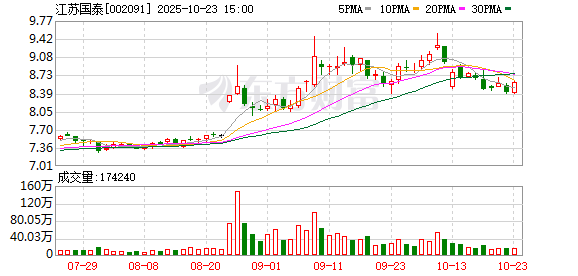
江苏国泰现2笔大宗交易 总成交金额1.97亿元
Zheng Quan Shi Bao Wang· 2025-10-23 09:34
Core Viewpoint - Jiangsu Guotai executed two block trades on October 23, totaling 25.89 million shares with a transaction value of 197 million yuan, indicating significant trading activity at a discount to the market price [2] Summary by Category Trading Activity - The total trading volume for the block trades was 25.89 million shares, with a total transaction value of 197 million yuan [2] - The transaction price was set at 7.60 yuan per share, reflecting an 11.53% discount compared to the closing price of the day [2] Institutional Participation - Institutional specialized seats were involved in one of the trades, contributing to a total transaction amount of 152 million yuan and a net purchase of 152 million yuan [2] Market Performance - Jiangsu Guotai's closing price on the same day was 8.59 yuan, which represented a 2.14% increase [2] - The stock had a turnover rate of 1.09%, with a total trading volume of 148 million yuan for the day [2] - There was a net outflow of 2.68 million yuan in main capital throughout the day, and the stock experienced a cumulative decline of 1.04% over the past five days, with a total net outflow of 52.80 million yuan [2] Margin Trading Data - The latest margin financing balance for Jiangsu Guotai was 394 million yuan, showing a decrease of 22.01 million yuan over the past five days, which corresponds to a decline of 5.29% [2]

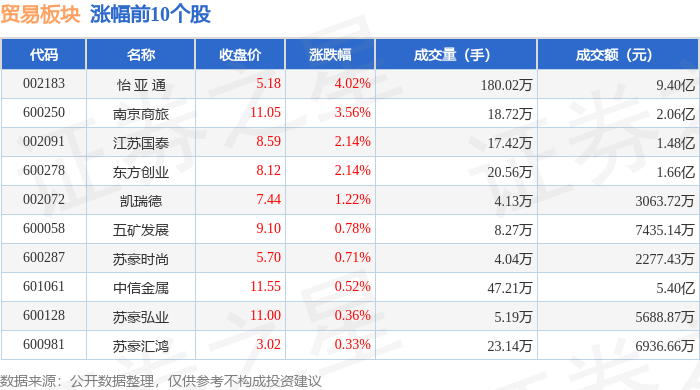
贸易板块10月23日涨1.41%,怡亚通领涨,主力资金净流入6082.32万元
Zheng Xing Xing Ye Ri Bao· 2025-10-23 08:20
Market Overview - On October 23, the trade sector increased by 1.41%, led by Yi Yatong [1] - The Shanghai Composite Index closed at 3922.41, up 0.22%, while the Shenzhen Component Index closed at 13025.45, also up 0.22% [1] Stock Performance - Yi Yatong (002183) closed at 5.18, with a rise of 4.02% and a trading volume of 1.8 million shares, amounting to 940 million yuan [1] - Nanjing Shanglv (600250) closed at 11.05, up 3.56%, with a trading volume of 187,200 shares and a turnover of 206 million yuan [1] - Jiangsu Guotai (002091) closed at 8.59, increasing by 2.14%, with a trading volume of 174,200 shares and a turnover of 148 million yuan [1] Capital Flow - The trade sector saw a net inflow of 60.82 million yuan from main funds, while retail investors experienced a net outflow of 69.72 million yuan [2] - Main funds showed significant net inflow in Yi Yatong (41.69 million yuan) and Nanjing Shanglv (35.52 million yuan) [3] Individual Stock Analysis - Yi Yatong had a main fund net inflow of 41.69 million yuan, accounting for 4.44% of its total trading [3] - Nanjing Shanglv's main fund net inflow was 35.52 million yuan, representing 17.24% of its trading volume [3] - In contrast, Jiangsu Guotai experienced a net outflow of 4.88 million yuan from main funds, indicating a negative sentiment [3]