
Securities

Search documents
券商“抢人战”一角:国盛证券医药、计算机、传媒等多行业分析师密集被挖,分仓佣金连降
Sou Hu Cai Jing· 2025-12-25 16:11
Group 1 - The core point of the article highlights a significant talent exodus at Guosheng Securities Research Institute, particularly in the fields of pharmaceuticals, computers, and media, as multiple analysts have recently left the firm, indicating a potential "brain drain" crisis [2][3][4] - The trend of analyst departures has been ongoing since September, with key figures such as the co-director and chief analysts from various sectors submitting their resignations, suggesting a deeper issue within the firm [4][5] - Guosheng Securities has experienced a notable decline in commission income, with a reported 28.35% year-on-year drop in the first half of the year, reflecting broader challenges faced by sell-side research amid increasing competition and changing market dynamics [6][8] Group 2 - The sell-side research industry is undergoing profound changes due to multiple pressures, including commission rate reforms and the rise of buy-side research capabilities, leading to a shrinking "cake" of commission income that previously supported rapid expansion [5][6] - The year-end talent migration is exacerbated by the "New Fortune Best Analyst Awards," which incentivizes analysts to switch firms for better career prospects and higher salaries, creating a competitive environment for talent acquisition [8][9] - Analysts are increasingly prioritizing personal brand and research quality over the brokerage platform itself, as buy-side institutions focus their budgets on analysts who can deliver tangible value, further complicating the talent retention landscape for smaller brokerages [6][7]




视频|东方证券研究所所长黄燕铭:AI无法替代证券研究的核心判断
Xin Lang Cai Jing· 2025-12-25 11:14
炒股就看金麒麟分析师研报,权威,专业,及时,全面,助您挖掘潜力主题机会! 来源:进门聊 责任编辑:何俊熹 炒股就看金麒麟分析师研报,权威,专业,及时,全面,助您挖掘潜力主题机会! 来源:进门聊 责任编辑:何俊熹 ...

今年土储专项债发行超5400亿元
Feng Huang Wang· 2025-12-25 09:25
Core Viewpoint - The resumption of land reserve special bonds is a significant measure to stabilize the land market and alleviate the pressure on local government financing and real estate companies, with over 540 billion yuan issued this year [1] Group 1: Special Bonds Issuance - A total of over 540 billion yuan in land reserve special bonds has been issued this year, with announced land acquisition projects exceeding 600 billion yuan, indicating a slight delay in bond issuance [1] - As of the latest data, 27 provinces and cities have publicly announced specific information on acquiring idle land projects, covering 5,314 plots with a total funding scale of 6,034.33 billion yuan [1] - The issuance of land reserve special bonds has been relatively slow, with only over 200 billion yuan issued in the first half of the year compared to nearly 500 billion yuan in announced projects [2] Group 2: Project Characteristics - Over 80% of the land acquisition projects involve local state-owned enterprises or city investment subsidiaries, with a minimal share from private enterprises, and the land types primarily include comprehensive, residential, and commercial properties [2] - The average negotiation period for project pricing has exceeded four months, indicating challenges in pricing agreements between government and enterprises [3] Group 3: Future Outlook - The issuance of land reserve special bonds is expected to accelerate in the second half of the year as more regions join the program, with 26 provinces and cities having issued or planned to issue bonds totaling 545.15 billion yuan [2] - Despite operational challenges, local governments are gradually implementing policies tailored to regional land market conditions, indicating a proactive approach to land reserve projects [3]
光大证券:广东电量电价签署结果符合预期 料其余省份2026年年度长协电价相对稳健
智通财经网· 2025-12-25 07:52
Core Viewpoint - The report from Everbright Securities indicates that the electricity trading results for Guangdong Province in 2026 are in line with expectations, with potential profitability pressure on thermal power units, while the spot market is expected to provide performance increments [1]. Group 1: Electricity Pricing and Trading - The average transaction price for thermal power is 372.14 cents/kWh, down 5.03% year-on-year, which is close to the market reference price's downward adjustment of 20% [1]. - The green electricity transaction price is 372.21 cents/kWh, with an environmental premium of 4.93 cents/kWh, leading to a comprehensive price of 377.14 cents/kWh, down 3.88% year-on-year, but higher than the mechanism price of 360 cents/kWh [1]. - The trading volume of green electricity in 2026 is expected to increase by 17.74% year-on-year, reaching 4.779 billion kWh compared to 4.059 billion kWh in 2025 [1]. Group 2: Capacity Pricing and Overall Electricity Price - Starting from January 2026, the coal power capacity subsidy in Guangdong will increase from 100 yuan/kW to 165 yuan/kW, resulting in a capacity price increase of 0.016 yuan/kWh year-on-year [2]. - The annual comprehensive electricity price for coal power units in Guangdong is projected to be 0.414 yuan/kWh, down 0.78% year-on-year, indicating stability [2]. Group 3: Market Conditions and Future Outlook - The electricity supply-demand situation in Guangdong is expected to remain loose in 2026, continuing the trend from 2025, with an anticipated increase in installed capacity [3]. - The spot market prices are expected to exhibit greater volatility due to the large-scale entry of green electricity, allowing operators to profit through flexible strategies [3]. - The functional premium of thermal power is expected to be highlighted through the spot market as green electricity enters the market in large quantities [3].

2025中国中小企业融资论坛在京举办,中国中小企业服务网推出三大板块
Xin Hua Cai Jing· 2025-12-25 06:34
Core Viewpoint - The "2025 China SME Financing Forum" was held in Beijing, focusing on enhancing financing services for small and medium-sized enterprises (SMEs) in China [1] Group 1: Event Overview - The forum was organized by the SME Development Promotion Center of the Ministry of Industry and Information Technology [1] - The event introduced three key service platforms: "Location Service Sector," "Innovation Achievement Launch Platform," and "Financial Credit Enhancement Service Platform" [1] Group 2: Partnerships and Collaborations - The SME Development Promotion Center has established an innovative partnership mechanism with various institutions, including Zhejiang Merchants Securities, Beijing Fund Industry Association, Renmin Financial, and Fushi Technology [1]
坚持“三个坚持”深化“四个联动”!山东“财金联动”赋能高质量发展
Qi Lu Wan Bao· 2025-12-25 04:34
Core Viewpoint - The Shandong provincial government is actively enhancing financial reform and development during the 14th Five-Year Plan period, focusing on innovative financial collaboration to drive high-quality growth [1][2]. Group 1: Financial Reform Strategies - The provincial finance department emphasizes a combination of effective markets and proactive government actions, aiming to innovate investment methods and enhance resource allocation efficiency [1]. - Key strategies include: 1. Adopting market-oriented approaches to improve resource allocation efficiency through financial subsidies, loan interest discounts, guiding funds, and equity investments [1]. 2. Fostering win-win scenarios by aligning fiscal and financial policies to direct financial resources effectively towards high-quality development [1]. 3. Implementing a systematic design to integrate support for development, ensuring smooth flow of production factors and maximizing market potential [1]. Group 2: Implementation of Financial Collaboration - The initiative has strengthened four types of collaboration: 1. Institutional collaboration by supporting eight provincial financial enterprises to develop a full range of financial products, forming the "Shandong Financial Enterprise Alliance" [2]. 2. Policy collaboration through the introduction of 29 supportive measures for financial collaboration, extending into various sectors such as technology, culture, and rural revitalization [2]. 3. Provincial, municipal, and county collaboration to gather resources for major projects, resulting in significant investments of 950 billion yuan in equity and debt, and 3,758 billion yuan in new loans in 2023 [2]. 4. Market collaboration by organizing project roadshows and resource matching, attracting central financial enterprises and banks to participate in financial collaboration [2]. Group 3: Future Outlook - The financial collaboration model has become a hallmark of Shandong's fiscal strategy, with plans for continued enhancement to contribute more effectively to the province's high-quality development [3].
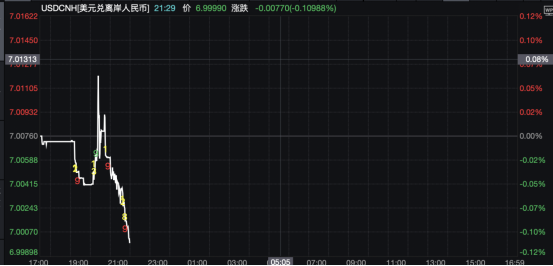
人民币汇率,破7
Zhong Guo Zheng Quan Bao· 2025-12-25 03:35
Core Viewpoint - The offshore RMB against the US dollar has reached a 15-month high, breaking the 7.0 yuan mark, driven by various factors including reduced external pressures, enhanced internal resilience, precise policy adjustments, and shifting market expectations [1][3]. Group 1: RMB Exchange Rate Dynamics - As of December 25, the offshore RMB was reported at 6.9999 yuan per US dollar, up 77 basis points from the previous close, with an intraday high of 6.9981 yuan [1]. - The onshore RMB was reported at 7.0073 yuan per US dollar, increasing by 88 basis points from the previous close, with an intraday high of 7.0061 yuan [4]. - Analysts suggest that the recent RMB appreciation is primarily driven by a changing dollar environment, with expectations of continued Fed rate cuts suppressing the dollar's long-term outlook, thus providing room for RMB appreciation [3]. Group 2: Future Outlook and Expert Opinions - Experts predict that the RMB exchange rate may maintain a moderate appreciation trend towards 2026, influenced by a weaker dollar index and stable monetary policy from the central bank [6]. - The core variables affecting the exchange rate in 2026 are expected to be the dollar's performance and changes in US-China trade relations, with a potential for the RMB to continue appreciating moderately due to narrowing interest rate differentials [6]. - The analysis indicates that the decoupling of the RMB exchange rate from the dollar index may become a norm, supported by both fundamental and policy factors [3].
兴业证券及子公司兴证全球基金斩获金融业唯一部级科技奖项
Xin Lang Cai Jing· 2025-12-25 02:12
Core Insights - Recently, Industrial Securities and its subsidiary, Xingsheng Global Fund, won the third prize in the "2024 Financial Technology Development Award," which is the only ministerial-level technology award in China's financial industry, selected from 681 top achievements nationwide [1][4]. Group 1: Industrial Securities - The award-winning project, "Data-Driven Intelligent Operation and Maintenance Governance Platform," is a core component of the company's next-generation intelligent operation and maintenance system, aiming to transition from "passive assurance" to "active empowerment" [2][5]. - The platform integrates monitoring, automation, management, and analysis, enhancing the synergy between business and technology [2][5]. - The company actively participates in industry standards development, being a key drafting unit for national standards in intelligent operation and maintenance [2][5]. Group 2: Xingsheng Global Fund - The "Qianxun Fixed Income Intelligent Trading Platform" developed by Xingsheng Global Fund has transformed the fixed income trading process from manual to fully automated, saving approximately 3 hours per trader daily and improving inquiry efficiency by over 50% [3][6]. - This achievement exemplifies the integration of cutting-edge technology with core business scenarios, creating a value loop of "technological innovation—business optimization—benefits for stakeholders" [3][6]. - The recognition of both the parent and subsidiary companies reflects the group's long-term commitment to leveraging technology for business innovation and service development [3][6].

2025,证券业的主动求变与重新定义
Shang Hai Zheng Quan Bao· 2025-12-24 19:15
2025年的证券业,进行了一场全方位变革。并购重组与新老交接重塑治理生态,为行业转型注入决策动 能;6185名分析师搭建起资本与产业的链接桥梁,让行业告别"佣金依赖"转向"专业赋能";11家券商密 集增资出海,跨境投行、数字金融多点突破,令行业向国际一流投行目标稳步迈进。这场涵盖治理、人 才、业务的全维度变革,既是行业应对市场竞争的主动求变,更是服务实体经济高质量发展、服务金融 强国建设的必然选择。变革之下,证券业的竞争版图与发展路径正被重新定义。 ...
平安广州交投广河高速公路封闭式基础设施证券投资基金关于二〇二五年十一月主要运营数据的公告
Shang Hai Zheng Quan Bao· 2025-12-24 18:15
Group 1 - The core objective of the fund is to obtain stable cash flows from infrastructure project fees through proactive management, aiming for long-term steady growth in cash flows [11][12] - In November 2025, the overall operational situation of the infrastructure project company was good, with no safety production accidents reported [11] - The toll revenue sources for the highway project are diversified, and there were no significant cash flow providers or changes in external management [11] Group 2 - The fund's investment operations are normal, with no undisclosed significant information, and the fund manager will strictly adhere to legal regulations and fund contracts [2][13] - The fund manager commits to managing and utilizing fund assets with honesty and diligence but does not guarantee profits or minimum returns [2][13] - Investors are reminded to read the fund contract and prospectus carefully to understand the risk-return characteristics and product features before making investment decisions [2][13] Group 3 - New sales institutions for the fund have been announced, including agreements with several banks effective from December 25, 2025 [3][4] - Investors can perform various transactions such as account opening, subscription, redemption, and regular investment through the newly appointed sales institutions [5][6] - Fee discounts are available for investors who subscribe or regularly invest through the sales institutions, with the specifics determined by the institutions [6][7]