
商业航天

Search documents
起猛了!马斯克收购马斯克
程序员的那些事· 2026-02-03 14:42
Core Viewpoint - SpaceX has officially completed the acquisition of xAI, with a combined valuation of $1.25 trillion, making it the most valuable private tech company globally [1] Group 1: Acquisition Details - The acquisition was conducted as an all-stock transaction, with SpaceX valued at $1 trillion and xAI at $250 billion, translating to a share price of approximately $527 [1] - This merger is aimed at creating a "super innovation engine" that integrates rockets, Starlink, AI models, and the X platform into a cohesive system [1] Group 2: Strategic Implications - xAI possesses the Grok AI model but incurs monthly losses exceeding $1 billion, highlighting a growing computational resource gap [1] - SpaceX's Starlink provides cash flow and global launch capabilities, which are essential for enhancing the AI narrative and boosting IPO valuation [1] - The merger is seen as complementary, with plans to launch a million satellites to establish an orbital computing network, addressing AI cooling and energy consumption challenges [1] Group 3: Market Positioning - This strategy aims to redefine the commercial space and AI landscape, allowing Musk's tech empire to extend from Earth to near-Earth orbit [1]


网友说:我看马斯克的火箭不顺眼,抵制他的电动车,这能行吗?
Sou Hu Cai Jing· 2026-02-03 13:11
近些年来,世界首富、亿万富豪马斯克手下的商业航天公司Space X发展迅猛,但也存在一些问题。 比如,他们的星链卫星曾两次危险抵近我国空间站,有概率造成航天事故,带来不可想象的后果。虽然 概率不大,但是考虑到后果的严重性,我们绝对不能忽视。为了防止灾难的发生,我国空间站实施了紧 急避轨。 尽管没有造成实质性的危害,但这种危险抵近行为还是非常不负责的,因此遭到了我国的谴责,也引起 了网友们的愤怒。不少网友表示,应该抵制他手下的电动车公司的产品,防止他拿这些钱去发展商业航 天,威胁我国。 问题在于,这样有用吗? 首先要明确一点:Space X 和特斯拉在法律上是两家独立的公司,除了都以马斯克为CEO、他掌握了较 大的股权之外,其实在法律上是没有什么关联的。 其中,特斯拉是上市公司,在纳斯达克股票市场有公开股票交易,其经营状况、营收和财报都要接受严 格的监管和公众披露。 Space X呢,是一家私有公司,尚未上市,它背后的股权大多掌握在创始人埃隆·马斯克和少数投资机构 手中。有消息说,他们将在今年年中的时候上市。即便如此,股权也是由另一批人所掌握。 进一步讲,这两家公司虽然是美国公司,但有大量的中国供应商,特斯拉在 ...

商业航天大年来了!广东、山东、浙江等已出手
2 1 Shi Ji Jing Ji Bao Dao· 2026-02-03 12:21
Core Insights - The Chinese government is accelerating the development of a strong aerospace industry, with a focus on commercial space by 2026, as highlighted in the "14th Five-Year Plan" and various local government reports [1][2] - Over 20 provinces have initiated discussions on commercial aerospace, with approximately half directly addressing related industries in their government work reports [2][3] - Key themes in local government plans include "full-chain" and "industry clusters," aiming to address existing challenges in the commercial aerospace sector [1][3] Full-Chain Development - Guangdong aims to achieve breakthroughs in key technologies across various fields, including commercial aerospace, by 2026, targeting a scale of 300 billion yuan for its aerospace and related industries [3] - Beijing has established over 210 commercial aerospace companies and plans to enhance its infrastructure, including a commercial space launch center, to support significant increases in launch activities by 2025 [3][4] - The need for a comprehensive policy framework and improved collaboration within the industry is emphasized to overcome existing challenges such as high costs and reliance on foreign technology [4][6] Industry Cluster Development - Zhejiang is focusing on developing emerging industries, including aerospace, with a goal for strategic emerging industries to account for 35% of industrial output by 2026 [8] - Shandong is promoting its commercial aerospace capabilities, particularly through the Dongfang Spaceport, which has launched 137 satellites, and aims to create a comprehensive aerospace industry chain [9] - Local governments are encouraged to leverage their unique resources and capabilities to foster innovation and avoid redundant developments in the aerospace sector [10] Company Initiatives - Companies like Tianbing Technology and Tianzhang Satellite are being supported by local governments to enhance their capabilities in the commercial aerospace sector [11] - Galaxy Aerospace is focusing on technological innovation, particularly in satellite technology that allows direct mobile connectivity, and aims to accelerate production and development [11][12] - Hongqing Technology is prioritizing innovation in satellite platforms and aims to integrate various systems to improve efficiency in satellite and rocket operations [12]
SpaceX收购xAI!估值8.6万亿!
国芯网· 2026-02-03 12:05
Core Viewpoint - Elon Musk's SpaceX has acquired its AI startup xAI, integrating advanced rocket and satellite technology with AI capabilities, marking a significant step in Musk's dual ambitions of artificial intelligence and space exploration [2][4]. Group 1: Acquisition Details - The merger is expected to create a new entity valued at approximately $1.25 trillion, with stock priced around $527 per share [2]. - The acquisition is set to be completed through a stock exchange, where xAI shares will convert to 0.1433 shares of SpaceX [6]. - Employees of xAI have the option to cash out by selling their shares back to the company [6]. Group 2: Strategic Implications - Musk aims to create an innovative engine for both Earth and space through this acquisition, enhancing SpaceX's capabilities [4]. - SpaceX operates a fleet of reusable rockets and has developed a crewed spacecraft capable of sending astronauts into orbit, alongside the Starlink project providing broadband internet globally [4]. Group 3: Ownership Structure - Prior to the acquisition, Musk controlled both SpaceX and xAI, holding approximately 42% of SpaceX's shares and 80% of its voting rights [7].
看涨率又升了!
第一财经· 2026-02-03 12:01
Market Overview - The three major A-share indices exhibited a V-shaped trend, collectively closing higher, with the Shanghai Composite Index stabilizing above 4000 points due to the joint efforts of heavyweight and thematic stocks. The Shenzhen Component Index led the gains, with growth stocks performing prominently, and the ChiNext Index rebounding under the leadership of the sci-tech sector [2]. Market Performance - A total of 4851 stocks rose, indicating a broad market rally, with a notable increase in the number of stocks hitting the daily limit up. Key sectors leading the gains included commercial aerospace/satellite internet, optical modules/CPO, controllable nuclear fusion, rare metals/rare earths, photovoltaic equipment, military industry, communication equipment, and AI computing hardware. Consumer sectors such as food and beverage and retail also saw upward movement ahead of the holiday, while precious metals, petrochemicals, and banking insurance experienced capital outflows and adjustments [3]. Capital Flow - The total trading volume of the two markets was 1.54 trillion yuan, down 1.57%, reflecting an overall contraction in trading volume and structural differentiation. Capital did not significantly withdraw but shifted from traditional heavyweight stocks in the Shanghai market to growth stocks in the Shenzhen market. Sectors like finance and real estate showed lackluster performance, while commercial aerospace, photovoltaic equipment, rare metals, and AI computing saw impressive trading volumes. Leading growth stocks had the highest trading volumes, indicating a concentration of funds in high-prosperity sectors [5]. Fund Inflows - Institutional investors actively positioned themselves, clearly adjusting their portfolios, with emerging sectors such as commercial aerospace, space photovoltaic, AI computing, and optical modules becoming the main focus for capital. There was a noticeable outflow from defensive sectors like precious metals, banking, and insurance. Retail investors transitioned from passive following to active participation, with some chasing strong stocks, particularly those hitting the daily limit up, especially in the commercial aerospace and AI computing sectors [6].

又一家!天仪研究院启动上市辅导,商业航天IPO竞速再添新军
Bei Jing Shang Bao· 2026-02-03 11:37
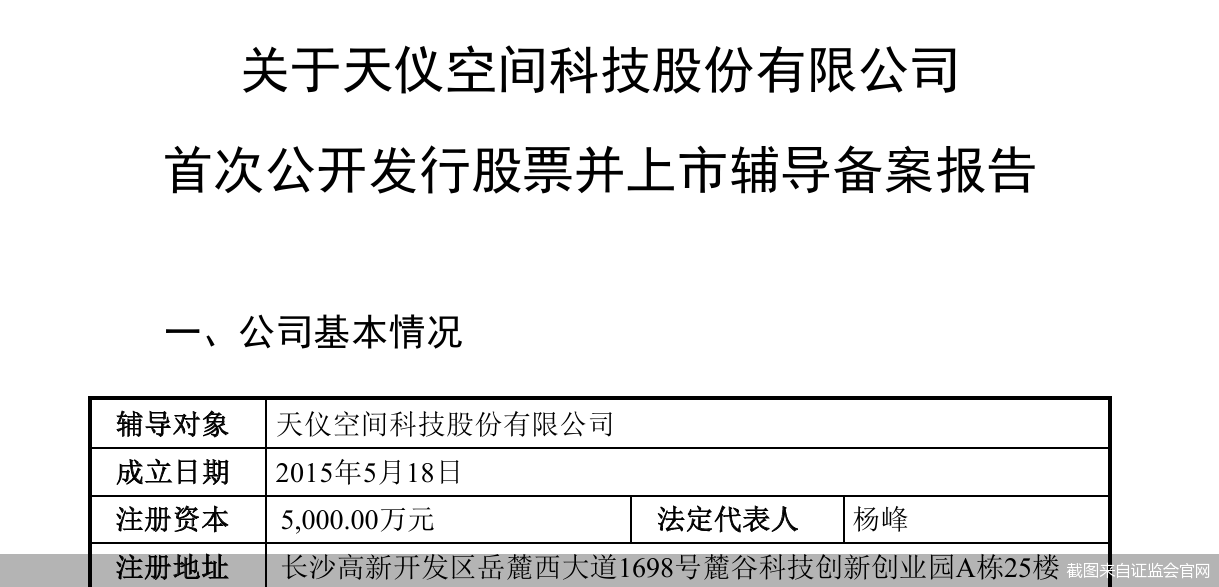
Core Viewpoint - The commercial aerospace sector is experiencing accelerated capitalization in 2026, driven by both policy and industry dynamics, with multiple companies, including Tianyi Space Technology Co., Ltd., initiating IPO preparations to enter the capital market [1][5][11]. Company Overview - Tianyi Space Technology Co., Ltd. (formerly known as Changsha Tianyi Space Technology Research Institute) was established on May 18, 2015, with a registered capital of 50 million yuan [2][3]. - The company has successfully launched 38 satellites and completed 21 space missions, focusing on SAR satellite constellation operations and integrated SAR satellite data services [3][4]. - The core team comprises members from aerospace institutions and international talent, having participated in nearly 100 aerospace projects [3]. Recent Developments - Tianyi Space has initiated the listing guidance process to pursue an A-share IPO, aiming to capitalize on the growing interest in commercial aerospace [1][3]. - The company completed a D+ round of financing in December 2025, receiving investment from Wuxi Liangxi Science and Technology Innovation Industry Investment Fund [4]. Industry Trends - The commercial aerospace sector, particularly in rocket manufacturing and satellite development, has seen a surge in companies seeking to go public, including Blue Arrow Aerospace and Yixin Aerospace [5][10]. - Blue Arrow Aerospace is currently the fastest in the IPO process, having its application accepted on December 31, 2025, and entering the inquiry phase in January 2026 [7][8]. - The sector is supported by favorable policies, including the implementation of the "1+6" reform measures by the China Securities Regulatory Commission, which expands the eligibility for companies in cutting-edge technology fields to access the Sci-Tech Innovation Board [11][12].
卫星ETF的配置价值与配置风险
Shanghai Securities· 2026-02-03 11:32
- The satellite ETF (159206.SZ) tracks the China Commercial Satellite Communication Industry Index (980018.CNI), and the best convergent stock during the period from October 30, 2025, to January 30, 2026, was identified as Shanghai Hanxun (300762.SZ), selected based on the deviation of component stocks from the satellite communication index and research coverage[3][10] - Shanghai Hanxun's valuation at the end of 2024 was 16x PS (Price-to-Sales ratio). Using linear extrapolation of 2027 and 2026 consensus revenue forecasts, the 2028 expected revenue was calculated and multiplied by 16x PS to estimate the 2028 fundamental value per share at 60.87 RMB. The highest stock price on January 14, 2026, was 60.77 RMB, which closely aligns with the 2028 expected fundamental value, indicating that the recent peak price reflects the growth expectations for the next three years[3][10] - The five major weighted stocks of the satellite ETF as of January 30, 2026, were Aerospace Electronics, China Satellite, Raytron Technology, Sunway Communication, and Zhenlei Technology, with a combined weight of 32.76%. For example, Aerospace Electronics showed a maximum price increase of 457.67% since 2024, while its cumulative net profit growth from 2023 to 2028 was expected to be 132.37%, highlighting a significant gap between market performance and fundamental growth expectations. Similar trends were observed for the other four stocks[4][11]

A股周二缩量上涨 电网设备板块领涨
Xin Lang Cai Jing· 2026-02-03 11:31
Group 1 - The Chinese A-share market experienced a rebound on February 3, with major indices closing in the green. The Shanghai Composite Index rose by 1.29% to 4067 points, the Shenzhen Component Index increased by 2.19% to 14127 points, and the ChiNext Index gained 1.86% to 3324 points. The total trading volume in the Shanghai and Shenzhen markets was approximately 25,442 billion RMB, a decrease of about 405 billion RMB from the previous trading day [1] - The electric grid equipment sector led the A-share market with a significant increase of 6.72%, marking it as the top-performing industry [1] - Notable individual stocks included Zerun New Energy, Dike Co., Aotewi, and Haiyou New Materials, all of which hit the daily limit with an approximate increase of 20% [1] Group 2 - The global commercial space industry is rapidly growing, driven by an increase in satellite launches and a shift from communication satellites to more power-intensive computing satellites. This trend is expected to sustain high demand for space energy [2] - Photovoltaics, as the only reliable form of space energy currently available, is anticipated to enter a new peak in capacity construction, benefiting related listed companies [2]
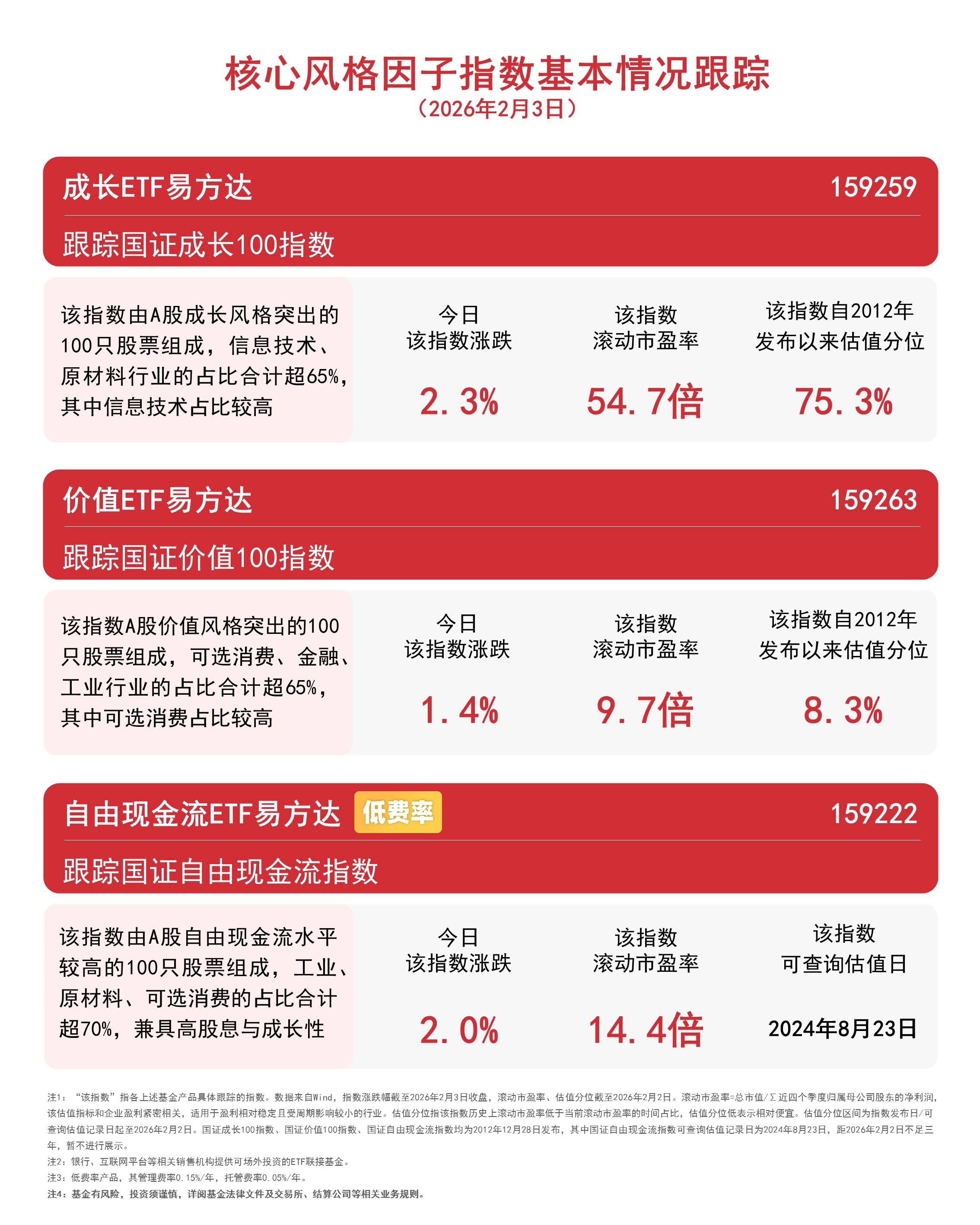
科技成长方向集体反弹,成长ETF易方达(159259)标的指数涨超2%
Sou Hu Cai Jing· 2026-02-03 11:22
Core Viewpoint - The technology growth sector rebounded collectively after a significant drop, with leading gains in optical communication, CPO, and commercial aerospace sectors [1] Group 1: Market Performance - The Guozheng Growth 100 Index increased by 2.3% at market close [1] - The Guozheng Free Cash Flow Index rose by 2% [1] - The Guozheng Value 100 Index saw a rise of 1.4% [1] Group 2: Fund Flows - Related ETFs attracted attention, with the E Fund Growth ETF (159259) experiencing a net inflow of over 100 million yuan across four consecutive trading days [1] Group 3: Index Composition - The Guozheng Growth 100 Index focuses on stocks with prominent growth styles in the A-share market, with over 70% of its weight concentrated in the electronics, communication, and computer sectors [1] - The index is strategically positioned to capitalize on the core aspects of AI computing power [1] Group 4: Investment Opportunities - The E Fund Growth ETF (159259) is the only product tracking the Guozheng Growth 100 Index, providing investors with opportunities to seize growth-style investment chances [1]
比去西藏简单?我们离太空旅行还有多远?
Guan Cha Zhe Wang· 2026-02-03 11:19
Core Viewpoint - The development of space tourism in China is accelerating, with multiple companies planning to offer suborbital flights for the general public by 2027-2028, indicating a significant shift in the commercial space industry [2][17]. Group 1: Company Announcements and Plans - Beijing Chuan Yue Zhe Space Technology Co., Ltd. announced that actor Huang Jingyu will be the "009th space tourist," with ticket sales for a single trip priced at 3 million yuan, and over ten individuals from various sectors have already signed up [1]. - Deep Blue Aerospace plans to start space tourism in 2027, with tickets priced at 1.5 million yuan, and has already completed pre-sales for two tickets [1]. - China Aerospace Science and Technology Corporation (CASC) initiated its space tourism plan in 2022, focusing on reusable launch vehicles and suborbital flight designs, with technology now relatively mature [1]. Group 2: Market Potential and Growth - The global space tourism market is projected to reach $300 billion by 2030, with China expected to capture over 30% of this market share [3]. - The Chinese government is actively promoting the commercial space sector, aiming to develop new industries related to space resources and tourism [2]. Group 3: Technical and Safety Considerations - Current space tourism in China is still in the "technical verification and concept pre-sale stage," with ongoing efforts to improve rocket recovery technology, safety, and cost reduction [6][16]. - The pricing strategies for space tickets are influenced by market potential, cost structures, and industry benchmarks, with estimates suggesting that ticket prices could drop significantly as technology matures [6][16]. - Safety training and health assessments for potential space tourists are necessary, but the requirements are not as stringent as initially perceived, allowing healthy individuals to participate [11][10]. Group 4: Legislative and Regulatory Framework - China has begun legislative efforts to establish safety standards and certification processes for commercial manned space vehicles, which are crucial for the development of the space tourism industry [18][19]. - The lack of specific international treaties governing space tourism presents challenges, and there is a need for domestic regulations to clarify the legal status of space tourists and liability issues [19].
