Home Appliances

Search documents
618第一周期"成绩单"出炉:天猫家电家居成交份额达45.3% 居行业第一
Ge Long Hui· 2025-06-03 08:43
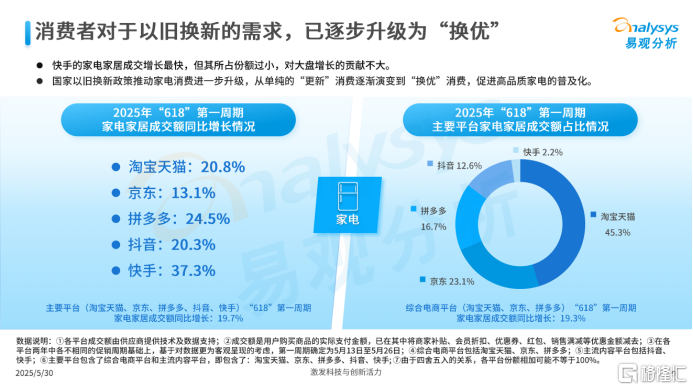
618大促过半,各大电商平台第一周期"成绩单"出炉。 今年618,天猫联合上千家品牌投入超百亿,积极响应国补旧换新增量政策,给消费者更大力度让利。 品牌立减15%,天猫发放9折的品类券及88VIP大额券,叠加至高20%国家补贴,四重折扣后,家电、家 装、家居、3C数码等品类优惠力度将低至5折。 来自天猫数据显示,截至5月26日,天猫618第一阶段,参加国补的家电家装、手机数码等品类成交总额 较去年双11增长283%,美的、海尔、科沃斯、源氏木语等40个品牌成交破亿;带动家电、家居、家 装、3C数码等行业整体成交同比双位数增长,超3000个品牌同比成交翻倍,全面激活换新消费。 目前,淘宝天猫已承接包括北京、上海、广东、浙江、江苏、新疆、西藏等全国29个省市的国补线上发 放,成为覆盖国补范围最广的平台之一。淘宝天猫覆盖的国补品类超1600个,包括家电12大类,手机数 码、智能穿戴,以及智能家居、家装等新增品类,日均超1.5亿人次在淘宝逛国补,成为消费者领用国 补频次最高的平台。 5月30日,研究机构易观发布《2025年"618"大促第一周期观察》,数据显示,在主要平台家电家居成交 额占比中,淘宝天猫以45.3%的 ...


别让低价潮牺牲用户体验,坚守底线的海尔再迎618开门红
Jin Tou Wang· 2025-06-03 08:08
Core Viewpoint - The article highlights the shift in consumer behavior during the 618 shopping festival, where quality and long-term value are prioritized over low prices, as demonstrated by Haier's success in maintaining high standards while avoiding price wars [1][2][3]. Group 1: Consumer Behavior - Consumers are increasingly rational and seek a balance between product quality and price, moving away from blindly following trends [2][3]. - The report from Beijing Business Daily indicates that consumers are more focused on brand reliability and product usability, willing to pay more for high-quality items [2]. Group 2: Haier's Market Position - Haier has consistently led the market during the 618 festival, with multiple product categories ranking first on platforms like JD and Tmall, showcasing their focus on quality and innovation [5][11]. - Specific products such as the Haier Mountain Camellia 485 refrigerator and Haier Cloud Creek washing machine have achieved top sales, reflecting consumer preference for high-quality, technologically advanced items [2][5]. Group 3: Value Creation and Innovation - The article emphasizes that engaging in price wars is a poor strategy; instead, companies should focus on enhancing product quality and user experience to foster consumer loyalty [7][13]. - Haier's approach involves continuous innovation based on user needs, leading to the development of advanced technologies that enhance product performance and user satisfaction [8][10]. Group 4: Service and Quality Assurance - Haier prioritizes service and quality as fundamental business principles, offering comprehensive support throughout the purchasing process and ensuring high-quality standards in their products [11][13]. - The company has implemented long-term warranties and guarantees on key components, reinforcing consumer trust and satisfaction [11]. Group 5: Future Market Trends - The future market is expected to favor brands that maintain quality standards and genuinely consider user needs, as evidenced by Haier's ongoing commitment to innovation and customer experience [13].

中国家电第二季度展望-增长放缓,出口减速
2025-06-02 15:44
Summary of Conference Call Notes on China Appliances Industry Industry Overview - The Chinese appliance market exhibited mixed dynamics in the first half of the year, with Q1 showing strong performance due to domestic subsidies and export pull-forward, while April data indicated a moderation in growth as exports flattened from Q1's growth [1][2][3]. - Q2 projections remain positive for overall air conditioning (AC) shipment growth, with a forecasted 9% increase, driven by a 17% growth in domestic shipments, despite a 1% decline in exports [3][4]. Key Company Insights Midea - Midea's revenue grew by 20.5% YoY in Q1, driven by domestic subsidies and export front-loading. However, growth is expected to decelerate to 4-5% for the remainder of the year [18]. - Forecasted revenue growth for Midea is approximately 9% in 2025, with home appliances contributing 66% of revenue, expected to grow by 8% [19]. - The company is focusing on energy solutions and industrial technology, with a projected 15% revenue growth in these segments [19]. - Midea's operating profit margin (OPM) is expected to dilute as it grows lower-margin businesses faster, with a forecasted OPM of 11% in 2024 [19][24]. Gree - Gree is expected to grow its topline by 6.5% YoY in 2025, but is likely to face challenges from softening domestic demand in the second half of 2025 as national trade-in subsidy programs taper off [8]. - The company’s topline growth is projected to decelerate significantly to 3.5% YoY in 2H25, underperforming industry peers [8]. Haier - Haier is projected to grow its topline by 7.4% YoY in 2025, with earnings expected to increase by 13.7% YoY, driven by growth in overseas markets, particularly in emerging markets [7]. - The target price for Haier is set at 28 RMB, indicating a potential upside of 5-6% [7]. Market Dynamics - Domestic sell-through growth is primarily volume-driven, with significant increases in both offline (20%) and online (45%) sales volumes, despite modest average selling price (ASP) growth of 3% [4]. - Intense pricing competition is noted in the entry-level segment, with manufacturers like Midea implementing price cuts of 5% across their online portfolio and targeting deeper reductions of 10-20% on specific entry-level products [4]. - The overall market remains value-conscious, with consumers showing a preference for premium SKUs due to national trade-in subsidy programs [4]. Production and Shipment Insights - April data indicated a cooling trend in AC shipments, with only 3% growth compared to 16% in Q1, driven by a flattening of exports [3][12]. - The production plans for Q2 indicate a 7% growth in domestic shipments for Midea, while exports are expected to remain flat or decline [18]. - The overall industry shipment data for ACs shows a YoY growth of 18% in Q1, with a projected 9% growth in Q2 [12]. Investment Implications - The investment outlook for Midea, Haier, and Gree is maintained at Market-Perform, reflecting cautious optimism amid mixed market dynamics and competitive pressures [11]. Additional Insights - The robotics and automation segment is expected to grow, with Midea positioned to benefit from potential growth in humanoid robotics manufacturing [6]. - Midea's long-term model forecasts a revenue compound annual growth rate (CAGR) of 7.7% and earnings CAGR of 9.1% from 2024 to 2029 [20]. This summary encapsulates the key points from the conference call regarding the Chinese appliances industry and the performance outlook for major companies within the sector.
松下家电中国联手阿里云,探索打造家电领域AI智能体
news flash· 2025-05-30 10:37
Core Insights - Panasonic Appliances (China) Co., Ltd. and Alibaba Cloud have officially announced an AI cooperation agreement focused on the smart home appliance sector [1] - The collaboration aims to leverage Panasonic's expertise in home appliances and Alibaba Cloud's global "cloud + AI" technology capabilities to develop AI applications and promote globalization in the home appliance industry [1] Group 1: AI Development - The partnership will explore the creation of AI intelligent agents tailored for the home appliance vertical, enhancing the smart functionalities of products like washing machines and refrigerators [1] - Panasonic will develop an AI platform based on Alibaba's Tongyi Qianwen large model, which will enable features such as smart laundry, smart cooking, and smart ingredient management [1] - The AI-driven appliances will also upgrade environmental perception capabilities to achieve "proactive service" [1] Group 2: Infrastructure and Support - Alibaba Cloud will provide cloud computing infrastructure, large model products, and a professional technical team to support the development of the AI platform [1] - The collaboration aligns with Panasonic's "China for Global" strategy, indicating plans to explore smart home IoT service cooperation in overseas markets such as Southeast Asia and the Middle East [1]
松下家电中国与阿里云达成AI合作
news flash· 2025-05-30 09:34
5月30日,松下家电(中国)有限公司与阿里云宣布正式达成AI合作协议。双方将共同探索打造针对家电 垂直领域的AI智能体、培养AI应用技术人才,并推动家电行业的全球化进程。 ...
2025全国新一线城市排名:南京第3,天津第7,厦门入围
Sou Hu Cai Jing· 2025-05-30 05:38
Core Insights - China's economic development has undergone significant transformations over the decades, evolving from early reform policies to becoming a global manufacturing hub and now focusing on innovation and dual circulation strategies [1] Group 1: New First-Tier Cities - The latest "National New First-Tier Cities Comprehensive Strength Ranking" for 2025 highlights cities like Hangzhou, Chengdu, Nanjing, and Wuhan as leaders, with Nanjing ranking third due to its historical and technological strengths [3][5] - Nanjing's integrated circuit industry is projected to exceed 200 billion yuan by 2025, showcasing its transformation into a hub for innovation [3] - Xiamen has made a notable entry into the new first-tier list at nineteenth place, driven by its "BRICS Innovation Base" and "Maritime Silk Road Central Legal Zone," with actual foreign investment expected to grow by 23% by 2025 [7] Group 2: Economic Shifts in Northern Cities - Tianjin maintains its seventh position by shifting its development focus from traditional heavy industry to precision services, with container throughput expected to surpass 22 million TEUs by 2025 [5][7] - The Binhai New Area is attracting financial institutions, with financing leasing business accounting for one-third of the national total, although it still faces challenges from its traditional petrochemical sector [7] - Challenges persist for cities like Qingdao and Xi'an, with Qingdao's marine economy growth slowing to 4.2% and Xi'an's semiconductor industry facing talent outflow, leading to a 7% decrease in integrated circuit design firms by 2025 [12] Group 3: Central and Southern City Strengths - Wuhan and Changsha demonstrate strong manufacturing capabilities, with Wuhan's high-tech enterprises expected to exceed 15,000 by 2025 and Changsha's construction machinery output accounting for 8% of the global market [14] - The competition between cities like Hangzhou and Chengdu reflects a broader struggle between digital economy and comprehensive hub development [9][10] Group 4: Future Economic Landscape - The 2025 rankings indicate a shift from a single-pole advancement to multi-center collaboration, emphasizing the importance of industrial depth over mere scale [15] - Future urban competition will focus on innovation density, ecological livability, and global resource allocation capabilities, determining which cities will thrive in the next economic cycle [15]

Why Is A.O. Smith (AOS) Down 5.4% Since Last Earnings Report?
ZACKS· 2025-05-29 16:37
Core Insights - A.O. Smith shares have declined approximately 5.4% since the last earnings report, underperforming the S&P 500 [1] - There is uncertainty regarding whether this negative trend will continue or if a breakout is imminent [1] Estimates Movement - Estimates for A.O. Smith have trended downward over the past month [2] VGM Scores - A.O. Smith has an average Growth Score of C, a Momentum Score of B, and a Value Score of B, placing it in the top 40% for the value investment strategy [3] Outlook - The downward trend in estimates suggests a negative shift, with A.O. Smith holding a Zacks Rank 3 (Hold), indicating expectations for an in-line return in the coming months [4]


市值管理加速落地,年内超140家公司推出员工持股计划,哪些值得划重点
Hua Xia Shi Bao· 2025-05-29 12:25
Core Viewpoint - The concept of "value management" has gained significant traction in the capital market since the release of the regulatory guidelines by the China Securities Regulatory Commission (CSRC) in November last year, with employee stock ownership plans (ESOPs) being a key method for companies to enhance their market value [2][8]. Group 1: Employee Stock Ownership Plans - As of May 29, 2023, a total of 141 listed companies have disclosed employee stock ownership plans, with 27 companies planning initial funding of over 100 million yuan [2][6]. - Notable companies like BYD and Midea Group have announced substantial employee stock ownership plans, with BYD's plan amounting to approximately 3.988 billion yuan and Midea Group's plan totaling 1.331 billion yuan [6][7]. - The employee stock ownership plan by Zijin Mining involves up to 2,500 participants, with a share price set at 70% of the average repurchase price, amounting to 10.89 yuan per share [3][6]. Group 2: Market Trends and Implications - The trend of implementing employee stock ownership plans is seen as a way to align the interests of employees with those of shareholders, potentially leading to better corporate governance and reduced short-termism among management [2][8]. - Analysts suggest that these plans can create a positive feedback loop of "performance growth - stock price increase - employee benefits," although there are concerns about the potential for short-term focus [7][8]. - The CSRC's guidelines encourage companies to enhance operational efficiency and profitability while utilizing various methods, including employee stock ownership plans, to reflect their investment value accurately [8][9].




“直播+国补”双轮驱动 闺蜜机、内衣机等潮电在618火了
Sou Hu Cai Jing· 2025-05-29 09:08
Core Insights - The demand for "trendy appliances" is experiencing a significant surge, particularly among young consumers, driven by new lifestyle needs and government subsidies [1][3][8] - The rise of live-streaming commerce, particularly through platforms like Li Jiaqi's, is playing a crucial role in promoting new domestic brands and innovative home appliances [3][5][7] Group 1: Market Trends - The trend of "trendy appliances" is opening new possibilities for consumers, with products like underwear washing machines and all-in-one cleaning robots gaining popularity [1][3] - Young consumers are increasingly favoring domestic brands that offer stylish and functional designs, leading to a shift in the home appliance market [4][5] Group 2: Consumer Behavior - Young consumers, particularly those born after 2000, are reshaping the home appliance landscape by prioritizing personal quality of life and social interaction experiences [5][7] - The demand for home automation and convenience is rising, with products like water purifiers and instant hot water dispensers becoming top choices for households [7] Group 3: Sales Performance - During the 618 shopping festival, the combination of government subsidies and live-streaming promotions is expected to drive record sales in the home appliance category [8] - Data shows that online retail sales of small appliances grew by 16% year-on-year in April, with average prices increasing by 22%, indicating a shift towards higher quality and innovative products [7]

2025中国家电出海:不高端,就出局
芯世相· 2025-05-29 07:03
Core Insights - The article highlights the impressive financial performance of China's major home appliance companies in 2024, with Midea leading the growth with a revenue of 409.1 billion yuan, a 9.5% increase year-on-year [3][4][6] - The growth of these companies is attributed to two main factors: globalization and premiumization, as they adapt to changing market dynamics and consumer preferences [7][10] Group 1: Financial Performance - Midea's revenue reached 409.1 billion yuan, marking a 9.5% year-on-year growth, making it the fastest-growing company among the four major appliance manufacturers [3][4] - Haier and TCL both reported revenues close to 300 billion yuan, with growth rates, while Hisense achieved a revenue of 151.3 billion yuan, reflecting an 8.7% increase [4][6] - Gree Electric Appliances, however, experienced a decline in revenue, reporting 190 billion yuan, a 7.31% drop [6] Group 2: Market Trends - The report indicates a trend of slowing growth in China's white goods market, while the black goods segment is seeing a shift towards high-end and smart products as key growth drivers [7][10] - The overseas market contribution has significantly increased, with major Chinese appliance companies adopting an OBM (Own Brand Manufacturing) strategy [7][10] Group 3: Globalization and Premiumization - Midea's overseas revenue reached 169.03 billion yuan, a 12.01% increase, with overseas sales accounting for 41.32% of its total revenue [8] - Haier's overseas revenue grew by 13% to 1.44 billion yuan, while Hisense's overseas revenue surged by 28% [8] - The article emphasizes that the high growth rates of these companies are primarily driven by their global expansion and focus on high-end products [9][10] Group 4: Strategic Initiatives - Midea has established 22 R&D centers globally, focusing on localized product development to meet regional demands, which has enhanced its competitive edge [13][14] - Haier has successfully implemented a multi-brand strategy and has made significant investments in North America, with 80% of its U.S. sales produced locally [15][19] - TCL's strategy focuses on large-screen products, with a 100.5% increase in shipments of 75-inch and larger TVs, indicating a strong push towards premium offerings [23][24] Group 5: Market Positioning - The article notes that Chinese home appliance brands are becoming increasingly popular in international markets, with significant growth in exports to Asia, Latin America, and Africa [29][30] - Chinese appliance manufacturers have established a strong global presence, with Haier and Hisense leading in various segments, including high-end markets [30][31]