乘用车

Search documents
广发证券:乘用车持续演绎“量稳价缓”逻辑 26年行业需求有望维持“价升量稳”
智通财经网· 2026-01-27 07:59
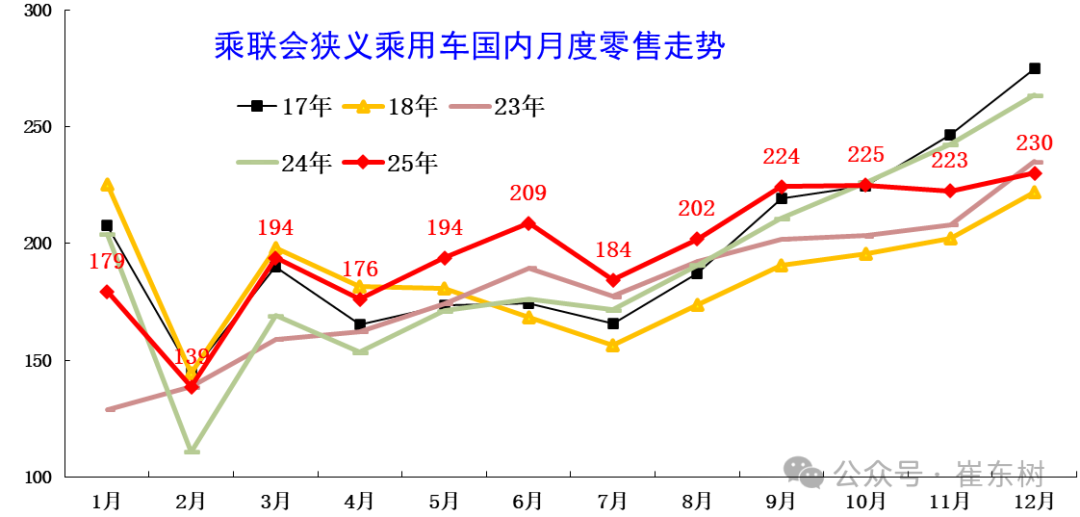
Group 1 - The core viewpoint is that the passenger car industry will continue to exhibit a "stable volume and slow price" logic in 2025, with ASP (Average Selling Price) showing a slight decline in the coming years [1][2] - In December 2025, the domestic passenger car compulsory insurance sales were 2.278 million units, a year-on-year decrease of 16.4%, indicating weaker demand compared to seasonal trends due to consumer hesitation influenced by the suspension of trade-in subsidies [1][2] - The dynamic inventory-to-sales ratio for the passenger car industry as of December 2025 was 2.48, with short-term inventory risks considered low due to expected demand release from continued trade-in policies [3] Group 2 - The passenger car ASP showed a year-on-year increase of 13.7% in December, indicating a positive trend after October, while the overall automotive retail sales decreased by 5.0% [2] - The elasticity of terminal sales for passenger cars in 2026 is expected to be influenced by the extension of scrapping and replacement subsidies, with estimated elasticities of 2.1% and 4.3% respectively [2] - The total inventory of passenger cars was 4.708 million units as of December 2025, with a decrease of 37,000 units in December, reflecting a cautious market environment [3]

【整车主线周报】北汽蓝谷发布业绩预告,12月重卡非俄出口创新高
东吴汽车黄细里团队· 2026-01-26 12:15
Group 1: Passenger Vehicle Insights - The industry subsidy policy has been implemented, and there is optimism for a recovery in passenger vehicle demand in Q1 2026, with a strong outlook for the passenger vehicle sector [3][27] - For the domestic market, focus on high-end electric vehicle companies that are less sensitive to policy changes, such as Jianghuai Automobile, and those expected to see growth in high-end offerings like Geely, Great Wall, BAIC Blue Valley, Seres, and Li Auto [3][27] - For exports, prioritize leading companies with established overseas systems and proven execution capabilities, recommending BYD, Great Wall, Chery, as well as Leap Motor, Xpeng, SAIC Motor, and Changan [3][27] Group 2: Heavy Truck Insights - In 2025, the wholesale volume reached 1.144 million units, a year-on-year increase of 26.8%, with domestic sales of 799,000 units (+32.8%) and exports of 341,000 units (+17.2%), exceeding initial market expectations [4][32] - The estimated number of operational heavy trucks meeting National IV standards or below was 690,000 at the beginning of 2025, expected to be reduced to 450,000-500,000 by the end of the year, with a total of 210,000 units eliminated throughout 2025 [4][32] - For 2026, domestic heavy truck sales are projected to reach 800,000-850,000 units, a year-on-year increase of 3%, with continued recommendations for leading companies such as China National Heavy Duty Truck, Weichai Power, Foton Motor, FAW Jiefang, and CIMC Vehicles [4][32] Group 3: Bus Insights - The implementation of the vehicle replacement policy in 2026 is slightly better than expected, with the continuation of subsidy levels rather than a reduction [4][32] - In 2025, bus sales were 29,000 units, a decrease of 6% year-on-year, indicating a gap from the reasonable replacement midpoint [4][32] - For 2026, a conservative estimate of 40,000 bus sales is projected, reflecting a 40% year-on-year increase, supported by the number of buses over eight years old awaiting replacement [4][32] Group 4: Motorcycle Insights - The motorcycle industry is expected to see total sales of 19.38 million units in 2026, a year-on-year increase of 14%, with large-displacement motorcycles projected at 1.26 million units (+31%) [5][29] - Domestic sales of large-displacement motorcycles are expected to grow slightly to 430,000 units (+5%) in 2026, while exports are anticipated to reach 830,000 units (+50%) [5][29] - The focus remains on leading companies benefiting from the sustained growth in large-displacement and export markets, recommending Chunfeng Power and Longxin General [5][29]



乘用车板块1月26日跌1.75%,北汽蓝谷领跌,主力资金净流出14.51亿元
Zheng Xing Xing Ye Ri Bao· 2026-01-26 09:37
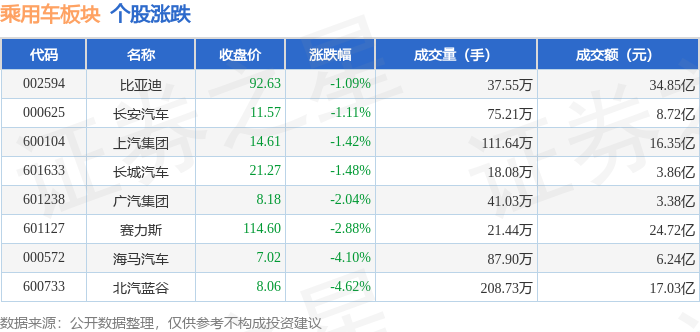
Group 1 - The passenger car sector experienced a decline of 1.75% on January 26, with Beiqi Blue Valley leading the drop [1] - The Shanghai Composite Index closed at 4132.61, down 0.09%, while the Shenzhen Component Index closed at 14316.64, down 0.85% [1] - Major companies in the passenger car sector saw varying declines in their stock prices, with BYD down 1.09% to 92.63, and Beiqi Blue Valley down 4.62% to 8.06 [1] Group 2 - The passenger car sector saw a net outflow of 1.451 billion yuan from main funds, while retail investors contributed a net inflow of 905 million yuan [1] - Specific companies like GAC Group and Great Wall Motors experienced significant net outflows from main funds, with GAC Group at -28.73 million yuan and Great Wall Motors at -46.11 million yuan [2] - BYD had a net outflow of 52.2 million yuan from main funds, while retail investors showed a net inflow of 55.37 million yuan [2]





2025年中国乘用车头部品牌“强者恒强”,新势力破局高端市场
Zhong Guo Jing Ji Wang· 2026-01-26 08:37
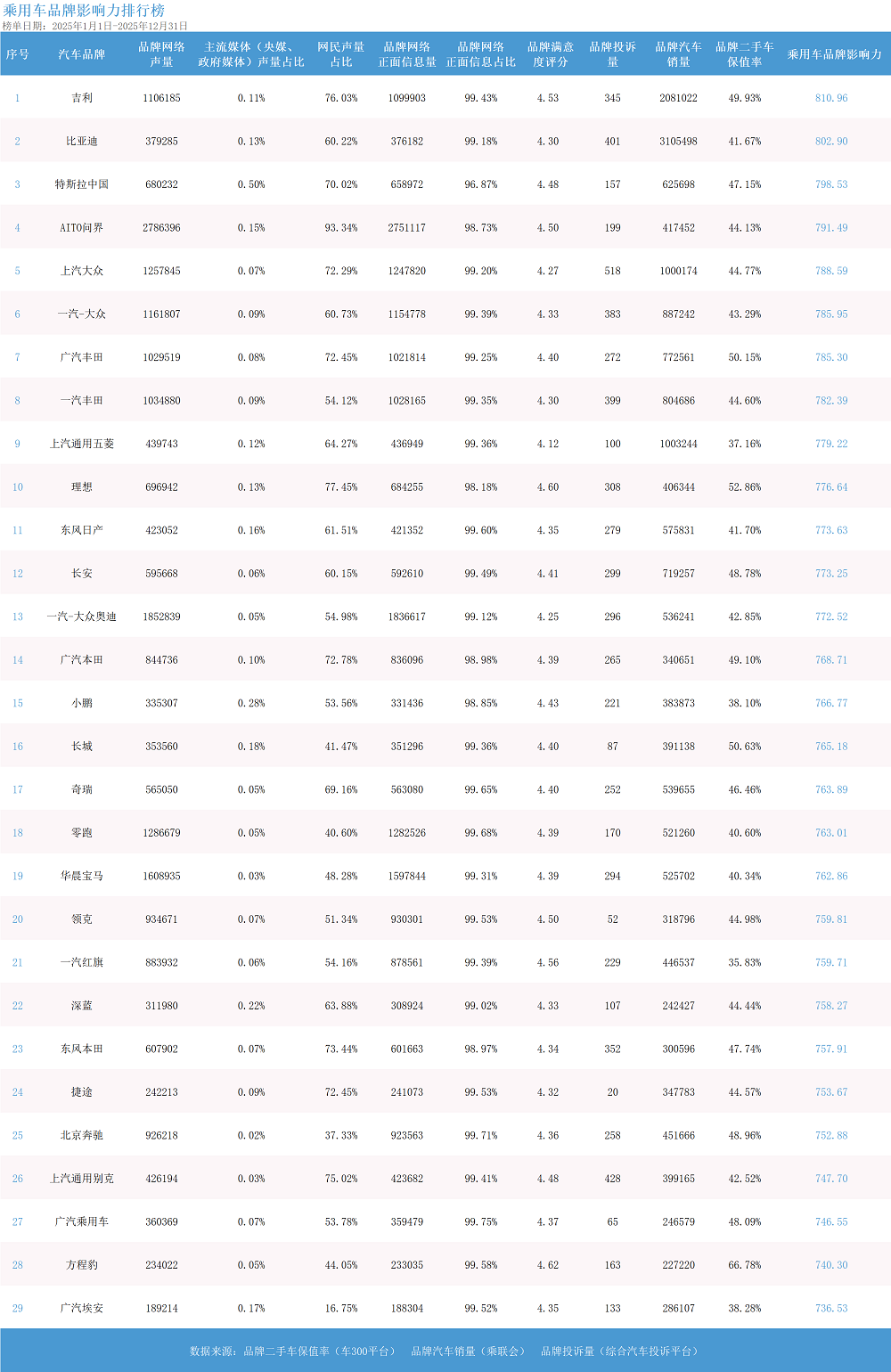
Core Insights - The article highlights the competitive landscape of the Chinese passenger car market in 2025, emphasizing the rise of domestic brands leveraging technology and user engagement to reshape market dynamics [1][2]. Group 1: Market Dynamics - By 2025, leading Chinese passenger car brands have established competitive advantages based on large-scale operations and strong brand reputation [1]. - Domestic brands, particularly Geely, BYD, and AITO, dominate the market, significantly altering the long-standing influence of joint venture brands [2][4]. Group 2: Brand Performance - Geely ranks first with a comprehensive influence score of 810.96, supported by 1,106,185 annual brand network mentions and 2,081,022 vehicle sales, alongside a 99.43% positive information ratio [4]. - BYD follows closely with a score of 802.90, showcasing a sales figure of 3,105,498 vehicles and a 99.18% positive sentiment [4]. - Tesla China maintains a strong position with a score of 798.53, attributed to its media presence and brand premium [5]. Group 3: Emerging Trends - AITO's performance is notable, with a network mention count of 2,786,396 and a 93.34% user sentiment ratio, indicating a strong foothold in the high-end market [6]. - New energy brands are rapidly growing, with Geely's Galaxy series becoming a key growth driver, while traditional automakers like Great Wall and Changan continue to innovate in hybrid and electric technologies [6]. Group 4: Challenges for Joint Ventures - Traditional joint venture brands face pressure from the rise of domestic brands, leading to a critical phase of adjustment and strategic transformation [7]. - Brands like SAIC Volkswagen and FAW-Volkswagen, despite their historical market presence, show signs of stagnation in user engagement and satisfaction compared to their domestic counterparts [7]. - The need for joint ventures to accelerate local electric vehicle development and adapt global technologies to meet Chinese consumer preferences is emphasized as a core challenge [7].



综合行业周报:RoboX进展顺利,家用机器人新品密集亮相
KAIYUAN SECURITIES· 2026-01-26 01:24
Investment Rating - The industry investment rating is "Positive" (maintained) [1] Core Views - The automotive sector is awaiting a turning point in passenger vehicle sales, with RoboX company making steady progress [5][7] - The tools sector is seeing significant developments, including the establishment of the QuanFeng Vietnam park and exciting new products showcased at CES [6][27] Automotive Sector Summary - The Hang Seng Automotive Theme Index increased by 2.2%, outperforming the Hang Seng Index (-0.4%) and the Hang Seng Technology Index (-0.4%) [5][13] - In December 2025, the passenger vehicle market reached a new high with retail sales of 2,374.5 million units, including 1,280.9 million units of new energy vehicles, marking a 17.6% year-on-year growth [14] - January 2026 passenger vehicle sales are expected to see a slight year-on-year increase, with an estimated total market retail of around 1.8 million units [15] - New vehicle launches have been relatively quiet, with the Geely Galaxy V900 being the only notable release [19][20] - RoboX plans to deploy 100,000 fully customized Robotaxis globally by 2030, enhancing commercial operations [22] Tools Sector Summary - The establishment of the QuanFeng (Vietnam) New Energy Intelligent Manufacturing Base marks a significant step in global strategic layout [39] - At CES 2026, several innovative home robot products were showcased, including the G-Rover by Stone Technology, which features a dual-wheel leg architecture [40] - Milwaukee Tools opened a flagship experience center in the UK, enhancing strategic value and user engagement [53]
出口或仍上升——实体经济图谱2026年第4周【陈兴团队·华福宏观】
陈兴宏观研究· 2026-01-25 08:06
Core Insights - In the fourth week of January, there are positive signs in terminal demand with market activity recovering, second-hand housing sales performing well, and an increase in theme park visitor numbers. However, automotive sales remain low year-on-year, and service consumption shows divergence with a lackluster film box office performance [2] Real Estate - In the first four weeks of January, new home sales in 42 cities saw a narrowing decline, improving from -25.6% to -22.5% year-on-year, while second-hand home sales in 19 cities turned positive at 13.1% from -27.7% [4] - The average sales volume of new homes in 42 cities improved to a decline of -19.5% from -34.9% the previous week, and second-hand home sales in 19 cities increased to 44.4% from -6.9% [4] Automotive - In the first 18 days of January, retail and wholesale sales of passenger cars saw an expanded year-on-year decline, with retail sales down by 28% and wholesale sales down by 35% [6] - The production of semi-steel tires increased to 74.6%, indicating potential strength in wholesale orders despite weak retail performance [8] Textile and Apparel - In December, the textile and apparel sub-industry experienced a decline in export growth, with textile yarn exports down by 4.2% year-on-year and clothing exports down by 10.2% [12] Agricultural Products - The agricultural product wholesale price index increased this week, with pork prices rising by 2.4% and egg prices by 6.3% [16] Film Industry - The film box office revenue and audience numbers both declined, with box office revenue around 280 million yuan, reflecting a year-on-year drop of 23.1% [20] Leisure and Entertainment - Theme park visitor numbers increased slightly, with Shanghai Disneyland seeing a rise to 54,000 visitors, although still down by 10.8% year-on-year [23] Employment - The national employment volume index decreased to 1.6, while the employment price index rose to 22.8, indicating a higher employment volume compared to last year but lower prices [28] Chemical Industry - The PTA industry chain saw most product prices rise, while the operating rates generally declined due to maintenance and reduced demand from downstream textile enterprises [33] Steel Industry - Steel prices and profit margins decreased, but steel production growth turned positive at 0.3%, indicating a recovery in output despite seasonal demand weakness [37] Cement Industry - National cement prices continued to decline, with a decrease in the cement enterprise capacity ratio, indicating a slowdown in production [43] Glass Industry - The average price of float glass increased slightly, but inventory levels rose, suggesting limited demand support [48] Oil Industry - Oil prices showed mixed trends, with Brent crude down and WTI crude up, influenced by geopolitical uncertainties and seasonal refinery demand [52] Non-ferrous Metals - Prices for major non-ferrous metals rose, with copper and aluminum inventories increasing, reflecting market dynamics influenced by geopolitical factors [57] Coal Industry - Thermal coal prices fell due to reduced demand from warmer weather, while coking coal prices increased, indicating mixed trends in the coal market [62] Freight Transport - In the first 18 days of January, sea freight growth increased while land transport growth declined, reflecting changes in shipping demand [64] Passenger Transport - Domestic flight operations increased, while subway passenger volumes in 20 cities showed slight declines, indicating a recovery in long-distance travel [69] Power Industry - The average daily coal consumption of major power generation groups turned positive at 6.7% year-on-year, driven by increased heating demand [73]

小鹏汽车全球累计布局超60国家,宇树2025年人形机器人出货量超5500台
KAIYUAN SECURITIES· 2026-01-25 06:43
Investment Rating - The industry investment rating is "Positive" (maintained) [1] Core Insights - The automotive sector shows a strong performance with a 2.21% increase, outperforming the broader market [6][23] - The demand for high-end domestic passenger vehicles is exceeding expectations, with a favorable competitive landscape [7] - The commercial vehicle index has seen a significant increase of 7.38%, indicating robust growth in this segment [6] Industry News - Geely's self-developed all-solid-state battery is set to complete its first pack line by the end of the year [5][13] - Tesla has adjusted its Model S/3/X/Y and Cybertruck models, removing the standard Autopilot feature and shifting to a subscription model for FSD [5][13] - Xiaopeng Motors has expanded its global sales network to over 1,000 outlets, entering nearly 30 new markets [5][16] - The humanoid robot market is seeing significant growth, with UNITREE announcing over 5,500 units shipped in 2025, potentially leading the industry [5][17] Market Performance - The automotive sector's performance is ranked 16th among A-share industries this week, with a notable increase in the commercial vehicle and auto parts sectors [6][23] - The passenger vehicle sector's PE valuation has decreased, while commercial vehicles and auto parts have seen a 10% increase in PE valuations [10][12] Investment Recommendations - For passenger vehicles, companies like JAC Motors and Seres are recommended due to strong demand and competitive positioning [7] - In the auto parts sector, companies such as Desay SV and Zhejiang Xiantong are highlighted for their growth potential amidst improving profitability [7]


实体经济图谱2026年第4周:出口或仍上升
Huafu Securities· 2026-01-25 06:09
Economic Indicators - In the fourth week of January, the average new home sales in 42 cities improved from a year-on-year decline of -25.6% to -22.5%[3] - The year-on-year sales of second-hand homes in 19 cities turned positive at 13.1%, improving from a previous decline of -27.7%[3] - The average wholesale price index for agricultural products increased, with pork prices rising by 2.4% month-on-month[26] Consumer Behavior - Movie box office revenue decreased to approximately 280 million yuan, with a year-on-year decline of -23.1%[36] - The average daily visitor count at Shanghai Disneyland rose to 54,000, but the year-on-year growth turned negative at -10.8%[39] - The average daily coal consumption of six major power generation groups increased by 6.7% year-on-year, driven by colder weather in northern regions[105] Industrial Production - The operating rate of semi-steel tires remained high, while the production growth rate of sample steel mills turned positive[5] - The PTA industry chain saw most product prices rise, although the load rates generally declined[51] - The steel production growth rate for sample steel mills turned positive at 0.3% year-on-year, with inventory levels recovering[57] Transportation and Logistics - The container throughput at key ports showed a year-on-year decline, while the overall cargo throughput increased[94] - Domestic flight operations increased, indicating a recovery in air travel demand[99]
崔东树:2025年12月末全国乘用车行业库存365万辆 去库天数为66天
智通财经网· 2026-01-23 11:12
Group 1: Industry Inventory Trends - As of December 2025, the national passenger car inventory stands at 3.65 million units, a decrease of 140,000 units from the previous month and an increase of 600,000 units compared to December 2024, indicating a year-end inventory decline trend [1][18] - The inventory level supports a future sales period of 66 days, which is an increase of 20 days compared to December 2024's 46 days [1][31] - The industry inventory saw a peak of 3.94 million units in December 2022, followed by a gradual decline to 3.25 million units in April 2023, before rising again to 3.92 million units in November 2023 [25] Group 2: Retail Sales Performance - In December 2024, the national passenger car market retail sales reached 2.3 million units, representing a year-on-year decline of 13% but a month-on-month increase of 3% [6] - The cumulative retail sales for the year reached 23.78 million units, showing a year-on-year growth of 4% [6] - The retail sales growth rate fluctuated throughout the year, starting from a negative 12% in January to a positive 11% in June, followed by a gradual slowdown in the latter half of the year [4][6] Group 3: Export Trends - In December 2025, passenger car exports (including complete vehicles and CKD) totaled 590,000 units, marking a year-on-year increase of 46% but a month-on-month decrease of 2% [11] - The total passenger car exports for the year reached 5.74 million units, reflecting a year-on-year growth of 20% [11] Group 4: Production Insights - December 2025 saw passenger car production at 2.79 million units, a year-on-year decrease of 5% and a month-on-month decrease of 10% [14] - The total production for the year amounted to 29.61 million units, with a cumulative year-on-year growth of 10% [14] Group 5: Market Forecast and Sentiment - The market sentiment has shifted from optimism to caution, with a predicted optimism level of 14% for January, indicating a challenging outlook for manufacturers [23] - The current inventory level of 3.65 million units suggests significant pressure for inventory digestion in the coming months [23][31]
乘用车板块1月23日涨0.49%,北汽蓝谷领涨,主力资金净流出11.47亿元
Zheng Xing Xing Ye Ri Bao· 2026-01-23 09:04
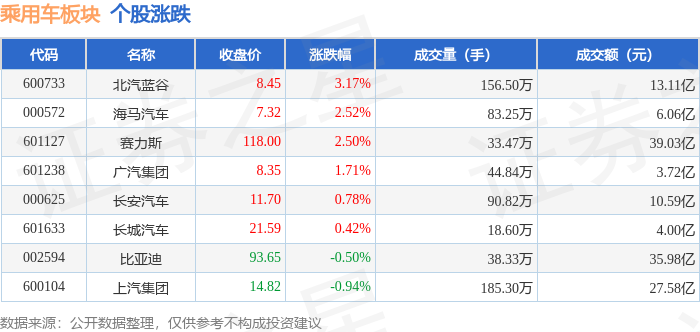
Core Viewpoint - The passenger car sector experienced a slight increase of 0.49% on January 23, with Beijing Blue Valley leading the gains. The Shanghai Composite Index closed at 4136.16, up 0.33%, while the Shenzhen Component Index closed at 14439.66, up 0.79% [1]. Group 1: Market Performance - Beijing Blue Valley (600733) closed at 8.45, up 3.17% with a trading volume of 1.565 million shares and a transaction value of 1.311 billion yuan [1]. - Haima Automobile (000572) closed at 7.32, up 2.52% with a trading volume of 832,500 shares and a transaction value of 606 million yuan [1]. - Seres (601127) closed at 118.00, up 2.50% with a trading volume of 334,700 shares and a transaction value of 3.903 billion yuan [1]. - GAC Group (601238) closed at 8.35, up 1.71% with a trading volume of 448,400 shares and a transaction value of 372 million yuan [1]. - Changan Automobile (000625) closed at 11.70, up 0.78% with a trading volume of 908,200 shares and a transaction value of 1.059 billion yuan [1]. - Great Wall Motors (601633) closed at 21.59, up 0.42% with a trading volume of 186,000 shares and a transaction value of 400 million yuan [1]. - BYD (002594) closed at 93.65, down 0.50% with a trading volume of 383,300 shares and a transaction value of 3.598 billion yuan [1]. - SAIC Motor (600104) closed at 14.82, down 0.94% with a trading volume of 1.853 million shares and a transaction value of 2.758 billion yuan [1]. Group 2: Fund Flow Analysis - The passenger car sector saw a net outflow of 1.147 billion yuan from institutional investors, while retail investors contributed a net inflow of 718 million yuan [1]. - The main fund inflow for Seres (601127) was 118 million yuan, accounting for 3.02% of the total, while retail investors had a net outflow of 11.6 million yuan [2]. - Beijing Blue Valley (600733) had a main fund inflow of 108 million yuan, representing 8.26% of the total, with retail investors contributing a net inflow of 35.217 million yuan [2]. - Changan Automobile (000625) experienced a main fund inflow of 43.554 million yuan, accounting for 4.11%, while retail investors had a net inflow of 19.761 million yuan [2]. - Haima Automobile (000572) saw a main fund inflow of 26.734 million yuan, representing 4.41%, with a retail net outflow of 9.9696 million yuan [2]. - GAC Group (601238) had a main fund inflow of 18.375 million yuan, accounting for 4.94%, while retail investors experienced a net outflow of 26.513 million yuan [2]. - Great Wall Motors (601633) had a main fund inflow of 12.320 million yuan, representing 3.08%, with a retail net outflow of 35.988 million yuan [2]. - BYD (002594) experienced a significant net outflow of 686 million yuan from institutional investors, while retail investors had a net inflow of 51 million yuan [2]. - SAIC Motor (600104) faced a substantial net outflow of 788 million yuan from institutional investors, while retail investors had a net inflow of 34.2 million yuan [2].