大数据

Search documents
兴业银行天津分行:金融助力畅通现代化产业体系血脉
Sou Hu Cai Jing· 2026-01-16 10:16
Group 1 - The "14th Five-Year Plan" emphasizes the construction of a modern industrial system and the strengthening of the real economy as a primary strategic task, highlighting key directions such as "solid foundation upgrade, innovation nurturing, capacity expansion and quality improvement, and efficiency enhancement" [1] - Tianjin is accelerating the establishment of a "1+3+4" modern industrial system, focusing on advanced manufacturing with a competitive edge nationwide, while the Industrial Bank Tianjin Branch integrates its development into the regional industrial evolution [1] - The Tianjin Branch aims to inject continuous financial support into the construction of the modern industrial system by leveraging its comprehensive service capabilities in both commercial and investment banking, particularly in the digital economy sector [1] Group 2 - In the commercial logistics sector, the Tianjin Branch focuses on cold chain logistics as a critical link for ensuring the supply of fresh produce, exemplified by the Yuhu Cold Chain Logistics (Tianjin) Co., Ltd. project [3] - The branch has formed a specialized service team to provide comprehensive financial support, aiding in the construction of high-standard cold chain facilities and the introduction of advanced international supply chain management systems [3] - By extending financial services to key enterprises in the supply chain, the Tianjin Branch aims to enhance the efficiency and safety of regional fresh agricultural product circulation, thereby solidifying the supply chain foundation for the modern industrial system [3]


韶关召开一季度政银企融资对接会 授信签约金额超47亿元
Nan Fang Ri Bao Wang Luo Ban· 2026-01-16 07:53
1月15日上午,韶关市2026年一季度政银企融资对接会在市区举行,会议由市政府办公室、韶关金融监 管分局主办,市银行业公会承办,相关行业主管部门、11家银行机构与44家企业代表参加会议。 本次政银企对接会聚焦"做大工业、做强主城、做优县域"三大重点,围绕金融支持"百县千镇万村高质 量发展工程",着力搭建政银企沟通平台,赋能韶关经济高质量发展。 据了解,韶关金融监管分局联合韶关市政府办公室谋划建成了"金融管理部门牵头+行业主管部门协同 +银行对接服务+企业融资发展"常态化政银企融资对接机制,并成立金融专班,于每季度在韶关市区和 7个县(市)同步召开政银企对接会,通过常态化对接、问题协调解决、产品服务创新等务实举措,"一 企一策"解决企业融资难题。 现场分三批次完成12轮授信签约,涵盖大数据、科技创新、制造业、农业等重点领域,现场签约授信金 额达30.68亿元。与此同时,全市7个县(市)同步举办对接活动,全市现场授信签约金额达47.46亿元。 ...
十年绿色实践!长江经济带18个典型零碳园区与碳达峰试点
Zhong Guo Dian Li Bao· 2026-01-16 04:07
Core Viewpoint - The development of the Yangtze River Economic Belt emphasizes ecological priority and green development, contributing significantly to China's GDP and carbon emissions reduction efforts [1]. Group 1: Achievements in Green Development - Over the past decade, the Yangtze River Economic Belt has promoted the green transformation of traditional industries such as steel, petrochemicals, and building materials [1]. - The region has established 24 national carbon peak pilot cities and parks, along with 14 zero-carbon parks, showcasing its leading role in ecological and green development [1]. - Sichuan province, a key ecological barrier, has achieved an annual clean energy generation of over 4,000 billion kilowatt-hours, accounting for over 80% of its total energy output, and has seen a nearly fourfold increase in new energy installations over five years, reaching 25.19 million kilowatts [1]. Group 2: Specific Pilot Cities and Parks - Leshan, located in Sichuan, is a national carbon peak pilot city with abundant hydropower resources, featuring 327 hydropower stations and an annual generation of approximately 26.5 billion kilowatt-hours [3]. - The Yibin Lingang Economic and Technological Development Zone aims to create a zero-carbon park, with over 70% of its industries being green and low-carbon [5]. - The Chongqing Jiulong New City Park serves as a national carbon peak pilot park, focusing on an aluminum industry chain and innovative green logistics [7]. Group 3: Regional Contributions - Hubei province plays a pivotal role in the central region's rise, hosting two national carbon peak pilot cities and a zero-carbon park, with a focus on green transformation in the automotive industry [10][12]. - Jiangsu province, located in the Yangtze River Delta, has four national carbon peak pilot cities and parks, promoting a circular economy and low-carbon development through various initiatives [18]. - Zhejiang province has three national carbon peak pilot cities and a zero-carbon park, emphasizing the integration of green manufacturing and renewable energy [24][26]. Group 4: Innovative Practices - The Suzhou Industrial Park has established a market-based voluntary emission reduction trading system, serving over 500 enterprises and promoting sustainable development practices [20]. - The Shanghai Lingang New Area Zero Carbon Bay has attracted major industries and aims to create a comprehensive zero-carbon system integrating various renewable energy sources [23]. - The Guizhou Big Data Science and Technology Innovation City focuses on green energy and advanced manufacturing, with a significant portion of its energy coming from renewable sources [39].
再募 150 亿美元,拿走全美 18%的风投资金,3 万字长文聊聊 a16z 是怎么运转的?
Founder Park· 2026-01-15 13:04
Core Insights - a16z has raised over $15 billion, capturing more than 18% of all VC funds raised in the U.S. in 2025 [2][10] - The firm has invested in 56 unicorns over the past decade, more than any other venture capital institution, and has backed 10 out of the top 15 private companies by valuation [3][15] - a16z is characterized as a "Firm" rather than a "Fund," focusing on building a long-term competitive advantage system that strengthens with scale [4][41] Fundraising and Market Position - In 2025, a16z's fundraising of $15 billion surpassed the combined total of its closest competitors, Lightspeed ($9 billion) and Founders Fund ($5.6 billion) [10] - a16z's fundraising success occurred in a challenging environment, where the average fund took 16 months to close, while a16z completed its fundraising in just over three months [10] - The firm has four independent funds that ranked in the top 10 for total capital raised in 2025, with its Late Stage Venture Fund II ranking second [12] Investment Strategy and Philosophy - a16z has led early-stage financing for 31 companies that eventually surpassed a valuation of $5 billion, outperforming its closest competitors by over 50% [16] - The firm holds 44% of the total valuation of all AI unicorns in its portfolio, indicating a strong position in the AI sector [16] - a16z's investment philosophy emphasizes identifying and backing the ultimate winners in their respective categories, often providing more capital than initially requested [26][34] Historical Context and Evolution - Since its inception, a16z has evolved through two distinct eras, focusing first on recognizing undervalued software companies and later on the increasing scale of successful tech firms [63][72] - The first era (2009-2017) was marked by a willingness to pay premium prices for high-potential companies, while the second era (2018-2024) focused on raising larger funds to maintain meaningful ownership in increasingly larger winners [66][72] - a16z's approach has been to build operational infrastructure that supports portfolio companies, a strategy that was initially viewed as unnecessary by peers [67] Notable Investments - a16z has invested in major companies such as OpenAI, SpaceX, and Databricks, which are among the top private companies by valuation [14][16] - Databricks exemplifies a16z's investment model, showcasing the firm's commitment to supporting founders and believing in their long-term vision [25][40] - The firm has consistently backed Databricks through multiple funding rounds, contributing to its growth into a $134 billion company [24][40]

科技板块ETF领涨 资金流向持续分化
Zhong Guo Zheng Quan Bao· 2026-01-14 21:07
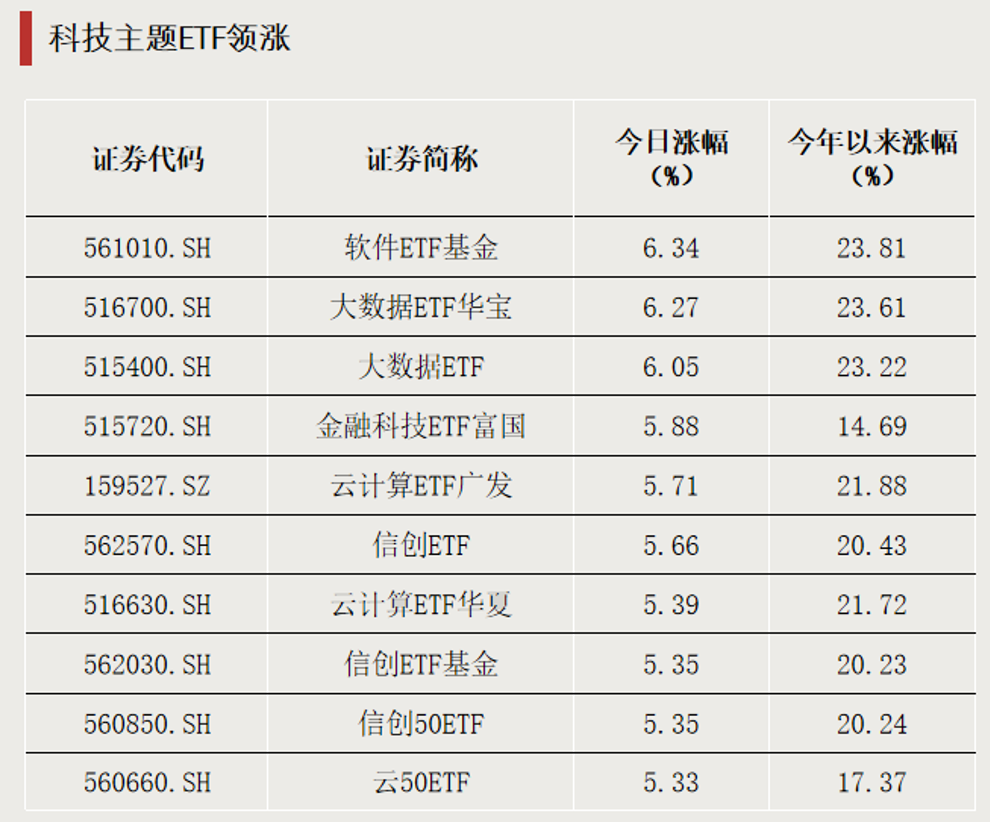
Group 1: Market Overview - On January 14, the overall ETF market saw more gains than losses, with over half of the ETFs closing higher, particularly in technology themes such as software, big data, and fintech, which dominated the top ten gainers with each showing an increase of over 5% [1] - The overall net inflow into the ETF market reached 5.66 billion yuan on January 13, a significant increase from 1.157 billion yuan on January 12, with stock ETFs continuing to attract capital [4] Group 2: Technology Theme ETFs - Technology-themed ETFs were the market focus on January 14, with all top ten gainers being such products, many of which exhibited premiums in the market [2] - The software ETF (561010) led the market with a daily increase of 6.34% and a premium rate of 2.19%, tracking the CSI All-Share Software Development Index, which includes 117 stocks [2] - Several technology ETFs have seen cumulative gains exceeding 20% since the beginning of the year, indicating a strong profit effect [2] Group 3: Underperforming Sectors - In stark contrast to the technology sector, ETFs related to the electric grid and banking were among the top ten losers, highlighting a clear market structure divergence [3] - The electric grid ETF (561380) experienced a significant decline of 5.81% on January 14, while another electric grid ETF (159320) fell by 1.75% [3] - Three ETFs tracking the CSI Bank Index also reported declines of over 1.6%, with only one stock remaining stable among the 42 components [3] Group 4: Fund Flow Dynamics - The net inflow of 5.66 billion yuan on January 13 was primarily driven by industry-themed ETFs, which occupied seven of the top ten positions for net inflow, including sectors like media, software, and internet [4] - The media ETF (512980) alone saw a net inflow exceeding 4 billion yuan on January 13, indicating strong investor interest in specific sectors [4] - Non-equity ETFs, particularly money market ETFs, faced significant outflows, with notable withdrawals exceeding 2 billion yuan from specific funds [4][5] Group 5: Investment Focus Areas - Institutions are currently focusing on commercial aerospace and AI applications as high-interest areas, with a positive long-term outlook for technology sectors [6] - The commercial aerospace sector is at a critical transition point, moving from technology validation to commercialization, suggesting potential investment opportunities in companies with core technologies [6] - The AI sector is also gaining attention, with expectations for significant investment opportunities arising from technological breakthroughs and application implementations [7]
科技板块ETF领涨资金流向持续分化
Zhong Guo Zheng Quan Bao· 2026-01-14 20:51
Group 1: Market Overview - On January 14, the overall ETF market saw more gains than losses, with over half of the ETFs closing higher. Technology-themed ETFs, including software, big data, and fintech, dominated the top gainers, each with an increase of over 5% [1][2] - The total net inflow into the ETF market on January 13 reached 5.66 billion yuan, a significant increase from 1.157 billion yuan on January 12, with equity ETFs continuing to attract capital [3][4] Group 2: Technology-Themed ETFs Performance - Technology-themed ETFs were the market focus on January 14, with all top ten gainers being such products, many showing premiums in the market. Several technology-themed ETFs have seen cumulative gains exceeding 20% within just eight trading days this year [1][2] - The Software ETF (561010) led the market with a daily increase of 6.34% and a premium rate of 2.19%. The underlying index includes 117 stocks, with 10 stocks rising over 10% on the same day [1][2] Group 3: Sector Performance Disparity - In stark contrast to the technology sector, ETFs related to the electric grid and banking sectors saw multiple products in the top ten losers. The Electric Grid ETF (561380) experienced a decline of 5.81%, while another electric grid ETF (159320) fell by 1.75% [2][3] - Three ETFs tracking the banking index also reported daily declines exceeding 1.6%, with all but one of the 42 constituent stocks closing lower [3] Group 4: Fund Flow Dynamics - The inflow of funds into industry-themed ETFs was notably strong, with seven out of the top ten ETFs by net inflow on January 13 being industry-themed, including media, software, and satellite sectors. The Media ETF (512980) alone saw a net inflow exceeding 4 billion yuan [3][4] - Non-equity ETFs faced net outflows, particularly in money market ETFs, with significant outflows exceeding 2 billion yuan for specific funds [4] Group 5: Investment Focus Areas - Institutions have highlighted commercial aerospace and AI applications as key areas of interest, with a positive long-term outlook for technology sectors. The commercial aerospace sector is at a critical transition point towards commercialization [4][5] - The AI sector is also gaining attention, with expectations for significant investment opportunities driven by technological breakthroughs and application implementations [6]
伍家岗区工商联:推动楼宇经济成为区域增长“强引擎”
Xin Lang Cai Jing· 2026-01-14 19:42
Core Insights - The article emphasizes the focus of the Wujiaogang District Federation of Industry and Commerce on the theme of "two healths," aiming for high-quality development through the establishment of building business associations as a breakthrough point [1] Group 1: Building Business Association - The Wujiaogang District Federation of Industry and Commerce has established the city's first building business association, the Zhixing Heyi Incubation Center Building Association, with the mission of "empowering intelligence and integrating strength" [1] - The association has created a quality service platform covering an area of 12,000 square meters, aggregating 97 enterprises and over 500 young talents to form an industrial ecosystem in fields such as artificial intelligence and big data [1] Group 2: Development Services - The district federation emphasizes both ideological guidance and development services, naming office floors after red landmarks like Ruijin and Nanhu, and creating themed spaces such as "Wangzhi Road 106" coffee shop to strengthen ideological foundations [1] - Full-cycle services are provided to empower development, facilitating interactions through technical salons and project roadshows, and promoting policy accessibility and problem-solving via building lectures and inter-enterprise stations [1] Group 3: Economic Impact - The federation acts as a bridge for businesses, attracting advanced technologies and incubating several high-tech enterprises, with one successfully listed on the "New Fourth Board" [1] - The total annual output value of building enterprises has exceeded 650 million yuan, while also guiding young entrepreneurs to participate in public welfare activities, thereby synchronizing corporate growth with regional development and injecting lasting momentum into the local economy [1]
大幅溢价!明天,停牌一小时
Zhong Guo Zheng Quan Bao· 2026-01-14 13:07
Group 1 - The overall ETF market saw more gains than losses on January 14, with over half of the funds rising, particularly in technology sectors such as software, big data, fintech, and cloud computing, where several products increased by over 5% [1][2] - The total scale of cross-border ETF products has surpassed 1 trillion yuan, with the number of products reaching 207. More than 30% of cross-border ETFs experienced premium trading prices, with the highest premium rate for the Nasdaq Technology ETF at 19.36% [1][13] - The ETF market had a net inflow of approximately 5.66 billion yuan, an increase from 1.157 billion yuan on January 12. Stock ETFs remain the main attraction for capital, although there is a divergence in internal structure [1][7] Group 2 - Technology sector ETFs performed exceptionally well on January 14, with all top gainers being technology-related products, each rising over 5%. Several technology ETFs have seen gains exceeding 20% in the first eight trading days of the year [2] - The Software ETF (561010) topped the gainers list with a 6.34% increase and a premium rate of 2.19%. The fund tracks the CSI All-Share Software Development Index, which includes 117 constituent stocks, with 10 stocks rising over 10% [2][3] - The two ETFs tracking the CSI Big Data Industry Index also saw gains exceeding 6%, with notable increases in stocks like Tianyuan Dike (300047) and Yidian Tianxia (301171) [2] Group 3 - Several ETFs in the electric grid and banking sectors experienced significant declines on January 14, with the electric grid ETF (561380) dropping 5.81%, marking the largest decline of the day [4][5] - The banking sector ETFs also saw widespread declines, with three ETFs falling more than 1.6%, all tracking the CSI Banking Index, where 41 out of 42 constituent stocks declined [5][6] - The electric grid ETF (561380) had a notable increase in turnover rate, reaching 51.72%, indicating heightened trading activity despite the price drop [5] Group 4 - The net inflow of 5.66 billion yuan into the ETF market indicates strong interest in stock ETFs, particularly in sectors like media, satellite, and software, while some broad-based index ETFs faced net outflows [7][8] - The Media ETF (512980) alone attracted over 4 billion yuan in net inflows in just one trading day, highlighting the strong demand for sector-specific ETFs [7][8] - Non-equity ETFs, particularly money market funds, have seen significant net outflows, with two money market ETFs experiencing outflows exceeding 2 billion yuan each [9][10]
涨超4.8%,大数据ETF华夏(516000)近5个交易日净流入1125.53万元
Xin Lang Cai Jing· 2026-01-14 07:01
Group 1 - The core viewpoint of the news is the strong performance of the China Securities Big Data Industry Index and its constituent stocks, with significant increases in both the index and the Big Data ETF Huaxia [1][2] - As of January 14, 2026, the China Securities Big Data Industry Index (930902) rose by 4.62%, with constituent stocks such as Zhongke Xingtong increasing by 13.93% and Yidian Tianxia by 13.70% [1] - The Big Data ETF Huaxia (516000) saw a rise of 4.81%, reaching a latest price of 1.24 yuan, and has accumulated an increase of 11.37% over the past week [1] Group 2 - The Big Data ETF Huaxia closely tracks the China Securities Big Data Industry Index, which includes companies involved in big data storage, analysis, operations, production, and applications [2] - As of December 31, 2025, the top ten weighted stocks in the China Securities Big Data Industry Index accounted for 50.68% of the index, including companies like iFLYTEK and Inspur Information [2] - The latest scale of the Big Data ETF Huaxia reached 360 million yuan, marking a three-month high [1]
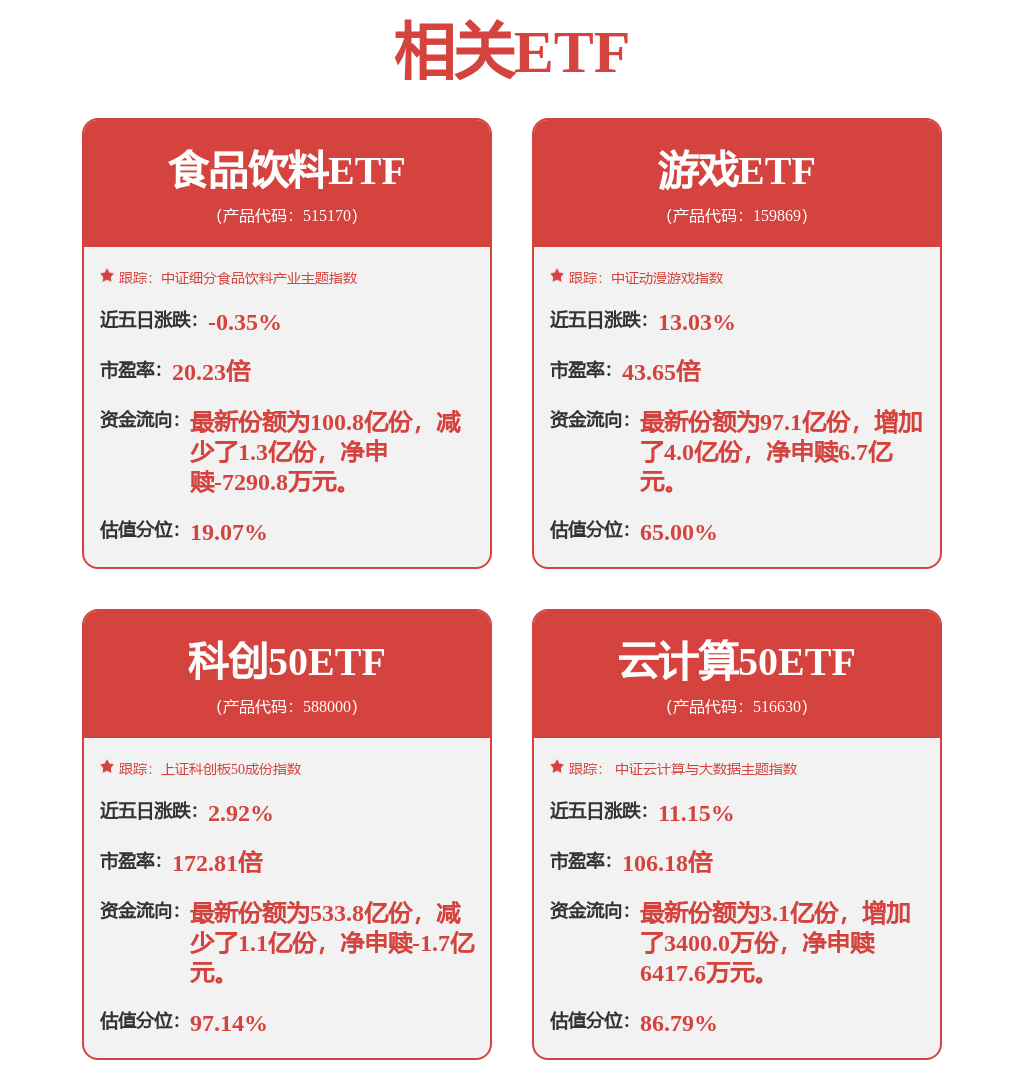
行业迎来密集催化!大数据ETF、大数据ETF华夏、云计算ETF广发、云计算ETF易方达涨超4%
Ge Long Hui· 2026-01-14 06:26
Core Viewpoint - The A-share market is experiencing increased volatility, with AI-related sectors leading the gains [1] Group 1: ETF Performance - As of the report, various ETFs such as Big Data ETF, Financial Technology ETF, and Cloud Computing ETFs have risen over 4% [2] - The Cloud Computing ETF from Huaxia focuses on domestic AI software and hardware capabilities, with a combined weight of computer software, cloud services, and computer equipment reaching 83.7%, and deep learning applications exceeding 40% [2] - The Big Data ETF tracks the CSI Big Data Industry Index, heavily investing in sectors like data centers and cloud computing, with major holdings in leading companies such as Inspur, iFlytek, and China Software [2] Group 2: Industry Catalysts - The industry is witnessing a series of catalysts, including DeepSeek's recent paper on conditional memory modules for large models, which is expected to be a core modeling primitive for the next generation of sparse large models [3] - Speculation arises regarding DeepSeek's next-generation model V4, anticipated to be released around the Spring Festival, based on recent research developments [4] Group 3: Company Developments - On January 8, Zhipu AI became the first global large model company to list on the Hong Kong Stock Exchange, followed by MiniMax on January 9, marking a competitive rush in the sector [5] - Alibaba's total capital expenditure for FY2026 Q2 reached 31.501 billion yuan, a year-on-year increase of 80.10%, with Alibaba Cloud planning to further invest in AI cloud computing infrastructure [6] Group 4: Market Dynamics - The demand for computing power is expected to grow significantly due to the AI wave, with domestic AI development striving to catch up [6] - The domestic AIDC (Artificial Intelligence Data Center) is rapidly developing, with the total number of operational computing center racks reaching 10.85 million and intelligent computing capacity at 788 EFLOPS (FP16) by June 2025 [6] - Supply-side constraints are evident, with high-end chip shortages persisting due to geopolitical factors, leading to a mismatch between supply and demand [7] Group 5: Trends and Future Outlook - The AI development is driving an increase in chip power consumption, with supernode deployment becoming a significant trend, and the demand for computing power leasing is surging amid US-China tensions [8] - The leasing market for computing power is thriving, with significant orders being secured by related companies, and the resale value of high-performance servers remains robust [8]