
生态治理

Search documents
大国五年丨“中国绿”,绘就高质量发展底色
Xin Hua She· 2025-10-31 12:51
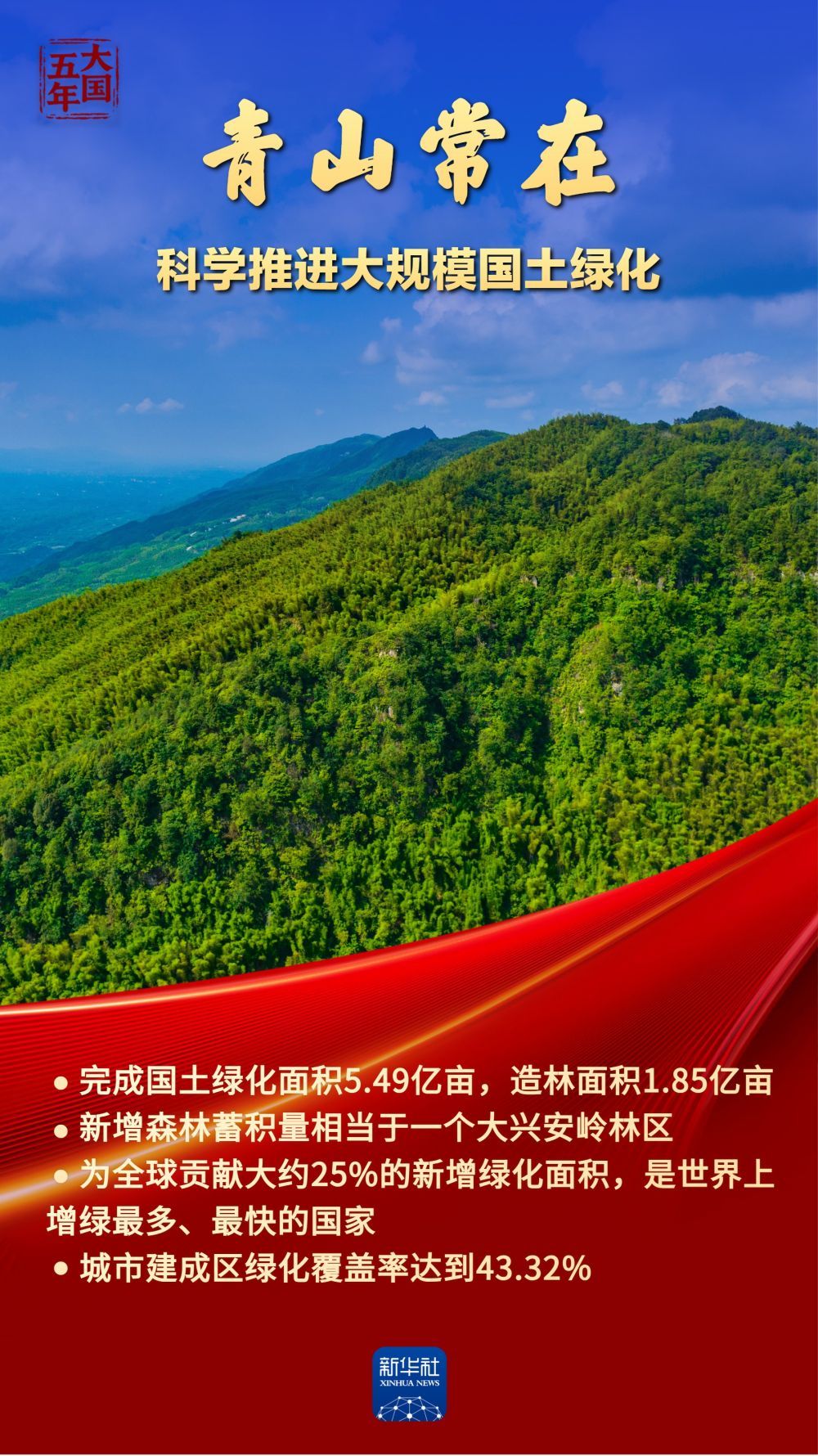
Core Points - China's green development has made significant progress, contributing approximately 25% of the world's new greening area, making it the fastest-growing country in terms of greening efforts [3][12] - The installed capacity of wind and solar energy has historically surpassed that of thermal power, indicating a major shift in energy sources [1][15] - The production and sales of new energy vehicles have maintained the world's highest position for ten consecutive years, promoting low-carbon transportation [1][18] Environmental Achievements - The area of afforestation reached 5.4916 million hectares, with a forest stock volume of 185 million cubic meters, equivalent to the Daxing'anling forest region [3] - Urban green coverage has reached 43.32%, enhancing the ecological environment in cities [3] - The "Blue Sky Defense War" has led to a reduction in PM2.5 concentrations by 18%, 10%, and 20% in the Beijing-Tianjin-Hebei region, Yangtze River Delta, and Fenwei Plain respectively over the past five years [5] Water and Soil Conservation - The completion rate for the remediation of seven major river basins and key bays has reached 90% and 93.3% [6] - The "Mother River Revival Action" has restored flow to several previously disconnected rivers, with an expected addition of 340,000 square kilometers of soil erosion control area by the end of the 14th Five-Year Plan [9][11] - The ecological flow compliance rate for key rivers and lakes has reached 98.6% [11] Renewable Energy Development - By 2024, China's energy consumption per unit of GDP is expected to decrease by 11.6% compared to the end of the 13th Five-Year Plan [15] - China has established the world's largest and fastest-growing renewable energy system, with new energy generation capacity surpassing coal power [15][16] - The number of electric vehicles is projected to reach 31.4 million by 2024, with a significant increase in charging infrastructure [18] Community and Ecological Initiatives - The construction of beautiful China pilot areas has been fully launched, with significant efforts in regions like Beijing-Tianjin-Hebei and the Yangtze River Delta [19] - The ecological satisfaction rate among the public has remained above 90% for four consecutive years, reflecting positive community engagement in environmental initiatives [20] - Over 240,000 acres of abandoned mines have been remediated, and coastal areas have been restored, enhancing marine ecosystems [22]

筑牢北疆万里绿色长城
Jing Ji Ri Bao· 2025-10-27 22:37
Group 1 - The core viewpoint emphasizes the importance of high-quality development in border ethnic areas for the overall strategy of Chinese modernization, highlighting ecological protection and sustainable development [1] - The Baotou region is focusing on integrated ecological protection and management, achieving a historical shift from desertification to greening, and utilizing water resources effectively [1][2] - The agricultural and livestock industry in Baotou has seen significant growth, with the total output value of the agricultural industry chain exceeding 90 billion yuan, and stable grain production at over 5.8 billion jin [2] Group 2 - Promoting national unity and progress is a key focus, with initiatives aimed at strengthening the sense of community among various ethnic groups and improving infrastructure and public services [3] - The region is leveraging its unique resource advantages to develop characteristic industries, aiming to stimulate economic vitality and improve living standards [2][3] - The future development prospects for border ethnic areas are promising, with strategies like the Western Development and East-West cooperation providing new momentum for growth [4]
成都/镜头定格处 雪山映蓉城
Zhong Guo Huan Jing Bao· 2025-10-23 02:33
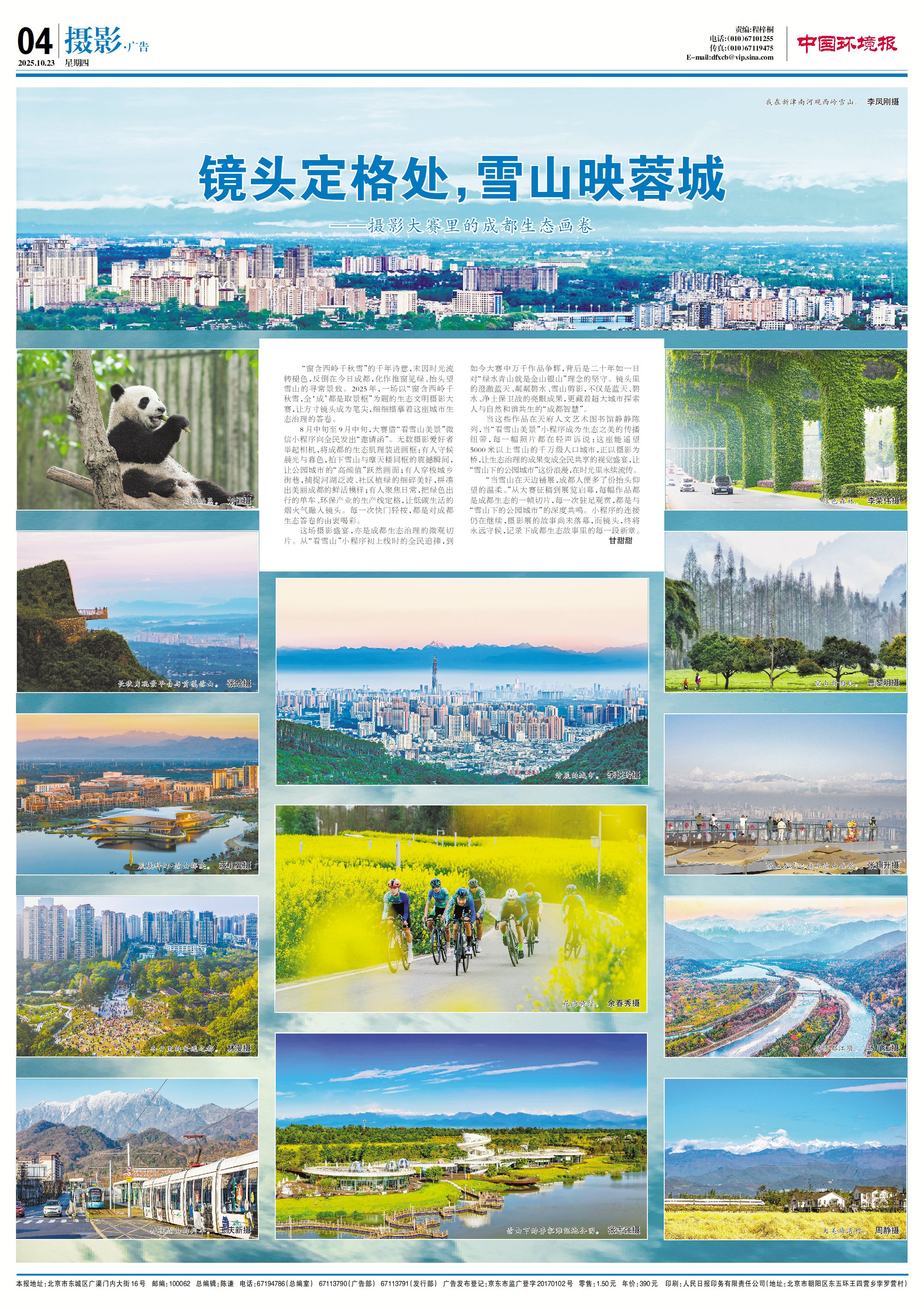
"窗含西岭千秋雪"的千年诗意,未因时光流转褪色,反倒在今日成都,化作推窗见绿、抬头望雪山的寻常景致。2025年,一场以"窗含西岭千秋 雪,全'成'都是取景框"为题的生态文明摄影大赛,让方寸镜头成为笔尖,细细描摹着这座城市生态治理的答卷。 8月中旬至9月中旬,大赛借"看雪山美景"微信小程序向全民发出"邀请函"。无数摄影爱好者举起相机,将成都的生态肌理装进画框:有人守候晨光 与暮色,拍下雪山与摩天楼同框的震撼瞬间,让公园城市的"高颜值"跃然画面;有人穿梭城乡街巷,捕捉河湖泛波、社区植绿的细碎美好,拼凑出 美丽成都的鲜活模样;有人聚焦日常,把绿色出行的单车、环保产业的生产线定格,让低碳生活的烟火气融入镜头。每一次快门轻按,都是对成都 生态答卷的由衷喝彩。 这场摄影盛宴,亦是成都生态治理的微观切片。从"看雪山"小程序初上线时的全民追捧,到如今大赛中万千作品争辉,背后是二十年如一日对绿水 青山就是金山银山理念的坚守。镜头里的澄澈蓝天、粼粼碧水、雪山剪影,不仅是蓝天、碧水、净土保卫战的亮眼成果,更藏着超大城市探索人与 自然和谐共生的"成都智慧"。 当这些作品在天府人文艺术图书馆静静陈列,当"看雪山美景"小程序成为生态之美 ...
深化生态文明体制改革,辽宁答卷这么写
Zhong Guo Huan Jing Bao· 2025-10-21 01:50
Core Viewpoint - The 20th Central Committee's decision emphasizes the need for deepening ecological civilization reforms to promote the construction of a beautiful China, particularly in Liaoning province [1] Group 1: Institutional Foundations - The establishment of a robust institutional framework is essential for advancing ecological civilization reforms in Liaoning, ensuring that regulations act as strict constraints [2] - Implementation of the "Four-level Three-category" land spatial planning system is crucial for optimizing agricultural, ecological, and urban layouts [2] - Strengthening legal protections and local regulations in the ecological environment sector is necessary to support the construction of a beautiful Liaoning [2] Group 2: Governance System - A modern environmental governance system must be established, involving leadership from the Party, government initiatives, corporate responsibility, and public participation [3] - Collaborative mechanisms for pollution control and a focus on major river and lake protection are vital for effective environmental management [3] - A comprehensive ecological safety assurance system should be developed to enhance the management of key ecological areas and improve risk assessment capabilities [3] Group 3: Green and Low-Carbon Development - Green and low-carbon development is identified as a key focus for high-quality growth, necessitating structural adjustments in industries and energy [4] - Strengthening technological support and innovation in clean energy and environmental protection is essential for achieving green transformation [4] - Financial and policy incentives should be implemented to support green and low-carbon initiatives, including the development of green finance mechanisms [4] Group 4: Incentive Mechanisms - Exploring pathways for converting ecological benefits into economic value is crucial, including the establishment of an ecological product value evaluation system [5] - Economic incentive policies should be aligned with agricultural green development to enhance ecological industries in Liaoning [5] - The focus should be on protecting key ecological areas while promoting green agriculture and tourism to create exemplary regions for ecological civilization [5]
“中国绿色创新既造福本国,也惠及世界”(国际人士看中国“十四五”成就)
Ren Min Ri Bao· 2025-10-20 22:01
"十四五"时期,中国生态环境持续改善,美丽中国建设迈出重大步伐,经济社会发展全面绿色转型取得 显著成效。接受本报记者采访的国际人士认为,中国经济社会发展已进入加快绿色化、低碳化的高质量 发展阶段,积极培育和壮大绿色生产力,为全球生态治理和可持续发展贡献了中国方案、中国力量,也 为共建地球生命共同体注入不竭动力。 "展现出'说到做到'的现代化治理能力" 2024年,中国地级及以上城市细颗粒物(PM2.5)浓度比2020年下降16.3%,空气质量优良天数比例比 2020年上升2.4个百分点;地表水优良水质断面比例首次超过90%;全国森林覆盖率比2020年提高约2个 百分点,成为增绿最多最快的国家。人民群众生态环境满意度连续4年超过90%。 10年来,中国推动全球风电和光伏发电成本分别下降超过60%和80%,"十四五"时期出口风电和光伏产 品累计为其他国家减少碳排放约41亿吨。"中国向其他国家提供相关服务和支持,显著提升了清洁能源 技术的可及性、可负担性。"国际能源署署长法提赫·比罗尔表示。 "塞罕坝林场几代人艰苦奋斗,将荒原变成百万亩林海;浙江'千村示范、万村整治'工程造就万千美丽 乡村、造福万千农民群众。中国正 ...
淅川石漠化综合治理案例入选北大县域治理创新优秀案例
Zhong Guo Jing Ji Wang· 2025-10-17 03:03
Core Insights - The article highlights the recognition of Xichuan County's innovative governance model in ecological management, specifically its comprehensive approach to combating stoniness and promoting green development, which has been selected as one of the top 50 innovative governance cases in China [1][2]. Group 1: Governance and Strategy - Xichuan County has implemented the "Ecological County" strategy, focusing on water quality protection and green development, which aligns with the philosophy that "lucid waters and lush mountains are invaluable assets" [2]. - The governance model emphasizes collaboration among government, departments, society, and technology, creating a comprehensive management framework for ecological protection [2]. Group 2: Achievements and Progress - Over the past decade, Xichuan County has completed over 600,000 acres of artificial afforestation, successfully addressing all stoniness issues within the county [2]. - The forest coverage rate around the reservoir has increased from 45.7% at the end of the 12th Five-Year Plan to 61.7%, showcasing significant ecological improvement [2]. Group 3: Future Plans - Xichuan County aims to further advance land greening efforts and integrate comprehensive management of mountains, waters, forests, fields, lakes, grasslands, and deserts to enhance ecological safety [2].
光伏如何爆改沙漠
Jing Ji Ri Bao· 2025-10-15 21:51
Core Viewpoint - The "Photovoltaic + Desertification Control" model in China is gaining global attention as it effectively combines energy production, ecological protection, and agricultural development, transforming deserts into productive lands [1][4]. Group 1: Photovoltaic Technology and Desertification Control - The construction of a 400-kilometer "Photovoltaic Great Wall" in the Kubuqi Desert is a significant initiative aimed at combating desertification while generating energy [1]. - Traditional desertification control methods, such as afforestation, face challenges like high costs, long cycles, and low efficiency, making them less sustainable [1][2]. - The "Photovoltaic +" model offers a revolutionary solution by using solar panels to stabilize sand and generate electricity, creating a self-sustaining economic cycle for ecological restoration [1][3]. Group 2: Economic Benefits and Local Development - The establishment of photovoltaic power stations in desert areas has unexpectedly enhanced local economies, turning desertification control from a loss-making endeavor into a profitable industry [3]. - The income generated from electricity production can be reinvested into ecological projects, fostering a sustainable cycle of "using electricity to support sand control and using sand to generate electricity" [3]. - The cultivation of crops and livestock under photovoltaic panels not only improves local economic conditions but also contributes to soil health and vegetation growth, creating a beneficial cycle of "sand stabilization, grass planting, and livestock raising" [3]. Group 3: Future Implications and Global Relevance - The "Photovoltaic + Desertification Control" model provides valuable insights for sustainable development globally, particularly for regions facing both desertification and energy shortages [4]. - This approach demonstrates that with innovative thinking and systematic planning, barren lands can be transformed into productive areas, contributing to both ecological and economic goals [4]. - Future integration of this model with technologies like hydrogen production and energy storage could further enhance its impact, positioning deserts as potential "energy oases" [4].
读懂中国·阿克苏的甜蜜故事|三代坚守,柯柯牙如何让荒漠变“金山”?
Zhong Guo Xin Wen Wang· 2025-10-15 08:26
Core Viewpoint - The article highlights the transformation of the Keke Ya region from a desert to a green oasis through decades of dedicated efforts by local communities, emphasizing the importance of environmental restoration and sustainable development in the region [1][3][12]. Group 1: Historical Context and Development - The Keke Ya desert greening project began in 1986, addressing a critical survival crisis as the desert was encroaching just 6 kilometers from the city at a rate of 5 meters per year [5]. - The first head of the Keke Ya Three North Shelter Forest Management Station, Imam Maimaiti, faced significant challenges, including soil salinity levels reaching 9.87%, far exceeding the 1% threshold required for afforestation [5]. - By 1987, the survival rate of tree seedlings improved significantly, with spring rates at 87.5% for 2,000 acres and autumn rates reaching 98% for 1,200 acres [5]. Group 2: Economic and Ecological Impact - The Keke Ya greening initiative has led to the establishment of 450,000 acres of specialty fruit bases around the Tarim Basin, with varieties like thin-skinned walnuts and sugar heart apples becoming local economic staples [8][11]. - The region's fruit production is projected to reach 300 million tons by 2025, with a total output value of 20 billion yuan, making the fruit industry a pillar of poverty alleviation and rural revitalization [11]. - The ecological improvements have resulted in increased annual rainfall from 60 mm to 120 mm, a reduction in sandstorm days from over 100 to about 30, and an increase in forest coverage from 3.35% to 9.04% [11]. Group 3: Community and Cultural Significance - The Keke Ya spirit, characterized by self-reliance, unity, hard work, and selfless dedication, has been a driving force behind the community's efforts to transform the landscape [3][6]. - The narrative of three generations of a family involved in the greening efforts symbolizes the collective commitment of the local population to environmental stewardship [1][12]. - The ongoing efforts are now being carried forward by younger generations, ensuring the continuation of the ecological restoration and economic development initiatives [12].
甘肃庆阳:“五个协同”筑牢生态安全屏障
Zhong Guo Huan Jing Bao· 2025-10-13 03:09
Core Viewpoint - The city of Qingyang in Gansu Province is implementing comprehensive ecological protection and governance strategies to combat desertification and improve water and soil conservation, aligning with national ecological initiatives and enhancing its environmental quality [1][2][3][4]. Group 1: Ecological Protection and Governance - Qingyang is focusing on integrated protection and systematic governance of its natural resources, emphasizing the importance of collaboration among various departments and levels of government [1]. - The city has invested 610 million yuan in desertification control, establishing a protected area of 309,000 acres and treating 1.26428 million acres of desertified land, achieving a shift from "sand encroachment" to "green recovery" [1]. - The total area of soil erosion in Qingyang is 23,000 square kilometers, accounting for 86% of the city's land area, prompting extensive soil erosion control measures [2]. Group 2: Water and Soil Conservation - Qingyang has completed soil erosion control over 17,600 square kilometers and has reduced annual sediment discharge into the Yellow River to below 10 million tons, indicating a sustained decrease in soil erosion intensity [2]. - The city is actively monitoring biodiversity and natural ecosystems, employing advanced technologies for wildlife monitoring and enforcing laws against illegal wildlife activities [2]. Group 3: Financial and Policy Support - Qingyang has received 7.687 billion yuan in transfer payments for ecological functions, which have been effectively utilized for environmental pollution control and ecological protection projects [3]. - The local government has implemented a series of actions to strengthen ecological civilization, including the establishment of ecological protection red lines and the promotion of legislative measures for environmental protection [4]. - By 2024, Qingyang aims to achieve stable air quality, with 95.7% of surface water quality meeting standards and a forest coverage rate of 60.63% [4].
【省生态环境厅】陕西黄河治理交出亮眼“成绩单”
Shan Xi Ri Bao· 2025-09-28 22:47
Core Insights - The article highlights the significant improvements in water quality and ecological conditions along the Yellow River in the Shaanxi section, attributed to the province's dedicated ecological governance efforts [1][2] Group 1: Water Quality Improvement - During the "14th Five-Year Plan" period, the overall water quality in the Yellow River basin (Shaanxi section) has gradually improved, exceeding national assessment targets, with three consecutive years of overall water quality rated as excellent and the elimination of inferior V-class sections [1] - In 2024, the proportion of national control sections with good water quality in the Yellow River (Shaanxi section) is expected to reach 93.8%, surpassing the average level of the Yellow River basin by 3.4 percentage points and improving by 12.5 percentage points compared to 2020 [2] Group 2: Sustainable Water Management - The province has achieved stable "clear water entering the Yellow River," with major rivers such as the Yanhe, Wudinghe, Beiluohe, and Jinghe all reaching at least class III water quality in 2024, and the Kuye River achieving class II across all sections [2] - The long-term stability of water quality in the Weihe River, which has maintained class III since 2018, demonstrates the sustainability of the governance results [2] Group 3: Governance and Collaboration - The achievements are attributed to strong legal protections, strict control measures, and extensive regional collaboration, including the implementation of the Yellow River Protection Law and the revision of the Shaanxi Province Weihe Protection Regulations [2] - Shaanxi has established horizontal ecological compensation and law enforcement coordination mechanisms with neighboring provinces such as Shanxi, Inner Mongolia, and Henan to jointly safeguard the Yellow River [2]