
金融理财

Search documents
「早知道」工信部:推动手机等终端设备直连卫星加快推广应用
Zheng Quan Shi Bao· 2025-08-28 00:30
Group 1 - The Ministry of Industry and Information Technology is promoting the direct connection of mobile phones and other terminal devices to satellites for faster application and promotion [1] - Shanghai is actively attracting social capital to participate in the renovation of urban villages and is exploring the issuance of corporate bonds [1] - Guangzhou held a meeting to advance urban renewal and quality improvement initiatives [1] Group 2 - The Ministry of Commerce and Jiangsu Province are supporting qualified innovative biopharmaceutical companies to list on the ChiNext, Science and Technology Innovation Board, and Beijing Stock Exchange [1] - China's first quantum computer manufacturing factory has been established in Nanshan, Shenzhen [1] - Under the trend of "deposit migration," 14 wealth management companies saw a net increase of approximately 1.8 trillion in management scale in July [1] - According to the Passenger Car Association, from August 1 to 24, the retail sales of new energy vehicles in the national passenger car market reached 727,000 units, representing a year-on-year growth of 6% [1]
【早知道】工信部:推动手机等终端设备直连卫星加快推广应用
Zheng Quan Shi Bao Wang· 2025-08-28 00:14
Group 1 - The Ministry of Industry and Information Technology (MIIT) is promoting the direct connection of mobile phones and other terminal devices to satellites to accelerate their application and adoption [1] - Shanghai is actively attracting social capital to participate in the renovation of urban villages and is exploring the issuance of corporate bonds [1] - Guangzhou held a meeting to advance urban renewal and quality improvement initiatives [1] Group 2 - The Ministry of Commerce and Jiangsu Province are supporting qualified innovative biopharmaceutical companies to list on the ChiNext, Science and Technology Innovation Board, and Beijing Stock Exchange [1] - China's first quantum computer manufacturing factory has been established in Nanshan, Shenzhen [1] - In July, 14 wealth management companies experienced a net growth of approximately 1.8 trillion in managed assets amid the trend of "deposit migration" [1] - According to the Passenger Car Association, from August 1 to 24, the retail sales of new energy vehicles in the national passenger car market reached 727,000 units, representing a year-on-year growth of 6% [1]
2025下半年大变局!房产促销潮起,车市价格跳水,货币价值走向成谜!
Sou Hu Cai Jing· 2025-08-26 23:53
Real Estate Market - The real estate market in the second half of 2025 is experiencing significant changes, with a shift from a "buying frenzy" to a more subdued environment, exemplified by promotional tactics such as "85% off for existing homes" and free parking spaces in Shanghai [1][2] - The controversial "shared area" concept is being phased out, with cities like Guangzhou and Hangzhou mandating that new home sales be based on "usable area," allowing consumers to save significantly on property costs [1] - Over 20 cities have made "existing home sales" a mandatory requirement for new land parcels, indicating a decline in the era of selling off-plan properties and addressing consumer concerns about unfinished projects [2] Automotive Market - The automotive market is witnessing intense price competition, with traditional fuel vehicles seeing unprecedented discounts, such as a 14,000 yuan reduction on a German brand's C-class sedan [4] - The penetration rate of new energy vehicles has surpassed 60%, with significant advancements in battery technology and charging infrastructure, leading to improved consumer confidence [4][6] - The cost of owning new energy vehicles is decreasing, with nighttime charging rates as low as 0.45 yuan per kilowatt-hour, resulting in a cost of only 3 yuan per 100 kilometers [6] Consumer Purchasing Power - The Consumer Price Index (CPI) has shown a slight increase of 0.1% in June, but overall prices for daily consumer goods remain stable, with some sectors increasing promotional activities [8] - The decline in housing and vehicle prices is enhancing purchasing power, with mortgage rates dropping to historical lows, allowing consumers to save on monthly payments [9] - The financial market is shifting towards low-risk investment products, with three-year large-denomination time deposits yielding less than 2%, prompting a preference for safer investment options [9]


2024银发人群洞察报告
Sou Hu Cai Jing· 2025-08-14 14:04
Core Insights - The report highlights the development of the silver economy and the increasing importance of elderly care services in response to the aging population in China, with significant policy support from the government [1][9]. Group 1: Policy and Economic Insights - The Central Committee and State Council issued opinions on deepening elderly care service reforms, aiming for a basic elderly care service network by 2029 and a mature system by 2035 [1]. - The recent government document outlines 26 measures to enhance the silver economy, focusing on improving elderly services, expanding product supply, and fostering innovation in elderly care [1][9]. Group 2: Demographic and Digital Engagement - The active user base of the silver population (aged 50 and above) has reached 329 million, showing a year-on-year growth of 1.5% [7][11]. - Short video applications dominate the engagement of the silver population, accounting for 35.1% of their total usage time, which is 5.2% higher than the overall user base [13]. Group 3: Consumption and Technology Trends - There is a notable increase in the penetration rates of digital reading, mobile shopping, and financial management apps among the silver population, with growth rates of 4.6%, 3.0%, and 2.3% respectively [18]. - The preference for mid-to-high-end smartphones (priced above 2000 yuan) is rising among the silver population, indicating a trend towards technology upgrades [7]. Group 4: Industry Engagement and Brand Awareness - The silver population shows significant engagement in mobile banking, with major banks like ICBC and CCB leading in active user numbers, reflecting a growing trend in digital financial services [29]. - Brand awareness among the silver population is high for categories such as beauty care and home appliances, with notable interest in brands like Lenovo and Haier [30].

交完五险一金后,年轻人的工资流入「一金一银」
Sou Hu Cai Jing· 2025-07-29 06:12
Core Insights - The article highlights the growing trend among young people towards stable and diversified financial management, moving away from the desire for quick wealth accumulation to a focus on steady growth and risk management [2][3][12]. Group 1: Young Investors' Behavior - A significant portion of young individuals, particularly those born in the 1990s, prioritize financial stability and passive income as essential components of their financial security, with 57% considering passive income sufficient to cover expenses as a core condition for stability [2][12]. - The report indicates that nearly 60% of post-95s view a savings threshold of 100,000 to 500,000 yuan as the baseline for financial security [2][12]. - Young investors are increasingly favoring bond funds and bank wealth management products over traditional savings accounts, reflecting a shift towards more diversified asset allocation [3][12]. Group 2: Financial Strategies and Tools - The article notes that young investors are adopting a multi-faceted approach to financial management, with a focus on bond funds, gold, and bank products, which are seen as essential tools for building a stable financial portfolio [12][16]. - Data from Ant Financial shows that as of November last year, 84% of users holding bond funds on Alipay reported positive returns, indicating a strong performance of these investment vehicles among young investors [12][16]. - The trend towards diversified asset allocation is underscored by the fact that over 40% of young investors hold bond and stock funds, while 30% invest in bank wealth management products, and 20% in gold [16]. Group 3: Personal Stories and Impact - The experiences of individuals like Xiao Ding and Chen Xiaofu illustrate the transformative impact of financial management on personal lives, with both achieving a sense of stability and control over their futures through strategic investments [18][21]. - Xiao Ding, who transitioned from a corporate job to a recognized financial influencer, emphasizes the importance of continuous adjustment and monitoring of her investment portfolio, reflecting a systematic approach to financial planning [18][17]. - Chen Xiaofu's journey from financial uncertainty to achieving a comfortable lifestyle through prudent investments highlights the potential for financial literacy and management to empower individuals, particularly in smaller communities [21][23].
*ST观典: 委托理财管理制度
Zheng Quan Zhi Xing· 2025-07-22 16:16
Core Points - The company establishes a management system for entrusted financial management to enhance fund operation efficiency and control risks while protecting the interests of the company and its shareholders [1][2] Group 1: General Principles - The entrusted financial management refers to the use of idle self-owned funds for short-term, low-risk financial products, primarily focusing on capital-preserving fixed and floating income products, prohibiting investments in non-capital-preserving products [1][2] - The system applies to all companies within the consolidated financial statements of the company, requiring strict adherence to approval authority, decision-making procedures, and information disclosure [1][2] Group 2: Operational Regulations - The company must ensure that entrusted financial management does not affect normal operations and business development, using only idle funds [2][3] - Financial products must be high in safety, good in liquidity, and short-term (not exceeding 12 months), with a focus on capital-preserving products [2][3] - The company is prohibited from using entrusted financial management funds for stock and derivative products, securities investment funds, or investments aimed at securities [2][3] Group 3: Approval Authority - If the entrusted financial management transaction amount exceeds 10% of the latest audited net assets and is over 10 million RMB, it must be approved by the board of directors before investment [3] - For amounts exceeding 50% of the latest audited net assets and over 50 million RMB, it requires both board and shareholder meeting approvals [3] Group 4: Implementation and Management - The finance department is responsible for the specific operations of entrusted financial management, including fund allocation, risk assessment, and monthly reporting [4][5] - A regular reporting mechanism is established for the finance department to report monthly on the status and returns of entrusted financial management [5][6] Group 5: Risk Control and Information Disclosure - The company must select qualified financial institutions with good credit and financial status as trustees, signing written contracts to clarify rights and obligations [6][7] - The company is required to disclose information regarding entrusted financial management, including purpose, type, amount, source of funds, and risk control measures [6][7]
卷走70亿!9人被抓3老板离境,5吨黄金蒸发,上万投资人倾家荡产
Sou Hu Cai Jing· 2025-07-05 05:08
Core Viewpoint - The article discusses a significant financial fraud involving a company called Huashiao Holdings, led by its actual controller Yu Zengyun, who has allegedly orchestrated a scheme that defrauded investors of 7 billion yuan, leaving over 100,000 investors with substantial losses. The company's executives have been arrested, while Yu and two other bosses have fled the country [1][3][30]. Group 1: Company Overview - Huashiao Holdings, under the leadership of Yu Zengyun, was involved in a fraudulent gold investment scheme that promised high returns to investors [5][9]. - The company operated a financial platform called "Qiaohang Tianxia," which presented itself as a legitimate investment opportunity in gold leasing, attracting investors with returns between 5.2% and 7.3% [7][11]. - By mid-2023, Huashiao Holdings managed over 20 billion yuan in funds, but by September 2023, the company abruptly stopped all gold investment payouts, leading to a crisis among investors and employees [20][22]. Group 2: Financial Impact - The financial report for 2024 indicated that the revenue of a related entity, Jiubianli, fell to 1.679 billion yuan, a decrease of 3.77%, with a net loss of 109 million yuan, a staggering drop of 468.03% [1][3]. - The total amount of unpaid funds from the gold leasing business reached over 4 billion yuan, with total unpaid amounts exceeding 7 billion yuan across various financial products [24][26]. - The fraudulent activities have severely impacted the reputation of China Gold, which denied any association with Huashiao Holdings, stating that the contracts were forged [26][29]. Group 3: Legal and Regulatory Developments - Yu Zengyun has been wanted for suspected fundraising fraud since September 2024, leading to a series of investigations and legal actions against the company and its executives [3][34]. - Nine executives from Huashiao Holdings have been detained, while Yu and two others have confirmed their departure from the country [33][34]. - Investigations revealed that investor funds were not used for gold purchases but were instead funneled into numerous shell companies, with significant amounts transferred overseas [26][27].
许家印还钱!
Sou Hu Cai Jing· 2025-07-02 01:42
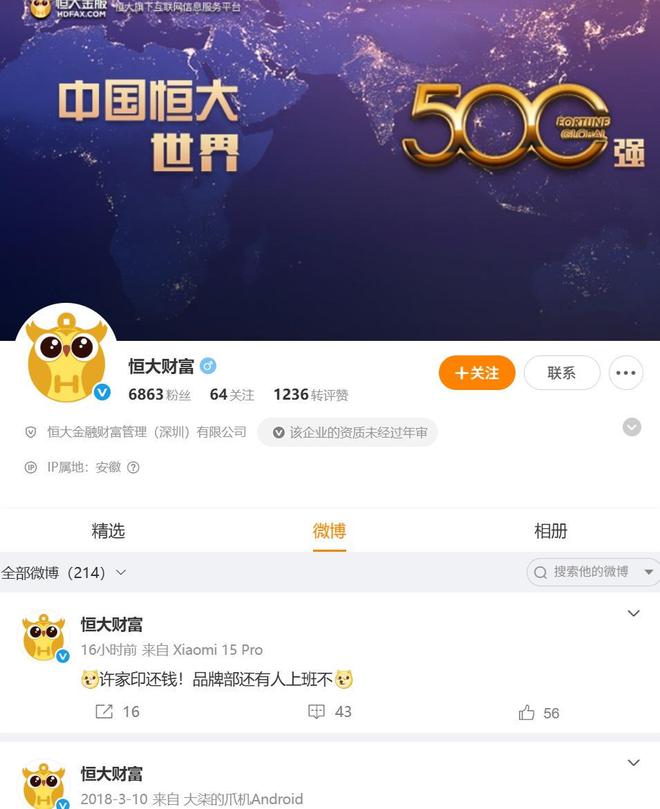
Core Viewpoint - The recent revival of Evergrande Wealth's official Weibo account, after seven years of silence, has sparked significant speculation regarding the current state of the Evergrande Group and its founder Xu Jiayin's financial commitments [2][4]. Group 1: Company Status - Evergrande Wealth in Shenzhen is currently listed as a dishonest executor and has failed its annual review, indicating potential operational restrictions [4][8]. - The last update from the Evergrande Wealth account was in March 2018, highlighting a long period of inactivity before the recent post [2]. Group 2: Financial Commitments - Xu Jiayin had previously promised in September 2021, during the initial payment crisis, that investors would not lose their investments, stating, "I can have nothing, but the investors of Evergrande Wealth cannot have nothing!" [4][6]. - Despite these assurances, over two years later, investors have yet to receive their full returns, raising concerns about the fulfillment of these commitments [6][8]. Group 3: Impact on Stakeholders - The ongoing financial crisis of Evergrande Group not only threatens the company's survival but also affects countless families who invested their life savings into Evergrande Wealth products [8]. - The recent developments reflect severe internal management issues within the Evergrande Group, as indicated by the unusual official communication from a company in such a precarious state [4][8].
恒大财富官微深夜喊话:许家印还钱!
Nan Fang Du Shi Bao· 2025-07-01 07:24
Core Viewpoint - The recent social media post from Evergrande Wealth has raised significant public interest, particularly regarding the company's ability to repay investors amid ongoing financial difficulties [1][2]. Company Background - Evergrande Wealth Shenzhen, established in November 2015, is a wholly-owned subsidiary of Evergrande Financial Holdings Group, with a registered and paid-in capital of 1 billion yuan [3]. - The company has been listed as a dishonest executor and has faced challenges in repaying its financial products since the second half of 2021, coinciding with Evergrande Group's debt issues [3][5]. Payment History and Adjustments - The initial repayment plan announced in September 2021 included a 10% repayment of due products by the end of the month, with subsequent payments every three months [5]. - By December 2021, the company committed to repaying 8,000 yuan monthly to each investor for three months, but the repayment process has not proceeded as planned [5]. - As of May 2023, Evergrande Wealth announced insufficient funds for repayment, and by August 2023, it indicated that asset disposal progress was slower than expected, impacting its ability to repay [5][6]. Legal and Regulatory Actions - In September 2023, law enforcement took action against individuals associated with Evergrande Wealth for suspected criminal activities [6]. - The China Securities Regulatory Commission imposed a fine of 4.175 billion yuan on Evergrande Real Estate for fraudulent bond issuance and information disclosure violations [6]. Recent Developments - In November 2024, Evergrande Wealth warned investors about false information regarding repayment processes and emphasized that updates would come from official police announcements [7]. - Reports indicate that significant debts from the "Evergrande system" are being offered for sale, totaling approximately 11.3 billion yuan across various cities and project types [7][8]. Future Outlook - Analysts suggest that the repayment of Evergrande Wealth's financial products will take time, contingent on the resolution of criminal accountability, asset recovery, and the clarification of debt repayment priorities [8].
华源晨会-20250629
Hua Yuan Zheng Quan· 2025-06-29 14:04
Group 1: Personal Pension System - The personal pension system in China has been fully implemented for six months, showcasing low-risk and stable returns as its core advantages, indicating significant investment potential in a multi-tiered pension system [2][6][8] - By the end of 2024, the total scale of the multi-tiered pension system in China was approximately 18.8 trillion yuan, with a year-on-year growth of 12.77%, and the participation rate in basic pension insurance reached 76.2% [6][7] - As of May 2025, the personal pension product matrix consists of four main categories: savings (45%), funds (29%), insurance (23%), and wealth management (3%), with leading institutions capturing market share through comprehensive product offerings [7][8] Group 2: North Exchange Market Strategy - The North Exchange has transitioned from "out of the circle" to "outstanding," experiencing market fluctuations and continuous policy improvements, with the North 50 index showing a remarkable increase of 36% since the beginning of 2025 [11][12] - Future expectations include ongoing policy support for the North Exchange, continuous supply of high-quality enterprises, and increased capital inflow, with a focus on scarcity investments as the strongest investment theme [12][14] - The merger and acquisition concept remains a hot investment topic in the North Exchange, with significant potential for companies that can leverage acquisitions for business diversification and optimization [25][26] Group 3: Renewable Energy Sector - As of May 2025, the cumulative installed power generation capacity in China reached 3.61 billion kilowatts, a year-on-year increase of 18.8%, with solar and wind power installations hitting record highs [17][18] - The wind power sector saw a significant increase in installed capacity, with 46.3 GW added in the first five months of 2025, representing a year-on-year growth of 134.2% [18][19] - The profitability of wind turbine manufacturers is expected to improve due to the stabilization of bidding prices and the reduction in the proportion of new product deliveries, which had previously pressured profit margins [21][24]