金融服务

Search documents
黄金多头们的福音! 美国1月“小非农”远低于预期 招聘“急刹车”点燃降息预期
Sou Hu Cai Jing· 2026-02-04 14:22
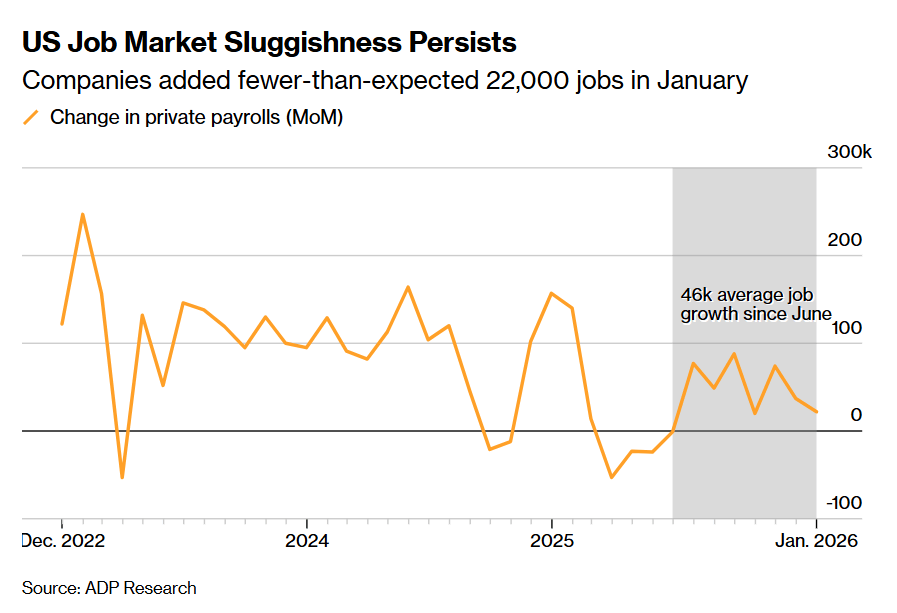
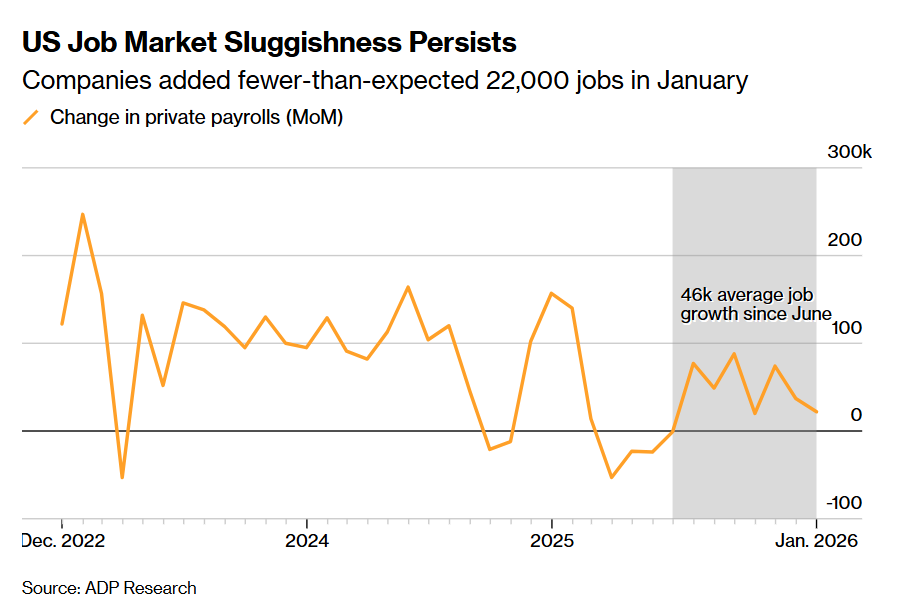
来源:智通财经网 最新的"小非农"数据显示,美国私营企业们1月新增就业岗位远远低于经济学家们普遍预期,表明年初美国劳动力市场继续放 缓。根据ADP研究机构(ADP Research)周三发布的美国私营部门就业数据(该项数据号称"小非农"),在对前一个月数据向下进行 小幅修正后,1月份的美国私营部门就业人数仅仅增加了2.2万人,远远低于4.8万人这一经济学家们多次下调后的预测中值,并 且低于机构调查所覆盖的经济学家们给出的最低增长预期。"小非农"公布之后,"CME美联储观察工具"显示6月与12月降息概率 均有所扩张。 另一方面,对于上周五创下40年来最猛烈跌幅且波动率罕见超越比特币的全球传统避险资产——黄金而言,大幅低于预期的美 国就业数据可谓利多金价。就业市场意外走弱,进而意味着市场更愿意押注降息/更鸽牌的美联储货币政策路径,也即意味着名 义/实际利率下行趋势以及美元走弱趋势,进而推动持有无息资产黄金的机会成本下降,从而利多金价;这一机制在黄金牛市主题 交易中经常出现,即弱就业数据带动降息押注、压低收益率从而推升金价。 由于之前部分联邦政府机构停摆,美国劳工统计局(简称BLS)编制的美国官方非农就业数据被推迟 ...

?黄金多头们的福音! 美国1月“小非农”远低于预期 招聘“急刹车”点燃降息预期
Zhi Tong Cai Jing· 2026-02-04 14:20
(原标题:?黄金多头们的福音! 美国1月"小非农"远低于预期 招聘"急刹车"点燃降息预期) 智通财经APP获悉,最新的"小非农"数据显示,美国私营企业们1月新增就业岗位远远低于经济学家们 普遍预期,表明年初美国劳动力市场继续放缓。根据ADP研究机构(ADP Research)周三发布的美国私营 部门就业数据(该项数据号称"小非农"),在对前一个月数据向下进行小幅修正后,1月份的美国私营部 门就业人数仅仅增加了2.2万人,远远低于4.8万人这一经济学家们多次下调后的预测中值,并且低于机 构调查所覆盖的经济学家们给出的最低增长预期。"小非农"公布之后,"CME美联储观察工具"显示6月 与12月降息概率均有所扩张。 ?另一方面,对于上周五创下40年来最猛烈跌幅且波动率罕见超越比特币的全球传统避险资产——黄金 而言,大幅低于预期的美国就业数据可谓利多金价。就业市场意外走弱,进而意味着市场更愿意押注降 息/更鸽牌的美联储货币政策路径,也即意味着名义/实际利率下行趋势以及美元走弱趋势,进而推动持 有无息资产黄金的机会成本下降,从而利多金价;这一机制在黄金牛市主题交易中经常出现,即弱就业 数据带动降息押注、压低收益率从而推 ...
黄金多头们的福音! 美国1月“小非农”远低于预期 招聘“急刹车”点燃降息预期
智通财经网· 2026-02-04 14:15
智通财经APP获悉,最新的"小非农"数据显示,美国私营企业们1月新增就业岗位远远低于经济学家们普遍预期,表明年初美国 劳动力市场继续放缓。根据ADP研究机构(ADP Research)周三发布的美国私营部门就业数据(该项数据号称"小非农"),在对前一 个月数据向下进行小幅修正后,1月份的美国私营部门就业人数仅仅增加了2.2万人,远远低于4.8万人这一经济学家们多次下调 后的预测中值,并且低于机构调查所覆盖的经济学家们给出的最低增长预期。"小非农"公布之后,"CME美联储观察工具"显示6 月与12月降息概率均有所扩张。 另一方面,对于上周五创下40年来最猛烈跌幅且波动率罕见超越比特币的全球传统避险资产——黄金而言,大幅低于预期的美 国就业数据可谓利多金价。就业市场意外走弱,进而意味着市场更愿意押注降息/更鸽牌的美联储货币政策路径,也即意味着名 义/实际利率下行趋势以及美元走弱趋势,进而推动持有无息资产黄金的机会成本下降,从而利多金价;这一机制在黄金牛市主题 交易中经常出现,即弱就业数据带动降息押注、压低收益率从而推升金价。 由于之前部分联邦政府机构停摆,美国劳工统计局(简称BLS)编制的美国官方非农就业数据被推 ...
黄金巨震、“影子内阁”与“马斯克公式”
经济观察报· 2026-02-04 13:44
Core Viewpoint - The article discusses the simultaneous events in the financial markets, highlighting a revaluation of productivity, cash flow, and credit, as seen through the lens of AI advancements and significant fluctuations in gold prices [1][4]. Group 1: Market Events - On January 30, global financial markets experienced unusual activity, with London spot gold dropping by 9.25% and silver by 26%, indicating a potential revaluation of "rules and trust" in the market [2]. - The volatility in gold prices continued, with a recovery noted on February 4, where gold reached $5079.3 (+2.66%) per ounce, and silver at $90.266 (+6.81%) [3]. - The Chicago Mercantile Exchange (CME) data showed a total trading volume of 447,704 contracts for gold futures on February 2, with open interest decreasing by 10,206 contracts, indicating a dominant trend of "long position deleveraging" [3]. Group 2: Market Dynamics - The article outlines three acts of market dynamics: the "shadow cabinet," rule resetting, and liquidity shock, which together illustrate the complex interplay of market forces [5][8][9]. - The "shadow cabinet" refers to market skepticism regarding the continuation of the "Fed Put," questioning whether the Federal Reserve will provide liquidity in times of economic downturns [6][7]. - The second act, rule resetting, describes how increased margin requirements lead to a chain reaction of forced deleveraging, impacting market volatility and pricing [8]. - The third act, liquidity shock, is characterized by a systematic sell-off triggered by margin calls, which can lead to a strong rebound once the weakest leveraged positions are cleared [9]. Group 3: AI and Economic Revaluation - The article highlights the potential impact of AI on market perceptions of inflation, growth, and dollar credit, suggesting a dual narrative of deflationary pressures from AI efficiency versus inflationary pressures from capital expenditures [10][11]. - The concept of "execution authority descent" indicates that as AI transitions from advisory roles to execution roles, market sensitivity to these changes will increase, leading to a reevaluation of labor's substitutability and long-term inflation paths [11]. - Institutions are increasingly viewing AI as a critical theme for future economic and market developments, with a focus on productivity, commercialization, and application diffusion across various sectors by 2026 [13]. Group 4: Gold as a Pricing Center - The recent fluctuations in gold prices are seen as a transitional phase in pricing power, reflecting a clash between tightening fiscal discipline and expansionary logic driven by AI and energy infrastructure [14]. - The article posits that gold may serve as a "third option" in the market, reflecting uncertainty about whether tightening can support growth or expansion can maintain credit, leading to increased volatility [15]. - Ultimately, the future volatility of gold will depend on the success of credit repair, with gold potentially remaining a contested pricing center amid ongoing economic challenges [15].

超级利空 全线崩盘!黄仁勋驳斥人工智能将取代软件工具的担忧
Zhong Guo Ji Jin Bao· 2026-02-04 13:39
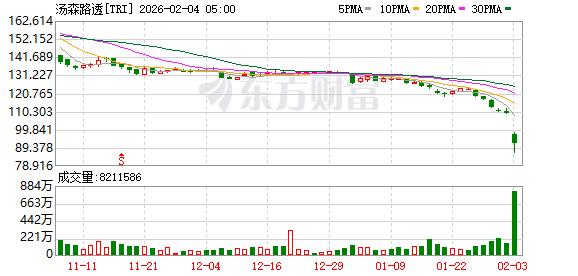
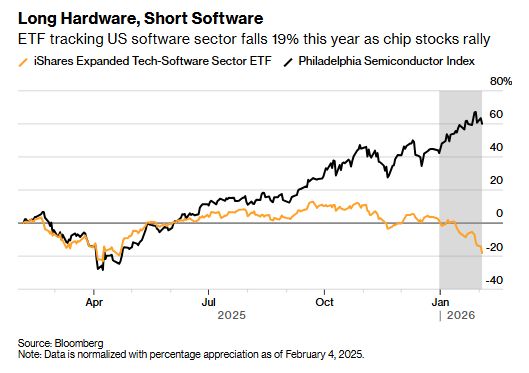
AI开发商Anthropic最新发布的AI法律插件,引发了华尔街的"末日抛售",隔夜美股追踪软件、金融数据和交易所股票的两只标普类股指数市值合计蒸发 约3000亿美元。 对此,英伟达CEO黄仁勋紧急回应了此事。 黄仁勋驳斥了人工智能将取代软件工具的担忧 2月4日,黄仁勋驳斥了"人工智能将取代软件及相关工具"的担忧,称这种想法"毫无逻辑"。 这轮抛售部分源于AI开发商Anthropic上周发布的更新版聊天机器人,引发市场对AI将冲击数据行业与专业服务行业、带来颠覆性影响的恐慌。周三,抛 售进一步扩大,波及印度、日本和A股的软件股。 黄仁勋在思科系统于旧金山举办的一场人工智能大会上表示,担心AI会让软件公司变得不重要是误判。AI将继续依赖现有软件,而不是从零开始重建基 础工具。 黄仁勋说:"有人认为软件行业的工具正在衰退,会被AI取代……这是世界上最不合逻辑的事情,时间会证明一切。" 他还补充道:"如果你是人类或机器人——你会使用工具,还是重新发明工具?答案显然是使用工具……这就是为什么AI最近的突破都在'工具使用'上, 因为这些工具被设计得很明确。" 人工智能新工具引发交易员"末日抛售" 昨日美股,AI公司An ...
海南自贸港跨境投融资日渐活跃
Xin Hua Cai Jing· 2026-02-04 12:33
新华财经海口2月4日电(记者陈碧琪)海南省新闻办公室4日召开新闻发布会,介绍了2025年金融支持 海南省经济社会高质量发展相关情况。近年来,海南省跨境收支规模持续增长,从结构上看,呈现货物 贸易亮点频现、服务贸易较快增长、跨境投融资活跃度较高等特点。 会议预计,2026年海南自贸港涉外收支规模将保持合理增长,海南省投融资活动将更加活跃。 (文章来源:新华财经) 会议介绍,2025年,海南省直接投资收支合计535.5亿美元,同比增长9.6%。海南省跨境投融资活跃主 要体现在三方面:一是对外直接投资增长明显,2025年,全省对外直接投资收支规模45.6亿美元,同比 增长15.2%;二是外国来华直接投资大幅增长,2025年,全省外国来华直接投资95.4亿美元,同比增长 32.5%;三是联属企业之间投资小幅增长,2025年,全省联属企业之间收支规模达394.6亿美元,同比增 长4.6%。 ...
全市前列!两江新区3项案例成“市级创新”!
Xin Lang Cai Jing· 2026-02-04 12:21
Core Viewpoint - Chongqing has announced the results of the 2025 Comprehensive Pilot Innovation Case Selection for the Expansion of the Service Industry, with three cases from the Liangjiang New Area being recognized, highlighting the region's advancements in integrating advanced manufacturing and modern services [2][8]. Group 1: Innovation Cases - The case titled "Industry Brain + Future Factory" has been awarded the "Best Innovation Case," representing a significant example of the integration of advanced manufacturing and modern services in Liangjiang New Area [3][10]. - The "Industry Brain" at the Seres Super Factory connects over 200 data points across eight categories, enhancing enterprise development and linking more than 300 partners, including over 50 core suppliers [3][10]. - The implementation of the "Industry Brain" has led to a 20% increase in productivity for supporting enterprises and a 15% reduction in order delivery cycles, establishing a solid data foundation for efficient industrial collaboration [3][10]. Group 2: Additional Recognized Cases - The "Bonded Declaration Financing Settlement Service Application Scenario Pilot Innovation" and the "Creation of AI Pre-Mediation Model and AI Complaint Mediation System" have been recognized as "Featured Innovation Case" and "Excellent Innovation Case," respectively [3][10]. - These cases focus on the deep integration of advanced manufacturing and service industries, innovations in bonded trade financial services, and intelligent mediation of consumer disputes, showcasing Liangjiang New Area's proactive exploration in technology empowerment and optimizing the business environment [6][13]. Group 3: Regional Development - Chongqing is the first national comprehensive pilot city for the expansion of the service industry in Central and Western China, achieving significant results since the pilot program began in 2021, ranking second among similar pilot provinces and cities [6][13]. - Liangjiang New Area aims to continue focusing on the tasks of expanding the service industry, striving to create more replicable and promotable institutional innovation results and practical cases to contribute to the high-quality development of the city's service industry and the construction of an open economic system [6][13].

“AI替代恐慌”愈演愈烈!全球软件股跌势难止 小摩直言:行业已至“未审先判”境地
Zhi Tong Cai Jing· 2026-02-04 12:17
Core Viewpoint - A market panic triggered by advancements in artificial intelligence (AI) technology is spreading globally, particularly impacting the software sector, with ongoing pessimism among investors [1] Group 1: Market Reaction - On Tuesday, a basket of U.S. software stocks tracked by Goldman Sachs plummeted by 6%, marking the largest single-day drop since April due to tariff-induced sell-offs [5] - The financial services index fell nearly 7%, while the Nasdaq 100 index experienced a maximum intraday drop of 2.4%, ultimately closing down 1.6%, resulting in a total market value loss of approximately $285 billion [5] - The sell-off quickly spread to Asian markets on Wednesday, with European markets continuing to decline, as evidenced by a UBS index of European companies at risk of AI disruption, which fell by 8% on Tuesday and an additional 2.1% on Wednesday [5] Group 2: Investor Sentiment - Morgan Stanley analyst Toby Ogg noted that investor sentiment towards the software sector has shifted from "presumed guilty" to "guilty until proven innocent" [1] - Ogg's discussions with over 50 investors revealed a significant reduction in software stock holdings over the past 12 to 18 months, with a general lack of interest in bottom-fishing despite the recent downturn [1][6] - The current earnings season shows that only 67% of software companies in the S&P 500 exceeded revenue expectations, significantly lower than the overall tech sector's 83% [6] Group 3: Industry Challenges - Ogg stated that for software companies, exceeding earnings expectations is no longer a compelling factor for the market unless they can convincingly demonstrate that AI is a sustainable growth driver rather than a long-term hindrance [6] - The pricing model based on user count is under threat as AI tools may reduce the number of accounts needed for customers to complete tasks, directly impacting revenue [7] - The introduction of new AI products by leading platforms, such as Anthropic's recent legal AI tool, exacerbates investor concerns regarding the software sector [7]

让资产流动起来:多层次REITs市场的法律实践
Xin Lang Cai Jing· 2026-02-04 12:08
Core Insights - The article emphasizes the rapid rise of China's REITs market as a key driver for revitalizing existing assets and enhancing capital allocation efficiency, which is crucial for economic growth [2][25] - It highlights the establishment of a multi-tiered ecosystem in the REITs market, characterized by public REITs setting benchmarks and private REITs nurturing the market [25] Group 1: Institutional REITs - Institutional REITs are described as independent and dynamic "innovation testing grounds," filling the gap in the multi-tiered REITs system and gradually building a unique market ecosystem [4][29] - The governance structure of institutional REITs focuses on asset credit rather than relying solely on the credit of original equity holders, ensuring a more robust framework for asset value [6][30] - Challenges faced by institutional REITs include valuation discrepancies and insufficient secondary market liquidity, which require ongoing ecosystem development [7][30] Group 2: Class REITs - Class REITs are recognized as flexible and adaptable structured tools that have become essential for revitalizing existing assets, with applications expanding across various asset types [8][31] - The legal framework for class REITs emphasizes compliance and verification of asset ownership and operational legality, facilitating the securitization of mature assets and new business models [14][37] - The innovative structure of class REITs aims to deepen the "de-subjectification" practice, connecting assets and capital through legal and financial engineering [15][38] Group 3: Public REITs - Public REITs provide a transparent pricing benchmark through public disclosure and continuous trading, marking significant progress in the financialization of core assets [16][39] - The establishment of a market-based value discovery mechanism through strict compliance checks and governance enhances the overall efficiency of resource allocation in the REITs ecosystem [18][41] - The evolution of public REITs reflects a broader financial revolution in China's REITs market, transitioning from individual ownership to public pricing, thereby unlocking the potential of dormant assets [21][44]