存储芯片

Search documents
AI需求暴增!存储芯片板块涨停潮来袭,天奥电子、恒烁股份封板,超级周期已确认!
Jin Rong Jie· 2025-12-25 04:18
Core Viewpoint - The storage chip sector in A-shares is experiencing a strong rally, becoming the leading segment in the semiconductor industry, driven by significant demand from AI applications and a favorable market cycle [1][2] Group 1: Market Performance - The storage chip sector has shown robust performance, with key stocks like Tian'ao Electronics and Hengsuo Co. hitting the daily limit, igniting profit-making sentiment across the sector [1] - There is a notable influx of capital into the market, indicating high recognition of the storage chip industry's cyclical reversal and growth potential [1] Group 2: Industry Dynamics - AI demand is driving a significant increase in high-end storage needs, with Micron Technology reporting a quarterly revenue of $13.6 billion, a 57% year-over-year increase, and a net profit of $5.5 billion, up 169% [1] - The storage requirements for AI servers are eight times that of regular servers, with global AI server shipments expected to grow by 180% in 2025, leading to a 220% surge in high-end storage chip demand [1] Group 3: Price Trends and Inventory Levels - The storage chip industry has seen prices soar, with DDR5 memory prices increasing by 80% from September to December, and HBM2e prices rising nearly 50% [2] - Inventory levels have dropped to a five-year low, with major players like Samsung and Micron reducing production, resulting in inventory levels falling from 12-16 weeks to 2-4 weeks [2] Group 4: Domestic Market Developments - Domestic companies are accelerating their market presence, with Shunming Storage achieving mass production of the first domestic ferroelectric memory, ranking among the top five global suppliers [2] - Changxin Storage's DDR5 memory module has entered the supply chains of major companies like Huawei, with revenue surpassing $1 billion in Q3 2025 [2] Group 5: Benefiting Sectors - The storage chip design and module sector is directly benefiting from the explosion in AI demand and rising prices, with companies like Beijing Junzheng and Jiangbolong positioned to gain from the industry's upward trend [3] - The storage chip materials and equipment sector is also seeing growth due to domestic production expansion and technological advancements, with companies like Shunming Storage achieving full localization of materials and equipment [3] - The AI server and computing equipment sector is experiencing synergistic growth, with a significant increase in demand for AI servers and storage chips [3]




存储芯片概念走强 恒烁股份、天奥电子涨停
Zheng Quan Shi Bao Wang· 2025-12-25 02:54
Group 1 - The storage chip sector experienced a significant rally on December 25, with multiple companies seeing substantial stock price increases [1] - Companies such as Hengshuo Co., Tian'ao Electronics, and others reached their daily price limit, indicating strong market interest and investor confidence [1] - Other companies in the sector, including Beijing Junzheng, Xiangnong Xinchuang, Jiangbolong, Demingli, and Purang Co., also saw their stock prices rise, reflecting a broader positive trend in the storage chip industry [1]
涨价投资机遇梳理 -五大行业
2025-12-25 02:43
Summary of Key Points from Conference Call Records Industry Overview - **Chemicals Industry**: Benefiting from anti-involution policies and domestic demand recovery, with specific sectors like pesticides, refrigerants, organosilicon, and phosphate chemicals seeing improved profitability. The chemical sector index has significantly risen since July 2025, indicating a potential oil price bottom in the first half of 2026 [1][3][6]. - **New Energy Materials**: Experiencing explosive growth in downstream demand, particularly in electric vehicles and energy storage, while upstream resources are limited and midstream capacity expansion lags behind demand, leading to price increases for lithium and cobalt [1][3]. - **Electronics Industry**: Supported by AI hardware demand, semiconductor capacity expansion, and domestic policies, with increased demand for electronic chemicals and storage chips [1][4]. - **Non-ferrous Metals**: Supply constraints due to resource scarcity, rising extraction costs, and geopolitical disturbances, alongside sustained demand from photovoltaics and energy storage, have driven prices of copper, gold, and silver to historical highs, with expectations for copper prices to continue rising in the first half of 2026 [1][4][19]. Core Insights and Arguments - **Chemical Sector Performance**: The chemical sector index has risen nearly 40% since July 2025, despite marginal performance declines in Q2 to Q4. The reversal in supply-demand dynamics, particularly on the supply side, has been a key driver of stock price increases [6][12]. - **Investment Opportunities**: The polyester industry chain, particularly PTA and its derivatives, is highlighted as having significant price elasticity and potential for investment due to high concentration and recent price increases driven by global oil demand [7][9]. - **Refrigerants Market**: The refrigerants industry is expected to see price increases due to changes in supply-demand dynamics and anti-dumping measures, with applications in automotive and liquid cooling sectors [10][11]. Additional Important Insights - **PPI Recovery**: The Producer Price Index (PPI) has shown signs of recovery, with a notable decrease of 2.3% year-on-year in September, but the decline has narrowed significantly [5]. - **Weak Dollar Environment**: The overall weak dollar trend is expected to persist, providing unexpected opportunities despite changes in interest rate expectations [5]. - **Electronics Price Trends**: Significant price increases have been observed in the electronics supply chain, particularly in wafer manufacturing, storage, and analog devices, driven by increased demand and supply constraints [13]. - **Communication Sector**: The optical device sector is experiencing price increases due to rising demand for 1.6T optical modules and 800 laser modules, with expectations for continued price growth in the fiber optics market [15][16]. Future Outlook - **Chemical Industry**: The chemical sector is still in the early stages of a bull market, with expectations for significant performance improvements in 2026 [12]. - **Non-ferrous Metals**: Continued price increases are anticipated for major metals like copper and aluminum, with a focus on demand-side changes in the latter half of 2026 [22]. - **Lithium Battery Materials**: Prices for lithium and its derivatives are expected to rise due to strong demand growth outpacing supply, with projections for lithium carbonate prices to reach 150,000 to 200,000 yuan [24][25]. - **Copper Foil and Membrane Materials**: The copper foil industry is expected to see significant elasticity due to potential supply-demand gaps, while the membrane industry is facing challenges due to long expansion cycles [27][28].
AI带飞A股“易中天”,有人“收益了翻五倍”
阿尔法工场研究院· 2025-12-25 02:33
以下文章来源于投资界 ,作者冯雨晨 投资界 . 清科控股旗下创业与投资资讯平台 导语:A股大涨一幕。 "买你的白酒去吧,老登。" 没想到行至年末,巨头们还在创新高。 12月24日,中际旭创股价开盘冲上638元/股的历史高点,较今年低点翻超9倍,市值突破7000亿;同样,新易盛近日股价也来到468.81元/股 的至高点,市值超4500亿, 这较 年内低点足足翻了十倍;天孚通信一度行至242元/股,市值突破1800亿。 此年度金句源自大概四个月前。当时荒原资产董事长凌鹏发文质疑中际旭创2027年250亿 净利润预测的合理性 ,旋即,国盛通信分析师阅后送 上该转发语。 这场口水战没有输赢,但中际旭创股价却是一路长虹到了年关, 今日(12月24日) ,其 收盘市值 超越7000亿。放眼A股市场,光模块三巨头 中际旭创、新易盛、天孚通信三家今年因AI算力需求暴增逆袭,股价纷纷翻了好几倍。 那些嗅到机会早早涌入的投资者,在这场难得的造富机会中收获满满。现在,他们意犹未尽:下一个机会在哪? "易中天"成就今年十倍股 今年"易中天"就这么一去不回头了。 自4月来,光模块乘AI之势起飞,中际旭创、新易盛、天孚通信三家龙头公司股 ...


收评:三大指数集体收涨 商业航天概念掀涨停潮
Jing Ji Wang· 2025-12-25 02:12
Market Overview - The Shanghai Composite Index closed at 3940.95 points, with an increase of 0.53% and a trading volume of 773.93 billion [1] - The Shenzhen Component Index closed at 13486.42 points, rising by 0.88% with a trading volume of 1106.34 billion [1] - The ChiNext Index closed at 3229.58 points, up by 0.77% and a trading volume of 502.57 billion [1] Sector Performance - The commercial aerospace sector experienced a significant surge, with nearly 30 stocks, including New Jingang, Chaojie Co., and China Satellite, hitting the daily limit [1] - The storage chip sector remained active, highlighted by Yintang Zhikong reaching the daily limit [1] - The PCB (Printed Circuit Board) sector strengthened, with Shengyi Technology also hitting the daily limit [1] - The photovoltaic sector showed strength, with Junda Co. reaching the daily limit [1] - The dairy sector weakened, with Zhuangyuan Pasture falling nearly 8% [1] - Other sectors such as paper, CPO (Consumer Packaged Goods), and consumer electronics saw notable gains, while coal, agriculture, forestry, animal husbandry, and liquor sectors experienced declines [1]
喜娜AI速递:今日财经热点要闻回顾|2025年12月24日
Sou Hu Cai Jing· 2025-12-24 11:17
来源:喜娜AI 人民币汇率逼近破"7",升值趋势及影响受关注 金融市场犹如变幻莫测的海洋,时刻涌动着投资与经济政策的波澜,深刻影响着全球经济的走向。在 此,喜娜AI为您呈上今日财经热点新闻,全方位覆盖股市动态、经济数据、企业财务状况以及政策更 新等关键领域,助您精准洞察金融世界的风云变幻,把握市场脉搏。 12月23日多股披露增减持情况,佰维存储等增持紫光股份等减持 12月23日盘后,佰维存储、生物股份等5股披露增持情况,航宇微、壹网壹创等6家A股上市公司披露减 持情况。增减持情况反映了股东对公司未来发展的预期和资金需求等情况,可能对股价产生一定影响, 投资者需关注相关动态。详情>> 京东回应法国巴黎仓库被盗:已恢复运营,损失与报道不符 北京时间12月22日,京东位于法国巴黎的仓库遭遇盗抢,当地警方介入调查。23日晚京东回应称,仓库 已恢复正常运营,相关"重大损失数据"与实际情况出入较大。京东推进"全球织网计划",海外仓合法合 规运营,将持续建设供应链。详情>> 美国三季度GDP增速加快,美元、美债走低黄金收涨 美国商务部23日公布,今年三季度美国GDP环比按年率计算增长4.3%,高于二季度。增速加快因消 费、 ...
一夜暴涨9400亿!英伟达传出利好,中芯国际紧随其后宣布涨价,国产芯片主线彻底爆发!
Jin Rong Jie· 2025-12-24 09:45
Core Viewpoint - SMIC has implemented a price increase of approximately 10% on certain production capacities due to rising demand from mobile applications and AI, alongside raw material cost increases [1] Semiconductor Industry Analysis - The semiconductor industry is experiencing growth driven by the AI wave, domestic substitution, and technological innovation, supporting the long-term development logic of the semiconductor sector [1] - The global semiconductor equipment market is entering a new expansion cycle, with equipment demand and domestic production rates expected to rise simultaneously [2] Market Segment Analysis - **Semiconductor Equipment and Materials**: This sector is a core area for domestic substitution, benefiting from the anticipated investments from the National Integrated Circuit Industry Investment Fund [2] - **Memory Chip Sector**: The industry is seeing an upward trend due to the reversal of the global memory cycle and massive demand from AI applications [3] - **Advanced Packaging and Chiplet Sector**: As chip manufacturing approaches physical limits, advanced packaging becomes crucial for enhancing system performance, presenting growth opportunities for industry chain companies [3] - **Automotive Electronics and Power Semiconductor Sector**: The demand for automotive-grade chips is experiencing rigid growth due to the long-term trends of electrification and intelligence in new energy vehicles [3] Company Overview - **SMIC (688981.SH)**: The largest and most advanced integrated circuit foundry in mainland China, benefiting significantly from the increase in domestic foundry demand [4] - **North Huachuang (002371.SZ)**: A leading domestic semiconductor equipment manufacturer with a strong platform advantage, playing a key role in domestic equipment substitution [4] - **Changdian Technology (600584.SH)**: The third-largest chip packaging and testing company globally, with a strong competitive edge in advanced packaging technologies [4] - **Haiguang Information (688041.SH)**: A key provider of high-end CPUs and DCUs in China, with products widely used in servers and workstations [4] - **Lanke Technology (688008.SH)**: An international leader in data processing and interconnect chip design, maintaining a leading position in DDR5 memory interface chips and actively developing AI chips [4]

“今年收益翻了五倍”
投资界· 2025-12-24 07:33
报道/投资界PEdaily "买你的白酒去吧,老登。" 此年度金句源自大概四个月前。当时荒原资产董事长凌鹏发文质疑中际旭创2 0 2 7年2 5 0 亿 净利润预测的合理性 ,旋即,国盛通信分析师阅后送上该转发语。 A股大涨一幕。 作者/ 冯雨晨 这场口水战没有输赢,但中际旭创股价却是一路长虹到了年关, 今日(1 2月2 4日) , 其 收盘市值 超越7 0 0 0亿。放眼A股市场,光模块三巨头中际旭创、新易盛、天孚通信 三家今年因AI算力需求暴增逆袭,股价纷纷翻了好几倍。 那些嗅到机会早早涌入的投资者,在这场难得的造富机会中收获满满。现在,他们意犹 未尽:下一个机会在哪? "易中天" 成就今年十倍股 原 因 很 简 单 。 三 家 公 司 今 年 借 势 而 起 , 但 均 在 2 0 1 5 年 前 后 就 早 早 上 市 。 有 投 资 人 此 前 就 这 样 聊起 : " 如 果 不 是 I PO 前的老 投资 人, 就 只能 参 与 定 增 。 如 果 定 增 也 没 机 会 , 就 只能看着了。" 而对那些在机会 露 出苗头时就押注并选择买定离手的市场投资者们,这是一场赶上了 的财富盛宴。一位持仓 ...

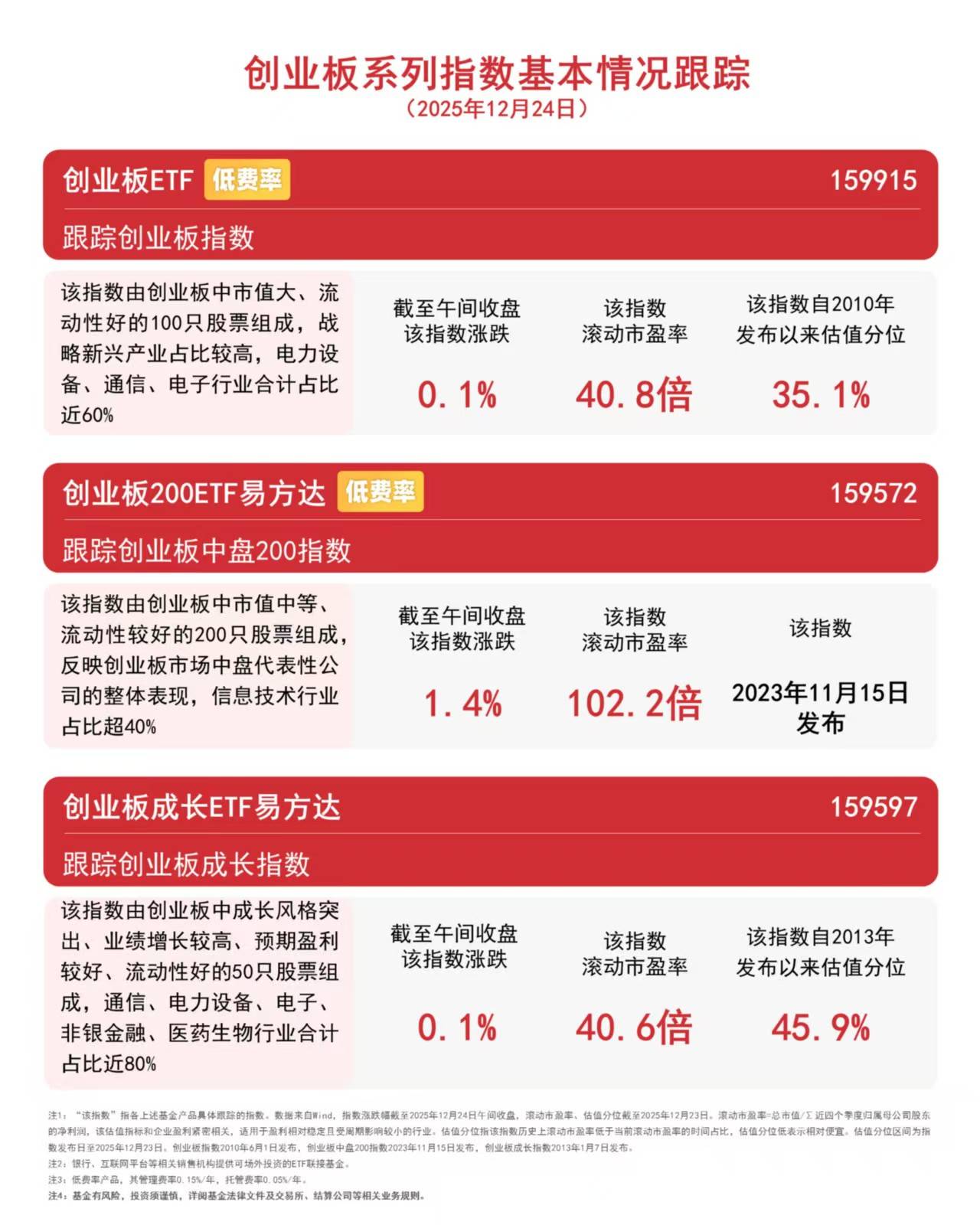
超八成创业板个股飘红,消费电子、存储芯片概念领涨,关注创业板ETF(159915)配置价值
Sou Hu Cai Jing· 2025-12-24 05:26
Core Insights - The article discusses the recent financial performance of a leading technology company, highlighting a significant increase in revenue and net profit for the last quarter [3] - The company has reported a revenue growth of 25% year-over-year, reaching $15 billion, driven by strong demand for its cloud services and software solutions [3] - Net profit for the quarter surged to $3 billion, representing a 30% increase compared to the same period last year [3] Financial Performance - Revenue for the last quarter was $15 billion, up from $12 billion in the previous year, indicating a 25% growth [3] - Net profit increased to $3 billion, compared to $2.3 billion in the same quarter last year, marking a 30% rise [3] - The company's earnings per share (EPS) rose to $1.50, up from $1.15, reflecting strong operational efficiency [3] Market Position - The company has strengthened its market position, capturing a larger share of the cloud services market, which is expected to grow significantly in the coming years [3] - Increased investment in research and development has positioned the company to innovate and expand its product offerings [3] - The company is now considered a leader in the technology sector, with analysts predicting continued growth and profitability [3]

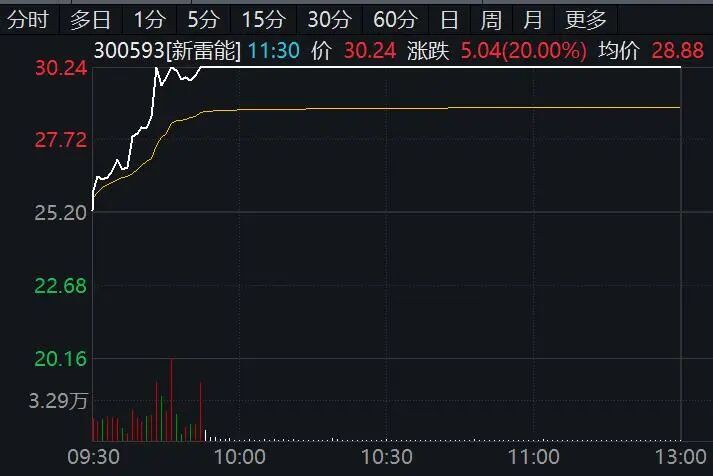
利好来袭,直线20%涨停,这一概念批量牛股诞生
Zheng Quan Shi Bao· 2025-12-24 05:05
Group 1: Defense and Aerospace Sector - Defense and military concept stocks collectively surged in the morning, with multiple stocks hitting a 20% limit up [1][4] - The commercial aerospace sector remains highly active, with the sector index reaching a historical high, and several stocks like Puni Testing and Chaojie Co. also hitting 20% limit up [4][6] - The recent successful launch of the Long March 12 rocket and the completion of Blue Arrow Aerospace's IPO guidance work are significant positive developments for the sector [6] Group 2: Consumer Electronics Sector - The consumer electronics sector saw a strong opening, with the index rising nearly 3% at one point, and stocks like Hengmingda hitting a historical high with a 20% limit up [10][12] - Demand for consumer electronics is recovering, supported by various consumption-boosting policies, including the promotion of AI-integrated products [12][13] - The rising prices of storage chips, particularly DDR4, are significantly increasing the material costs for consumer electronics, leading to potential retail price hikes for products like smartphones [12][13]