生物医药

Search documents
【西安】规上工业总产值首超万亿元
Shan Xi Ri Bao· 2026-02-06 23:27
Group 1 - The core viewpoint of the articles highlights that Xi'an's industrial output value is projected to exceed 1 trillion yuan for the first time in 2025, reaching 1.06 trillion yuan, with a year-on-year growth of 6.9% [1] - Xi'an is focusing on key industries through tailored strategies, including "one chain, one policy" for major industries and "one enterprise, one special team" for key companies, to support industrial growth [1] - The city is concentrating on ten key industrial chains, including aerospace, semiconductors, new materials, and biomedicine, and has developed a three-year action plan to address weaknesses in these chains [1] Group 2 - The six pillar industries in Xi'an, including automotive and electronic information, are expected to achieve an output value of 826.48 billion yuan, growing by 6.1%, which will account for 77.9% of the total industrial output [1] - The ten key industrial chains are projected to generate a manufacturing output value of 740.63 billion yuan, representing 69.8% of the industrial total, becoming the main engine for industrial growth [1] - The photovoltaic, intelligent connected new energy vehicles, and new materials chains are leading in growth rates, with increases of 56.1%, 14.9%, and 14.2% respectively, indicating significant enhancement in industrial competitiveness [1] Group 3 - Xi'an is promoting enterprise growth through layered cultivation, precise positioning in industrial chains, and integration of small and medium-sized enterprises, achieving over 65% coverage of "smart transformation and digital upgrade" among regulated enterprises [2] - By 2025, Xi'an plans to add 260 regulated industrial enterprises, cultivate 442 specialized and innovative enterprises, and establish 36 manufacturing champions, marking a record high in innovation vitality [2] - The city aims to accelerate the transformation of traditional industries towards high-end, intelligent, and green development, while fostering emerging industries such as biomedicine and new materials [2]
“高出1.7岁”背后的含金量
Xin Lang Cai Jing· 2026-02-06 22:00
Group 1 - The core viewpoint of the article highlights that Jiangsu's per capita life expectancy has exceeded 80 years, reaching 80.7 years by 2025, which is 1.7 years higher than the national average, indicating significant underlying value [1] Group 2 - The improvement in medical standards is a key factor, with Jiangsu achieving breakthroughs in high-level hospital construction and maintaining the top service capability of county hospitals for seven consecutive years, establishing a tiered medical service system [1][2] - Economic development provides strong support for health and public services, with a robust economic foundation enabling substantial funding for healthcare, leading to a virtuous cycle of economic growth and health improvement [2] - Social security measures are in place, with basic medical insurance coverage stable at over 95%, and continuous improvements in social welfare standards, ensuring that health benefits are shared among all residents [2] Group 3 - Environmental quality has improved, with better water and air quality contributing to a favorable living environment, while health literacy among residents has increased to 40.1%, promoting healthier lifestyles [3] - Jiangsu's 1.7-year advantage in life expectancy reflects balanced regional development, with equitable access to healthcare resources across urban and rural areas [3] - The article emphasizes that the 1.7-year lead is not an endpoint but a new starting point, as the province faces challenges such as aging population and chronic disease management, necessitating ongoing healthcare reforms and public service optimization [3]
让外籍患者来苏就医更便捷
Xin Hua Ri Bao· 2026-02-06 21:49
Core Viewpoint - The expansion of China's visa-free policy has led to an increase in foreign patients seeking medical treatment in China, particularly in Jiangsu province, highlighting the efficiency, quality, and cost-effectiveness of the Chinese healthcare system [1][2]. Group 1: Medical Efficiency and Cost-Effectiveness - Foreign patients are attracted to China's medical services due to significantly shorter waiting times for procedures, such as MRI scans, which are 25 weeks shorter than in the UK, and cosmetic surgery costs that are 30%-50% lower than in Europe and the US [1]. - The Chinese healthcare system has achieved substantial progress during the 14th Five-Year Plan, as noted by officials, indicating a high level of service efficiency compared to other countries where patients may wait months for surgeries [2][3]. Group 2: Traditional Chinese Medicine (TCM) Appeal - TCM, including acupuncture and herbal medicine, is becoming a key attraction for foreign patients, often referred to as part of the "new three-piece set" of medical services in China [2]. - The World Health Organization's recognition of acupuncture's efficacy supports the growing acceptance of TCM globally, particularly in managing chronic diseases [2]. Group 3: International Medical Services Development - Jiangsu province is enhancing international medical exchanges and building convenient bridges for foreign patients seeking cross-border medical care [3]. - The establishment of international medical departments in high-level public hospitals is encouraged to connect with commercial insurance and broaden revenue channels, which will also stimulate the biopharmaceutical industry and integrate various healthcare-related sectors [3].
中国500强,上海增速第一!
财联社· 2026-02-06 14:58
Core Insights - The total value of the top 500 companies in China increased by 21 trillion yuan (38%), reaching 77 trillion yuan, with an average value growth of 41.5 billion yuan, now at 153 billion yuan [4][5] - The entry threshold for the list rose to 34 billion yuan, an increase of 7.5 billion yuan from the previous year, marking a historical high [4][5] - The technology sector continues to be a growth engine, with significant increases in the number and market value of companies in semiconductor, biomedicine, artificial intelligence, and new energy sectors [4][6] Industry Performance - The semiconductor sector has emerged as a leading industry, surpassing life sciences to become the second-largest sector in the list, with TSMC's value increasing by 3.5 trillion yuan, making it the highest-valued private enterprise in China [6][7][12] - New entrants in the semiconductor industry have become crucial for growth, with 95 new companies on the list, including two new semiconductor firms valued over 100 billion yuan [7][12] - The life sciences sector remains robust, with companies like BeiGene and Hansoh Pharmaceutical showing significant value increases, indicating steady growth despite being overtaken by semiconductors [7][12] Regional Highlights - Shanghai has 57 companies on the list, an increase of 7 from the previous year, making it the city with the fastest growth in the number of listed companies [14][15] - The city is a preferred research and development base, with 101 companies establishing their main R&D facilities there, highlighting its strategic importance in the tech sector [14][15] - Shanghai's companies are primarily concentrated in high-tech sectors such as semiconductors and life sciences, aligning with national trends towards innovation-driven industries [15][16] Emerging Trends - Nearly 40% of this year's listed companies were not on the list four years ago, indicating a dynamic shift in the corporate landscape [6][13] - The focus on hard technology is evident, with a significant number of new companies in AI computing, consumer electronics, and new energy sectors [6][10] - The integration of the Yangtze River Delta region has fostered a collaborative development environment, with 161 companies from this area making it to the list, accounting for 32% of the total [16]



中国三大国际科创中心如何成为全球创新“关键极”?
Xin Lang Cai Jing· 2026-02-06 13:45
Core Insights - The article emphasizes the establishment of three major international technology innovation centers in China: Beijing (Jing-Jin-Ji), Shanghai (Yangtze River Delta), and the Guangdong-Hong Kong-Macau Greater Bay Area, which are seen as strategic choices to enhance China's global competitiveness and foster new productive forces [1][3]. Group 1: Regional Advantages - The Jing-Jin-Ji region, centered in Beijing, boasts the highest quality research resources in China, including top universities and research institutions, and is at the forefront of basic research in fields like artificial intelligence and quantum information [3][5]. - The Yangtze River Delta, leveraging Shanghai's resource aggregation capabilities, has formed a complete industrial system that competes with global leaders in integrated circuits and biomedicine, with Shanghai ranked 10th globally in the GIHI2025 index [5][6]. - The Guangdong-Hong Kong-Macau Greater Bay Area utilizes its unique "one country, two systems" advantage to lead in applications like 5G and new energy, achieving a global ranking of 2nd in innovation hubs [5][6]. Group 2: Global Innovation Dynamics - The article draws parallels with international innovation centers, highlighting that successful models like Silicon Valley and Boston are characterized by deep integration of top research institutions and enterprises, open markets for innovation factors, and a culture that tolerates failure [6][7]. - China's innovation cities are transitioning from "catching up" to "keeping pace" and even "leading" in certain areas, with 21 cities making it to the global top 100, second only to the United States [7][8]. Group 3: Future Development Strategies - To build globally influential innovation centers, China must focus on enhancing original innovation capabilities, improving talent attraction and development mechanisms, and deepening the integration of innovation and industrial chains [8][11]. - The article suggests constructing an open and collaborative innovation ecosystem to enhance global resource allocation capabilities, breaking down regional administrative barriers and fostering cooperation with top global innovation clusters [11].

华大智造:并购补齐技术矩阵,减亏趋势明确,整合兑现可期-20260206
Guolian Minsheng Securities· 2026-02-06 13:30
Investment Rating - The report assigns a "Recommended" rating to the company, indicating an expected price increase of over 15% relative to the benchmark index within the next 12 months [3][11]. Core Insights - The company is undergoing a strategic acquisition to enhance its technology matrix, which is expected to lead to a clear trend of reduced losses and improved operational margins [8]. - The acquisition involves the purchase of 100% equity in two companies for a total consideration of approximately 365.7 million yuan, along with additional capital increases [8]. - The company anticipates a significant narrowing of losses in 2025, with a projected net profit attributable to shareholders ranging from -2.21 billion to -2.73 billion yuan, representing a year-on-year reduction of 54.56% to 63.22% [8]. Financial Forecasts - Revenue projections for the company are as follows: 3,013 million yuan in 2024, 2,716 million yuan in 2025 (a decrease of 9.9%), 3,209 million yuan in 2026 (an increase of 18.2%), and 3,717 million yuan in 2027 (an increase of 15.8%) [2][9]. - The net profit attributable to shareholders is expected to be -601 million yuan in 2024, -242 million yuan in 2025, 21 million yuan in 2026, and 162 million yuan in 2027, with significant growth rates projected in the following years [2][9]. - The report highlights an expected EBITDA growth rate of 85.6% in 2025, 402.3% in 2026, and 230.1% in 2027, indicating strong operational improvements [9].

长春高新:持续提升公司核心竞争力,最终实现高质量稳健发展
Zheng Quan Ri Bao Zhi Sheng· 2026-02-06 13:09
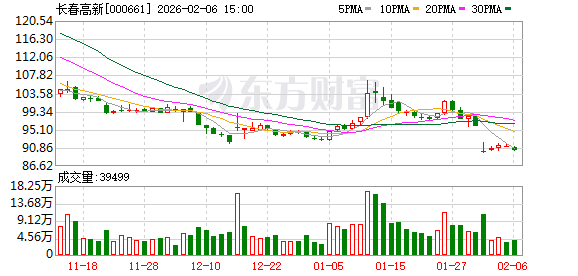
Core Viewpoint - The company is currently experiencing short-term profit impacts due to increased investments in new product development and global expansion, but management remains focused on enhancing core competitiveness through innovation in the biopharmaceutical sector to achieve sustainable high-quality growth [1] Group 1 - The company is investing heavily in new product layouts and global expansion, which is affecting net profit in the short term [1] - Management emphasizes a commitment to focusing on the biopharmaceutical core business and deepening innovation-driven strategies [1] - The goal is to continuously improve the company's core competitiveness for stable and high-quality development in the long run [1]

新力量NewForce总第4960期
First Shanghai Securities· 2026-02-06 12:20
Group 1: New Oriental (EDU) - New Oriental's FY26Q2 net revenue increased by 14.7% year-on-year to $1.191 billion, slightly exceeding the previous guidance of $1.132 to $1.163 billion[9] - Operating profit reached $66.3 million, up 244.4% year-on-year, while Non-GAAP operating profit rose by 206.9% to $89.13 million[9] - The company adjusted its FY26 revenue guidance to between $5.292 billion and $5.49 billion, reflecting a year-on-year growth of 8% to 12%[12] Group 2: Financial Metrics - The target price for New Oriental is set at $78.00, representing a potential upside of 24.3% from the current price of $62.8[6] - The company's EPS for FY26 is projected to be $0.31, an increase of 3% from the previous estimate of $0.30[2] - The net profit margin improved by 0.7 percentage points to 3.8%, while Non-GAAP net profit margin increased by 1.9 percentage points to 6.1%[10] Group 3: Business Performance - New business revenue grew by 21.6% year-on-year, with non-academic tutoring registrations reaching 1.058 million, a 6.4% increase[11] - The number of active paid users for the smart learning system and devices reached 352,000, up 34.8% year-on-year[11] - The company operates 1,379 learning centers and schools, a significant increase from 1,189 in FY25Q2[11] Group 4: Market Outlook - The company expects FY26Q3 net revenue to be between $1.313 billion and $1.349 billion, indicating a year-on-year growth of 11% to 14%[12] - The overall positive performance is attributed to the recovery of new business growth and effective cost management, leading to improved profit margins[10]

百奥赛图:公司引领和带动了靶点人源化小鼠的现货模式
Zheng Quan Ri Bao· 2026-02-06 12:12
Group 1 - The company, BaiAoSaiTu, has led and promoted the on-demand model of humanized mice, catering to the research and development needs of numerous overseas pharmaceutical clients [1] - As a result of this strategy, the proportion of overseas revenue has been increasing year by year [1]
长春高新:公司三费投入均围绕生物医药主业发展、研发创新、市场拓展及合规运营开展
Zheng Quan Ri Bao· 2026-02-06 11:41
Core Viewpoint - Changchun High-tech emphasizes its commitment to balancing operational development and shareholder returns through strict internal control and auditing mechanisms for all expenditures [2] Group 1: Financial Management - The company states that its three major expenses are focused on the development of the biopharmaceutical industry, research and innovation, market expansion, and compliance operations [2] - All expenditures are subject to strict internal control approval, audit supervision, and information disclosure mechanisms [2] Group 2: Shareholder Returns - The company adheres to profit distribution rules while considering the industry's development stage for comprehensive planning [2] - Future efforts will focus on enhancing the precision of expense management and improving capital efficiency [2] - The company aims to balance long-term development of its core business with reasonable returns for shareholders, ensuring the interests of all shareholders are maintained [2]