电网设备

Search documents
政策定调电网高质量发展,电网设备ETF(159326)全市场同类规模最大,多只成分股涨幅超10%
Mei Ri Jing Ji Xin Wen· 2026-01-14 06:31
Core Viewpoint - The A-share market saw a collective rise in its three major indices on January 14, with the electric grid equipment sector experiencing a slight pullback, presenting a potential investment opportunity [1] Group 1: Market Performance - The only electric grid equipment ETF (159326) fell by 1.28% with a trading volume of 1.135 billion yuan as of 14:05 [1] - The leading stock, Hongxiang Co., surged over 15%, while Changlan Technology and Zhongrong Electric both increased by over 10% [1] - The electric grid equipment ETF has seen a net inflow of funds for four consecutive trading days, totaling over 1.1 billion yuan, with the latest scale reaching 5.558 billion yuan, making it the largest power-related ETF in the market [1] Group 2: Policy and Industry Outlook - The National Development and Reform Commission and the National Energy Administration issued guidelines to promote high-quality development of the electric grid, aiming for a "West-to-East Power Transmission" capacity exceeding 420 million kilowatts by 2030 [1] - The guidelines also target an increase in inter-provincial power exchange capacity by approximately 40 million kilowatts, supporting a renewable energy generation share of around 30% and distributed renewable energy capacity of 900 million kilowatts, along with over 40 million charging infrastructure units [1] - Zhongyou Securities suggests that there is currently no definitive technical direction for the consumption of high proportions of renewable energy, advocating for an open attitude towards various technologies [1] Group 3: ETF Composition - The electric grid equipment ETF tracks the CSI Electric Grid Equipment Theme Index, with a strong representation in the sectors of transmission and transformation equipment, grid automation equipment, cable components, communication cables, and distribution equipment [2] - The smart grid accounts for a high weight of 88%, while ultra-high voltage holds a weight of 65%, both being the highest in the market [2]
主力个股资金流出前20:海格通信流出11.97亿元、特变电工流出10.48亿元
Jin Rong Jie· 2026-01-14 04:03
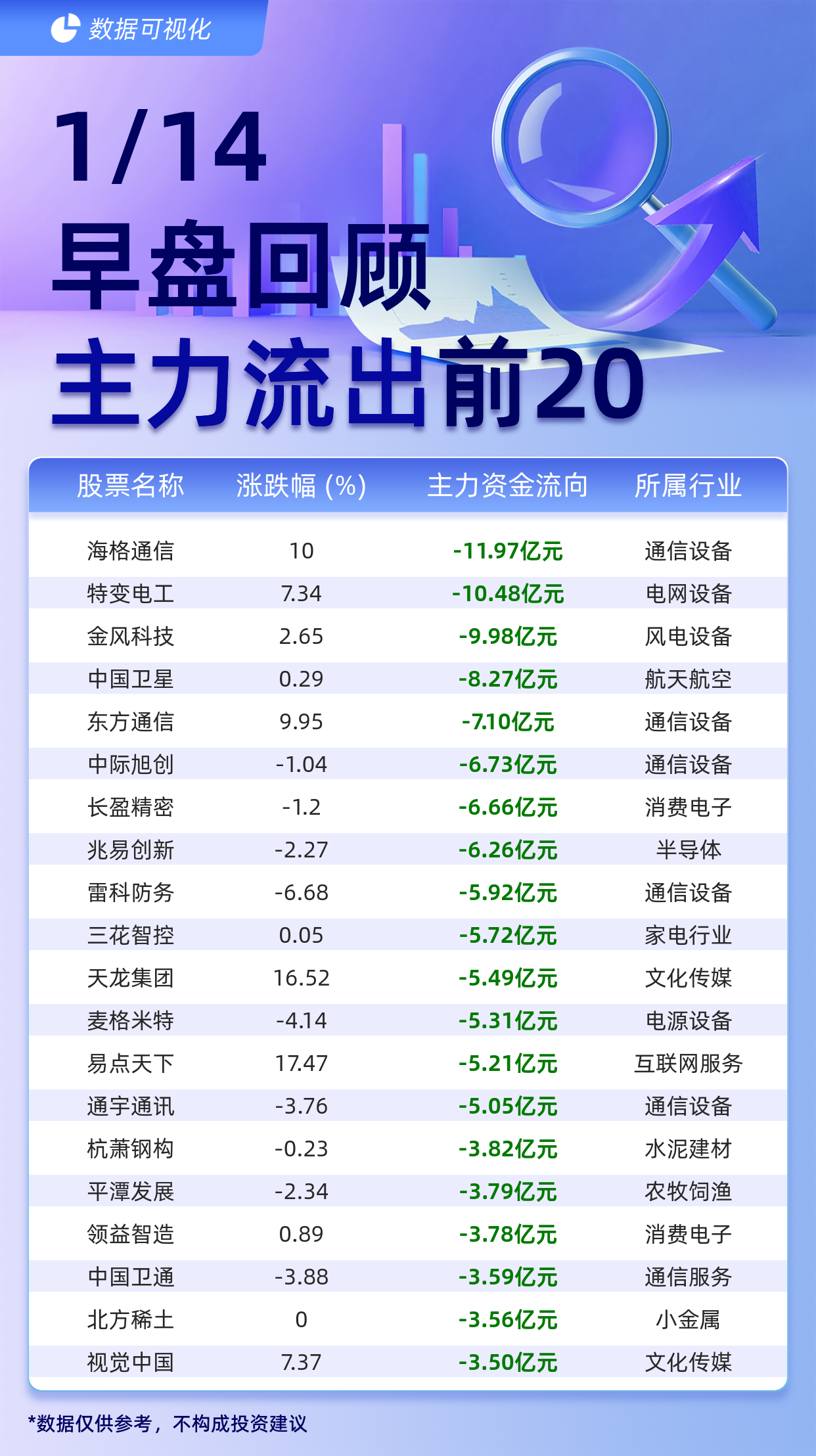
Group 1 - The main stocks with significant capital outflows include Haige Communication (-1.197 billion), TBEA (-1.048 billion), and Goldwind Technology (-0.998 billion) [1][2] - Haige Communication experienced a price increase of 10%, while TBEA and Goldwind Technology saw increases of 7.34% and 2.65% respectively [2][3] - Other notable stocks with capital outflows include China Satellite (-0.827 billion), Oriental Communication (-0.710 billion), and Zhongji Xuchuang (-0.673 billion) [1][2] Group 2 - The sectors represented by the stocks with the largest capital outflows include communication equipment, power grid equipment, and wind power equipment [2][3] - Stocks like Tianlong Group and Yidian Tianxia saw significant price increases of 16.52% and 17.47% respectively, despite experiencing capital outflows of -0.549 billion and -0.521 billion [2][3] - The data indicates a mixed performance across various sectors, with some stocks showing positive price movements while still facing substantial capital outflows [1][2]





光大期货金融期货日报-20260114
Guang Da Qi Huo· 2026-01-14 03:50
1. Report Industry Investment Ratings - Stock Index Futures: Oscillating [1] - Treasury Bond Futures: Relatively Strong [2] 2. Core Views of the Report - The A-share market adjusted with oscillations throughout the day, with the ChiNext Index dropping nearly 2%. AI-related concepts and some sectors like oil and gas and power grid equipment showed strength, while the commercial spaceflight concept declined. The trading volume reached 3.7 trillion yuan, setting a new record. The rise of the A-share index at the beginning of 2026 was driven by global technological development, the Fed's potential interest rate cuts, and the weakening dollar. The tense global geopolitical situation led to a short-term surge in rare metals. With the index at a high level and heavy trading volume, caution is advised when chasing high prices, and it is recommended to wait and see [1]. - On Tuesday, treasury bond futures closed with gains in some contracts. The central bank conducted reverse repurchase operations, resulting in a net capital withdrawal. The short-term sufficient liquidity supports the bond market, but factors such as economic stability, rising inflation, and cautiousness towards interest rate cuts pose certain constraints. The bond market is expected to remain in a range-bound oscillation pattern in the short term [2]. 3. Summary by Relevant Catalogs 3.1 Research Views - **Stock Index Futures**: The market adjusted with oscillations, with the ChiNext Index down nearly 2%. AI medical, AI pharmaceutical, AI marketing, oil and gas, and power grid equipment sectors performed well, while the commercial spaceflight concept retreated. The trading volume reached 3.7 trillion yuan, a new record. The index rise at the beginning of 2026 was driven by global technological development, the Fed's potential interest rate cuts, and the weakening dollar. The tense geopolitical situation led to a short - term surge in rare metals. With the index at a high level and heavy trading volume, caution is needed when chasing high prices, and it is advisable to wait and see [1]. - **Treasury Bond Futures**: On Tuesday, the 30 - year, 10 - year, and 5 - year treasury bond futures contracts closed higher, while the 2 - year contract remained stable. The central bank conducted 3586 billion yuan of 7 - day reverse repurchase operations, resulting in a net capital withdrawal of 2576 billion yuan. The short - term sufficient liquidity supports the bond market, but economic stability, rising inflation, and cautiousness towards interest rate cuts pose constraints. The bond market is expected to remain range - bound in the short term [2]. 3.2 Price Changes on the Day - **Stock Index Futures**: On January 13, 2026, IH decreased by 0.08%, IF by 0.32%, IC by 1.28%, and IM by 1.82% compared to the previous day [4]. - **Stock Indexes**: The Shanghai Composite 50 Index decreased by 0.34%, the CSI 300 Index by 0.60%, the CSI 500 Index by 1.28%, and the CSI 1000 Index by 1.84% [4]. - **Treasury Bond Futures**: TS decreased by 0.01%, TF remained unchanged, T increased slightly by 0.00%, and TL increased by 0.13% [4]. 3.3 Market News - The market adjusted with oscillations throughout the day, with the ChiNext Index down nearly 2%. AI - related concepts and some sectors like oil and gas and power grid equipment showed strength, while the commercial spaceflight concept declined. The trading volume reached 3.7 trillion yuan, a new record. The Shanghai Composite Index closed down 0.64%, the Shenzhen Component Index down 1.37%, and the ChiNext Index down 1.96% [5]. - AI medical, AI pharmaceutical, AI marketing, and oil and gas sectors led the gains, while commercial spaceflight, controlled nuclear fusion, quantum technology, and optical communication sectors led the losses [5]. - There were 1520 rising stocks, 74 daily limit stocks, 3547 falling stocks, 56 daily limit down stocks, and 58 stocks with broken daily limits, with a broken - limit rate of 47% [5]. 3.4 Chart Analysis - **Stock Index Futures**: The report presents the historical price trends and basis trends of IH, IF, IC, and IM contracts [7][9][11]. - **Treasury Bond Futures**: The report shows the historical price trends, basis trends, inter - period spread trends, cross - variety spread trends, and capital interest rate trends of treasury bond futures contracts [14][16][19][22]. - **Exchange Rates**: The report displays the historical trends of the central parity rate of the US dollar against the RMB, the euro against the RMB, forward exchange rates, the US dollar index, and exchange rates between major currencies [24][25][26][28][30].
财达证券每日市场观察-20260114
Caida Securities· 2026-01-14 01:49
Market Overview - The market experienced a decline on January 13, with the Shanghai Composite Index falling by 0.64%, the Shenzhen Component Index dropping by 1.37%, and the ChiNext Index decreasing by 1.96% [2] - The total trading volume reached 3.7 trillion yuan, an increase of approximately 60 billion yuan compared to the previous trading day [1] Sector Performance - Most sectors saw declines, with notable exceptions in oil, pharmaceuticals, and non-ferrous metals, while aerospace, electronics, communications, and computers faced the largest drops [1] - The aerospace sector's significant adjustment was influenced by multiple companies announcing share reductions, although this adjustment is not seen as severe compared to previous gains [1] Investment Opportunities - Despite the downturn in the aerospace sector, the overall market did not exhibit panic, with over 90 companies experiencing declines of 10% or more, primarily from the aerospace sector [1] - There is potential for short-term investment in other technology sectors, such as innovative pharmaceuticals and AI applications, as recent large-scale business development transactions in domestic innovative pharmaceutical companies indicate a high level of activity in this area [1] Policy Developments - The Ministry of Civil Affairs is working on measures to promote the silver economy, focusing on elderly care services, rehabilitation aids, and age-friendly products, aiming to optimize industry layout and attract social capital [3][5] - The Ministry of Industry and Information Technology has released an action plan for the high-quality development of industrial internet platforms, targeting the establishment of over 450 influential platforms by 2028 [4] Fund Dynamics - The first domestic fund management company has surpassed 1 trillion yuan in ETF assets, marking a significant milestone in the Chinese ETF market [10] - As of January 12, the total trading volume of ETFs reached 465.79 billion yuan, with stock ETFs accounting for 256.06 billion yuan of this total [12]
美国政府批准向中国出口英伟达H200芯片;五部门出手规范网络招聘秩序丨盘前情报
2 1 Shi Ji Jing Ji Bao Dao· 2026-01-14 00:47
Market Overview - On January 13, major indices in China experienced collective adjustments, with the Shenzhen Component Index falling over 1% and the ChiNext Index dropping nearly 2%. The Shanghai Composite Index closed down 0.64%, the Shenzhen Component Index down 1.37%, and the ChiNext Index down 1.96%. The total trading volume in the Shanghai and Shenzhen markets reached 3.65 trillion yuan, an increase of 49.6 billion yuan compared to the previous trading day [1] - In the U.S. stock market, the three major indices also declined on January 13. The Dow Jones Industrial Average fell by 398.21 points to close at 49,191.99, a decrease of 0.80%. The S&P 500 Index dropped by 13.53 points to 6,963.74, down 0.19%, while the Nasdaq Composite Index decreased by 24.03 points to 23,709.87, a decline of 0.10% [1] Sector Performance - In the Chinese market, over 3,700 stocks declined, with the AI application concept sector rising against the trend, seeing over ten constituent stocks hitting the daily limit up. The AI medical concept remained active, while the power grid equipment sector strengthened in the afternoon. The retail sector also showed active performance. Conversely, the commercial aerospace and controllable nuclear fusion sectors experienced significant declines [1] - In the U.S., the performance of major indices reflected a general downward trend, indicating a cautious market sentiment [1] Commodity Prices - International oil prices rose on January 13. The price of light crude oil futures for February delivery on the New York Mercantile Exchange increased by $1.65 to $61.15 per barrel, a rise of 2.77%. The March delivery Brent crude oil futures price rose by $1.60 to $65.47 per barrel, an increase of 2.51% [2] Policy and Regulatory Updates - The Ministry of Commerce of China announced the continuation of anti-dumping duties on imported solar-grade polysilicon from the U.S. and South Korea, effective from January 14, 2026, for a period of five years [2] - The Ministry of Industry and Information Technology issued an action plan for the high-quality development of industrial internet platforms from 2026 to 2028, aiming for significant progress in platform development and resource connectivity by 2028 [3][4] Company-Specific Developments - The approval of NVIDIA to export its H200 AI chips to China is expected to restart shipments to Chinese customers. This decision will be overseen by the U.S. Department of Commerce, which will also impose a fee of approximately 25% on the related transactions [7]




成交额续创新高,主力净流出超千亿
Ge Long Hui· 2026-01-13 21:46
Market Performance - The three major indices collectively rose after a slight increase, with the Shanghai Composite Index down by 0.64%, the Shenzhen Component down by 1.37%, and the ChiNext Index down by 1.96% [1] - Over 3,700 stocks declined in the two markets, with a total trading volume of 3.65 trillion [1] Aerospace and Defense Sector - The aerospace sector opened low and continued to decline, closing down by 6.75%, with over 10 stocks, including Aerospace Huanyu and Guanglian Aviation, hitting the daily limit down or falling over 10% [3] - More than 20 industry sectors, including commercial aerospace, large aircraft, satellite internet, controllable nuclear fusion, military-civilian integration, aircraft carrier concepts, and space station concepts, experienced declines of over 4% [3] AI and Healthcare Sector - The AI application concept rose against the trend, with over 10 stocks, including Gravity Media and Lioo Co., hitting the daily limit up [3] - The AI healthcare concept remained active, with Meiyan Health achieving three consecutive limit ups, and stocks like Hongbo Pharmaceutical and Xin Ganjiang also hitting the daily limit up [3] Market Dynamics - Today's market pullback was anticipated, as the trading volume continued to increase significantly while the main funds were flowing out [3] - Compared to the previous day's trading volume of 3.15 trillion, today's volume increased by 49.6 billion, with a net outflow of main funds reaching 141.165 billion [3]
技术看市:“降龙十八涨”爽约,市场有分歧难以形成合力,回落随时可能结束
Jin Rong Jie· 2026-01-13 16:00
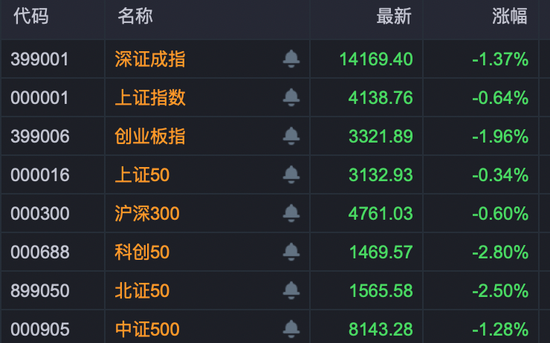
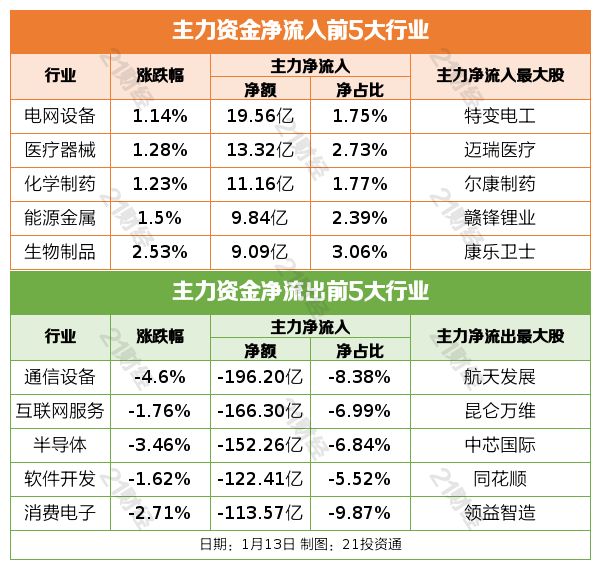
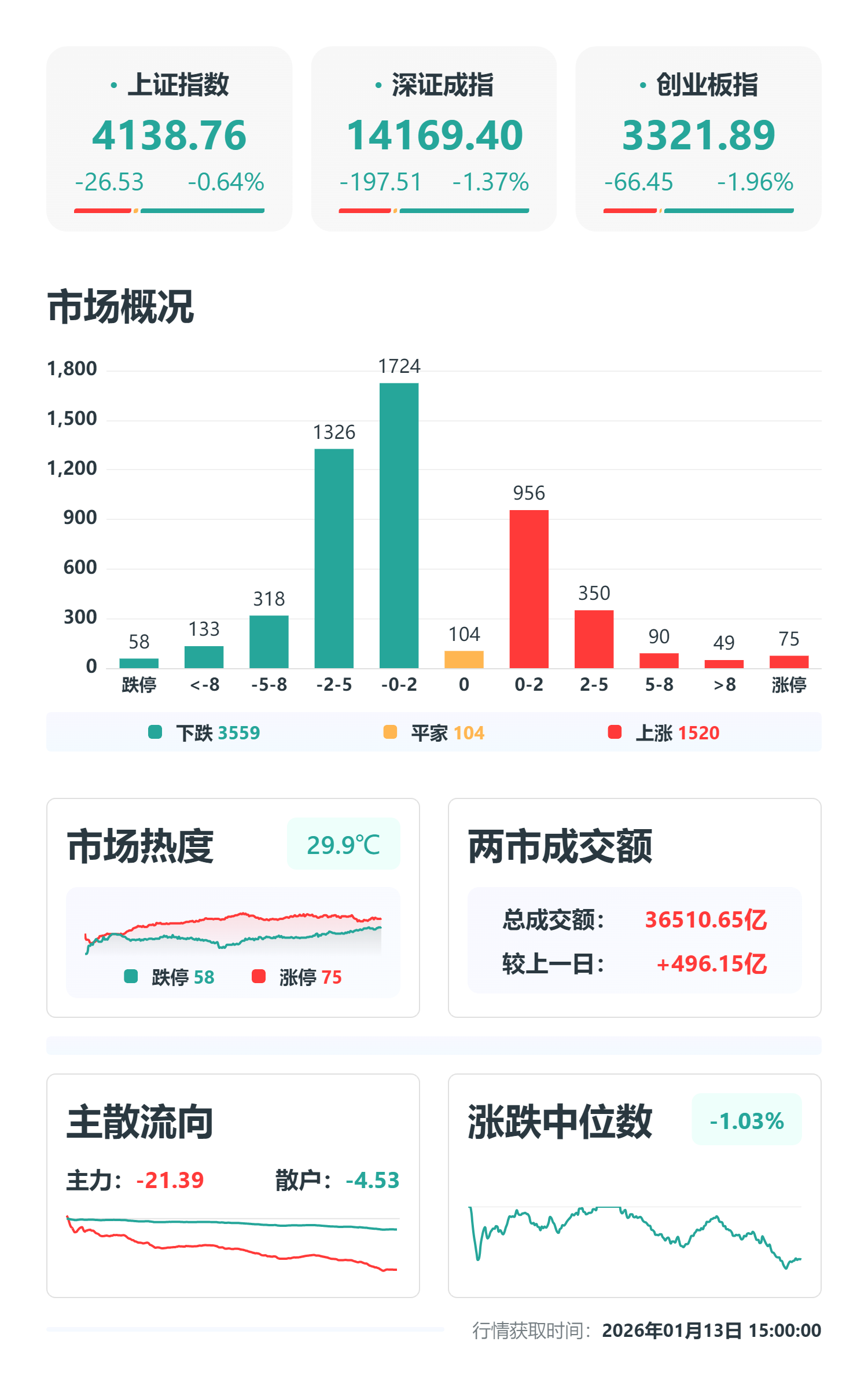
Market Overview - The A-share market experienced a decline with major indices all retreating, including the Shanghai Composite Index down 0.64% to 4138.76 points, Shenzhen Component Index down 1.37%, ChiNext Index down 1.96%, CSI 300 down 0.6%, and STAR 50 down 2.8% [1] - A total of 1520 stocks rose while 3547 stocks fell, with a total trading volume of 3.65 trillion yuan, an increase of approximately 496.18 billion yuan compared to the previous trading day [1] - The net outflow of main capital from the market was 1805.56 billion yuan, with the power grid equipment sector seeing a net inflow of 19.56 billion yuan, while the communication equipment sector experienced a net outflow of 196.20 billion yuan [1] Sector Performance - In terms of themes, sectors such as Ant Group's Afu, MCP concept, recombinant proteins, CRO, and SST concepts saw significant gains, while sectors like space computing, commercial aerospace, large aircraft, space station concepts, and phased array antennas faced substantial declines [2] Market Sentiment - Senior market analyst Xu Xiaoming commented on the market's adjustment, indicating that the Shanghai Composite Index has ended a 17-day winning streak, suggesting a return to rational and normal market behavior [3] - Xu noted that it is difficult to determine the scale of the current pullback, as the market has not established a clear top structure, and the rapid price movements make it challenging to assess the high points [3] - There is a divergence among indices, with the CSI 500 showing strong performance while the ChiNext Index is slowing down, indicating market disagreements that complicate the formation of a unified market direction [3]
最后4分钟,突然拉升
Zhong Guo Zheng Quan Bao· 2026-01-13 12:55
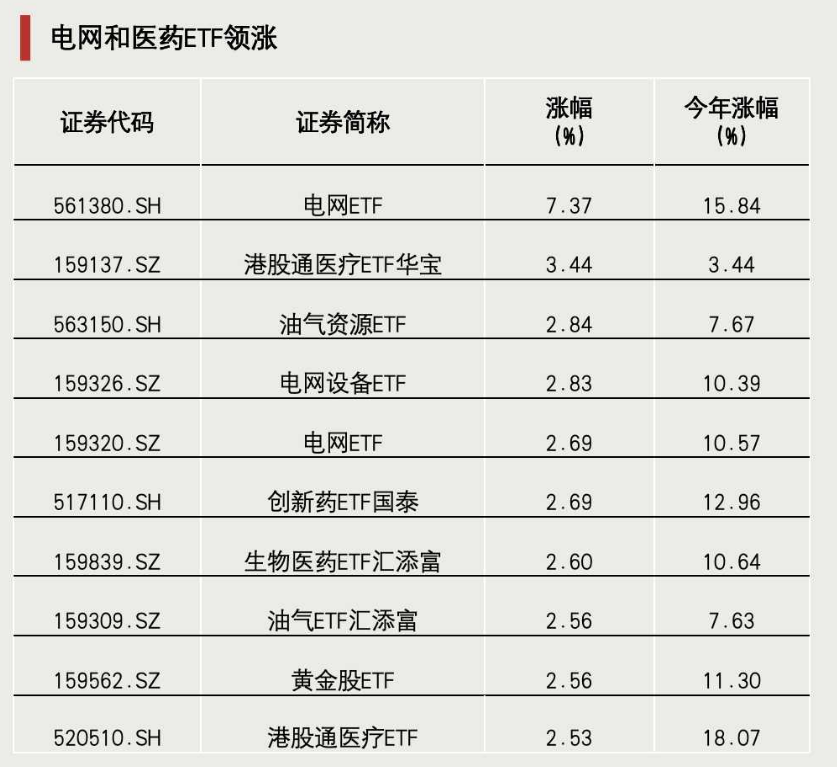
Core Viewpoint - The A-share market experienced a collective pullback on January 13, with the ChiNext index dropping nearly 2%, while over 900 out of 1300 ETFs fell. However, ETFs focused on defensive sectors like electric power, pharmaceuticals, oil and gas, and gold saw gains, with several products rising over 2% [1][3]. ETF Market Performance - The overall net inflow in the ETF market was approximately 1.16 billion yuan on January 12, a significant decrease from about 16.4 billion yuan on January 9. The media, satellite aerospace, software, non-ferrous metals, and AI sectors attracted substantial net inflows, with the media ETF (512980) leading at 2.32 billion yuan [2][6]. - On January 13, ETFs focused on electric power, oil and gas, and gold sectors showed resilience against the market downturn, with the top 20 gaining ETFs primarily concentrated in these areas. The electric power ETF (561380) surged by 7.37% due to a last-minute rally, while the oil and gas ETFs also performed well, with two tracking the China Securities Oil and Gas Resources Index rising over 2% [3][4]. Sector-Specific Insights - The gold sector ETFs all recorded gains, particularly those linked to the China Securities Hong Kong and Shanghai Gold Industry Stock Index, with all six ETFs rising over 2%. In the pharmaceutical sector, ETFs focusing on Hong Kong medical, innovative drugs, and biomedicine showed strong performance, with the Hong Kong medical ETF (159137) rising by 3.44% [4]. - Conversely, several popular sector ETFs, particularly in AI and aerospace, faced significant declines, with many dropping over 8%. The leading AI ETF, Morgan's ChiNext AI ETF, saw a sharp drop of over 11% after a trading halt due to price premiums [5]. Fund Flows and Trends - Seven ETFs attracted over 1 billion yuan in net inflows, primarily in sectors like media, satellite aerospace, software, and non-ferrous metals, as well as one small-cap broad-based index ETF. The media ETF (512980) alone garnered over 2 billion yuan in net inflows on January 12 [6][7]. - Non-equity ETFs, including money market and bond funds, experienced significant net outflows, with some non-equity ETFs seeing outflows exceeding 10 billion yuan since the beginning of the year. Despite the overall upward trend in the equity market, the ETF market faced a net outflow of over 55 billion yuan year-to-date [8]. Industry Developments - 华夏基金 became the first public fund company in China to surpass 1 trillion yuan in ETF management scale, reaching 1,016.42 billion yuan as of January 12. The rapid growth of ETFs in China is notable, with the time taken to reach successive trillion yuan milestones decreasing significantly [10].
最后4分钟,突然拉升!
Zhong Guo Zheng Quan Bao· 2026-01-13 12:47
Market Overview - On January 13, A-shares experienced a collective pullback, with the ChiNext Index dropping nearly 2% and over 900 out of 1300 ETFs declining [1] - Despite the overall market downturn, ETFs focused on defensive sectors such as electric grid, oil and gas, gold, and pharmaceuticals saw gains, with several products rising over 2% [1] ETF Performance - The Electric Grid ETF (561380) led the market with a 7.37% increase, experiencing a significant surge in the last four minutes before closing [2][4] - The AI-focused ETF Morgan (588420), which had performed well previously, saw a sharp decline of over 11% today, marking the largest drop in the market [2][7] Fund Flows - The overall net inflow into the ETF market was approximately 1.157 billion yuan, a significant decrease from the 16.4 billion yuan net inflow on January 9 [3][9] - The Media ETF (512980) attracted the highest net inflow of 2.327 billion yuan, contributing to a total of over 3 billion yuan in net inflows this year [3][10] Sector Analysis - ETFs targeting the electric grid, oil and gas, and gold sectors showed resilience, with all ETFs in these categories posting gains [4][5] - The Medical ETF focusing on Hong Kong stocks and innovative drugs also performed well, with the Hong Kong Medical ETF (159137) rising by 3.44% [5][6] Notable Declines - Several ETFs in the AI and aerospace sectors faced significant declines, with nine out of the top ten ETFs by drop percentage being aerospace-related [7] - The AI ETF Morgan experienced a drastic increase in turnover rate, indicating high trading activity amid its price drop [7] Non-Equity ETF Trends - Non-equity ETFs, including money market and bond funds, faced substantial net outflows, with some experiencing over 10 billion yuan in outflows this year [11][12] Industry Insights - The aviation sector is viewed as having significant long-term growth potential, supported by policy backing and industry acceleration [13] - The semiconductor sector is experiencing short-term volatility but is expected to maintain a positive long-term outlook due to strong demand and supportive policies [13] ETF Market Milestone - Huaxia Fund became the first public fund company in China to have an ETF management scale surpassing 1 trillion yuan, reaching 1.016424 trillion yuan as of January 12 [14]
A股风向变了?商业航天股退潮,电网设备股尾盘异动拉升!
Xin Lang Cai Jing· 2026-01-13 11:44
Market Overview - The A-share market experienced fluctuations with the Shanghai Composite Index down by 0.64% to 4138.76, the Shenzhen Component Index down by 1.37% to 14169.40, and the ChiNext Index down by 1.96% to 3321.89, while the total market turnover reached 3.7 trillion yuan [1][2][8]. Sector Performance - Sectors such as pharmaceuticals, precious metals, electric grid equipment, and oil service engineering showed positive performance, while previously popular sectors like commercial aerospace, controllable nuclear fusion, low-altitude economy, and chips faced declines [2][9]. - The electric grid equipment sector saw a significant rebound, with some stocks like YN Power and Double Jet Electric hitting their daily limit up by 20% and 30% respectively, indicating strong market interest [4][11]. Capital Flow - Major capital inflows were observed in the media sector with over 15.8 billion yuan, pharmaceuticals with over 9.1 billion yuan, and non-ferrous metals with over 5.3 billion yuan. Conversely, the electronics sector faced a net outflow exceeding 36 billion yuan [3][10]. Future Outlook - Analysts from Guangfa Securities suggest that if the spring market rally occurs earlier, it may indicate a favorable economic cycle, with potential adjustments in mid-January providing good investment opportunities [3][10]. - Haitong Securities noted that while the spring market may still have room for growth, the concentration of trading structures could lead to a rotation in market trends, advising investors to focus on high-value sectors with improving external demand [3][10]. Industry Developments - The Ministry of Industry and Information Technology and other departments released guidelines for the construction and application of industrial green microgrids, aiming to enhance green electricity usage in industrial sectors [6][13]. - The global demand for electricity in data centers is projected to increase significantly due to AI applications, with estimates suggesting an additional 325 to 580 TWh by 2028, which will elevate overall electricity demand [6][13]. - Goldman Sachs forecasts that investments in global digital infrastructure and energy systems driven by AI could reach 5 trillion USD over the next decade, with electric grid equipment being a primary beneficiary [6][13]. Transformer Industry Insights - Data from the General Administration of Customs indicates that transformer exports from January to November 2025 reached 57.86 billion yuan, marking a year-on-year increase of 36.3% [14]. - The transformer industry is currently facing significant order backlogs, leading to supply chain bottlenecks and market shortages [14]. Commercial Aerospace Sector - The commercial aerospace sector experienced a sharp decline, with the sector index dropping by 5.01%, and numerous stocks within the sector facing significant losses, including Aerospace Huan Yu and Aerospace Software [6][14][15].