房地产开发

Search documents
马年,盛产首富和科技狂人
吴晓波频道· 2026-02-17 00:29
Core Viewpoint - The article discusses the complex narratives of three prominent Chinese entrepreneurs born in the Year of the Horse, highlighting their distinct paths and contributions to China's industrial upgrade amidst economic transformations. Group 1: Wang Jianlin - Wang Jianlin, once a three-time richest man in China, has faced significant challenges, including asset sales and debt issues, reflecting the broader real estate cycle in China [3][6][7] - He has sold over 85 Wanda Plaza locations and exited various sectors, including sports and film, to manage debt and maintain cash flow [7] - Despite his struggles, Wang demonstrates resilience and strategic asset management to preserve Wanda's credit standing [6][7] Group 2: Zhong Shanshan - Zhong Shanshan, founder of Nongfu Spring, became the richest man in China for the fourth time, with a net worth of 530 billion yuan, setting a new record [8][9] - He faced public scrutiny but actively addressed it through media engagement and product innovation, launching "green bottle" water to capture market share [9][10] - Zhong's wealth is primarily derived from the bottled water business, which benefits from a stable cash flow and high profit margins, contrasting with the volatility of tech sectors [10] Group 3: Wang Chuanfu - Wang Chuanfu, founder of BYD, represents the rise of Chinese electric vehicle manufacturers, with BYD's sales projected to reach approximately 2.26 million units in 2025, a 27.86% increase year-on-year [14] - The shift in perception of BYD from being underestimated to recognized as a strong competitor by global leaders like Elon Musk illustrates the changing dynamics in the EV market [13][14] - Wang's leadership reflects China's ambition to reshape global supply chains and technology leadership in the automotive sector [16] Group 4: Demographic Insights - The article notes that 47.5% of the Horse zodiac billionaires are aged 57, representing a significant portion of the wealth accumulation in sectors like new energy and technology [17] - The younger generation of entrepreneurs, born in 1978, is characterized by their digital-savvy approaches, leveraging the internet and technology for business growth [24] - The article highlights the generational divide, with older entrepreneurs having built wealth in traditional industries, while younger ones thrive in digital and tech-driven markets [24][25]




存款、现金都迎“贬值潮”?央行明确,2026年持有3样东西或不慌
Sou Hu Cai Jing· 2026-02-16 16:40
多家信息源近日警示,居民持有的存款和现金,可能正面临新一轮的购买力缩水。 尽管美国在军事开支上不遗余力,但其作为当今世界首屈一指的强大国家,其金融霸权体系至今仍无可匹敌。全球外汇储备中,美元的占比依 旧高达百分之五十六点九,这使得世界金融市场常常因美联储的一举一动而风起云涌。 我们注意到,2025年广义货币供应量M2预计同比增长8.5%,净增约26.5万亿元。若2026年继续维持此增长速度,全年M2的增量将达到约29万 亿元。如此巨量的资金流入社会,对物价水平的影响将是显而易见的,这也恰恰是我国经济发展的既定目标之一。 自中央经济工作会议确立促进经济稳定增长的基调以来,央行和发改委相继明确将促进物价合理回升作为2026年货币政策的重要考量。因此, 央行在最新的货币政策执行报告中新增"降准降息"的表述,便不足为奇了。 从目前主流机构的观点来看,降息降准的操作窗口期,有望在"两会"结束后开启,为"十五五"规划的开局赢得一个良好的开端。毫无疑问,一 旦降准降息落地,流入社会的资金将进一步增加,物价上涨的目标也将随之实现。与此同时,无论是我们的存款还是现金,其购买力都将不可 避免地下降,面临一场"贬值潮"。 需要强调 ...
新明中国拟按“1供6”基准进行供股 净筹约1.01亿港元
Zhi Tong Cai Jing· 2026-02-16 14:49
Group 1 - The company proposes a rights issue at a subscription price of HKD 0.188 per share, offering 6 rights shares for every 1 share held as of the record date, aiming to raise up to approximately HKD 106 million before expenses through the issuance of up to 564 million rights shares [1] - The rights issue will be conducted on a non-underwritten basis and will only be presented to qualifying shareholders, with any unsubscribed shares being placed with independent subscribers [1] - If fully subscribed, the rights shares will represent 600% of the existing shares and approximately 85.71% of the enlarged share capital post-issue [1] Group 2 - The subscription price represents a discount of about 20.0% compared to the last closing price of HKD 0.235 per share [2] - If fully subscribed, the estimated gross proceeds from the rights issue will be approximately HKD 106 million, with a net amount of about HKD 101 million after expenses [2] - The net proceeds are intended to be used as follows: approximately 96.0% (about HKD 97.4 million) for repaying convertible bonds, bank loans, and other payables; about 1.80% (approximately HKD 1.8 million) for acquiring property development projects in China; and about 2.20% (approximately HKD 2.2 million) for general working capital [2]
房地产的“两端发力”,在动什么真格?
Sou Hu Cai Jing· 2026-02-16 14:48
Core Viewpoint - The article emphasizes that the current actions in the real estate sector are not merely market rescue efforts but rather a structural repair aimed at enhancing the economic cycle [1][3]. Group 1: Supply Side Strategy - The supply side strategy consists of three steps: controlling new supply, reducing inventory, and improving quality of supply. This means focusing on digesting existing stock before expanding new developments and establishing standards for "good housing" [4]. - The new standards for housing include safety, comfort, sustainability, and intelligence, marking a shift from merely selling space to selling quality [4]. Group 2: Demand Side Strategy - The demand side emphasizes a targeted approach to policy adjustments, avoiding broad measures that could lead to excessive liquidity in the market. This includes addressing the intertwined risks of real estate, local government debt, and small financial institutions [4]. - The article highlights the importance of preventing false debt and not allowing the creation of new hidden debts, indicating a dual focus on treatment and prevention of financial issues [4]. Group 3: Economic Context - The article notes that by 2025, domestic demand is expected to contribute over two-thirds to economic growth, with consumption accounting for 52%. However, there is a notable trend of households saving more and spending less, which could tighten consumption and investment [4]. - The external environment remains challenging, with the WTO predicting a mere 0.5% growth in global goods trade by 2026, underscoring the need for China to strengthen its internal capabilities [5].

北投栖澐湾注销预售证,屈晨准备在马年发力了!
Xin Lang Cai Jing· 2026-02-16 14:09
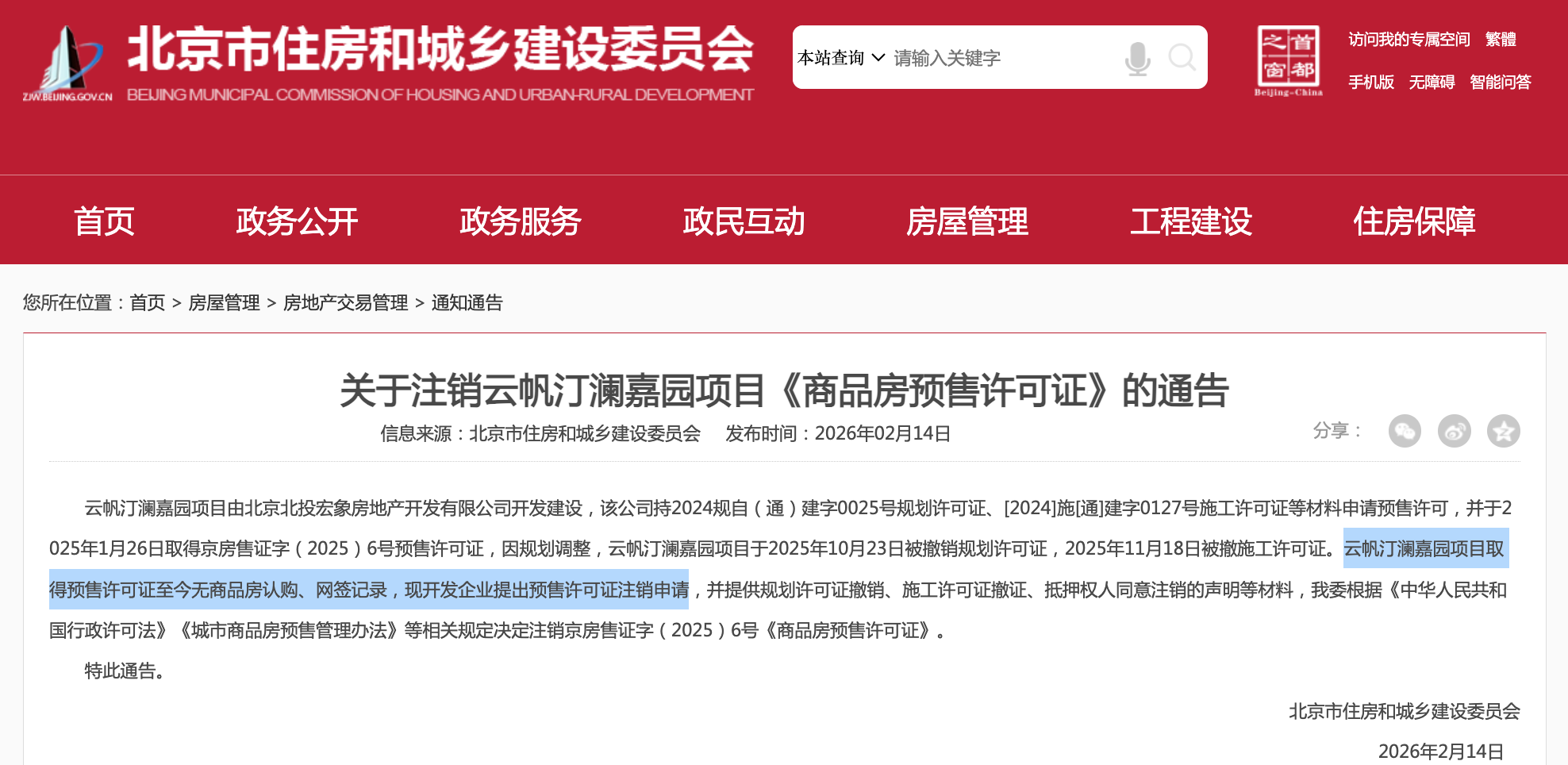
北京进深 徐迪 2月14日,北京住建委通告,注销云帆汀澜嘉园项目《商品房预售许可证》。 通告显示,云帆汀澜嘉园项目由北京北投宏象房地产开发有限公司开发建设,该公司持2024规自(通)建字0025号规划许可证、[2024]施[通]建字0127号施 工许可证等材料申请预售许可,并于2025年1月26日取得京房售证字(2025)6号预售许可证。 因规划调整,云帆汀澜嘉园项目于2025年10月23日被撤销规划许可证,2025年11月18日被撤施工许可证。 云帆汀澜嘉园项目取得预售许可证至今无商品房认购、网签记录,现开发企业提出预售许可证注销申请,并提供规划许可证撤销、施工许可证撤证、抵押权 人同意注销的声明等材料,住建委根据《中华人民共和国行政许可法》《城市商品房预售管理办法》等相关规定决定注销京房售证字(2025)6号《商品房 预售许可证》。 云帆汀澜嘉园项目,即北投置业在通州张家湾的新盘,取得预售许可证时推广案名为"云帆汀澜",去年年底,项目正式更名为"北投栖澐湾"。 今年通州好几个新盘都带了云字,栖澐湾保留了"云"音,又加了所在张家湾的水元素。 更重要的是,与兄弟盘晟景汀澜起码在案名上做了分割,避免同一产品系的 ...
花样年控股:重组协议各方同意将最终截止日期延长至2026年3月31日。
Xin Lang Cai Jing· 2026-02-16 13:42
Group 1 - The core point of the article is that the parties involved in the restructuring agreement of the company have agreed to extend the final deadline to March 31, 2026 [1]
2025总结与展望|土地篇:供地结构持续优化,多城地价创新高
克而瑞地产研究· 2026-02-16 11:32
Core Viewpoint - The land market in China is undergoing a significant adjustment, with a focus on inventory reduction and optimization of land supply structures, leading to a cautious investment environment for real estate companies [2][30]. Group 1: Land Market Performance - In 2025, the total land transaction area in 300 cities decreased by 11% year-on-year, reaching approximately 10 billion square meters, marking the third consecutive year of declining transaction volume [3][4]. - The decline in land transaction area is slightly larger than that of new housing sales, indicating a continuous improvement in the supply-demand relationship within the industry [4]. - The average land transaction price increased, with the average premium rate rising to 5.3%, the highest in four years, driven by the sale of high-quality residential land [20][16]. Group 2: City-Level Analysis - The number of cities with land transaction areas exceeding 10 million square meters decreased by 40%, reflecting a proactive response to control land supply and reduce inventory [11]. - In first-tier cities, land transaction areas fell by an average of 28%, with Guangzhou experiencing the largest decline at 38% [6]. - Second-tier cities saw a significant narrowing of the decline to 2%, while third and fourth-tier cities experienced a 13% decrease in transaction area [9][8]. Group 3: Investment Trends - In 2025, the investment from the top 100 real estate companies showed signs of weak recovery, with total land acquisition value reaching 22,614 billion yuan, a 2% increase year-on-year [24][29]. - Central and state-owned enterprises dominated land acquisitions, accounting for over 50% of the total investment, while private enterprises showed signs of recovery with an 8% increase in land acquisition value [29][27]. - The overall land acquisition-to-sales ratio for the top 100 companies improved to 0.29, indicating a cautious return to investment levels seen in 2021 [27]. Group 4: Future Outlook - The land market is expected to stabilize further in 2026, with a focus on quality land supply and a balanced approach to new project launches [31][32]. - Investment in the real estate sector is likely to remain cautious, with a concentration on core cities and high-quality land, as companies navigate cash flow pressures and uncertain sales [34][35]. - The potential for asset-liability balance restoration in 2026 may provide structural opportunities for companies with strong resources and capabilities [34][35].
炸锅!马年楼市彻底反转,全国涨声四起,当下买房稳抓最后红利
Xin Lang Cai Jing· 2026-02-16 10:55
2026 年马年开年,中国楼市迎来四年调整后的标志性转折,"全国涨声四起" 并非空穴来风,而是政策 底、市场底、资金底三重力量共振的必然结果。国家统计局 2 月数据显示,70 个大中城市商品住宅价 格环比降幅全面收窄,一线城市二手住宅降幅收窄 0.4 个百分点,二线、三线城市分别收窄 0.2 个和 0.1 个百分点,止跌回升趋势已明确显现。这一反转背后,是政策、市场、资金的系统性发力。 政策层面实现从 "微调" 到 "强托底" 的质变。与以往 "添油战术" 不同,2026 年作为 "十五五" 开局之 年,中央明确提出 "政策一次性给足",住建部部署 "稳市场、防风险、优供给、促转型" 四大目标,标 志着调控思路转向构建房地产发展新模式。截至 1 月,全国超 60 个城市出台优化政策,金融支持力度 空前:首套房贷利率降至 3.5%-4% 区间,部分城市进入 "2 字头",首付比例最低 15%,公积金贷款额 度大幅提升;税费优惠精准落地,换购住房个税退税延续至 2027 年,不足 2 年住房增值税率从 5% 降 至 3%,一套 500 万房产可省近 10 万元税费,有效激活 "卖旧买新" 链条。供给端更出现突破性 ...
港股16日涨0.52% 收报26705.94点
Xin Hua Wang· 2026-02-16 09:53
Market Performance - The Hang Seng Index rose by 138.82 points, an increase of 0.52%, closing at 26,705.94 points [1] - The Main Board recorded a total turnover of 84.997 billion HKD [1] - The National Enterprises Index increased by 37.61 points, closing at 9,070.32 points, a rise of 0.42% [1] - The Hang Seng Tech Index saw a slight increase of 7.10 points, closing at 5,367.52 points, up by 0.13% [1] Blue-Chip Stocks - Tencent Holdings increased by 0.19%, closing at 533 HKD [1] - Hong Kong Exchanges and Clearing rose by 0.89%, closing at 408.8 HKD [1] - China Mobile saw a rise of 0.26%, closing at 78.4 HKD [1] - HSBC Holdings decreased by 1.11%, closing at 134.2 HKD [1] Local Hong Kong Stocks - Cheung Kong Holdings increased by 0.72%, closing at 47.24 HKD [1] - Sun Hung Kai Properties rose by 0.75%, closing at 134.7 HKD [1] - Henderson Land Development saw an increase of 0.93%, closing at 32.7 HKD [1] Chinese Financial Stocks - Bank of China rose by 0.22%, closing at 4.66 HKD [1] - China Construction Bank increased by 0.63%, closing at 8.01 HKD [1] - Industrial and Commercial Bank of China decreased by 0.16%, closing at 6.4 HKD [1] - Ping An Insurance rose by 0.43%, closing at 70.65 HKD [1] - China Life Insurance saw a significant increase of 1.93%, closing at 33.72 HKD [1] Oil and Petrochemical Stocks - Sinopec increased by 1.3%, closing at 5.44 HKD [1] - PetroChina rose by 1.44%, closing at 9.18 HKD [1] - CNOOC saw a notable increase of 3.71%, closing at 25.14 HKD [1]
2026 年楼市生变!曹德旺发声:普通人买房慎之又慎
Xin Lang Cai Jing· 2026-02-16 08:49
Core Viewpoint - The real estate market in China is undergoing a significant transformation, moving away from the era of guaranteed appreciation to a more cautious and rational investment approach, as highlighted by industry expert Cao Dewang [1][12]. Group 1: Market Trends - The national housing price adjustment has lasted over 40 months, with the number of second-hand homes listed exceeding 8.5 million, indicating a shift from real estate as a wealth generator to a burden for some families [1]. - By 2026, the real estate market is expected to undergo fundamental restructuring, with a warning from Cao Dewang that ordinary people should be cautious when purchasing homes to avoid potential wealth loss [1][4]. - The core contradiction in the housing market is highlighted by the demographic shift, with over 200 million people aged 65 and above and fewer than 10 million newborns, leading to a shrinking home-buying demographic [4][7]. Group 2: Regional Disparities - The past two decades saw a "same rise and fall" pattern in real estate across cities, but this will collapse by 2026, with population and industry becoming the key determinants of property value [4][5]. - Core cities like Shenzhen and Hangzhou continue to attract population inflows, with Shenzhen's net inflow nearing 500,000 in 2025, supporting price resilience in these areas [5]. - In contrast, third and fourth-tier cities are experiencing significant population outflows, with a net loss of 3.12 million in 2025, leading to prolonged inventory cycles and potential price declines of 10% in 2026 [5][6]. Group 3: Demand Structure Changes - The demand for housing is shifting qualitatively, with the proportion of improvement-driven demand rising from 35% in 2020 to an expected 60% in 2026, indicating a preference for larger, quality homes [6][7]. - Older homes in third and fourth-tier cities are becoming "abandoned assets" due to outdated designs and lack of investment value, with many properties remaining unsold even after significant price reductions [6][7]. - The changing demographics and housing preferences, particularly among younger generations who favor "light asset" lifestyles, are contributing to a decline in overall housing demand [7]. Group 4: Rising Holding Costs - The cost of holding properties is expected to rise significantly in 2026, with mortgage payments, property fees, and maintenance costs becoming burdensome for homeowners [8][9]. - For homeowners who purchased at high prices between 2020 and 2021, monthly mortgage payments could consume over 50% of household income, increasing the risk of default [8]. - The average annual operating costs for a 100 square meter property could reach tens of thousands of yuan, exacerbated by a soft rental market where rental income fails to cover expenses [9]. Group 5: Home Buying Guidance - Ordinary buyers are advised to focus on core areas and avoid risky investments, prioritizing properties in first and strong second-tier cities that meet basic living needs and have strong anti-depreciation potential [10][11]. - For those looking to upgrade, 2026 presents an opportunity to sell older properties and invest in quality developments that offer better living conditions and potential for value retention [11]. - Investors are urged to abandon speculative strategies and focus on core areas, with a shift in goals from appreciation to preservation of value, particularly avoiding investments in third and fourth-tier cities [11].