
建筑业

Search documents
肯未能将外国投资转化为工业发展
Shang Wu Bu Wang Zhan· 2025-08-13 17:55
Core Insights - A study by the Kenya Institute for Public Policy Research and Analysis (KIPRRA) indicates that despite billions in foreign direct investment (FDI) flowing into Kenya, these investments are not directed towards critical industrial sectors such as manufacturing, mining, and construction, but rather into service sectors like retail, finance, information and communication technology, and hospitality [1] - The report highlights that even when investments do enter industrial sectors, they often take the form of greenfield projects, which require a long time to yield benefits and frequently do not align with local industrial needs [1] - The study found that in the four key sectors analyzed, both foreign direct investment and domestic direct investment (DDI) have statistically insignificant impacts on industrial output, revealing deep structural issues in Kenya's ability to attract and manage capital investments [1]
天津建发发盈警 预计中期纯利不少于30万元 同比减少不多于1020万元或96.8%
Zhi Tong Cai Jing· 2025-08-13 09:35
董事会认为,上述预期本期间纯利减少乃主要由于(i)本期间天津建筑业发展放缓,导致收入较去年同期 减少约8.2%;及(ii)本期间录得贸易应收款项、租赁应收款项、其他应收款项及合约资产减值亏损,而去 年同期则拨回贸易应收款项、租赁应收款项、其他应收款项及合约资产减值亏损人民币500万元。 天津建发(02515)发布公告,预期集团截至2025年6月30日止六个月纯利不少于人民币30万元,较集团截 至2024年6月30日止六个月纯利约人民币1050万元减少不多于人民币1020万元或96.8%。 ...
天津建发(02515.HK)盈警:预计中期纯利不少于30万元
Ge Long Hui· 2025-08-13 09:30
董事会认为,上述预期本期间纯利减少主要由于(i)本期间天津建筑业发展放缓,导致收入较去年同期减 少约8.2%;及(ii)本期间录得贸易应收款项、租赁应收款项、其他应收款项及合约资产减值亏损,而去 年同期则拨回贸易应收款项、租赁应收款项、其他应收款项及合约资产减值亏损人民币500万元。 格隆汇8月13日丨天津建发(02515.HK)发布公告,截至2025年6月30日止六个月,预期集团本期间纯利不 少于人民币30万元,较集团截至2024年6月30日止六个月("去年同期")纯利约人民币1050万元减少不多 于人民币1020万元或96.8%。 ...
天津建发(02515)发盈警 预计中期纯利不少于30万元 同比减少不多于1020万元或96.8%
智通财经网· 2025-08-13 09:28
董事会认为,上述预期本期间纯利减少乃主要由于(i)本期间天津建筑业发展放缓,导致收入较去年同期 减少约8.2%;及(ii)本期间录得贸易应收款项、租赁应收款项、其他应收款项及合约资产减值亏损,而去 年同期则拨回贸易应收款项、租赁应收款项、其他应收款项及合约资产减值亏损人民币500万元。 智通财经APP讯,天津建发(02515)发布公告,预期集团截至2025年6月30日止六个月纯利不少于人民币 30万元,较集团截至2024年6月30日止六个月纯利约人民币1050万元减少不多于人民币1020万元或 96.8%。 ...
机构:低迷的私人部门招聘或拖累韩国2025年经济增长
Sou Hu Cai Jing· 2025-08-13 02:36
NIG的经济学家Min Joo Kang研报称,韩国低迷的私人部门招聘,尤其是制造业和 建筑业的招聘,可能 会在今年全年拖累整体经济增长。Kang表示,该国7月份经季节性调整的失业率从6月份的2.6%小幅降 至2.5%,但制造业就业人数连续第二个月下降,而建筑业在2025年的过去七个月中有六个月出现就业 人数减少。尽管疲软的国内需求需要韩国央行的政策支持,但该央行可能会将降息推迟到10月份,因为 缺乏当地房产价格正在降温的迹象。 ...
土耳其基建挑战中国,底气在哪里?
虎嗅APP· 2025-08-12 10:31
Core Viewpoint - The article discusses the rise of Turkey as a new "infrastructure powerhouse" competing with China in the global construction market, highlighting Turkey's unique economic model and the role of government in driving infrastructure development [4][5]. Group 1: Turkey's Infrastructure Era - Turkey's infrastructure capabilities have surged, closely linked to the real estate sector becoming a pillar of its economy [6][7]. - Urbanization in Turkey accelerated from 48.1% in 1983 to 65.95% in 2002, leading to a significant number of substandard housing and informal settlements [8][9]. - By the early 21st century, approximately 10 million illegal buildings existed, accounting for 62% of total housing, with around 20 million people living in slums [8][10]. Group 2: Economic Dependency on Infrastructure - Post-2008 financial crisis, Turkey's reliance on infrastructure became institutionalized, shifting from an export-driven economy to one focused on domestic demand through construction [15][19]. - The construction sector became a key driver of economic growth, with GDP growth averaging 4.9% from 2002 to 2014, while the construction industry grew at 6.5% [13][14]. - The construction industry’s share of total employment rose from 5.6% in 2005 to 7.4% in 2014, reflecting its importance in job creation [13][14]. Group 3: Government and Infrastructure - The Turkish government has significantly expanded the powers of the Ministry of Urbanization, facilitating large-scale construction projects through legislative support [22][23]. - The area of building permits issued increased from 36 million square meters in 2002 to 219 million square meters in 2014, a growth of over 500% [23]. - The Housing Development Administration of Turkey (TOKİ) has played a crucial role in providing social housing, constructing over 1.4 million units from 2003 to 2023 [24]. Group 4: Infrastructure as National Capability - The Erdogan government has transformed infrastructure capabilities into national strength, enabling wealth redistribution and creating a new middle class from rural migrants [26][30]. - The close ties between major construction firms and the government have led to allegations of favoritism and corruption, with five major companies being particularly influential [30][31]. - As domestic real estate markets saturate, Turkish construction firms are increasingly looking to expand internationally, raising questions about their competitive positioning against Chinese firms [31].


位于临界点附近,3月经济先行指标释放哪些信号?
Xin Hua Wang· 2025-08-12 06:28
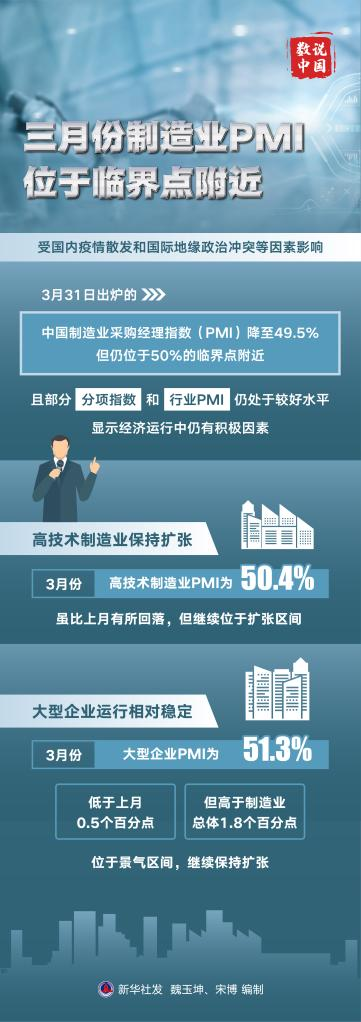
Core Viewpoint - The manufacturing Purchasing Managers' Index (PMI) in China dropped to 49.5% in March, indicating a contraction but remaining close to the critical threshold of 50%, suggesting mixed signals in the economy [2][3][4]. Manufacturing Sector - The manufacturing PMI fell to 49.5%, influenced by domestic COVID-19 outbreaks and international geopolitical conflicts, leading to reduced production and demand [3][4]. - The production index and new order index both fell into the contraction zone, with new export orders decreasing by 1.8 percentage points compared to the previous month [3][4]. - The PMI for large enterprises was 51.3%, indicating stability and continued expansion despite a slight decline from the previous month [5]. High-Tech Manufacturing - High-tech manufacturing PMI was reported at 50.4%, remaining in the expansion zone despite a decrease from the previous month [4]. - Employment and business activity expectation indices for high-tech manufacturing were 52.0% and 57.8%, respectively, indicating strong resilience and positive market outlook [4]. Basic Raw Materials - The PMI for the basic raw materials sector increased to 49.5%, reflecting a slight recovery despite pressures from rising raw material prices [4]. - The purchasing price index for basic raw materials was over 10 percentage points higher than that of equipment manufacturing, indicating some cost absorption within the sector [4]. Business Sentiment - The production and business activity expectation index was 55.7%, showing a relatively optimistic outlook despite a decline from the previous month [5]. - The non-manufacturing business activity index fell below the critical point, but construction activity showed signs of improvement as weather conditions became favorable [5]. Economic Challenges - The economy faces pressures from demand contraction, supply shocks, and weakened expectations, compounded by ongoing COVID-19 and geopolitical issues [5][6]. - Recommendations include improving pandemic control measures and expanding domestic demand policies to mitigate economic impacts [6].
2025年1-4月全国国有及国有控股企业经济运行情况
Xin Hua Wang· 2025-08-12 05:54
Revenue - In the first four months, the total operating revenue of state-owned enterprises remained flat compared to the previous year, amounting to 262,755.0 billion yuan [1] Profit - The total profit of state-owned enterprises in the first four months decreased by 1.7% year-on-year, totaling 13,491.4 billion yuan [2] Tax Payable - The tax payable by state-owned enterprises in the first four months was 20,380.0 billion yuan, reflecting a slight increase of 0.1% year-on-year [3] Debt Ratio - As of the end of April, the asset-liability ratio of state-owned enterprises was 65.1%, which represents an increase of 0.2 percentage points compared to the previous year [4]
产业龙头领衔 专项贷款频现 2025年首月A股公司回购势头喜人
Xin Hua Wang· 2025-08-12 05:38
Group 1 - In January 2025, nearly 500 listed companies in the A-share market announced share buybacks, with a total buyback amount exceeding 18 billion yuan, surpassing the same period last year [1] - Major industry leaders are actively participating in the buyback trend, with 38 companies implementing buybacks exceeding 100 million yuan in January 2025 [2] - Kweichow Moutai leads the buyback efforts with approximately 1 billion yuan in buybacks, marking its first buyback plan in 23 years [2][3] Group 2 - China State Construction also engaged in buybacks, with an amount of 887 million yuan aimed at optimizing its capital structure [3] - Muyuan Foods announced a buyback plan of 3 to 4 billion yuan, having repurchased shares worth 1.25 billion yuan by the end of January 2025 [3] - The recent policy adjustments regarding buyback loans have stimulated market confidence, leading to over 100 companies disclosing buyback plans since the beginning of 2025 [4] Group 3 - Tianqi Materials reported a buyback of 6.524 million shares for a total of approximately 121 million yuan, funded by both its own resources and a special loan of 180 million yuan from CITIC Bank [4] - Zhongheng Group plans to repurchase shares worth 300 to 500 million yuan, supported by a loan commitment of up to 450 million yuan from Bank of Communications [5] - Shunfa Hengye intends to use its own funds and special loans for a buyback plan of 250 to 500 million yuan, with a loan commitment of up to 450 million yuan from China Construction Bank [5]





印尼二季度经济增速超预期
Jing Ji Ri Bao· 2025-08-11 22:05
Core Insights - Indonesia's GDP grew by 5.12% year-on-year in Q2, surpassing market expectations of 4.8% and marking the fastest quarterly growth since Q2 2023, demonstrating the resilience of the Indonesian economy amid global uncertainties [1] - The manufacturing, agriculture, trade, construction, and mining sectors contributed significantly to GDP growth, accounting for 63.59% of the total [1] - The manufacturing sector showed remarkable performance with a growth rate of 5.88% in Q2, driven by rising domestic demand and strong export activity [1] Economic Drivers - Exports increased by 10.67% year-on-year in Q2, supported by higher shipments of metals, electronics, automotive parts, and palm oil, as international buyers rushed to complete purchases before new U.S. tariffs took effect [2] - Fixed asset investment grew by 6.99% in Q2, the fastest rate in four years, largely due to significant investments in infrastructure projects, including the expansion of Jakarta's rapid transit system [2] - Domestic consumption showed a moderate recovery with household consumption rising by 4.97% year-on-year, aided by increased spending during holidays and government incentives [3] Government Support - The Indonesian government implemented various policy measures to stimulate economic growth, including easing spending restrictions and launching quick-impact projects to enhance public purchasing power [3] - Despite a 0.33% year-on-year decline in government spending, the improvement from a 2.9% contraction in Q1 indicates a positive trend [3] - The government plans to extend tax relief for properties below a certain value and provide investment credits and low-interest loans for labor-intensive industries [4] Market Reactions - The strong economic performance led to a 1% increase in the Jakarta Composite Index (JCI) and an appreciation of the Indonesian rupiah against the U.S. dollar [4] - While some experts express concerns about the sustainability of this growth due to potential global economic slowdowns and domestic challenges, the government remains optimistic about future economic development [4][5] Long-term Outlook - Indonesia, as the largest economy in Southeast Asia, has significant growth potential supported by its large population and abundant natural resources [4] - The government's ongoing economic reforms aim to improve the investment environment and attract more domestic and foreign investments [4] - The increasing global focus on sustainable development and renewable energy presents promising opportunities for Indonesia in the green energy sector [4]