
高技术制造业

Search documents
前三季度GDP同比增长5.2%,实现全年目标有支撑
Ren Min Wang· 2025-10-22 03:22
Group 1 - The core viewpoint of the articles highlights that China's GDP growth in the first three quarters of 2025 reached 5.2% year-on-year, indicating a stable economic performance despite external pressures and internal challenges [1][2] - The economic growth in the first three quarters resulted in an increase of 39,679 billion yuan, which is 1,368 billion yuan more than the previous year, showcasing the difficulty of maintaining stability in a large economy [1] - China's total import and export value of goods reached 33.61 trillion yuan, a year-on-year increase of 4%, marking a historical high for the same period and demonstrating strong resilience in foreign trade [1][2] Group 2 - The transformation of green and innovative "momentum" into economic "dynamics" has been effective, with the added value of the equipment manufacturing and high-tech manufacturing industries accounting for 35.9% and 16.7% of the total industrial added value, respectively [2] - Non-fossil energy consumption's share of total energy consumption increased by approximately 1.7 percentage points year-on-year, indicating progress in green and low-carbon transformation [2] - Despite global economic challenges, China's economic growth rate of 4.8% in the third quarter remains significantly higher than that of most major economies, with the total economic output reaching 35.5 trillion yuan [2] Group 3 - Looking ahead, achieving the annual economic targets requires sustained effort and confidence, with a focus on expanding domestic demand and strengthening the domestic circulation [3] - Continuous efforts are needed to enhance endogenous growth momentum to promote sustained and healthy economic development [3]
央广财评|中国经济“三季报”:韧性不减 活力强劲
Yang Guang Wang· 2025-10-22 03:19
Economic Growth - China's GDP for the first three quarters of 2025 reached 10,150.36 billion yuan, with a year-on-year growth of 5.2%, accelerating by 0.2 percentage points compared to the previous year and 0.4 percentage points compared to the same period last year, indicating stable economic growth [1] - The 5.2% growth rate positions China among the leading major economies globally, showcasing its role as a stable driving force for global economic growth [1] Innovation and High-tech Manufacturing - The added value of high-tech manufacturing in China increased by 9.6% year-on-year in the first three quarters, with significant growth in specific sectors: 3D printing equipment (40.5%), industrial robots (29.8%), and new energy vehicles (29.7%) [1] - The rise of domestic large models has led to explosive growth in the artificial intelligence industry, with sales revenue in integrated circuit manufacturing, robot manufacturing, and drone manufacturing increasing by 17%, 21.7%, and 69.8% respectively [1] Consumer Spending - Final consumption expenditure contributed 53.5% to economic growth in the first three quarters, an increase of 9.0 percentage points from the previous year, reinforcing its role as the main engine of economic growth [2] - Service consumption grew by 5.2% year-on-year, outpacing the growth of retail sales of goods, indicating an optimization in consumption structure alongside an expansion in consumption scale [2] Policy Support - Recent macroeconomic policies have been implemented to boost consumption, including measures to expand service consumption and the allocation of funds for replacing old consumer goods, which are expected to support stable economic performance in the fourth quarter [2]
从6.2%增速看工业经济韧性:结构优化、出口改善、企业效益回升
Yang Shi Wang· 2025-10-22 02:37
Core Insights - The industrial value added in China for the first three quarters of this year increased by 6.2% year-on-year, indicating a stable and progressive development of the industrial economy supported by proactive macro policies [1][3] Industrial Growth - Among 41 major industrial categories, 37 experienced year-on-year growth, resulting in a growth coverage of 90.2% [3] - Out of 623 major industrial products, 385 saw an increase in production compared to the previous year [3] - Industrial exports showed improvement, with a year-on-year increase of 3.3% in the value of industrial exports for the first three quarters [3] High-tech and Traditional Industries - High-tech manufacturing's value added grew by 9.6%, contributing 24.7% to the overall industrial growth, particularly in sectors like integrated circuit manufacturing [7] - Traditional industries such as light industry and textiles remain competitive due to complete supply chains and strong upstream support [5] Structural Optimization - The industrial structure is continuously optimizing, with significant growth in intelligent manufacturing, green manufacturing, and digital technology [5] - Equipment manufacturing's value added rose by 9.7%, accounting for 35.9% of the total industrial value added, maintaining above 30% for 31 consecutive months [5] Profitability and Capacity Utilization - Industrial enterprises' profits improved, with a 0.9% year-on-year increase in profits for the first eight months, reversing a declining trend since May [10][12] - The profit growth in the manufacturing sector was 7.4%, with notable increases in sectors like non-ferrous metals and electrical machinery, which saw profits rise by 12.7% and 11.5% respectively [12] - The capacity utilization rate for large-scale industrial enterprises rose to 74.6%, an increase of 0.6 percentage points from the second quarter, with 21 out of 41 major industries showing improved utilization [12]

人民财评:前三季度GDP同比增长5.2%,实现全年目标有支撑
Ren Min Wang· 2025-10-22 02:29
Group 1 - The core viewpoint of the articles highlights that China's GDP grew by 5.2% year-on-year in the first three quarters of 2025, indicating a stable and resilient economic performance despite external pressures and internal challenges [1][2] - The total GDP increment for the first three quarters reached 39,679 billion yuan, with an increase of 1,368 billion yuan compared to the previous year, showcasing the difficulty of maintaining stable growth for a large economy [1] - China's total import and export value of goods reached 33.61 trillion yuan, reflecting a year-on-year growth of 4%, with the scale of foreign trade hitting a historical high for the same period [1][2] Group 2 - The articles emphasize the effective transformation of green and innovative "momentum" into economic "dynamics," with significant contributions from high-tech manufacturing and equipment manufacturing, which accounted for 35.9% and 16.7% of industrial added value, respectively [2] - The share of non-fossil energy consumption in total energy consumption increased by approximately 1.7 percentage points year-on-year, indicating progress in green and low-carbon transitions [2] - Despite global economic challenges, China's economic growth rate of 4.8% in the third quarter remains significantly higher than that of most major economies, with the total economic output reaching 35.5 trillion yuan [2] Group 3 - Looking ahead, while there is a solid foundation to achieve annual targets, it requires concerted efforts to enhance domestic demand and strengthen the domestic circulation to foster sustainable economic growth [3]
前三季度工业数据出炉 新质生产力成为增长主引擎
Xin Lang Cai Jing· 2025-10-22 00:58
Core Insights - The industrial added value of large-scale industries in China grew by 6.2% year-on-year in the first three quarters of this year, indicating a stable and progressive development of the industrial economy driven by proactive macro policies [1] Group 1: Industrial Growth - The added value of large-scale equipment manufacturing increased by 9.7% year-on-year, accounting for 35.9% of the total added value of large-scale industries, marking 31 consecutive months above 30% [1] - The high-tech manufacturing sector saw a 9.6% year-on-year increase in added value, contributing 24.7% to the growth of all large-scale industries, with rapid growth in sectors such as integrated circuit manufacturing [1] Group 2: Smart Manufacturing - The added value of large-scale digital product manufacturing grew by 9.7%, exceeding the overall growth of large-scale industries by 3.5 percentage points [1] - Production of key products such as robot reducers, industrial robots, and service robots increased by 120%, 29.8%, and 16.3% respectively [1] Group 3: Green Transformation - Under the influence of energy green transformation, the production of green equipment such as wind turbine generators, nuclear power generators, and solar cells increased by 72.4%, 38.9%, and 14% respectively in the first three quarters [1]
促消费政策显效 企业贷款保持增势 电商物流指数走高 多项数据释放需求端积极信号
Zhong Guo Zheng Quan Bao· 2025-10-21 22:26
Group 1: Economic Indicators - The core Consumer Price Index (CPI) has increased for the fifth consecutive month, with a year-on-year rise of 1% in September, marking the first time in 19 months that the increase has returned to 1% [2] - The narrow gap between narrow money (M1) and broad money (M2) has shrunk to 1.2 percentage points, the lowest this year, indicating improved business activity and personal investment demand [3] - The logistics industry has maintained a positive outlook, with the logistics industry prosperity index at 51.2% in September, reflecting a continuous demand for logistics services [4] Group 2: Consumer Demand and Spending - The rise in core CPI suggests accelerated consumer demand, particularly in quality and upgraded consumption, with notable price increases in sectors such as arts and crafts (14.7%), sports equipment (4%), and nutritional foods (1.8%) [2] - E-commerce logistics have shown strong demand, with the e-commerce logistics index reaching a new high of 112.7 points in September, driven by seasonal consumption and holiday factors [5][6] - The overall consumer market remains stable, with policies aimed at expanding domestic demand and promoting consumption showing positive effects [2] Group 3: Financial Sector and Lending - Corporate loans have shown a positive growth trend, particularly in key sectors like equipment manufacturing and high-tech manufacturing, with a year-on-year increase of 8.2% in medium to long-term loans for the manufacturing sector [3] - Personal credit demand has rebounded, supported by lower interest costs and adjustments in housing purchase policies in major cities, leading to a 7% year-on-year increase in housing transaction volume in September [3] - Financial mechanisms are expected to play a crucial role in stimulating effective demand in the real economy through interest rate adjustments and coordinated market rates [3]
中国经济顶压前行
21世纪经济报道· 2025-10-21 12:46
Core Viewpoint - The economic growth in the first three quarters of 2023 was 5.2%, laying a solid foundation for achieving the annual growth target of around 5% [2][10][12]. Economic Indicators - The GDP for the first three quarters reached 101.5 trillion yuan, with a year-on-year growth of 5.2%. The quarterly growth rates were 5.4% in Q1, 5.2% in Q2, and 4.8% in Q3, indicating a decline in growth [1][2]. - In Q3, industrial production maintained stability with a year-on-year increase of 6.2%, although this was a slight decrease from the first half of the year [4]. - The service sector's value added grew by 5.4% year-on-year in the first three quarters, showing overall stability [4]. - Retail sales of consumer goods increased by 4.5% year-on-year, but the growth rate fell by 0.5 percentage points compared to the first half of the year [5]. Investment Trends - Fixed asset investment (excluding rural households) decreased by 0.5% year-on-year, with infrastructure investment growing by 1.1% and real estate investment declining by 13.9% [5][11]. - The introduction of 500 billion yuan in new policy financial tools and another 500 billion yuan in local government debt limits aims to stimulate effective investment and address local fiscal challenges [1][11]. Export Performance - Exports in the first three quarters grew by 7.1%, maintaining resilience despite global uncertainties, while imports fell by 0.2% [5][6]. - The high-tech industry showed strong performance, with high-tech manufacturing value added increasing by 9.6% year-on-year [4][6]. Policy Outlook - The government is expected to implement further measures to stabilize growth, including potential interest rate cuts and support for the real estate market [2][10][12]. - The focus will be on expanding domestic demand, enhancing effective investment, and stabilizing foreign trade and investment [10][12].

《2025年前三季度宏观政策“三策合一”研究报告》发布
Zhong Guo Jing Ji Wang· 2025-10-21 07:36
Core Viewpoint - The report highlights the resilience and positive development of China's industrial economy in the first three quarters of 2025, emphasizing the need for coordinated macroeconomic policies to support growth and innovation [1][2][4]. Economic Performance - In the first three quarters of 2025, the industrial added value grew by 6.2%, surpassing the growth rates of 2023 and 2024 by 1.6 and 0.4 percentage points respectively [2]. - The equipment manufacturing and high-tech manufacturing sectors saw added value growth of 9.7% and 9.6%, respectively, exceeding the overall industrial growth by 3.5 and 3.4 percentage points [2]. - The service sector also experienced rapid growth, with a 5.4% increase in added value, 0.4 percentage points higher than in 2024 [2]. - Notably, the information transmission, software, and IT services sector achieved an impressive growth rate of 11.2% [2]. R&D and Innovation - China's R&D investment intensity rose from 1.91% in 2012 to 2.68% in 2024, indicating a strong commitment to innovation [3]. - The proportion of basic research funding within total R&D expenditures increased from below 5% (2012-2014) to 6.91% in 2024, highlighting a focus on foundational research [3]. - China's global innovation index ranking improved from 34th in 2012 to 11th in 2024, marking a significant advancement in overall innovation capabilities [3]. Policy Recommendations - The report suggests enhancing the proportion of basic R&D investment and improving the coordination of stability, structural, and growth policies to address potential impacts on employment and economic structure [3]. - It emphasizes the need for a comprehensive macroeconomic policy package in the fourth quarter, focusing on optimizing investment, industrial, and income distribution structures to balance supply and demand [4].
解读中国经济“三季报”背后发展图景 透过“稳”“升”“新”等关键字看答案
Yang Shi Wang· 2025-10-21 07:19
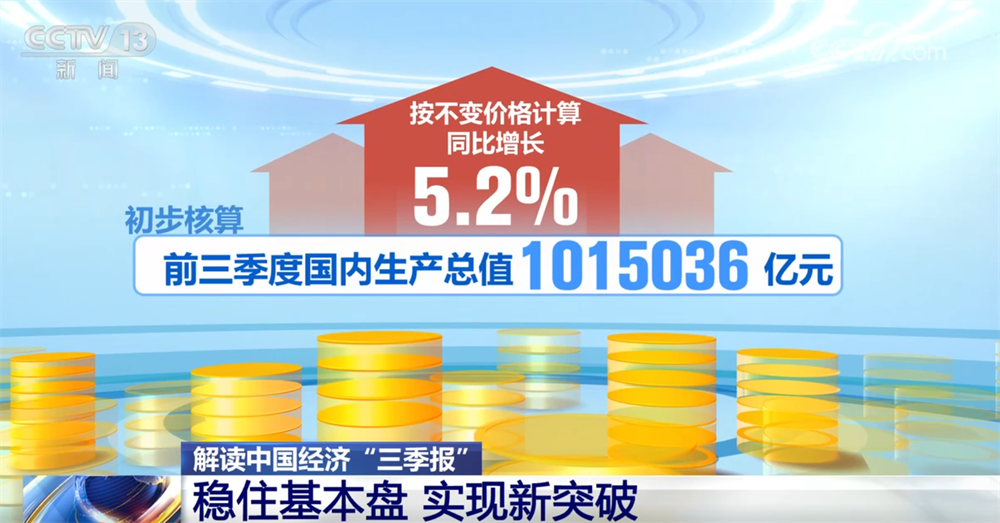
Economic Overview - China's GDP for the first three quarters reached 10,150.36 billion yuan, showing a year-on-year growth of 5.2% at constant prices, indicating a stable economic foundation amidst external pressures [1][3] - The 5.2% growth rate positions China among the top global economies, highlighting its role as a significant contributor to global economic growth [3] Industrial Performance - Industrial profits for large-scale enterprises shifted from a year-on-year decline of 1.7% in the first seven months to a growth of 0.9% in the first eight months, reversing a downward trend since May [5] - Key sectors driving this recovery include raw material manufacturing and equipment manufacturing, with strong market demand for high-tech products [7] Innovation and Technology - The implementation of innovation-driven strategies has accelerated the cultivation of new productive forces, with significant growth in artificial intelligence and digital economy sectors [7] - The value added by high-tech manufacturing increased by 9.6% year-on-year in the first three quarters, reflecting the integration of technological and industrial innovation [9] Consumer Trends - The total retail sales of consumer goods grew by 4.5% year-on-year in the first three quarters, with service retail sales increasing by 5.2%, indicating a shift towards consumption-driven economic growth [13] - Consumer preferences are evolving from functionality to a combination of functionality and emotional value, prompting businesses to diversify their service offerings [15]
生产强于需求,转型与温差共存
SINOLINK SECURITIES· 2025-10-21 05:58
Economic Growth - The cumulative growth rate for the first three quarters is 5.2%, establishing a solid foundation for achieving the annual target of 5%[3] - The minimum GDP growth requirement for the fourth quarter is set at 4.6% to meet the annual goal[3] Policy Measures - Continuous and stable policies will be maintained, with potential for monetary policy adjustments such as interest rate cuts if pressures increase[3] - Fiscal policy may involve increasing the scale of policy financial tools and utilizing government bond balances to support growth[3] GDP Performance - In Q3, GDP at constant prices grew by 4.8% year-on-year, down from 5.2%, while nominal GDP growth was 3.7%, also lower than the previous 3.9%[5] - Q3 fixed asset investment (FAI) saw a significant decline of 6.6%, while retail sales growth dropped to 3.4%[5] Economic Disparities - The gap between constant price GDP growth and nominal GDP growth indicates a disparity in economic performance, with nominal GDP growth at its lowest for 2023[8] - The GDP deflator index has shown negative growth for ten consecutive quarters, reflecting ongoing price pressures in the economy[8] Sectoral Insights - Industrial value added increased by 5.8% year-on-year in Q3, with high-tech manufacturing growing by approximately 9.6%[12] - Service sector value added rose by 5.4%, with information technology services leading at 11.2% growth[12] Investment Dynamics - Despite a decline in fixed asset investment, capital formation contributed positively to GDP growth, adding 0.9 percentage points[19] - The performance of intangible asset investments, particularly in software, has been relatively strong, benefiting from advancements in artificial intelligence[19] Future Outlook - Economic growth may slow in Q4 due to high base effects, particularly in consumer goods, with automotive retail showing negative growth[21] - Policy efforts will focus on boosting service consumption and fixed asset investment, with an estimated 2.2 percentage point support from new fiscal measures[21] Risk Factors - Risks include US-China trade tensions, tariff increases, and global supply chain adjustments, which may impact exports and corporate profits[4] - Ongoing geopolitical changes and international market fluctuations could affect commodity prices and related industries[4]