
邮政业

Search documents
制造业PMI低于荣枯线 国常会部署贴息政策促消费
Di Yi Cai Jing· 2025-07-31 13:51
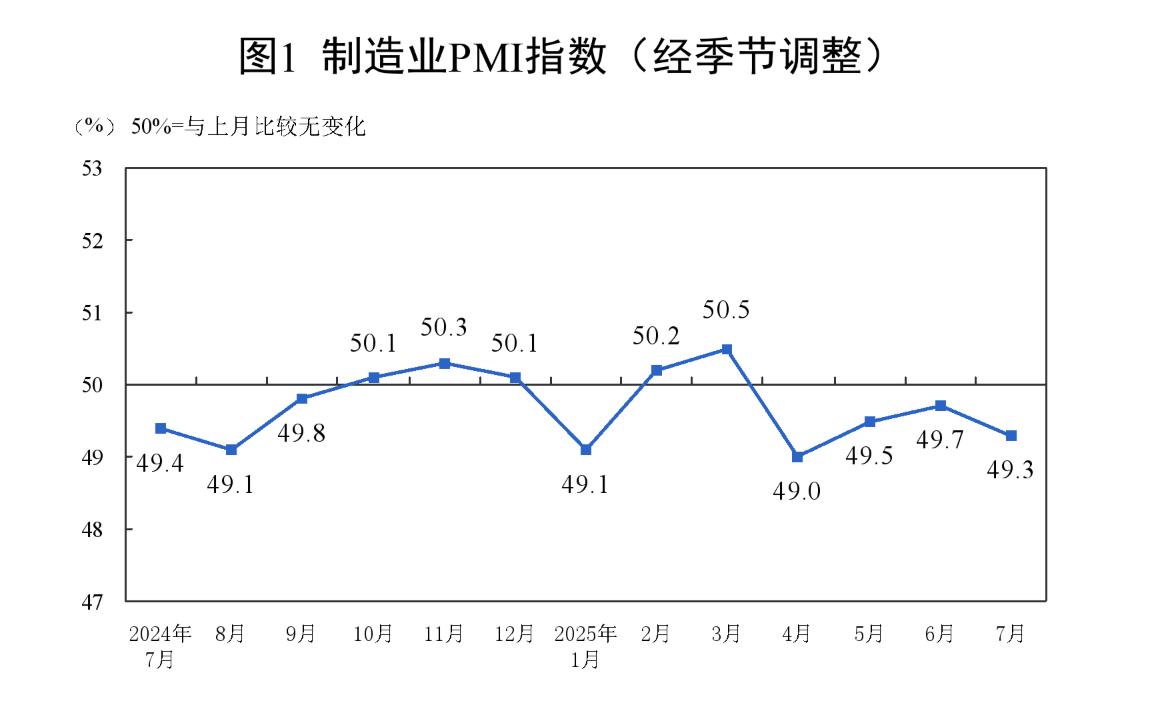
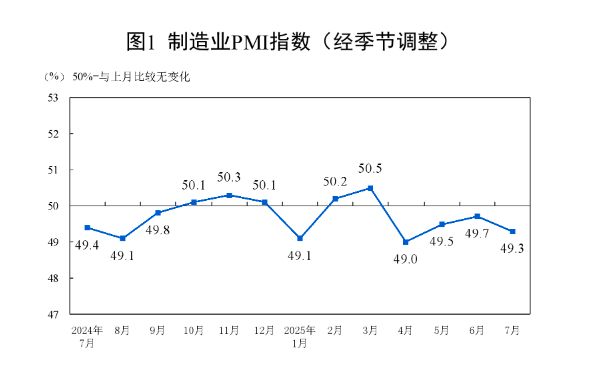
Economic Overview - The Central Political Bureau emphasized the need to enhance macroeconomic policy effectiveness and stimulate internal economic growth [1] - The State Council reiterated the implementation of personal consumption loan interest subsidy policies to better stimulate consumption potential [1][7] Manufacturing Sector - The manufacturing Purchasing Managers' Index (PMI) for July was reported at 49.3%, a decrease of 0.4 percentage points from the previous month, marking the fourth consecutive month below the growth threshold [1][4] - The new orders index for manufacturing fell to 49.4%, down 0.8 percentage points, indicating a contraction in market demand [6] - Despite the decline in demand, the production index remained at 50.5%, indicating continued expansion in manufacturing activities [6] Price Trends - The manufacturing raw material purchase price index rose to 51.5%, an increase of 3.1 percentage points, indicating a recovery in raw material prices [6] - The ex-factory price index increased to 48.3%, up 2.1 percentage points, marking the second-highest point this year [6] Business Confidence - The production and business activity expectation index rose to 52.6%, reflecting increased confidence among manufacturing enterprises regarding market development [8] - Large enterprises maintained a PMI of 50.3%, while medium-sized enterprises improved to 49.5%, indicating a mixed outlook across different enterprise sizes [8] Non-Manufacturing Sector - The non-manufacturing business activity index was reported at 50.1%, a decrease of 0.4 percentage points, but still within the expansion range [10] - The construction business activity index fell to 50.6%, influenced by seasonal weather conditions, while infrastructure-related activities continued to show robust growth [10] Consumer Behavior - The summer consumption effect began to show, with retail and postal service indices rising above 50%, indicating strong consumer spending intentions [11] - However, the accommodation and catering sectors remained below 50%, suggesting that summer consumption has not yet significantly impacted these areas [11][12] Policy Implications - The Central Political Bureau's meeting highlighted the importance of releasing internal demand potential and implementing consumption-boosting actions [12] - The focus on service consumption is expected to play a crucial role in meeting public needs and driving consumption industry upgrades [12]

制造业PMI低于荣枯线,国常会部署贴息政策促消费
Di Yi Cai Jing· 2025-07-31 13:22
Economic Policy and Measures - The State Council emphasizes the need to anchor annual development goals and enhance the effectiveness of macroeconomic policies, focusing on stimulating internal economic momentum [1][4] - Implementation of personal consumption loan interest subsidy policies and service industry loan interest subsidy policies aims to better stimulate consumption potential [1][7] Manufacturing Sector Performance - In July, the manufacturing Purchasing Managers' Index (PMI) was 49.3%, a decrease of 0.4 percentage points from the previous month, remaining below the expansion threshold for four consecutive months [1][4] - The new orders index for manufacturing was 49.4%, down 0.8 percentage points, indicating a contraction in market demand [6] - Despite weak demand, manufacturing production activities expanded, with a production index of 50.5%, although it decreased by 0.5 percentage points from the previous month [6][9] Price Trends - The manufacturing raw material purchase price index rose to 51.5%, an increase of 3.1 percentage points, indicating a recovery in raw material prices [6] - The ex-factory price index for manufactured goods was 48.3%, up 2.1 percentage points, marking the second-highest point this year [6] Business Confidence and Expectations - The production and business activity expectation index for July was 52.6%, reflecting an increase in confidence among manufacturing enterprises regarding market development [8] - Large enterprises maintained a PMI of 50.3%, while medium-sized enterprises improved to 49.5%, indicating a mixed outlook across different enterprise sizes [8] Non-Manufacturing Sector Insights - The non-manufacturing business activity index was 50.1%, a decrease of 0.4 percentage points, but still within the expansion range [10] - The construction industry index was 50.6%, indicating a slowdown in construction activities due to seasonal weather impacts [10] Consumer Behavior and Seasonal Trends - Summer consumption effects began to show, with retail and postal service indices rising above 50%, indicating strong consumer spending intentions [11] - However, the accommodation and catering sectors remained below 50%, suggesting that summer spending was more focused on outdoor and entertainment activities rather than dining [13] Future Economic Outlook - The Central Political Bureau meeting highlighted the need to effectively release internal demand potential and implement actions to boost consumption [14] - The focus on service consumption is expected to play a crucial role in meeting public needs and driving consumption industry upgrades [14]
制造业PMI季节性回落至49.3%,下阶段走势如何
第一财经· 2025-07-31 06:06
Economic Overview - The manufacturing PMI for July is reported at 49.3%, a decrease of 0.4 percentage points from the previous month, indicating a slight contraction in manufacturing activity [1] - The non-manufacturing business activity index stands at 50.1%, also down by 0.4 percentage points, but still indicates expansion [1] - The comprehensive PMI output index is at 50.2%, down 0.5 percentage points, remaining above the critical point, suggesting overall expansion in business activities [1] Manufacturing Sector Analysis - The new orders index for manufacturing is at 49.4%, down 0.8 percentage points, indicating a contraction in market demand [6] - The new export orders index is at 47.1%, a decrease of 0.6 percentage points, reflecting weakened demand [6] - Despite the decline in demand, the production index is at 50.5%, indicating continued expansion in manufacturing activities for the third consecutive month [6] Price Trends - The raw materials purchase price index for manufacturing is at 51.5%, up 3.1 percentage points, indicating a recovery in raw material prices [7] - The ex-factory price index is at 48.3%, an increase of 2.1 percentage points, marking the second-highest point this year [7] - Price stability in the manufacturing sector is primarily driven by the basic raw materials industry, with significant increases in both purchase and ex-factory price indices [7] Business Expectations - The production and business activity expectation index is at 52.6%, up 0.6 percentage points, indicating increased confidence among manufacturing enterprises [8] - Large enterprises maintain a PMI of 50.3%, while medium and small enterprises show PMIs of 49.5% and 46.4%, respectively, indicating varying levels of economic health across different enterprise sizes [8] Non-Manufacturing Sector Insights - The non-manufacturing business activity index is at 50.1%, down 0.4 percentage points, but still indicates expansion [13] - The construction sector's business activity index is at 50.6%, down 2.2 percentage points, reflecting a slowdown due to seasonal weather impacts [13] - Summer consumption shows positive trends, with retail and postal service indices rising above 50%, indicating strong consumer spending [15] Future Outlook - The construction sector is expected to rebound post-rainy season, with infrastructure activities projected to grow steadily [14] - Continued implementation of macroeconomic policies aimed at boosting demand is anticipated to support economic recovery in the second half of the year [9][16]

反内卷改善企业预期!7月份PMI数据出炉
券商中国· 2025-07-31 05:59
Core Viewpoint - The manufacturing PMI for July is 49.3%, a decrease of 0.4 percentage points from the previous month, primarily influenced by seasonal production slowdowns and adverse weather conditions [1][3]. Group 1: Economic Recovery and Manufacturing Performance - The foundation for economic recovery remains solid, with the equipment manufacturing and high-tech manufacturing PMIs continuing to expand, indicating ongoing structural optimization [2][3]. - Large enterprises are maintaining stable expansion, acting as a "ballast" for the economy [2][3]. - The rebound in the major raw material purchasing price index, which rose above the critical point for the first time since March, reflects improved market conditions in certain industries [4]. Group 2: Impact of Anti-Competition Measures - The anti-competition measures have positively influenced corporate expectations, as indicated by rising indices for purchasing prices, output prices, employment, supplier delivery times, and production activity expectations [4][5]. - The purchasing price index for major raw materials increased to 51.5%, while the output price index rose to 48.3%, showing significant recovery in specific sectors like petroleum and black metal processing [4]. Group 3: Consumer Activity and Seasonal Trends - The non-manufacturing business activity index for July is 50.1%, reflecting a slight decline but showing initial signs of summer consumption boosting economic activity [6][7]. - Retail activity is on the rise, with the retail business activity index surpassing the critical point, and new order indices showing significant increases [7]. - Travel and leisure activities are also gaining momentum, with indices for railway and air transport exceeding 60%, indicating strong consumer willingness to travel [7][8]. Group 4: Future Outlook - The summer consumption boost is expected to continue into August, supported by ongoing macroeconomic policies aimed at expanding domestic demand [8].
反内卷改善企业预期!短期因素造成制造业PMI环比微降
证券时报· 2025-07-31 05:47
Core Viewpoint - The manufacturing PMI for July is reported at 49.3%, a decrease of 0.4 percentage points from the previous month, primarily influenced by seasonal production slowdowns and adverse weather conditions [1][5][6]. Group 1: Manufacturing Sector Analysis - The manufacturing PMI reflects a contraction, but the underlying economic recovery remains solid, with equipment manufacturing and high-tech manufacturing PMIs continuing to expand [3][7]. - Large enterprises are maintaining stable expansion, acting as a stabilizing force in the economy [3][7]. - The rebound in the major raw material purchasing price index indicates a positive shift in business expectations due to anti-involution measures [10][12]. Group 2: Non-Manufacturing Sector Insights - The non-manufacturing business activity index stands at 50.1%, showing a slight decline but remaining above the critical point, indicating ongoing activity in the sector [2][14]. - Summer consumption is beginning to show positive effects, with significant increases in retail and travel activities, although the accommodation and catering sectors remain below the critical point [14][15][16]. Group 3: Future Economic Outlook - The implementation of policies aimed at expanding domestic demand is expected to support stable economic growth and quality improvement in the second half of the year [8][17]. - Analysts predict that the positive impact of summer consumption will continue into August, contributing to a gradual increase in investment and consumption activities [16][17].

反内卷改善企业预期!短期因素造成制造业PMI环比微降
Zheng Quan Shi Bao· 2025-07-31 05:45
Core Points - The manufacturing PMI for July is reported at 49.3%, a decrease of 0.4 percentage points from the previous month, primarily influenced by seasonal production slowdowns and adverse weather conditions [1][3] - The non-manufacturing business activity index and the composite PMI output index are at 50.1% and 50.2%, respectively, both showing a decline but remaining above the critical point [1][3] - Economic recovery fundamentals remain solid, with the equipment manufacturing and high-tech manufacturing PMIs continuing to expand, indicating ongoing structural optimization [1][3] Manufacturing Sector - The manufacturing PMI's decline is attributed to traditional production off-seasons and extreme weather events, leading to a weaker demand side [2][3] - Despite the overall PMI decline, production activities in manufacturing are still expanding, particularly in the equipment and high-tech sectors, which are crucial for economic growth [3][5] Price Indices - Among the 13 sub-indices of the manufacturing PMI, the purchasing price index and the ex-factory price index have risen, indicating improved market conditions in certain sectors [5] - The main raw material purchasing price index has risen to 51.5%, marking the first increase above the critical point since March, suggesting a potential recovery in material costs [5] Non-Manufacturing Sector - The non-manufacturing business activity index is at 50.1%, reflecting a slight decline, but summer consumption is beginning to show positive effects in retail, travel, and entertainment sectors [7][9] - Retail activity is increasing, with the retail business activity index rising above the critical point, indicating strong consumer purchasing intentions [8] Future Outlook - The implementation of policies aimed at expanding domestic demand, such as "two new" and "two heavy" initiatives, is expected to support stable economic expansion and quality improvement in the second half of the year [1][9] - The positive impact of summer consumption is anticipated to continue into August, contributing to economic recovery [9]
制造业PMI季节性回落至49.3%,下阶段走势如何
Di Yi Cai Jing Zi Xun· 2025-07-31 03:29
Economic Overview - The manufacturing Purchasing Managers' Index (PMI) for July is reported at 49.3%, a decrease of 0.4 percentage points from the previous month, indicating a slight contraction in manufacturing activity [1] - The non-manufacturing business activity index stands at 50.1%, also down by 0.4 percentage points, reflecting a slowdown in growth [1] - The composite PMI output index is at 50.2%, down 0.5 percentage points, but still above the critical point, suggesting overall expansion in business activities [1] Manufacturing Sector Insights - The new orders index for manufacturing is at 49.4%, a decline of 0.8 percentage points, indicating a tightening in market demand [3] - The new export orders index is reported at 47.1%, down 0.6 percentage points, further highlighting weak demand [3] - Despite the demand weakness, the production index remains at 50.5%, indicating continued expansion in manufacturing activities for the third consecutive month [3] - The raw material purchase price index has risen to 51.5%, an increase of 3.1 percentage points, suggesting a recovery in raw material prices [3] Price Trends - The ex-factory price index for manufactured goods is at 48.3%, up 2.1 percentage points, marking the second-highest point this year [3] - The basic raw materials sector is driving the stabilization and recovery of market prices, with the purchase price index rising over 7 percentage points to 52% [4] Business Confidence and Expectations - The production and business activity expectation index is at 52.6%, an increase of 0.6 percentage points, indicating improved confidence among manufacturing enterprises [4] - Large enterprises maintain a PMI of 50.3%, while medium-sized enterprises show improvement with a PMI of 49.5%, and small enterprises have a PMI of 46.4%, indicating varying levels of economic health across different company sizes [4] Non-Manufacturing Sector Performance - The non-manufacturing business activity index is at 50.1%, reflecting a slowdown but still within the expansion range [8] - The construction sector's business activity index is at 50.6%, down 2.2 percentage points, indicating a slowdown due to seasonal weather impacts [8] - Consumer spending during the summer shows positive trends, with retail and postal service indices rising above 50% and 60%, respectively, indicating strong consumer purchasing intentions [9] Future Outlook - The construction sector is expected to rebound post-rainy season, with infrastructure activities projected to continue steady growth [8][9] - The overall economic foundation remains solid, with expectations for continued stable expansion and quality improvement in the second half of the year, supported by ongoing macroeconomic policies [5]
河南商丘:上半年经济增长7% 呈现稳中有进态势
Zhong Guo Chan Ye Jing Ji Xin Xi Wang· 2025-07-27 22:28
Economic Performance - The GDP of Shangqiu City reached 170.17 billion yuan in the first half of 2025, with a year-on-year growth of 7.0% [1] - The primary industry added value was 23.21 billion yuan, growing by 3.1%; the secondary industry added value was 63.09 billion yuan, growing by 6.2%; and the tertiary industry added value was 83.86 billion yuan, growing by 8.9% [1] Agricultural Production - The summer grain production in Shangqiu reached 9.05 billion jin, indicating a stable agricultural production situation [1] - Vegetable and edible fungus production was 4.32 million tons, growing by 3.2%; fruit production was 1.53 million tons, growing by 1.9%; and meat production from pigs, cattle, sheep, and poultry was 330,600 tons, growing by 3.0% [1] Industrial Growth - The added value of industrial enterprises above designated size grew by 8.7%, with 23 out of 34 industrial sectors experiencing growth, resulting in a growth coverage of 67.6% [1] - The added value of coal, chemical, and aluminum smelting industries grew by 13.0%, 13.2%, and 42.1% respectively, collectively contributing 5 percentage points to the overall industrial growth [1] Service Sector Expansion - The added value of the service sector grew by 8.9%, with wholesale and retail growing by 7.7%, transportation, storage, and postal services growing by 8.2%, accommodation and catering growing by 9.1%, and information transmission, software, and IT services growing by 11.2% [1] - From January to May, the operating income of the service sector above designated size increased by 10.3% [1] Investment and Consumption - Fixed asset investment in the city grew by 6.8%, with industrial investment growing by 24.8%, surpassing the overall investment growth by 18 percentage points [2] - Private investment increased by 9.9%, accelerating by 6.6 percentage points compared to the first quarter, and exceeding the overall investment growth by 3.1 percentage points [2] - The total retail sales of consumer goods reached 78.93 billion yuan, growing by 7.6%, with 17 out of 22 categories of goods experiencing growth, resulting in a growth coverage of 77.3% [2] - Notable growth in retail sales included home appliances and audio-visual equipment at 34.4%, communication equipment at 34.6%, and automotive products at 11.4%, indicating a clear trend of consumption upgrading [2]
“十四五”前4年交通固定资产投资达到15.2万亿元
Zheng Quan Ri Bao· 2025-07-21 16:29
Group 1 - The core viewpoint of the news is that significant progress has been made in building a strong transportation country during the "14th Five-Year Plan" period, with a comprehensive transportation system achieving historic milestones [1] - The construction of the national comprehensive three-dimensional transportation network has exceeded 90% completion, enhancing transportation capacity, service quality, and operational efficiency [1] - Key areas of focus include improved infrastructure networks, stronger strategic support, more efficient transportation services, advanced technological equipment, deeper open cooperation, and a more complete governance system [1] Group 2 - By the end of 2024, the railway operating mileage is expected to reach 162,000 kilometers, an increase of approximately 16,000 kilometers from the end of the "13th Five-Year Plan," with high-speed rail increasing by 10,000 kilometers [1] - The total length of highways is projected to reach 5.49 million kilometers, an increase of about 290,000 kilometers, including an increase of 30,000 kilometers in expressways [1] - Fixed asset investment in transportation during the first four years of the "14th Five-Year Plan" reached 15.2 trillion yuan, a year-on-year increase of 23.3% [1] Group 3 - Since the 18th National Congress of the Communist Party, over 4.9 trillion yuan has been invested in rural road fixed assets, with more than 1.2 trillion yuan allocated for maintenance [2] - By the end of 2024, the total length of rural roads is expected to reach 4.64 million kilometers, forming a basic rural transportation network [2] - The national railway fixed asset investment is expected to reach 4 trillion yuan during the "14th Five-Year Plan," effectively driving economic growth [2] Group 4 - The Civil Aviation Administration of China has set 14 development indicators for the "14th Five-Year Plan" period to promote the development of air logistics, focusing on scale, safety, intelligence, and quality [2] - By the end of 2024, there will be 13 cargo airlines and 268 cargo aircraft, an increase of 2 airlines and 82 aircraft compared to 2020 [2] - The international cargo market share of Chinese airlines has reached 44%, an increase of 4 percentage points year-on-year [2] Group 5 - The postal industry has prioritized high-quality development during the "14th Five-Year Plan," achieving significant results in reform and development [3] - The industry has seen continuous growth in operating entities and an enhancement in transformation and upgrading capabilities [3] - During the "14th Five-Year Plan," there are 8 listed companies in the postal industry, with two entering the global top 500 [3]
国家邮政局:邮政业在服务构建全国统一大市场中发挥重要作用
Xin Hua Cai Jing· 2025-07-21 04:47
Core Viewpoint - The postal industry plays a crucial role in enhancing the market-oriented, legal, and international business environment in China, significantly contributing to the construction of a unified national market [1][2]. Group 1: Urban-Rural Development - The postal industry has improved the effectiveness of urban-rural balanced development by strengthening the rural delivery logistics system, creating a three-tier logistics system of "county-town-village," which transforms the delivery service shortfalls in rural areas into potential growth opportunities [1]. - This initiative has alleviated consumption bottlenecks and narrowed the gap in consumption patterns and service experiences between urban and rural residents [1]. Group 2: Regional Coordinated Development - The State Post Bureau is actively implementing regional coordinated development strategies, enhancing postal infrastructure in central and western regions, and improving the effective connection of various transportation modes with key nodes and supply chains [2]. - In 2024, the express delivery volume in central and western regions is expected to grow by 30% and 34% year-on-year, significantly outpacing the national average [2]. - Newly established mail and express processing centers in regions like Qinghai and Gansu have greatly improved processing capabilities, enhancing logistics infrastructure in the western areas [2]. Group 3: Smooth Flow of Production Factors - The postal industry connects various sectors and integrates online and offline channels, embedding itself in production and consumption scenarios, thus reflecting the dynamic nature of China and its open market [2]. - Through infrastructure development, data empowerment, and policy collaboration, the industry directly unleashes consumer potential and serves as a vital channel for breaking market segmentation and promoting the free flow of production factors [2].