Funds

Search documents
四位基金经理共管一只年内业绩垫底的“迷你”产品 此前兴华基金数只“迷你”基被清盘
Sou Hu Cai Jing· 2026-02-13 10:16
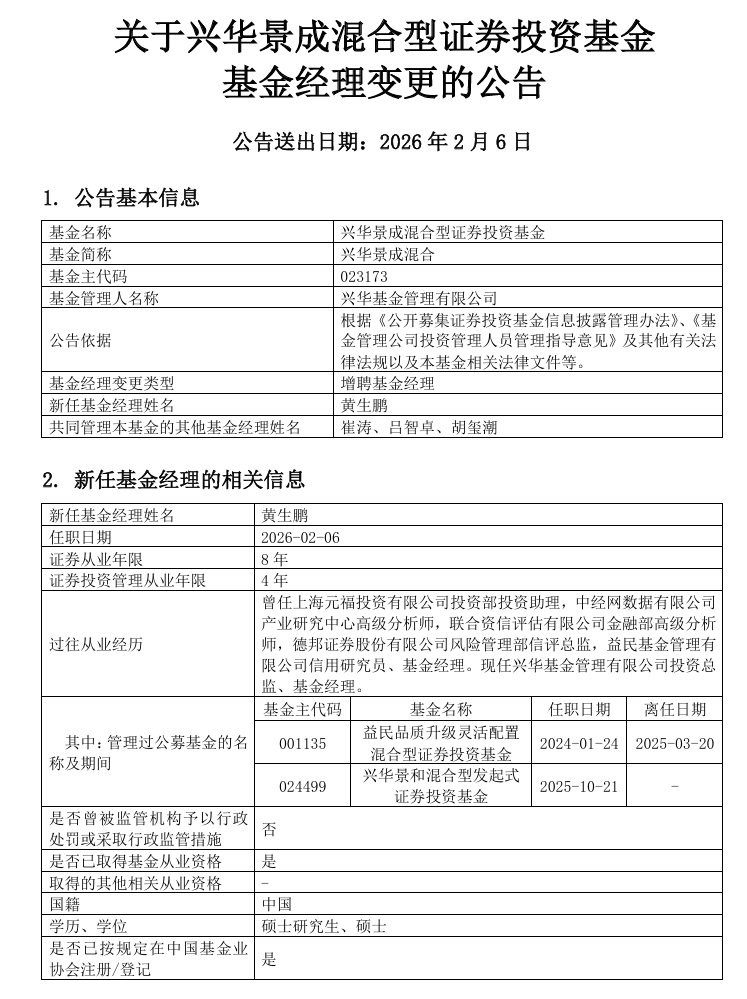
深圳商报·读创客户端记者 詹钰叶 兴华基金旗下一只产品日前宣布增聘基金经理,并与原有的3名基金经理共管;而这只产品去年末规模不 足8000万元,年内业绩不佳。这一罕见操作引起市场热议。 | 基金名称 | 兴华景成混合型证券投资基金 | | --- | --- | | 基金简称 | 兴华景成混合 | | 基金主代码 | 023173 | | 基金管理人名称 | 兴华基金管理有限公司 | | 公告依据 | 根据《公开募集证券投资基金信息披露管理办法》、《基 金管理公司投资管理人员管理指导意见》及其他有关法 | | | 律法规以及本基金相关法律文件等。 | | 基金经理变更类型 | 增聘基金经理 | | 新任基金经理姓名 | 黄生鹏 | | 共同管理本基金的其他基金经理姓名 | 崔涛、吕智卓、胡玺潮 | 具体来看,吕智卓的累计任职时间超过5年,现任基金资产管理总规模为35.84亿元,在管基金最佳任期回 报为17.78%。但其现任兴华基金固收公募部副总经理,历任产品多为债券型基金,市场担忧其对权益类产 品的管理经验不足。崔涛的基金经理累计任职时间接近3年,现任基金资产管理总规模为1.5亿元,在管基 金最佳任期回报为4 ...

公募密集“补血”背后:中小机构陷“马太效应”旋涡
经济观察报· 2026-02-13 09:17
更多中小机构增资,是在行业竞争日趋激烈的大环境下,依靠 股东 "输血" 保障持续运营。 作者:陈姗 封图:图虫创意 (有限合伙)、上海湛远企业管理中心(有限合伙)、上海瑛远企业管理中心(有限合伙)以现金 出资方式,向公司增资合计495万元。本次增资事项已完成,公司股东不变,上述新增注册资本均 已实缴。 本 次 增 资 后 , 睿 远 基 金 创 始 人 陈 光 明 为 公 司 第 一 大 股 东 , 出 资 4991.98 万 元 , 持 股 比 例 为 47.57%;公司副总经理傅鹏博出资1200万元,持股比例为11.43%;公司董事长刘桂芳、副总 经理林敏、董事总经理赵枫分别出资720万元、499万元、499万元,持股比例分别为6.86%、 4.75%、4.75%;上海盈远企业管理中心(有限合伙)等7家员工持股平台合计出资2585.02万 元,持有余下合计约24.63%股权。在业内人士看来,睿远基金此次增资或与实施股权激励、稳固 核心团队有关。 2月10日,睿远基金公告称,已完成注册资本变更,员工持股平台通过现金增资495万元,使公司 注 册 资 本 从 1 亿 元 提 升 至 1.0495 亿 元 。 ...

【上交所】ETF小知识问答 | Q9:资金过节怎么办?看懂货币与债券ETF的春节收益
Sou Hu Cai Jing· 2026-02-13 02:11
来源:市场资讯 货币ETF及债券ETF均为假期稳健收益之选 (来源:东北证券金融世界) Q9 资金过节怎么办?看懂货币与债券ETF的春节收益 A 根据国务院办公厅发布的通知,2026年春节将拥有一个为期9天的悠长假期(2月15日至2月23日)。这个来得稍晚的马年新春,不仅适合享受团聚,也为 投资者提供了一个规划资金的契机——如何让资产在春节休市期间依然创造收益?实现这一点的关键,在于理解货币ETF和债券ETF的"假日收益"特性。 即便在春节休市期间,这些ETF所持有的资产仍会持续计息,使得基金净值在假期中依然能够增长,真正做到"人闲钱不闲"。 | | | | 2026-2月休市安排 | | | | | --- | --- | --- | --- | --- | --- | --- | | 周一 | 周二 | 周三 | 周四 | 周五 | 周六 | 周 日 | | 9 | 10 | 11 | 12 | 13 | 14 | । રે | | 16 | 17 | 18 | 19 | 20 | 21 | 22 | | 23 | 24 | 25 | 26 | 27 | 28 | | 简单来说,收益来自于它们投资的底层资 ...

基金实时估值叫停 灰色工具售卖暗流涌动 谁在贩卖投资焦虑?
Nan Fang Du Shi Bao· 2026-02-12 23:13
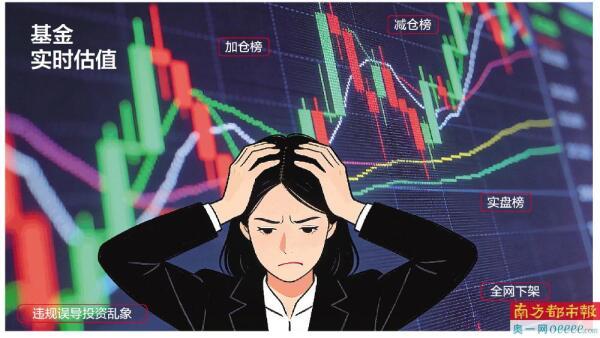
Core Viewpoint - The China Securities Regulatory Commission (CSRC) has issued a notice mandating the removal of real-time fund valuation tools and related features from major platforms, aiming to rectify misleading practices in the fund industry and promote long-term investment strategies [2][6][16] Regulatory Actions - The CSRC's notice on January 29 clearly delineated compliance boundaries for fund sales, requiring the removal of features like "real-time valuation," "buying list," and "real trading list" from sales platforms and third-party networks [2][3] - Major platforms, including Ant Wealth, JD Finance, and Tencent Licai, swiftly complied by removing these functionalities, indicating a rapid and extensive industry response to regulatory demands [3][4] Market Reactions - The removal of real-time valuation tools has sparked significant discussion among investors on social media, with many expressing confusion and concern over how to assess fund performance without these tools [4][5] - Some experienced investors feel the loss of a critical market sentiment observation tool, while novice investors are particularly perplexed by the difference between "valuation" and "net value" [5][6] Expert Insights - Experts suggest that the regulatory crackdown aims to correct the distorted investment ecosystem characterized by short-term speculation and to guide investors back to the fundamental nature of fund investments [6][7] - Real-time valuations are based on outdated quarterly reports and do not reflect the dynamic adjustments made by fund managers, leading to potential misinterpretations and investment risks [7][8] Investment Risks - The average deviation between real-time valuations and actual net values can reach 0.8%, with extreme cases exceeding 3%, posing significant risks for investors who rely on these estimates for decision-making [7][8] - Investors using real-time valuations for trading decisions may incur losses due to discrepancies between estimated and actual net values, highlighting the dangers of short-term trading strategies in a long-term investment context [8][14] Gray Market Developments - Despite the regulatory actions, a gray market for real-time valuation tools has emerged on social media platforms, where users seek alternative, often unregulated, solutions to fulfill their information needs [9][10] - Platforms like Xiaohongshu have become hotspots for the sale of these tools, with users being directed to private groups for access to unofficial valuation services [10][12] Underlying Investor Psychology - The persistence of gray market demand reflects deep-seated investor anxieties about information asymmetry and a desire for control over their investments, often leading to reliance on unofficial data sources [12][13] - Many investors have developed a habit of monitoring real-time data, which has become their primary method for evaluating fund performance, despite the risks associated with such practices [13][14] Recommendations for Investors - Experts recommend that investors shift their focus from short-term data to long-term evaluation metrics, emphasizing the importance of understanding fund performance through comprehensive analysis rather than relying on real-time valuations [16] - Suggested strategies include focusing on risk-adjusted returns, maximum drawdown recovery capabilities, and long-term excess returns against benchmarks to better assess fund managers' performance [16]
国泰基金管理有限公司关于旗下部分交易型开放式基金新增国联民生证券股份有限公司为一级交易商的公告
Zhong Guo Zheng Quan Bao - Zhong Zheng Wang· 2026-02-12 22:57
Group 1 - The announcement states that Guotai Fund Management Co., Ltd. will add Guolian Minsheng Securities Co., Ltd. as a primary trading dealer for certain exchange-traded open-end funds starting from February 13, 2026 [1] - Investors can conduct subscription and redemption transactions for the relevant funds through Guolian Minsheng Securities [1] - The announcement includes the contact information for both Guolian Minsheng Securities and Guotai Fund Management Co., Ltd. [1] Group 2 - The Guotai Fund Management Co., Ltd. has issued a risk warning regarding the Nasdaq 100 Exchange-Traded Fund (ETF), indicating that its secondary market trading price is significantly higher than the reference net asset value, leading to a substantial premium [3] - The fund management company warns that if the premium persists, it may take measures such as applying for a temporary trading halt on the Shanghai Stock Exchange to alert the market about the risks [3] - The fund is currently operating normally with no undisclosed significant information, and the management will adhere to legal regulations and fund contracts in its investment operations [4]

利润增幅跑输规模,降费潮下华夏基金ETF“一哥”位次承压
Sou Hu Cai Jing· 2026-02-12 06:41
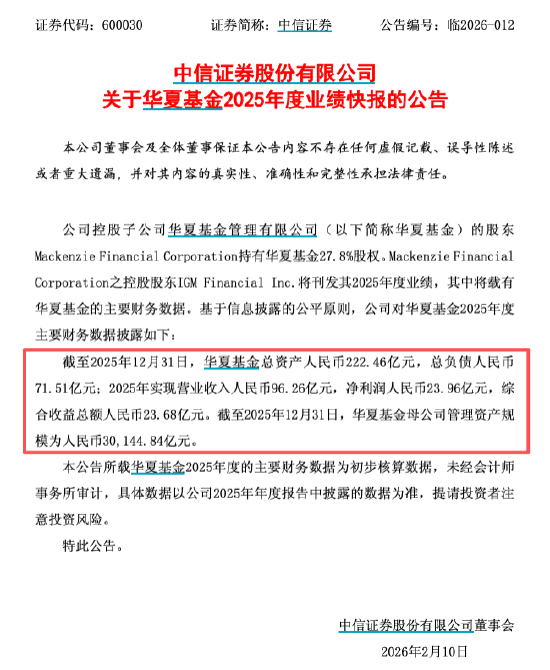
Core Insights - The article highlights the competitive landscape of the ETF market, focusing on the performance and challenges faced by China Asset Management Co., Ltd. (华夏基金) as it navigates fee reductions and market pressures [2][4]. Group 1: Financial Performance - In 2025, 华夏基金 reported operating revenue of 9.626 billion yuan, a year-on-year increase of 19.86%, and a net profit of 2.396 billion yuan, with an increase of 11.03% [3]. - The total assets of 华夏基金 reached 222.46 billion yuan, with total liabilities of 71.51 billion yuan, and the management asset scale surpassed 3 trillion yuan, reaching 3.014484 trillion yuan, a growth of 22% compared to the previous year [3]. - The growth in management scale over three years was significant, with an increase of nearly 1.2 trillion yuan, from 1.823564 trillion yuan in 2023 to 2.464531 trillion yuan in 2024, and then to 3.014484 trillion yuan in 2025 [3]. Group 2: Market Position and Competition - 华夏基金 maintains its position as the leading ETF provider with an ETF management scale of 892.67 billion yuan, accounting for 42% of its total managed public products, and a growth of 35.55% in 2025 [4][8]. - However, competitors like 易方达基金 are closing the gap, with an ETF management scale of 794.91 billion yuan, representing a growth of 32.08% [4][8]. - The reliance on ETF products is increasing for 华夏基金, which faces significant pressure from the ongoing fee reduction trend in the industry, as many competitors have lowered their management fees to the minimum level of 0.15% [4][6]. Group 3: Fee Structure and Market Dynamics - The ETF market is experiencing a fee reduction trend, with 27.2% of the 1,400 existing ETFs having management fees at the lowest tier of 0.15% [6]. - Among the top fund management companies, 华夏基金 has a lower proportion of ETFs with the minimum management fee, with only 27.5% of its ETFs at this rate, compared to 52.9% for 易方达基金 [8]. - The competitive landscape indicates that while fee rates are not the sole factor in attracting investors, they are increasingly significant in a low-interest-rate environment, impacting the profitability of fund management companies [8].

华夏基金2025年业绩快报出炉:营收96亿元同比增长20%,净利润24亿元同比增长11%
Xin Lang Cai Jing· 2026-02-12 05:29
Core Insights - Huaxia Fund achieved a total revenue of 9.626 billion yuan in 2025, representing a year-on-year growth of 19.86%, and a net profit of 2.396 billion yuan, up 11.03% year-on-year [3][24] - The company demonstrated accelerated growth in the second half of 2025, with revenue reaching 5.368 billion yuan and net profit at 1.273 billion yuan, indicating enhanced profitability compared to the first half [3][24] - By the end of 2025, total assets amounted to 22.246 billion yuan, a 9.94% increase from the end of 2024, while shareholders' equity grew by 8.35% to 15.095 billion yuan [3][24] Financial Performance - In the first half of 2025, revenue was 4.258 billion yuan and net profit was 1.123 billion yuan, with year-on-year growth rates of 16.05% and 5.74% respectively [3][24] - The quarterly asset scale showed a consistent expansion, starting from 19.2 trillion yuan in Q1, surpassing 20 trillion yuan in Q2, reaching 22.5 trillion yuan in Q3, and ending at 22.8 trillion yuan in Q4 [3][24] Product Issuance - New asset net value for 2024 reached 23.661 billion yuan with 55 new products, while in 2025, it increased to 43.64 billion yuan with 60 new products [5][26] - As of early 2025, three new funds were issued with a net asset value of 3.032 billion yuan [5][26] Product Structure - ETFs became the core driver of scale growth, with the ETF size reaching 957 billion yuan by the end of 2025, an increase of nearly 300 billion yuan within a year, and 25 new products launched [7][28] - However, there was a net outflow of funds from broad-based ETFs at the beginning of 2026, with the ETF size dropping to approximately 748.894 billion yuan by February 11, 2026 [7][28] Fund Manager Changes - The number of fund managers increased from 131 in the first half of 2025 to 138 by year-end, with 23 new hires and 11 departures, including several long-serving senior managers [14][37] - Notably, the average tenure of fund managers at Huaxia Fund is 4.93 years, with the longest-serving manager having 19.52 years of experience [37][38] Management and Ownership Changes - 2025 marked the 27th anniversary of Huaxia Fund and a significant year for ownership and management changes, including a transfer of 10% equity to Qatar Holding [12][33] - Following the ownership change, there was a management reshuffle, with a new chairman and vice-chairman appointed in September 2025 [13][34]
谁在主导这场公募FOF的千亿狂欢?
阿尔法工场研究院· 2026-02-12 04:06
Core Viewpoint - The public fund of funds (FOF) is undergoing a silent revolution, with significant growth in both market acceptance and product diversity, leading to a resurgence in investment opportunities and strategies [5][6][7]. Group 1: Market Dynamics - The average return of public FOFs over the past year is 17.9%, with top products capturing over 90% of this return, and the market size expected to exceed 244.1 billion by the end of 2025 [6]. - In just over a month, 36 new FOFs were launched, with several products raising over 4 billion in their initial offerings, making FOFs the third-largest issuance category this year after mixed and index funds [9]. - The liquidity of new FOF products has significantly increased, with holding periods reduced to 3 or 6 months, reflecting a shift in investment strategy towards more diversified asset classes [10][11]. Group 2: Structural Changes - The recognition of FOFs by institutional investors has risen, with the proportion of institutional holdings increasing from 16.34% at the end of 2024 to 26.82% by the end of 2025, a notable increase of 10.48 percentage points [12]. - The growth in institutional investment is primarily driven by mixed-asset FOFs, which are expected to support a second growth curve for FOFs [13]. Group 3: Historical Context - FOFs in China began in 2017 but faced challenges during the 2018 bear market, leading to a lack of investor confidence due to poor performance and management practices [15][16]. - The recovery in the stock market in 2019 marked the beginning of a prosperous phase for FOFs, with significant growth in both the number and size of pension-related FOF products [17][18]. - By the end of 2021, the size of FOFs surged from 10.7 billion at the end of 2018 to 210 billion, representing a growth of 1862% [19]. Group 4: Competitive Landscape - The competitive landscape for FOF management has shifted, with the concentration of top managers decreasing slightly, as new players emerge in the market [24][26]. - By the end of 2025, E Fund has become the largest FOF manager with 21.1 billion, surpassing previously dominant firms, indicating a significant shift in market preferences towards diversified and multi-strategy FOFs [25]. Group 5: Sales and Distribution Innovations - The sales model for FOFs is evolving, with banks like China Merchants Bank and China Construction Bank playing a crucial role in driving growth through innovative distribution strategies [27][28]. - The "TREE Long-term Plan" by China Merchants Bank and the "Dragon Profit Plan" by China Construction Bank have successfully launched multiple FOF products, significantly boosting the overall market size [28][30]. Group 6: Future Outlook - The public FOF sector is transitioning into a phase characterized by mature strategies, empowered channels, and diverse demand, with expectations for continued growth driven by institutional investment and evolving wealth management needs [33].


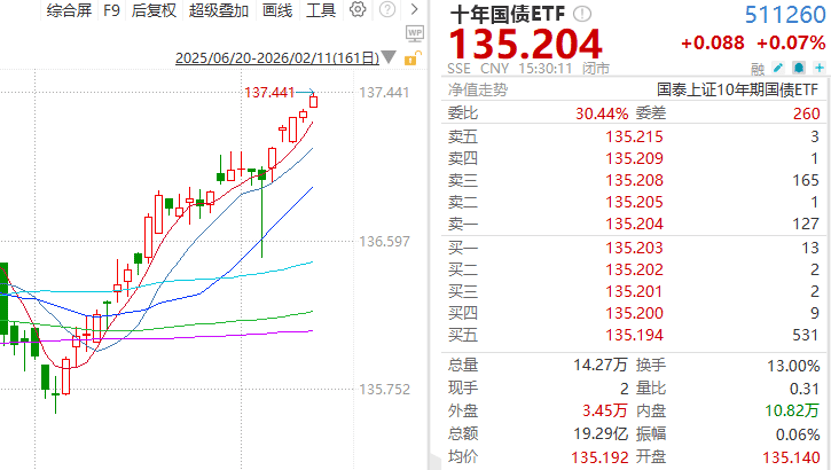
债市持续回暖,关注十年国债ETF(511260)配置价值
Sou Hu Cai Jing· 2026-02-12 01:15
Core Viewpoint - The bond market is experiencing a recovery, with the 10-year government bond ETF (511260) rising by 0.87% over the past 20 days, driven by unexpected bank deposits and allocation strength [1] Group 1: Short-term Factors - The recent surge in bank deposits and allocation strength are identified as the main short-term factors contributing to the bond market's recovery [1] - The interbank funding environment has improved, as evidenced by the 1-year interbank certificate of deposit rate breaking through 1.6%, indicating sustained easing in the interbank funding situation [1] Group 2: Investment Recommendations - In the short term, it is suggested to consider a long position in government bond ETFs (511010) and the 10-year government bond ETF (511260) [1] - The report indicates that the medium-term outlook for long-term bond interest rates is limited, favoring a strategic allocation approach over a trading mindset [3] - Mid-duration products, such as government bond ETFs (511010) and the 10-year government bond ETF (511260), are expected to be more favored in the current market environment [3] Group 3: Policy Insights - The central bank's recent monetary policy report emphasizes the importance of monetary-fiscal coordination, supporting government bond issuance through ample liquidity [3] - The report highlights the need for stronger policy synergy and transmission efficiency, with a focus on maintaining reasonable interest rate relationships and regulating unreasonable low-interest behaviors [3]
1月基金月报 | 股债携手上行,公募基金迎来普涨
Morningstar晨星· 2026-02-12 01:02
Macro Economic Overview - The manufacturing PMI for January recorded at 49.3%, down 0.8 percentage points from December's 50.1%, indicating a contraction in manufacturing activity [3] - January's CPI increased by 0.8% year-on-year, while PPI decreased by 1.9%, showing a mixed inflationary trend [3] A-Share Market Performance - A-shares experienced a strong start in January, with the Shanghai Composite Index reaching a high of 4190.9 points, marking a new peak since the September 24 market [4] - The technology growth sectors, particularly AI computing and commercial aerospace, led the market rally due to policy support and increased demand [4] - Major indices showed positive performance in January, with the Shanghai Composite Index and Shenzhen Component Index rising by 3.85% and 5.08%, respectively [4] - Among 31 Shenwan industry sectors, 26 sectors saw gains, with non-ferrous metals, media, and oil & petrochemicals sectors rising over 15% [4] Bond Market Dynamics - The bond market initially showed weakness due to concerns over supply and interest rate expectations but later recovered as liquidity was injected by the central bank [5][6] - The yields on various government bonds decreased in January, with 1-year, 5-year, and 10-year yields falling to 1.30%, 1.58%, and 1.81%, respectively [6] - The overall return of the bond market, as reflected by the China Bond Index, increased by 0.41% in January [6] Global Economic Indicators - The economic conditions in major Western economies remain in the expansion zone, but growth momentum is showing signs of marginal slowdown [7] - The US Markit Composite PMI for January was 52.8, slightly down from December's 53.0, while the Eurozone's PMI fell to 51.5 from 51.9 [7] - Geopolitical tensions, particularly in the Middle East, have driven up international commodity prices, with Brent crude oil prices rising by 14.64% in January [7] Fund Performance Insights - The Morningstar China Open-End Fund Index recorded a 4.77% increase in January, with various fund types showing positive returns [15] - Equity funds, particularly small and mid-cap growth funds, outperformed large-cap funds, with mid-cap balanced and growth funds achieving average returns of 9.74% and 9.13%, respectively [19] - QDII funds also performed well, with commodity funds, global emerging market mixed funds, and Greater China mixed funds recording returns of 17.15%, 13.51%, and 8.69% [20]