交通运输

Search documents
大众交通(600611.SH):超短期融资券及中期票据获准注册
Ge Long Hui A P P· 2025-12-04 08:40
格隆汇12月4日丨大众交通(600611.SH)公布,中国银行间市场交易商协会《接受注册通知书》(中市协 注〔2025〕SCP358号),通知书称:决定接受公司超短期融资券注册。公司超短期融资券注册金额为 30亿元,注册额度自本通知书落款之日起2年内有效,由上海银行股份有限公司、宁波银行股份有限公 司、上海农村商业银行股份有限公司和上海浦东发展银行股份有限公司联席主承销。公司在注册有效期 内可分期发行超短期融资券,发行完成后,应通过交易商协会认可的途径披露发行结果。 中国银行间市场交易商协会《接受注册通知书》(中市协注〔2025〕MTN1154号),通知书称:决定 接受公司中期票据注册。公司中期票据注册金额为15亿元,注册额度自本通知书落款之日起2年内有 效,由上海银行股份有限公司、宁波银行股份有限公司、上海农村商业银行股份有限公司和上海浦东发 展银行股份有限公司联席主承销。公司在注册有效期内可分期发行中期票据,发行完成后,应通过交易 商协会认可的途径披露发行结果。 ...

早盘直击|今日行情关注
申万宏源证券上海北京西路营业部· 2025-12-04 02:11
首先,目前时点进入12月份,临近年底,年末因素如机构年终结账等开始影响市场。 同时,短线市场缺乏新的热点,在半导体芯片、人工智能等科 技股进入调整后,市场缺乏稳定而持续的新热点,导致场内资金被动观望,成交量持续萎缩,目前维持在1.6~1.8万亿元的日成交量较8月底3.1万亿元的最 大量相比,萎缩超过40%。而没有强而有力的领涨板块,大盘就难以持续放量,进而也较难推动大盘放量上涨。从目前看,12 月份以震荡整理,过渡性 行情为大概率事件,波动空间有限。 从热点看, 热点轮动,交通运输、有色金属等周期性行业震荡走强,而前期涨幅较大的如传媒、计算机等板块冲高回落,市场风格由激进转向防 御。另外,前期炒名字的热潮有所降温,部分代表性个股周三出现跌停,盲目追涨风险凸显。 展望后市: 大盘继续震荡整理,以稳为主。从技术面看,成交量萎缩,观望气氛有所增强。关注陆续公布的11月份宏观经济数据以及盘中热点和量 能的匹配情况。 风险提示: 消息面或海外市场表现超预期,流动性的不确定性。 ...


万联晨会-20251204
Wanlian Securities· 2025-12-04 01:37
Core Insights - The A-share market experienced a decline across all major indices, with the Shanghai Composite Index falling by 0.51% to 3,878.00 points, and the Shenzhen Component Index down by 0.78% to 12,955.25 points. The total trading volume in the A-share market reached 1.67 trillion RMB, with net inflows from southbound funds amounting to 2.279 billion HKD [2][8] - The transportation, non-ferrous metals, and coal industries showed the highest gains, while the media and computer sectors faced the largest declines. Notably, the cultivated diamond and hyperbaric oxygen chamber concept indices saw significant increases, whereas the Kuaishou concept and MLOps concept indices experienced notable declines [2][8] Industry Overview - The report highlights the successful maiden flight of China's reusable carrier rocket, Zhuque-3, marking a significant milestone in the commercial space sector. The Chinese commercial space industry is projected to reach a scale of 7-10 trillion RMB by 2030, with capabilities for in-orbit maintenance and construction of spacecraft becoming a reality [3][9] - The State-owned Assets Supervision and Administration Commission (SASAC) held a meeting to discuss the "14th Five-Year Plan" for central enterprises, emphasizing the importance of strategic planning and industry layout for major state-owned enterprises [3][9] Investment Highlights - The trading card game (TCG) market is evolving into a comprehensive cultural consumption product, driven by IP ecosystems. The core logic revolves around "collecting-exchanging-value accumulation," with emotional connections between IP and consumers being crucial for long-term engagement [10][11] - The TCG industry has established a complete industrial chain covering IP authorization, content creation, product manufacturing, channel distribution, and community operation. The upstream sector relies heavily on IP as the fundamental driver of user engagement and retention [11][12] - The design aspect is critical for product differentiation and targeting specific consumer segments, enhancing brand value and maximizing user lifecycle value [12][13] - The distribution channels are characterized by a dual approach of "offline foundation and online expansion," with offline channels focusing on high accessibility and experience, while online channels provide flexibility and broad coverage [13][14] Industry Development - The integration of TCG with diverse business models is highlighted, with examples such as Pokémon's multi-ecosystem approach that combines online digital empowerment with offline experiences and global competitions [14] - Companies like Huali Technology are exploring new avenues by merging gaming equipment with TCG, aiming to enhance consumer experiences through innovative integrations [14] Investment Recommendations - The report suggests focusing on companies with rich upstream IP resources and original IP development capabilities, leading companies in TCG design and manufacturing, and those with significant advantages in sales channels [15]
市场情绪延续偏弱
Tebon Securities· 2025-12-03 13:13
Market Overview - The A-share market is experiencing a weak sentiment with major indices showing a general decline, particularly in the growth sectors which are adjusting more significantly than value sectors [3][6] - The Shanghai Composite Index closed at 3878.00 points, down 0.51%, while the Shenzhen Component Index fell 0.78% to 12955.25 points, and the ChiNext Index decreased by 1.12% to 3036.79 points [3] Stock Market Analysis - The market lacks a clear leading sector, with significant fluctuations observed in the commercial aerospace sector, influenced by recent rocket launch news [6][10] - Defensive sectors and some cyclical stocks are showing resilience against the overall market decline, suggesting a rotation in investment strategies [6][7] Bond Market Insights - The bond futures market is characterized by a clear differentiation in performance across maturities, with long-term bonds underperforming while mid to short-term bonds are stabilizing [10] - The 30-year bond contract saw a decline of 0.26%, while the 10-year bond contract increased by 0.06%, indicating a mixed sentiment in the bond market [10] Commodity Market Trends - Financial commodities are outperforming industrial commodities, with the Nanhua Commodity Index down 0.28% while industrial products are under pressure [10][11] - The industrial product index has decreased by 7.19% since the beginning of the year, reflecting weak demand and a contraction in manufacturing activity [10] Investment Strategy Recommendations - The report suggests maintaining a balanced allocation between technology and dividend stocks to hedge against sector rotation risks [7][12] - Focus on structural opportunities in undervalued defensive sectors and industries aligned with the "15th Five-Year Plan" trends [7][12] Recent Trading Hotspots - Key investment themes include dividend stocks for their attractive yields, AI applications driven by major tech advancements, and consumer sectors benefiting from currency appreciation [12] - The brokerage sector is highlighted due to active trading volumes and potential changes in trading regulations [12]
【3日资金路线图】两市主力资金净流出超450亿元 有色金属等行业实现净流入
Zheng Quan Shi Bao· 2025-12-03 12:02
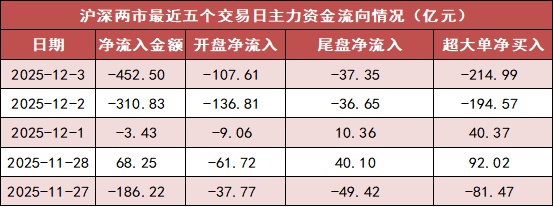
今日沪深两市主力资金开盘净流出107.61亿元,尾盘净流出37.35亿元,全天净流出452.5亿元。 截至收盘,上证指数收报3878点,下跌0.51%;深证成指收报12955.25点,下跌0.78%;创业板指收报3036.79点, 下跌1.12%。两市合计成交16699.62亿元,较上一交易日增加765.32亿元。 1.两市主力资金净流出超450亿元 | | | 沪深两市最近五个交易日主力资金流向情况(亿元) | | | | --- | --- | --- | --- | --- | | 日期 | | 净流入金额 开盘净流入 | 尾盘净流入 | 超大单净买入 | | 2025-12-3 | -452.50 | -107. 61 | -37. 35 | -214. 99 | | 2025-12-2 | -310. 83 | -136.81 | -36. 65 | -194. 57 | | 2025-12-1 | -3. 43 | -9.06 | 10. 36 | 40. 37 | | 2025-11-28 | 68. 25 | -61.72 | 40. 10 | 92. 02 | | 2025-11-27 | ...
【3日资金路线图】两市主力资金净流出超450亿元 有色金属等行业实现净流入
证券时报· 2025-12-03 11:58
12月3日,A股市场整体下跌。 截至收盘,上证指数收报3878点,下跌0.51%;深证成指收报12955.25点,下跌0.78%;创业板指收报3036.79点,下跌 1.12%。两市合计成交16699.62亿元,较上一交易日增加765.32亿元。 1. 两市主力资金净流出超450亿元 今日沪深两市主力资金开盘净流出107.61亿元,尾盘净流出37.35亿元,全天净流出452.5亿元。 | | | 沪深两市最近五个交易日主力资金流向情况(亿元) | | | | --- | --- | --- | --- | --- | | 日期 | | 净流入金额 开盘净流入 | 尾盘净流入 | 超大单净买入 | | 2025-12-3 | -452. 50 | -107. 61 | -37. 35 | -214. 99 | | 2025-12-2 | -310. 83 | -136.81 | -36. 65 | -194. 57 | | 2025-12-1 | -3. 43 | -9.06 | 10. 36 | 40. 37 | | 2025-11-28 | 68. 25 | -61. 72 | 40. 10 | 92. 0 ...

两市主力资金净流出578.83亿元,计算机行业净流出居首
Zheng Quan Shi Bao Wang· 2025-12-03 09:24
分行业来看,申万所属的一级行业中,今日上涨的有6个,涨幅居前的行业为交通运输、有色金属,涨 幅为0.69%、0.63%。跌幅居前的行业为传媒、计算机,跌幅为2.86%、2.26%。 12月3日,沪指下跌0.51%,深成指下跌0.78%,创业板指下跌1.12%,沪深300指数下跌0.51%。可交易 A股中,上涨的有1442只,占比26.50%,下跌的3876只。 资金面上,今日主力资金全天净流出578.83亿元。其中,创业板主力资金净流出189.29亿元;科创板主 力资金净流出58.58亿元;沪深300成份股主力资金净流出150.73亿元。 | 行业 | 日涨跌幅(%) | 资金流向(亿元) | 行业 | 日涨跌幅(%) | 资金流向(亿元) | | --- | --- | --- | --- | --- | --- | | 有色金属 | 0.63 | 44.07 | 机械设备 | -0.19 | -12.27 | | 煤炭 | 0.57 | 2.35 | 建筑装饰 | -0.69 | -12.56 | | 交通运输 | 0.69 | 0.05 | 商贸零售 | -1.40 | -13.55 | | 美容护理 ...
博时市场点评12月3日:两市继续调整,量能维持低位
Xin Lang Cai Jing· 2025-12-03 09:03
【博时市场点评12月3日】两市继续调整,量能维持低位 每日观点 今日沪深三大指数继续调整,两市成交仍不足1.7万亿。海外方面,上周多数补发的数据显示政府"停 摆"前美国经济已呈现减速趋势,经济下行风险增加,美联储12月降息概率重回八成以上,本月议息会 议或呈现降息+鹰派表态的局面。国内方面,11月央行通过多种工具净投放流动性,显示货币政策维持 稳健偏宽松基调。12月将进入重要会议的政策窗口期,但当前市场对于增量政策预期或不高。当前经济 处于弱修复状态,权益市场短期或仍维持震荡格局,配置上建议均衡。 消息面 央行发布11月各项工具流动性投放情况显示,11月公开市场国债买卖净投放500亿元,抵押补充贷款 (PSL)净投放254亿元,其他结构性货币政策工具净投放1150亿元,中期借贷便利(MLF)净投放 1000亿元。尽管同期7天期逆回购操作为净回笼,但通过加大中长期流动性工具的运用与搭配,央行在 整体上依然实现了资金面的净投放。 简评:11月央行通过公开市场操作及各类货币政策工具合计净投放2904亿元,显示逆周期调节力度持续 加大。其中结构性工具净投放占比近40%,体现精准滴灌导向,有助于缓解实体经济融资压力。在 ...
粤开市场日报-20251203
Yuekai Securities· 2025-12-03 07:36
Market Overview - The A-share market experienced a decline today, with the Shanghai Composite Index falling by 0.51% to close at 3878.00 points, the Shenzhen Component Index down by 0.78% to 12955.25 points, the Sci-Tech 50 Index decreasing by 0.89% to 1308.37 points, and the ChiNext Index dropping by 1.12% to 3036.79 points [1][10] - Overall, there were 1442 stocks that rose while 3872 stocks fell, with 137 stocks remaining unchanged. The total trading volume in the Shanghai and Shenzhen markets reached 167 billion yuan, an increase of 765 million yuan compared to the previous trading day [1] Industry Performance - Among the Shenwan first-level industries, transportation, non-ferrous metals, coal, home appliances, and light industry manufacturing showed the highest gains, with increases of 0.69%, 0.63%, 0.57%, 0.30%, and 0.25% respectively. Conversely, the media, computer, real estate, retail, and comprehensive sectors led the declines, with decreases of 2.86%, 2.26%, 1.53%, 1.40%, and 1.26% respectively [1][10] - The concept sectors that performed well included cultivated diamonds, superhard materials, industrial metal selection, and others, while sectors like WEB3.0, Baidu platform, and Xiaohongshu platform experienced declines [2][12]
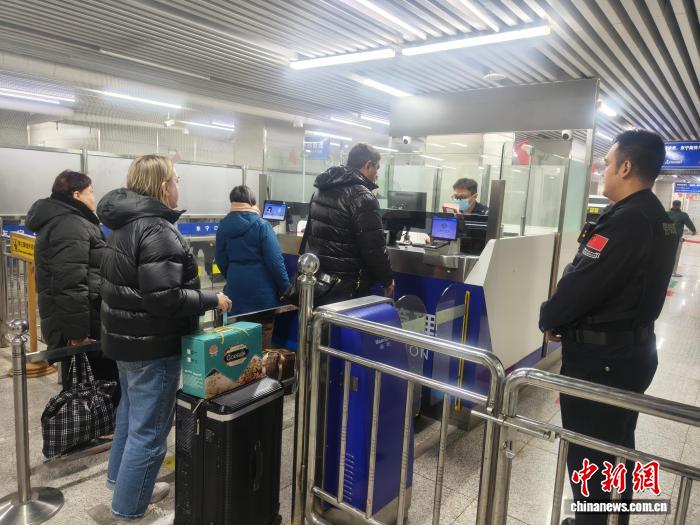
中俄免签新政助推跨境出行 东宁打造全链条“保姆式”服务
Zhong Guo Xin Wen Wang· 2025-12-03 06:06
Core Viewpoint - The implementation of the visa-free policy between China and Russia is revitalizing cross-border travel, with Dongning City enhancing its services to create a comprehensive travel experience for visitors [1][2]. Group 1: Policy Impact - The visa-free policy for Chinese passport holders has been officially implemented, injecting new momentum into personnel exchanges and economic and cultural interactions between China and Russia [2]. - Dongning Port, as the closest land port to Vladivostok, has become a significant channel for Sino-Russian exchanges since its opening in 1990 [2]. Group 2: Service Enhancements - Dongning City has optimized its entry and exit services by setting up clear signage and providing dedicated personnel to assist travelers, resulting in a smooth and efficient crossing experience [2]. - The city has introduced a "7 days × 12 hours without lunch break + flexible extended customs clearance" model to meet cross-border travel demands [3]. - A "fast-track passport replacement green channel" has been established, along with electronic verification process improvements and Russian translation equipment, significantly reducing customs clearance times [3]. Group 3: Transportation and Tourism - Dongning City has launched bilingual shuttle services from the port to key urban areas, established transportation service desks, and created one-stop service packages that include accommodation and transportation [3]. - The city is promoting unique tourism routes such as border-themed tours and leisure picking, while also enhancing shopping experiences through the establishment of display and sales centers [3]. - Cultural events like Sino-Russian art evenings and calligraphy exhibitions are planned to enrich cross-border consumption scenarios [3]. Group 4: Future Development - Dongning officials aim to further improve the "port-scenery-business circle" travel loop, ensuring that the benefits of the visa-free policy are fully realized for open development [5]. - The city is poised to become a vital active node in the Northeast Asia economic corridor as the visa-free policy continues to be implemented [5].