电子信息

Search documents
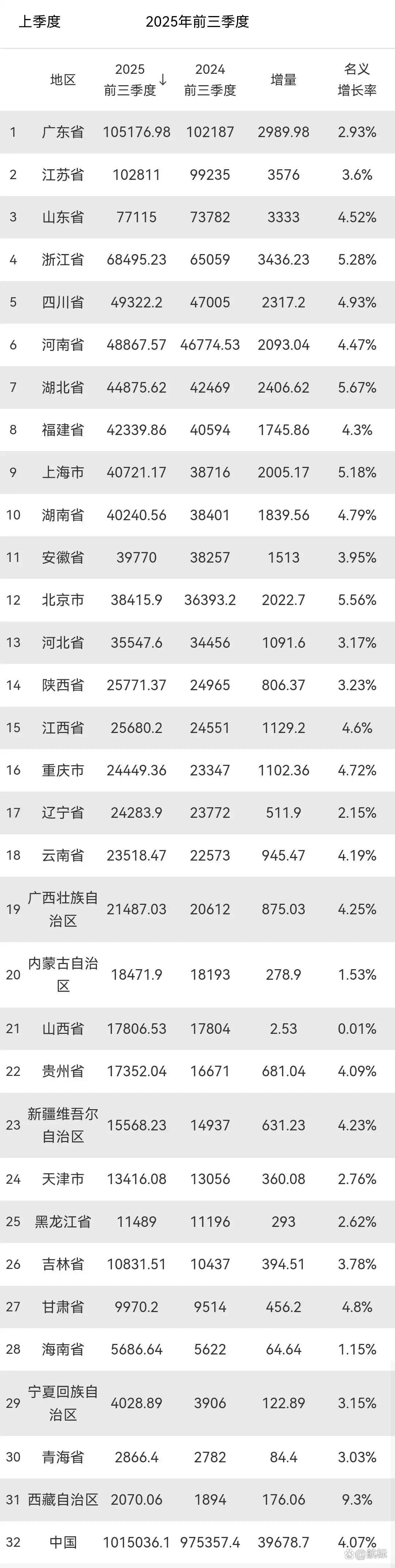
最新GDP!全国31省GDP大洗牌:四川约5万亿,重庆逼近江西,甘肃增速近5%!
Sou Hu Cai Jing· 2025-11-25 03:38
Core Insights - The economic resilience across various regions in China has been highlighted, with a national GDP exceeding 101 trillion yuan, reflecting a year-on-year growth of 4.07% in the first three quarters of the year [1] Group 1: Regional Economic Performance - Guangdong Province leads with a GDP of approximately 105.18 billion yuan, showing a growth rate of 2.93% [2] - Jiangsu Province follows closely with a GDP of about 102.81 billion yuan and a growth rate of 3.6% [2] - Sichuan Province has reached a GDP of 49.32 billion yuan, with a growth rate of 4.93%, driven by the Chengdu-Chongqing economic circle [4] Group 2: Competitive Dynamics - The GDP gap between Chongqing and Jiangxi has narrowed to 230 billion yuan, showcasing a competition between two distinct economic models [5] - Chongqing's automotive manufacturing, particularly in new energy vehicles, has seen a 40% increase in production, while Jiangxi excels in lithium battery and photovoltaic industries [5] - Both regions are competing in the digital economy, with Jiangxi focusing on IoT demonstration zones and Chongqing enhancing industrial internet coverage [5] Group 3: Emerging Growth Areas - Gansu Province has achieved a growth rate of 4.8%, primarily driven by its renewable energy strategy, with significant wind and solar capacity [8] - The province's data center cluster is growing rapidly, attracting major tech companies, although traditional industries still dominate its economic structure [8] - The challenge for Gansu lies in avoiding becoming a "green energy island" and developing a local consumption and high-value conversion system [8] Group 4: Future Outlook - The essence of regional competition is seen as an iteration of development models, with eastern provinces relying on technological innovation while central and western regions explore differentiated paths [10] - The upcoming quarters may reveal which provinces will achieve ranking improvements through the cultivation of new productive forces [10]

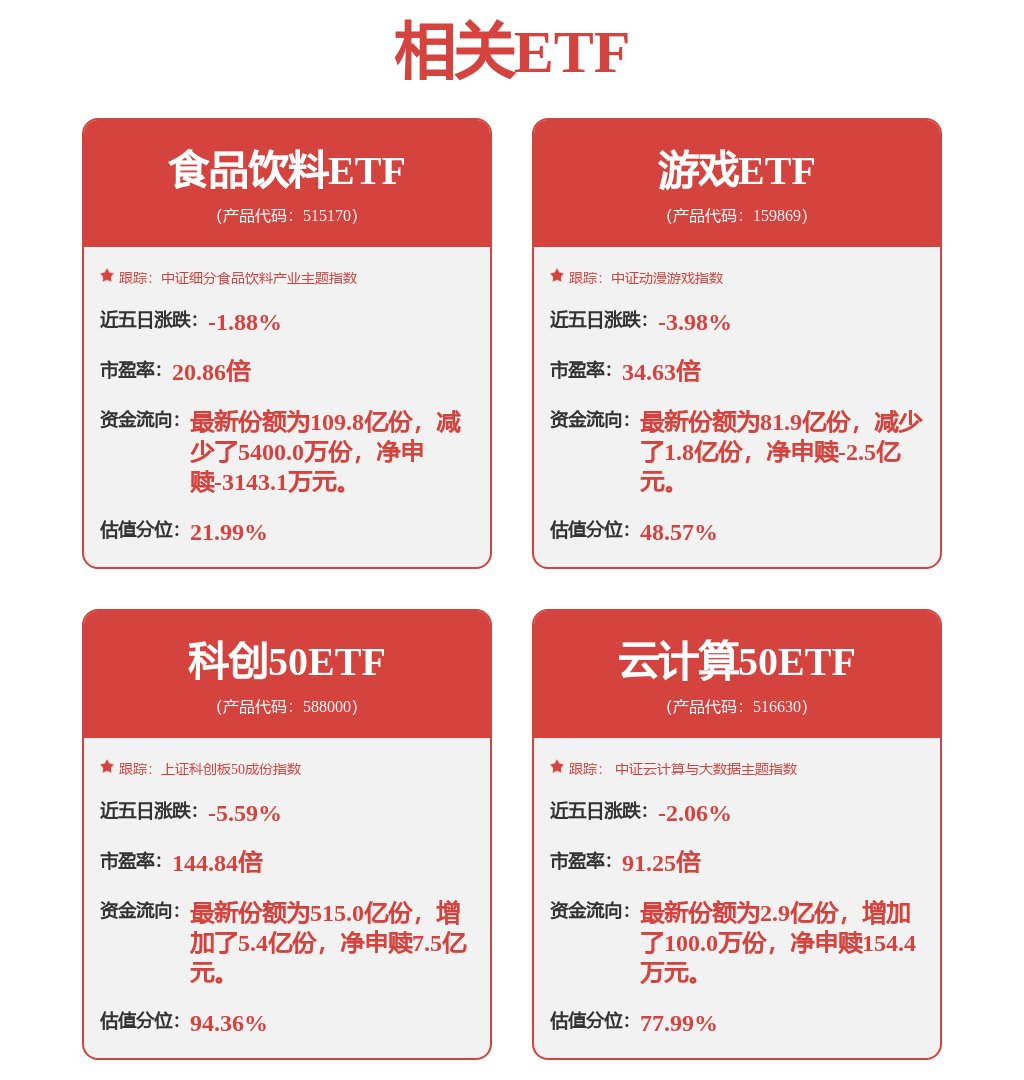
方正科技股价涨5.02%,华泰柏瑞基金旗下1只基金重仓,持有2.3万股浮盈赚取1.31万元
Xin Lang Cai Jing· 2025-11-25 02:19
Group 1 - The core point of the article highlights the recent performance of Founder Technology, which saw a 5.02% increase in stock price, reaching 11.92 CNY per share, with a trading volume of 958 million CNY and a turnover rate of 1.96%, resulting in a total market capitalization of 50.943 billion CNY [1] - Founder Technology Group Co., Ltd. is located in Changning District, Shanghai, and was established on November 15, 1993, with its listing date on December 19, 1990. The company's main business involves the production and sale of PCB products, internet access services, and IT system integration and solutions [1] - The revenue composition of Founder Technology shows that 98.83% comes from product sales, while 1.17% is from service provision [1] Group 2 - From the perspective of fund holdings, data indicates that one fund under Huatai-PB holds a significant position in Founder Technology, with the CSI 1000 fund (516300) holding 23,000 shares, accounting for 0.36% of the fund's net value, making it the eighth largest holding [2] - The CSI 1000 fund was established on March 15, 2021, with a latest scale of 72.1163 million CNY. Year-to-date returns stand at 22.79%, ranking 1801 out of 4206 in its category, while the one-year return is 22.27%, ranking 1854 out of 3983 [2] - The fund manager of CSI 1000 is Hu Yiqing, who has a cumulative tenure of 307 days, with total fund assets of 3.926 billion CNY. During his tenure, the best fund return was 38.16%, while the worst was -2.15% [2]

全球GDP30强城市:东京或将退至第4,苏州太抢眼,成都领先悉尼
Sou Hu Cai Jing· 2025-11-25 01:39
Group 1: Global City GDP Rankings - New York leads the 2024 global city GDP rankings with 9.06 trillion RMB, followed by Los Angeles and Tokyo [1] - Six Chinese cities made the list, with Shanghai (5.39 trillion RMB) and Beijing (4.98 trillion RMB) ranking fifth and sixth, respectively [1] - Shenzhen, Chongqing, and Guangzhou are in the top 15, while Suzhou (2.67 trillion RMB) and Chengdu (2.35 trillion RMB) are noted for their industrial innovation [1] Group 2: Tokyo's Economic Challenges - Tokyo's economy relies on traditional strengths in automotive and electronics, with major companies like Sony and Toyota contributing over 30% of industrial output [3] - The manufacturing capacity utilization rate is projected to decline to 72% in 2024, with semiconductor equipment exports down 18% year-on-year [3] - Tokyo's innovation efforts focus on robotics and hydrogen technology, but it lags behind leading cities in startup incubation, holding only 6% of unicorn companies [3] Group 3: Suzhou's Industrial Growth - Suzhou's GDP reached 2.67 trillion RMB, ranking 20th globally, driven by explosive growth in the biopharmaceutical sector, which surpassed 350 billion RMB in 2022 [5] - The city leads in nanotechnology applications and holds over 30% market share in third-generation semiconductor materials [5] - Significant foreign and private investment has been noted, with Bosch investing 1 billion euros in electric vehicle components and a 58% increase in high-tech private enterprises [5] Group 4: Chengdu's Economic Development - Chengdu's GDP of 2.35 trillion RMB surpasses Sydney by 120 billion RMB, marking its first entry into the global top 30 [7] - The electronic information industry is a core driver, with a supply chain scale exceeding 1.2 trillion RMB and BOE's flexible display capacity accounting for 25% of the global market [7] Group 5: Western China’s Trade and Infrastructure - The new western land-sea corridor has enhanced trade potential, with the China-Europe Railway Express (Chengdu-Chongqing) exceeding 5,000 trips in 2023, leading to a 19% increase in import and export volume [8] - Tianfu International Airport has become a key logistics hub, ranking among the top 30 globally in cargo and mail throughput [8] - The establishment of a free trade zone has attracted 4,200 cross-border e-commerce companies, achieving an annual transaction volume exceeding 90 billion RMB [8] Group 6: Innovation Ecosystem Competition - The competition among cities is fundamentally about the strength of their innovation ecosystems, with Tokyo exploring transformation, Suzhou focusing on smart manufacturing, and Chengdu leveraging inland openness [10]

稳增长方案出炉,顺周期持续收益
2025-11-25 01:19
Summary of Key Points from Conference Call Records Industry Overview Automotive Industry - The automotive industry is projected to achieve sales of 32 million units in 2025, representing a year-on-year growth of approximately 3% [1] - New energy vehicle (NEV) sales are expected to reach 15.5 million units, with a penetration rate of 50% [1][3] - Concerns include the sustainability of sales post-subsidy reduction and China's global competitiveness in NEVs [1][4] Steel Industry - The steel industry will focus on supply-demand balance, industrial structure optimization, green low-carbon initiatives, and digital transformation [1][5] - Despite a long-term downturn in the real estate sector, steel companies are transitioning towards low-carbon metallurgy and new materials [5] - Demand for steel used in NEVs, stainless steel, special steel, and oriented silicon steel for the power industry is increasing [5] - The commencement of iron ore shipments from Guinea is expected to improve profitability in the steel sector due to falling iron ore prices [5] Building Materials and Light Industry - The building materials sector aims to develop green building materials, targeting revenues exceeding 300 billion yuan, focusing on steel structures and integrated forming [1][6] - The light industry is concentrating on smart home products, elderly and infant goods, fashion items, and sports products, driving consumer upgrades [1][6] Power Equipment Industry - The power equipment sector is a key focus for the upcoming year, with a growth target of around 6% and a goal to increase the localization rate to 7% [1][7] - Leading companies are expected to achieve annual revenues of 10% [7] - The sector is poised for growth due to increased market entry of new energy, heightened demand for grid safety, and rising overseas computing power needs [7] Electronic Information Industry - Investment opportunities in the electronic information sector for 2026 include large-scale AI application deployments and significant investments in national supercomputing centers [3][9] - The focus will shift from AI computing power to specific applications in media and gaming, indicating robust growth potential [9] Nonferrous Metals Industry - The nonferrous metals sector is expected to see significant development, with prices rebounding and potential capacity shortages anticipated in 2026 and beyond, which may drive prices higher [10] - The Federal Reserve's interest rate cuts are favorable for gold prices, making the gold sector worth monitoring [10] Machinery and Petrochemical Industries - The machinery sector is expected to experience growth opportunities, particularly in automation investments [11] - The petrochemical industry is shifting towards new materials, including basic chemicals, as part of the new growth strategy [11] Capital Market Insights - The capital market in 2025 has experienced a notable correction, primarily due to skepticism regarding Nvidia's performance, leading to a significant downturn in the global computing industry [12] - A decline in risk appetite has made consumer goods stocks attractive due to their defensive characteristics [12] - It is suggested that now is an opportune time for investors to position themselves for 2026, particularly in cyclical sectors, as price increases are expected to continue [12]
香港启动百亿港元创科产业引导基金公开遴选;杭州设立20亿元润苗基金丨11.17-11.23
创业邦· 2025-11-25 00:08
Key Points - The article discusses significant events in the private equity fund market from November 17 to November 23, highlighting various government-led and market-driven funds established to support innovation and technology sectors [5]. Government-Backed Funds - Hong Kong has launched a HKD 10 billion Innovation and Technology Industry Fund, focusing on five key sectors including life sciences and AI, with a target of establishing multiple sub-funds totaling at least HKD 40 billion [7]. - Sichuan Province has established a CNY 10 billion electronic information sub-fund, the largest in its government fund system, aimed at strategic projects in the electronic information sector [8]. - Hangzhou has set up a CNY 2 billion "Run Miao Fund" to address early-stage financing challenges for tech startups, focusing on projects with valuations under CNY 100 million [8]. - A CNY 10 billion pig industry chain fund is being established in Sichuan to support the development of the pig industry cluster [9]. - The Nantong Baoyuehu Science and Technology Mother Fund is seeking managers for sub-funds focusing on strategic emerging industries [9]. - Nanjing is selecting managers for a CNY 200 million silicon-based micro-display industry fund, with a focus on local investments [9]. - Hainan is looking for managers for a CNY 500 million healthcare fund targeting seed and early-stage tech companies [10]. - The Yulin Science and Technology Innovation City Fund has been established with a CNY 200 million scale, focusing on various strategic emerging industries [10]. Market-Driven Funds - Wuhan has established a CNY 1 billion Future Intelligent Venture Capital Fund, focusing on private equity investment management [12]. - Nanjing has launched a CNY 1 billion artificial intelligence fund, targeting cutting-edge fields like AI and big data [12]. - Zhengzhou has registered a CNY 200 million angel investment fund aimed at supporting early-stage tech startups [12]. - The Chuchang Tongda Industrial Fund has completed registration with an initial scale of CNY 14 million, focusing on the life sciences sector [13][14]. - The Anhui Huidao Transportation Science and Technology Fund has been established with a scale of CNY 1 billion, focusing on transportation technology [14]. - The Yantai Happiness New City Mother Fund has been set up with a CNY 1 billion scale, focusing on private equity investments [15]. - A CNY 3 billion investment fund for new materials has been established, with a focus on unlisted companies in the new materials sector [18]. - The Hangzhou Guoling Yuanqi Fund has been established with a total scale of CNY 1 billion, focusing on energy-related projects [18].

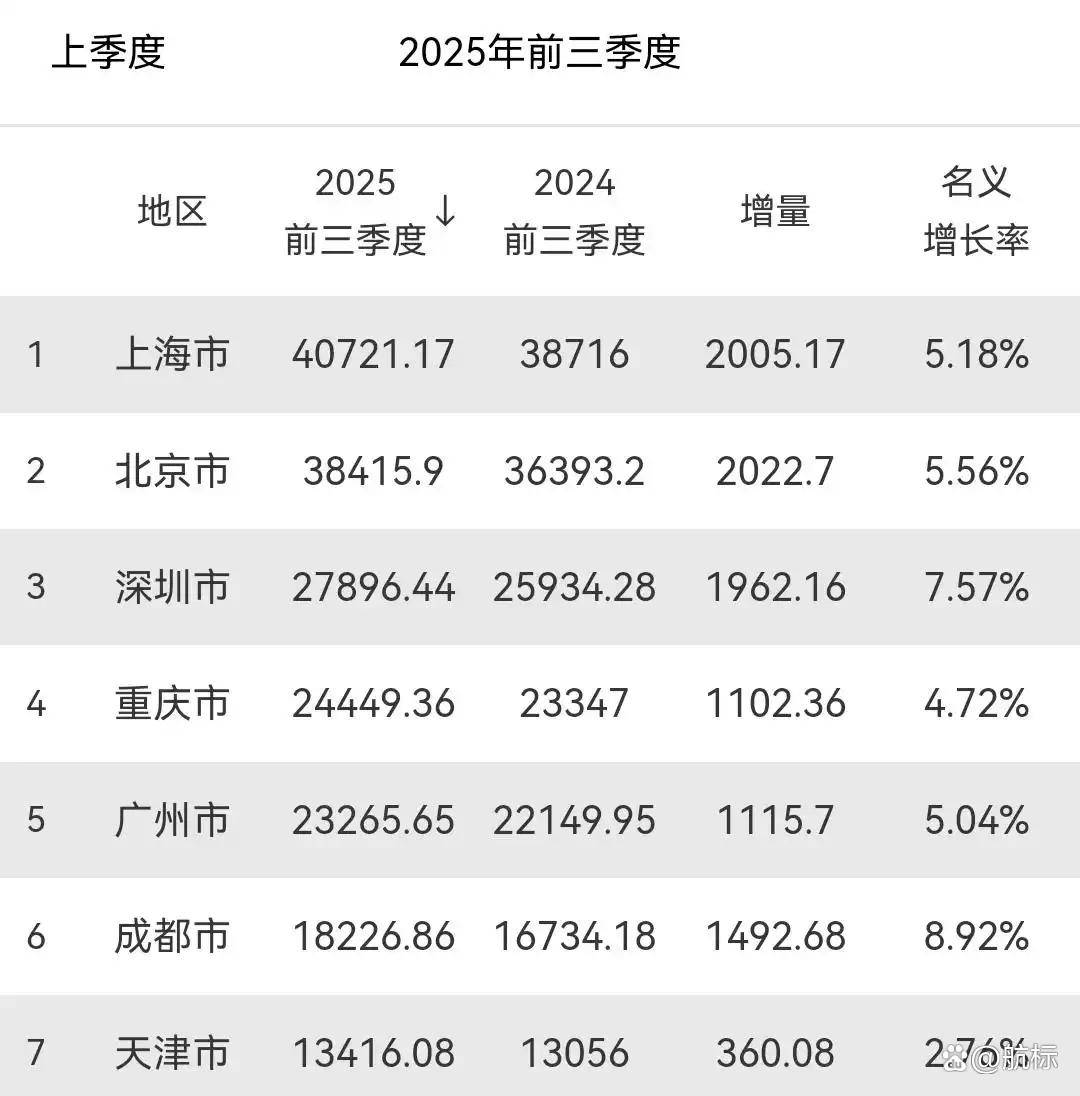
我国7个经济超强城市出炉:北京逼近上海,重庆近2.5万亿,成都增速约9%!
Sou Hu Cai Jing· 2025-11-24 21:22
| | 地区 | 2025 | 2024 | 增量 | 名义 | | --- | --- | --- | --- | --- | --- | | | | 前三季度 | 前三季度 | | 增长率 | | ー | 上海市 | 40721.17 | 38716 | 2005.17 | 5.18% | | 2 | 北京市 | 38415.9 | 36393.2 | 2022.7 | 5.56% | | 3 | 深圳市 | 27896.44 25934.28 | | 1962.16 | 7.57% | | 4 | 重庆市 | 24449.36 | 23347 | 1102.36 | 4.72% | | 5 | 广州市 | 23265.65 22149.95 | | 1115.7 | 5.04% | | 6 | 成都市 | 18226.86 16734.18 | | 1492.68 | 8.92% | | 7 | 天津市 | 13416.08 | 13056 | 360.08 | 28 向前景 | 区域经济的竞争,从来不只是数字的比拼,更是战略布局与产业动能的深度较量。2025年前三季度GDP数据近日揭晓,上海、北京、深 ...
河北“十五五”规划建议发布:推动重大交通基础设施布局建设 深入推进京津冀协同发展
Jing Ji Guan Cha Bao· 2025-11-24 04:10
Core Viewpoint - The Hebei Provincial Government has released suggestions for the 15th Five-Year Plan, emphasizing the importance of Xi Jinping's leadership and the need for high-quality development in the province, while addressing both opportunities and challenges in the upcoming period [1][2][5]. Group 1: Achievements During the 14th Five-Year Plan - Hebei's economic strength has significantly increased, with major economic indicators consistently outperforming the national average since 2022, and the province's GDP approaching 5 trillion yuan [3]. - The effectiveness of the Beijing-Tianjin-Hebei coordinated development has improved, with enhanced transportation networks and successful hosting of the Beijing Winter Olympics [3]. - The pace of industrial transformation has accelerated, with R&D investment growing at an annual rate exceeding 10%, and the province leading in comprehensive computing power index [3]. - Reforms and opening-up have effectively released vitality, with significant improvements in the business environment and a historic increase in the number of central enterprises' subsidiaries in Hebei [3]. - Environmental quality has improved significantly, with all cities achieving better air quality and advancements in water and soil pollution control [3]. Group 2: Opportunities and Challenges for the 15th Five-Year Plan - Internationally, the world is undergoing significant changes, with increased uncertainty in the economic and trade order, while domestically, China's economic fundamentals remain strong [5]. - The coordinated development of the Beijing-Tianjin-Hebei region presents strategic opportunities, particularly with the large-scale construction of the Xiong'an New Area [5]. - However, challenges remain, including the need for stronger innovation capabilities and the urgency of industrial transformation [5]. Group 3: Development Goals for the 15th Five-Year Plan - The plan aims for high-quality development, with annual economic growth rates exceeding the national average and significant advancements in new industrialization and modernization [10]. - There is a focus on enhancing technological innovation capabilities, with increased R&D investment and the establishment of a comprehensive innovation ecosystem [10]. - The plan emphasizes the importance of social and cultural development, aiming to improve the quality of life for residents and enhance public services [11]. Group 4: Key Strategies for Implementation - The plan outlines principles such as maintaining the Party's leadership, prioritizing people-centered development, and promoting high-quality growth [9][8]. - It emphasizes the need for comprehensive reforms, effective market mechanisms, and a balance between development and security [9][8]. - The plan also highlights the importance of expanding domestic demand and integrating into the national market, with a focus on enhancing consumption and investment [27][28].
全国31省GDP大调整:广东、江苏突破10万亿,重庆约2.5万亿,西藏增速9.3%!
Sou Hu Cai Jing· 2025-11-23 17:59
Economic Overview - The national economy reached 101.5 trillion yuan, with a year-on-year growth of approximately 4.07%, indicating a clear recovery trend [1] - Over 80% of provinces achieved positive growth compared to the previous year, with Tibet, Hubei, and Beijing showing remarkable growth rates exceeding 5.5% [1] - The economic landscape is divided into three tiers: Guangdong, Jiangsu, Shandong, and Zhejiang in the first tier; 12 provinces including Sichuan, Henan, and Hubei in the second tier; and the remaining regions in the third tier [1] Guangdong and Jiangsu - Guangdong maintained its leading position with an economic volume of 105.18 trillion yuan, driven by strong performance in electronics and new energy vehicles, with high-tech manufacturing investment growth at 11.2% [3] - Jiangsu's economy reached 102.81 trillion yuan, with emerging industries like biomedicine and IoT showing significant growth, and port container throughput increasing by 8.7% [3] - Both provinces are part of the "10 trillion club," with Guangdong focusing on consumer electronics and digital economy, while Jiangsu emphasizes high-end equipment manufacturing and cross-border trade [3] Tibet's Economic Growth - Tibet achieved a remarkable growth rate of 9.3%, supported by unique resource endowments and favorable national policies [4] - Clean energy capacity surpassed 12 million kilowatts, and infrastructure investment, particularly in hydropower, increased by 23% [4] - The tourism sector saw a 42% increase in visitor numbers compared to 2019, and the export of specialty agricultural products expanded significantly [4] Chongqing's Development - Chongqing's economy reached 24.45 trillion yuan, with key growth driven by the transformation of the automotive industry and the digital economy [10] - The production of smart connected electric vehicles surged by 34%, and the construction of the Western Land-Sea New Corridor facilitated over 1,500 freight trains, boosting cross-border e-commerce transactions to over 60 billion yuan [10] - The city is evolving from a manufacturing base to a globally influential supply chain hub through channel advantages and platform empowerment [10]

一周快讯丨南通宝月湖科创母基金招GP;成都千亿未来产业基金集群正式启航;浙江省社保科创基金完成备案
FOFWEEKLY· 2025-11-23 06:00
Group 1 - Multiple mother funds have been established or announced in regions such as Sichuan, Jiangsu, Zhejiang, and Shandong, focusing on sectors like artificial intelligence, new generation information technology, semiconductors, new materials, high-end equipment, and biomedicine [2] - The Nanjing, Yulin, Hangzhou, Chengdu, and Deyang areas have also seen the establishment of funds primarily targeting artificial intelligence, digital economy, high-end manufacturing, health, biomedicine, aerospace, low-altitude economy, new energy, and new materials [2] - The Zhejiang Provincial Social Security Science and Technology Innovation Equity Investment Fund has completed its filing, marking a successful collaboration between the National Social Security Fund Council and local governments [2] Group 2 - The Chengdu Future Industry Fund has launched its first batch of sub-funds with a total scale of approximately 6.5 billion yuan, indicating a shift from policy layout to actual operation [3] - The Nantong Baoyuehu Science and Technology Innovation Mother Fund has been established with a total scale of 5 billion yuan, focusing on strategic emerging industries [4][5] - The Zhejiang Social Security Science and Technology Innovation Fund has a first-phase scale of 50 billion yuan, targeting key industries such as artificial intelligence and biomedicine [6][7] Group 3 - The Hangzhou Runmiao Fund has been officially established with an initial scale of 2 billion yuan and a duration of 20 years, significantly longer than typical early-stage government-led funds [15] - The Sichuan Guiding Fund has launched an electronic information sub-fund with a target scale of 10 billion yuan, contributing to a total fund scale exceeding 30 billion yuan [14] - The Anhui Weidao Transportation Science and Technology Industry Fund has completed its registration with a total scale of 1 billion yuan, focusing on the transportation technology sector [18]

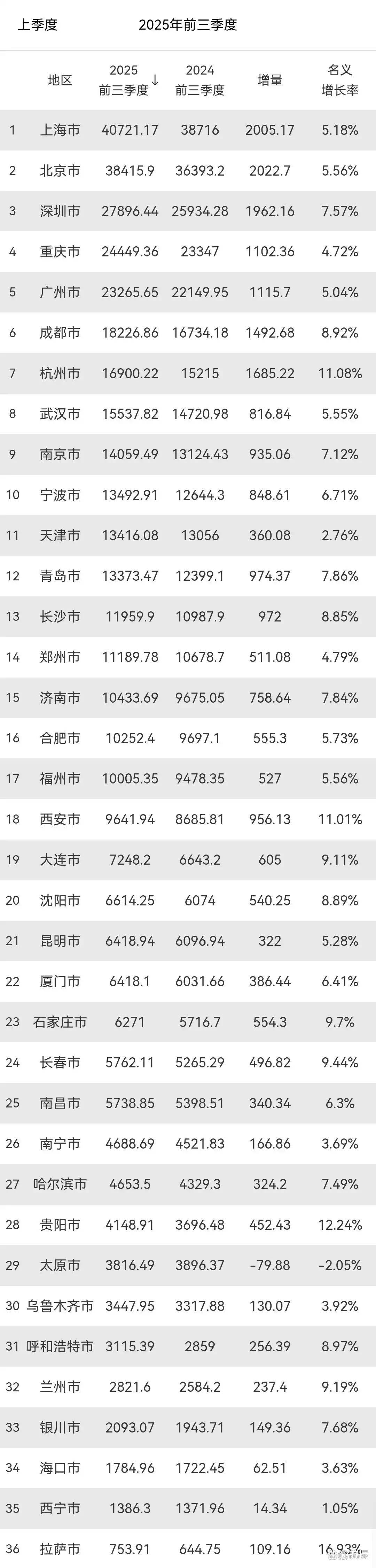
我国36个主要城市GDP更新:成都增速约9%,福州首破万亿,沈阳逆袭昆明!
Sou Hu Cai Jing· 2025-11-22 02:11
| | 地区 | 2025 | 2024 | 増量 | 名义 | | --- | --- | --- | --- | --- | --- | | | | 前三季度 | 前三季度 | | 增长率 | | | 1 上海市 | 40721.17 | 38716 | 2005.17 | 5.18% | | 2 | 北京市 | 38415.9 | 36393.2 | 2022.7 | 5.56% | | 3 | 深圳市 | 27896.44 25934.28 1962.16 | | | 7.57% | | 4 | 重庆市 | 24449.36 | 23347 | 1102.36 | 4.72% | | 5 | 广州市 | | 23265.65 22149.95 | 1115.7 | 5.04% | | 6 | 成都市 | | 18226.86 16734.18 | 1492.68 | 8.92% | | 7 | 杭州市 | 16900.22 | 15215 | 1685.22 | 11.08% | | 8 | 武汉市 | | 15537.82 14720.98 | 816.84 | 5.55% | | 0 | 南京市 ...