
电子商务

Search documents
极光月狐|京东集团2025年Q3,新业务成为新的增长亮点
Xin Lang Cai Jing· 2025-11-26 08:11
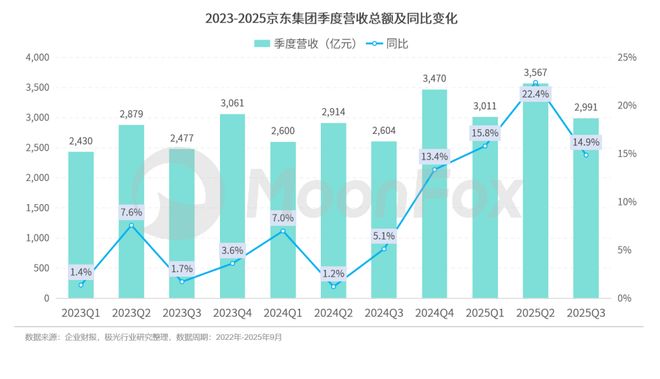
Overall Performance - JD Group achieved total revenue of 299.1 billion RMB in Q3 2025, representing a year-on-year growth of 14.9%, marking the first decline in quarterly revenue growth after four consecutive quarters of increase [2] - Net profit has dropped to the same level as in 2023, with a year-on-year decline exceeding 50% in Q3 [4] - Gross margin for Q3 was 16.8%, down 0.4 percentage points year-on-year, while net margin fell sharply from 4.7% last year to 2.1% [8] Cost Analysis - Operating costs reached 248.6 billion RMB in Q3, up 15.4% year-on-year, slightly exceeding revenue growth [11] - Marketing expenses surged to 21.05 billion RMB, a staggering increase of 110.5% year-on-year, accounting for 7.0% of revenue [11] - Fulfillment costs also rose significantly to 22 billion RMB, up 35.2% year-on-year, representing 7.4% of revenue [11] Business Analysis - In the first three quarters of 2025, service revenue accounted for 24% of total revenue, up 2 percentage points year-on-year, while product revenue decreased by 2 percentage points [13] - Product revenue in Q3 was 226.1 billion RMB, growing 10.5% year-on-year, while service revenue reached 73 billion RMB, a substantial increase of 30.8% [13] - New business revenue saw a remarkable growth of 213.7% year-on-year, totaling 15.6 billion RMB [16] Business Development - JD is expanding its offline stores and enhancing its online-offline retail service network, with over 20 JD MALL stores and more than 100 JD Electrical flagship stores operational by the end of Q3 [17] - The company is investing in AI technology to empower supply chain and vertical business applications, with significant partnerships established in the healthcare sector [17] - The launch of an independent "JD Takeout" app aims to enhance user retention and integrate local services, reflecting a comprehensive approach to local life services [18]


2477亿营收暴击!阿里云市占率碾压
Xin Lang Cai Jing· 2025-11-26 07:56
Core Insights - Alibaba's Q2 FY2026 results exceeded market expectations, with revenue reaching 247.8 billion RMB, showcasing significant improvement in core business profitability [1][2] - Alibaba Cloud's revenue grew by 34% year-on-year, and AI-related product revenue has maintained triple-digit growth for nine consecutive quarters [1] - Instant retail business revenue surged by 60% year-on-year, contributing to a double-digit increase in monthly active consumers on the Taobao app [1] Financial Performance - For the three months ending September 30, 2025, Alibaba reported a revenue of 247.8 billion RMB, a 5% increase compared to the previous year [2] - Key segments showed varied growth: - Cloud revenue increased by 34% - Instant retail revenue rose by 80% - International business revenue grew by 10% [2] - Despite strong financial results, Alibaba's stock experienced a decline, with Hong Kong shares down 1.33% and US shares down 2.31% on the reporting day [2] Market Position and Strategy - Alibaba's dual strategy of "deepening foundational models and accelerating industry solutions" is yielding results, with significant engagement from global developers [4] - The company is focusing on AI integration in both B2B and B2C sectors, aiming to capture more market share in AI cloud and instant retail [4] - Analysts remain optimistic about Alibaba's long-term prospects, with target prices from major investment banks indicating confidence in revenue growth driven by AI, cloud, and e-commerce synergies [4] Operational Efficiency - The financial report indicates a shift towards improved efficiency, with Alibaba Cloud becoming a core profit driver due to increased demand for AI services [5] - Instant retail metrics such as user retention and average order value have shown significant improvement, suggesting a transition from mere scale expansion to a balanced focus on scale and profitability [5] - Overall, Alibaba's Q2 results validate the resilience of its core business and the effectiveness of its AI and consumer strategy [5]


亚马逊据称正与美国运营商谈判 为Prime用户提供免费电话服务
Xin Lang Ke Ji· 2025-11-26 07:29
Group 1 - Amazon is negotiating with mobile carriers to offer low-cost or free mobile phone services to its Prime members in the U.S. [1] - Major U.S. carriers AT&T, Verizon, and T-Mobile saw their stocks drop over 5% following the news of Amazon's negotiations [1] - The negotiations have been ongoing for 6 to 8 weeks, with Amazon aiming for a wholesale price that would allow it to offer services at $10 per month or for free [1] Group 2 - Since Amazon raised the annual fee for Prime membership from $119 to $139, the number of Prime members has stagnated, indicating a decline in the service's attractiveness amid high inflation [2] - As of March 2023, approximately 167 million Amazon shoppers hold Prime membership, unchanged from the previous year [2] - Competitor Walmart offers a similar membership, "Walmart+", at $98 per year, with a lower free shipping threshold of $35 compared to Amazon's increased threshold of $150 [2]

六部门:有序发展直播电商、即时零售、策展零售、循环电商等新业态
Zheng Quan Shi Bao Wang· 2025-11-26 06:44
Core Insights - The Ministry of Industry and Information Technology, along with five other departments, has issued a plan to enhance the adaptability of supply and demand in consumer goods, promoting orderly development of platform consumption [1] Group 1: New Business Models - The plan encourages the orderly development of new business models such as live e-commerce, instant retail, curated retail, and circular e-commerce [1] - It supports platform enterprises in leveraging artificial intelligence to explore user needs and match products and services accordingly [1] Group 2: Technological Integration - The initiative promotes the application of digital technologies like virtual reality, metaverse, artificial intelligence, and blockchain to create multi-scenario, immersive consumer experiences [1] Group 3: Consumer Engagement and Responsibility - The plan aims to guide platform enterprises in conducting brand quality promotion activities to stimulate consumption [1] - It emphasizes the need for platform enterprises to take responsibility, including enhancing operator qualification reviews and product information verification [1] - The establishment of a rapid dispute resolution mechanism for consumer complaints is also highlighted [1]
格隆汇发布阿里巴巴FY2Q26更新报告
Ge Long Hui· 2025-11-26 06:41
Core Insights - Alibaba reported a solid FY2Q26 performance with total revenue of RMB247.8 billion, a 5% year-over-year increase, slightly above market expectations [1] - The company's Cloud Intelligence Group revenue grew 34% year-over-year, exceeding consensus estimates, while international digital commerce showed a 10% increase [1][2] - Adjusted EBITA dropped significantly by 77.6% year-over-year, primarily due to increased investments in quick commerce, although the overall outcome was better than feared due to strong cloud and AIDC performance [1][2] Revenue Performance - Alibaba's total revenue reached RMB247.8 billion, surpassing the consensus of RMB245.2 billion [1] - The Alibaba China E-commerce Group revenue grew 16% year-over-year to RMB132.6 billion, with customer management revenue rising 10% to RMB78.9 billion [1] - Cloud revenue increased by 34% year-over-year to RMB39.8 billion, ahead of the consensus of RMB37.93 billion [1][2] - International Digital Commerce revenue grew 10% year-over-year to RMB34.8 billion, below the consensus of RMB37.2 billion [1] Profitability and Margins - Non-GAAP net income to ordinary shareholders fell 71.3% year-over-year to RMB10.5 billion, which was 23% below consensus [1] - Adjusted EBITA decreased by 77.6% year-over-year to RMB9.07 billion, exceeding the consensus estimate of RMB6.87 billion [1] Cloud Business Insights - Cloud revenue growth accelerated to 34% year-over-year, with external customer revenue up 29% and internal customer revenue up 53% [2] - AI revenue now accounts for approximately 20% of external cloud revenue, marking the ninth consecutive quarter of triple-digit AI revenue growth [2] - The EBITA margin remained stable at 9%, reflecting ongoing strategic investments in AI [2] Capital Expenditure and Strategy - Alibaba's quarterly capital expenditure rose 80% year-over-year to RMB32 billion, contrasting with Tencent's decline [3] - The company aims to strengthen its AI infrastructure and full-stack capabilities, similar to global leaders like Google [3] E-Commerce and Quick Commerce - Customer management revenue in e-commerce grew 10% year-over-year, but management noted potential deceleration in growth due to competition and user investment intensity [4] - Quick commerce recorded an EBITA loss of approximately RMB36.4 billion in FY2Q26, but improvements in unit economics are expected to narrow losses in FY3Q26 [5] Valuation Insights - Alibaba's current trading price implies an enterprise value of US$356 billion, with consensus EBITDA forecasts suggesting potential upside [6] - The valuation gap compared to peers indicates meaningful upside potential if Alibaba can stabilize e-commerce profitability and improve visibility on quick-commerce losses [6]
大行评级丨花旗:阿里巴巴第二财季业绩稳健 评级“买入”
Ge Long Hui· 2025-11-26 06:11
Core Viewpoint - Citigroup published a report indicating that Alibaba's revenue for the second quarter of the fiscal year ending September 2026 increased by 5% year-on-year to 247.8 billion yuan, exceeding both Citigroup's and market forecasts by 2.1% and 1.1% respectively [1] Group 1 - Overall, Citigroup views this as a robust performance, with cloud business revenue surpassing expectations [1] - E-commerce business and total EBITA also outperformed market concerns [1] - Citigroup set a target price of $218 for Alibaba's U.S. stock, with a "Buy" rating [1]
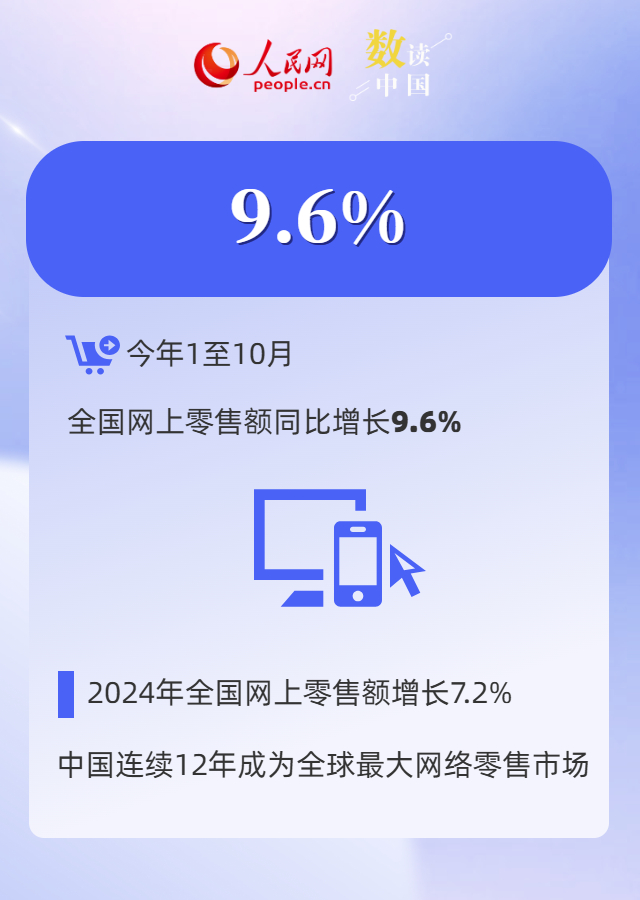
数读中国 9.6%!数看前十月电子商务发展“成绩单”
Ren Min Wang· 2025-11-26 05:21
Core Insights - E-commerce plays a significant role in boosting consumption, enhancing modern industrial systems, and expanding high-level openness in China, continuously releasing new momentum for business development [1] Group 1: E-commerce Growth Metrics - From January to October this year, the online retail sales of smart wearable devices, such as smart glasses and smartwatches, increased by 23.1%, while online service consumption grew by 21% [3] - The growth in online coupon purchases for offline dining experiences surged by 25.1%, and instant e-commerce sales rose by 24.3% [3] Group 2: Support for SMEs - Major e-commerce platforms conducted over 400 industry e-commerce matchmaking events, enhancing the digital transformation and flexible manufacturing capabilities of small and medium-sized enterprises (SMEs) [4] - The transaction volume in key monitored sectors, such as textiles and pharmaceuticals, increased by 5.5% and 3.4%, respectively [4] Group 3: Agricultural E-commerce - The online retail sales of agricultural products grew by 7.5%, while rural online retail sales increased by 9.5% from January to October [8] Group 4: International Cooperation and Initiatives - The "Silk Road E-commerce" cooperation has established 12 innovative practice cases, which are being replicated and promoted nationwide [10] - The "Silk Road E-commerce Benefits the World" initiative included 36 events aimed at promoting China's large market as a global opportunity, alongside the launch of "Silk Road Cloud Products" during the 8th China International Import Expo [10]
中概股重磅利好,多只明星股强势拉升
Yang Zi Wan Bao Wang· 2025-11-26 05:11
Group 1: Alibaba - Alibaba's latest financial report for Q2 of FY2026 shows a revenue increase of 34% year-on-year to 398.2 billion RMB, exceeding market expectations [2] - The total revenue for Alibaba in Q2 reached 2477.95 billion RMB, with a year-on-year growth of 4.8%, surpassing the market estimate of 2452 billion RMB [2] - The cloud intelligence group reported a revenue of 398.2 billion RMB, a 34% increase year-on-year, also exceeding market expectations [2][3] - AI-related product revenue has seen triple-digit year-on-year growth for nine consecutive quarters, indicating strong adoption among enterprise clients [3] - Alibaba Cloud holds the largest market share in China's AI cloud market at 35.8% [3] Group 2: NIO - NIO's Q3 financial report indicates a revenue of 217.9 billion RMB, reflecting a year-on-year increase of 16.7% and a quarter-on-quarter increase of 14.7% [4] - The company delivered 87,071 smart electric vehicles in Q3, marking a 40.8% year-on-year growth [4] - NIO's gross profit reached 30.2 billion RMB, a 50.7% increase year-on-year, with a gross margin improvement to 13.9% from 10.7% in the previous year [4] - As of the end of Q3, NIO's total cash and equivalents amounted to 367 billion RMB, a significant increase of nearly 10 billion RMB quarter-on-quarter [4] Group 3: Pony.ai - Pony.ai reported a total revenue of 181 million RMB for Q3, a substantial year-on-year growth of 72% [5] - The Robotaxi business generated revenue of 47.7 million RMB, with an impressive year-on-year increase of 89.5%, and passenger fare revenue surged over 200% [5] - The company anticipates achieving its goal of over 1,000 vehicles in its fleet ahead of schedule and plans to triple this number to over 3,000 by the end of 2026 [5]

安庆市兴隆汇电子商务有限公司成立 注册资本10万人民币
Sou Hu Cai Jing· 2025-11-26 02:18
Group 1 - A new company named Anqing Xinglonghui E-commerce Co., Ltd. has been established with a registered capital of 100,000 RMB [1] - The legal representative of the company is Cao Hongfei [1] - The business scope includes a wide range of retail and wholesale activities, such as hardware products, clothing, toys, and household goods [1] Group 2 - The company is involved in internet sales, excluding items that require special licenses [1] - It also engages in the manufacturing and sales of feather products, leather goods, and personal hygiene products [1] - Additional services include health care services (non-medical) and the sale of health food (pre-packaged) [1]
信达国际控股港股晨报-20251126
Xin Da Guo Ji Kong Gu· 2025-11-26 01:47
Market Overview - The Hang Seng Index has short-term support at the 25,000 point level, with recent hawkish signals from the Federal Reserve indicating limited rate cut space in 2026. The meeting between the US and Chinese leaders in October has temporarily eased tensions, but the core issues remain unresolved. The Chinese economy showed further signs of cooling in Q3, with the 14th Five-Year Plan focusing on expanding domestic demand and promoting technological self-reliance, aligning with expectations. However, there are no strong signals for short-term policy adjustments, making it difficult for Hong Kong stocks to see significant earnings improvements. The recent volatility in US tech stocks and concerns over AI industry valuations add to the profit-taking incentives as the Hang Seng Index has seen substantial gains this year [2][3]. Macro Focus - Hong Kong's exports in October increased by 17.5%, surpassing expectations, following a 16.1% rise in September. The total export value reached HKD 461.8 billion, while imports rose by 18.3% to HKD 501.7 billion, leading to a trade deficit of HKD 39.9 billion [8]. - The US PPI rose by 0.3% in September, driven by higher energy costs, indicating a resurgence in inflation. Retail sales in the US for September increased by only 0.2%, significantly below expectations, with auto sales being a major drag [8][9]. - The Chinese gaming market saw a revenue increase of 7.8% year-on-year in October, with mobile games contributing significantly to this growth [8]. Company News - Alibaba (9988) reported a 72% year-on-year decline in adjusted net profit for Q2, attributed to investments in instant retail, although its cloud business showed strong growth with a 34% revenue increase. The company faces supply chain challenges in AI server components, which may continue for the next two to three years [10]. - JD.com (9618) denied rumors of issuing exchangeable bonds worth at least USD 1 billion, clarifying that discussions are still in the early stages [10]. - Zhihu (2390) reported a widened adjusted loss of RMB 21 million for Q3, with total revenue declining by 22.02% year-on-year [10]. - Vitasoy (0345) saw a slight increase in half-year profit by 0.7% to HKD 170 million, despite a 6.3% drop in revenue due to weak market conditions in mainland China [10]. - Tuniu (0780) reported a 16.5% increase in adjusted net profit for Q3, with revenue rising by 10.4% [10]. - Chow Tai Fook (1929) reported a 0.2% increase in half-year profit to HKD 2.534 billion, with same-store sales in mainland China growing by 38.8% [10].