
小家电

Search documents
699元徕芬“打不过”399飞科?徕芬CEO怒怼前员工弟弟“收钱办事可以,不能没良心”,还称前员工靠出卖打击老东家获利,双方回应
Sou Hu Cai Jing· 2025-08-18 06:52
Core Viewpoint - The ongoing public dispute between Leifen Technology and former employee Pan, which has escalated into accusations and counter-accusations regarding product evaluations and business practices, highlights the competitive pressures in the small appliance market, particularly in the electric shaver and toothbrush segments. Group 1: Company Dispute - Leifen's CEO Ye Hongxin publicly criticized a review by blogger @楼斌Robin, claiming that the evaluation was biased and questioning the integrity of the review process [1][2] - Ye clarified that his criticism was directed at Pan, a former employee, and emphasized the importance of factual content in media evaluations [2] - The conflict intensified as Ye accused Pan of profiting from undermining Leifen after leaving the company, alleging that Pan received 5 million yuan upon departure in 2022 [4][6] Group 2: Market Performance - Leifen reported impressive sales figures during the 618 shopping festival, achieving a total sales amount of 5.3 billion yuan, with a year-on-year growth of 60% [9] - Despite strong sales, the small appliance market is becoming increasingly competitive, with many brands launching similar products, leading to a decline in product pricing and profit margins [9][10] - The electric shaver market is projected to see a decline in retail volume and value in 2024, with a 9.5% decrease in volume and an 8.1% decrease in retail value [10]


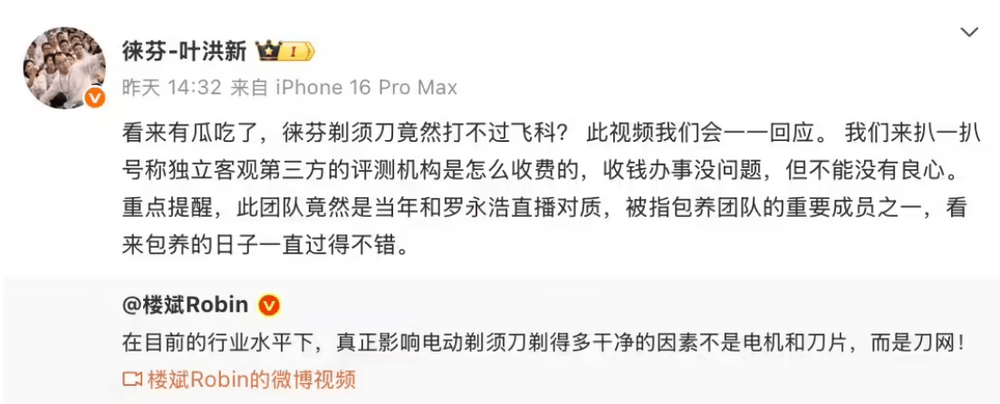
徕芬 CEO 叶洪新怼前员工风波结束,双方表示到此为止
Sou Hu Cai Jing· 2025-08-18 06:29
Core Viewpoint - The controversy surrounding the CEO of Laifen, Ye Hongxin, and former employee has reached a resolution, with both parties indicating a desire to move on from the issue [1][3]. Group 1: Company Response - Ye Hongxin, CEO of Laifen, responded to a product review video by critic, Lou Bin, suggesting that Laifen's shaver could not compete with Feike's products and indicated that the company would address the review [3][4]. - Ye criticized the review process of independent evaluators, implying that they may lack integrity and are motivated by financial incentives [4][6]. - The CEO also pointed out that Lou Bin's brother, Pan Jian, a former employee of Laifen, has been profiting from negative commentary about the company since leaving [5][7]. Group 2: Product Evaluation - Lou Bin's review highlighted that the performance of Laifen's shaver was only at a conventional level, questioning the value of the pricing at 699 yuan for a three-blade model and 499 yuan for a single-blade model [1][5]. - Lou Bin noted that the material used in Laifen's shaver, specifically the nickel-cadmium blade net, could cause allergic reactions, although he acknowledged similar issues with other brands [1][5]. - In contrast, Lou Bin praised the Feike F8 shaver, indicating a strong impression of its quality compared to Laifen's offerings [1].

石头科技(688169):公司信息更新报告:2025Q2主业利润率拐点已现超预期,期待新品+新品类+新市场持续增量
KAIYUAN SECURITIES· 2025-08-17 12:28
Investment Rating - The investment rating for the company is "Buy" (maintained) [5] Core Views - The company has shown an unexpected turning point in its main business profit margin, with expectations for continuous revenue growth driven by new products, new categories, and new markets [5][6] - The company reported a revenue of 4.48 billion yuan in Q2 2025, representing a year-on-year increase of 73.8%, while the net profit attributable to the parent company was 410 million yuan, down 43.2% [5] - The report anticipates an improvement in profitability starting from Q3 2025, with a projected net profit of 2.02 billion yuan for 2025, reflecting a slight increase from previous estimates [5][6] Financial Summary - For Q2 2025, the company achieved a gross margin of 43.9%, a decrease of 8.0% year-on-year, primarily due to increased tariffs in North America and a higher proportion of lower-margin products [7] - The company expects to see a significant increase in sales of its sweeping and washing machines, with domestic sales projected to grow approximately 50% and 250% respectively [6] - The forecast for 2025-2027 indicates net profits of 2.02 billion, 3.08 billion, and 3.92 billion yuan respectively, with corresponding EPS of 7.79, 11.87, and 15.12 yuan [5][9] Market Performance - The company has seen a significant increase in market share for its washing machines, with online sales in China reaching a market share of 23.2%, up 20.1 percentage points [6] - In the European market, the company expects a growth of over 50%, with market share in Germany projected to reach 40% [6] - The North American market is anticipated to grow by over 30%, with expectations of a recovery in growth rates as tariff impacts diminish [6]

利仁科技:第四届董事会第三次会议决议公告
Zheng Quan Ri Bao· 2025-08-15 12:49
Core Viewpoint - Liren Technology announced the approval of a proposal to use idle raised funds for cash management during the third meeting of its fourth board of directors [2] Group 1 - The board meeting was held on August 15, where the proposal was reviewed and approved [2]
2025年中国小家电行业调研简报-20250815
Tou Bao Yan Jiu Yuan· 2025-08-15 12:36
Investment Rating - The report does not explicitly provide an investment rating for the small home appliance industry Core Insights - The small home appliance market in China is categorized into kitchen appliances, home appliances, and personal care appliances, emphasizing portability and functionality [3][4] - Online sales channels for small home appliances have significantly increased, with online sales accounting for 79% of total sales by 2024, reflecting a clear shift towards e-commerce [9][12] - The kitchen small appliance market is projected to have a retail value of 609 billion yuan in 2024, showing a slight decline of 0.8% year-on-year, with online sales being the main growth driver [18][19] - The personal care small appliance market is diverse, with notable growth in hair dryers but declines in electric toothbrushes and shavers, indicating varied performance across product categories [24][27] Summary by Sections Small Appliance Definition and Classification - Small appliances are defined as compact, convenient, low-energy, and affordable household devices that enhance the quality of life [3] - Categories include kitchen appliances, home appliances, and personal care appliances [3][4] Sales Channel Distribution - The sales channels for small appliances are increasingly diversified, with a strong shift towards online platforms, which dominate the market [12] - Traditional retail channels are facing challenges and are in a period of adjustment, while new channels like community group buying are emerging [12] Kitchen Small Appliance Market - The kitchen small appliance market's retail value is expected to be 609 billion yuan in 2024, with online sales reaching 478 billion yuan, a 1.7% increase [18][19] - The market is segmented into traditional large items, health-oriented small items, Western-style appliances, and rapidly penetrating but previously stagnant categories [19][20] Personal Care Small Appliance Market - The personal care small appliance market shows mixed results, with hair dryers experiencing a 10.4% increase in retail sales, while electric toothbrushes and shavers face declines [24][27] - The market dynamics are influenced by social media platforms and the immediacy of retail needs [24][27] Competitive Landscape - The small appliance market in China is characterized by high brand concentration, with leading brands like Midea, Supor, and Joyoung holding over 50% market share in kitchen appliances [35] - The competitive landscape includes a mix of established brands and emerging players, with a trend towards innovation and technology integration in product offerings [36]
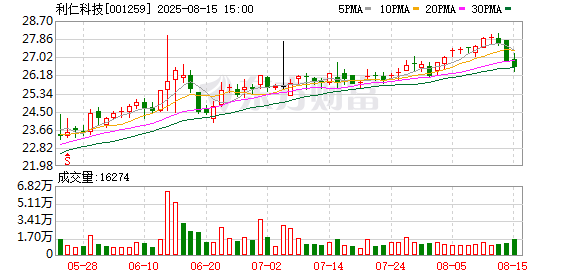
利仁科技:8月15日召开董事会会议
Mei Ri Jing Ji Xin Wen· 2025-08-15 09:15
利仁科技(SZ 001259,收盘价:26.54元)8月15日晚间发布公告称,公司第四届第三次董事会会议于 2025年8月15日在公司会议室召开。会议审议了《关于使用闲置募集资金进行现金管理的议案》。 2024年1至12月份,利仁科技的营业收入构成为:小家电行业占比100.0%。 (文章来源:每日经济新闻) ...
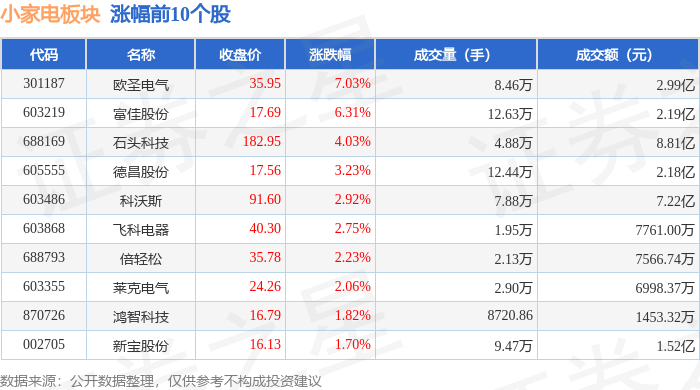
小家电板块8月15日涨2.39%,欧圣电气领涨,主力资金净流入9477.32万元
Zheng Xing Xing Ye Ri Bao· 2025-08-15 08:37
Market Performance - The small home appliance sector increased by 2.39% on August 15, with Ousheng Electric leading the gains [1] - The Shanghai Composite Index closed at 3696.77, up 0.83%, while the Shenzhen Component Index closed at 11634.67, up 1.6% [1] Key Stocks in Small Home Appliance Sector - Ousheng Electric (301187) closed at 35.95, up 7.03% with a trading volume of 84,600 shares and a transaction value of 299 million [1] - Fujia Co., Ltd. (603219) closed at 17.69, up 6.31% with a trading volume of 126,300 shares and a transaction value of 219 million [1] - Stone Technology (681889) closed at 182.95, up 4.03% with a trading volume of 48,800 shares and a transaction value of 881 million [1] - Other notable stocks include Dechang Co., Ltd. (605555) up 3.23%, and Ecovacs (603486) up 2.92% [1] Capital Flow Analysis - The small home appliance sector saw a net inflow of 94.77 million from institutional investors, while retail investors experienced a net outflow of 26.44 million [2] - The main capital inflow was observed in stocks like Ecovacs and Fujia Co., Ltd., while significant outflows were noted in Stone Technology and Dechang Co., Ltd. [3] Individual Stock Capital Flow - Ecovacs had a net outflow of 36.01 million from main capital, with a 4.99% share of main capital [3] - Fujia Co., Ltd. saw a net inflow of 34.37 million from main capital, representing 15.66% of its total [3] - Stone Technology experienced a net inflow of 25.24 million from main capital, but a significant outflow of 70.10 million from speculative capital [3]


泳池机器人厂商进军小型潜水艇赛道;清洁品牌新业务先拉订单后研发;割草机厂商「高端方案」实测崩盘丨鲸犀情报局Vol.17
雷峰网· 2025-08-15 08:28
Group 1 - A pool robot manufacturer focuses on in-house production and rigorous testing, including extreme environment tests, to ensure product quality [2] - The founder plans to invest 20 million to develop a prototype for a small submarine targeting tourist attractions [2] - A small home appliance company misjudged the market, leading to an 80 million loss on its second product due to high marketing costs and poor sales performance [3][4] Group 2 - A cleaning brand's cross-industry hardware line struggles with product definition and internal team conflicts, leading to a lack of progress [4] - The brand's strategy of securing orders before product development has proven ineffective in the hardware sector [4] - A 3D printer company ended its investment collaboration with a laser engraving company after only four months, leading to competition between the two [5] Group 3 - A personal care company failed to protect its product innovation with patents, resulting in competitors replicating its features and launching negative marketing campaigns [5] - An intelligent appliance company's overseas market struggles are compounded by frequent leadership changes and declining profit margins [6][7] - A smart garden robot company maintains strict confidentiality about its operations and has reportedly shipped over 100,000 units this year [6] Group 4 - A laser engraving company faced significant losses due to leaked core technology, which allowed competitors to release similar products ahead of its planned launch [7] - A storage giant's performance is heavily reliant on external factors like natural disasters and geopolitical events, leading to unstable revenue [7] - An industrial manufacturer is cautiously entering the smart lawn mower market with a modest investment, aiming for realistic sales targets [8] Group 5 - A lawn mower manufacturer faced poor market reception in North America due to technical failures in its high-end product, resulting in negligible sales [9] - User feedback highlighted severe operational issues, including frequent malfunctions and inability to recognize obstacles [9]

欧圣电气(301187):空压机与清洁工具出海龙头,养老护理业务助力远期成长
Guoxin Securities· 2025-08-15 06:49
Investment Rating - The report gives an "Outperform" rating for the company [6]. Core Insights - The company is a leading exporter of air compressors and cleaning appliances, with a strong focus on overseas markets and a growing presence in the elderly care sector through its nursing robots [1][15]. - The company is expected to achieve a compound annual revenue growth rate of 24% from 2019 to 2024, reaching 1.76 billion yuan in revenue, with a compound annual profit growth rate of 34% to 250 million yuan [1][4]. - The global market for pneumatic tools is projected to exceed $10 billion, with strong demand in North America and Europe, indicating a robust growth opportunity for the company [2][34]. Company Overview - The company specializes in small piston air compressors and cleaning appliances, primarily exporting to North America, and has established long-term partnerships with major retailers and brands [15][25]. - The company has a high self-manufacturing rate of over 80% for its motors, which enhances its research and development capabilities [3][22]. - The company has a strong customer and channel advantage, ensuring customer stickiness and profitability through deep cooperation with major clients [3][22]. Industry Analysis - The overseas tools market is characterized as a long-term growth sector, with significant demand for pneumatic and electric tools, as well as cleaning appliances [2][34]. - The cleaning appliance market is expected to reach approximately $30 billion globally, with strong demand in both residential and commercial sectors [51][55]. - The elderly care market is anticipated to grow significantly due to the increasing aging population in China, with a projected total demand exceeding 200 billion yuan [63][65]. Financial Performance - The company is expected to achieve net profits of 329 million yuan, 432 million yuan, and 549 million yuan in 2025, 2026, and 2027, respectively, with corresponding earnings per share of 1.29, 1.69, and 2.15 yuan [4][5]. - The company's revenue is projected to recover in 2024 after a decline in 2022-2023, with a significant year-on-year growth of 61.3% in Q1 2025 [25][26]. - The company maintains a high dividend payout ratio, reflecting its strong cash flow and financial health [30][32].
国信证券晨会纪要-20250815
Guoxin Securities· 2025-08-15 01:19
Macro and Strategy - In July, new social financing in China was 1.16 trillion yuan, lower than the expected 1.41 trillion yuan, with new RMB loans decreasing by 500 billion yuan, indicating a rare negative growth [9][10] - The structure of social financing showed a dual characteristic of resilience and differentiation, with government financing contributing significantly to the increase [10][11] - The overall social financing growth rate rose to 9.0%, with a year-on-year increase of 3.893 billion yuan, primarily driven by government bonds and direct financing [10][11] Real Estate Industry - In the first half of 2025, new residential sales in China decreased by 4% year-on-year, with total sales area at 460 million square meters [18][19] - The sales of existing homes have increased, with the proportion of second-hand homes in total residential transactions rising to 46% in 2024, up from the lowest point in 2021 [19][20] - The competition landscape in the real estate sector is stabilizing, with major state-owned enterprises maintaining their positions in sales rankings [21][22] Food and Beverage Industry - The white liquor sector is showing signs of recovery in sales, with improved performance in August following a challenging second quarter [22][23] - Moutai's mid-year performance demonstrated resilience, with a revenue increase of 9.2% year-on-year, reflecting the industry's adjustment to market pressures [23][24] - The overall valuation of the white liquor sector is expected to enter a recovery phase, supported by positive policy expectations and improved consumer demand [24] Banking Industry - The cross-border payment landscape is evolving, with significant players like Ant International and Lianlian Digital shaping the competitive dynamics [25][26] Home Appliances and Light Industry - The home appliance sector is expected to see stable growth in domestic sales, driven by government subsidy policies, despite facing challenges from tariffs [26][27] - The white goods segment is benefiting from strong domestic demand, while the black goods segment is experiencing price improvements due to cost reductions [27][28] Energy Sector - The domestic oil and gas production is on the rise, with the Guyana Yellowtail project being brought into production ahead of schedule, indicating strong operational performance [34][36]