酒类

Search documents
中经酒业周报∣5月中国啤酒出口量同比增52.9%,美团闪购“618”白酒成交额增长超10倍,2025四川国际美酒博览会开幕
Xin Hua Cai Jing· 2025-06-20 07:06
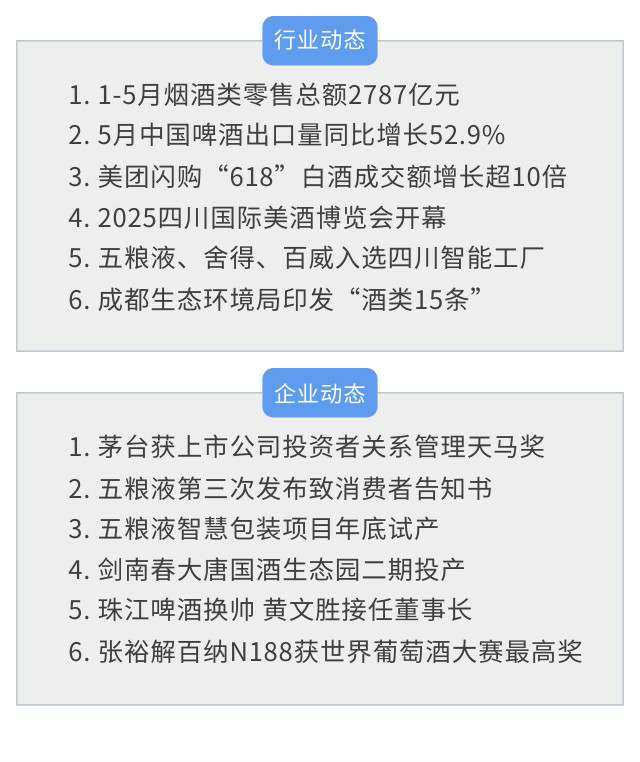
Industry Dynamics - In the first five months, the retail sales of tobacco and alcohol reached 278.7 billion yuan, with a year-on-year growth of 6.7% [4] - In May, China's beer export volume increased by 52.9% year-on-year, totaling 78.41 million liters, while the export value rose by 59.6% to 406.94 million yuan [4] - During the "618" shopping festival, Meituan's flash purchase platform reported a more than tenfold increase in white liquor sales compared to the same period last year [5] - The 2025 Sichuan International Wine Expo opened, featuring over 100 renowned wine companies from more than 10 countries [5] - Three companies, including Wuliangye, Shede, and Budweiser, were selected as advanced intelligent factories in Sichuan for 2025 [5] - Chengdu's ecological environment bureau issued "15 measures" to support the high-quality development of the liquor industry [6] Company Dynamics - Kweichow Moutai won the "Investor Relations Management Tianma Award" for its outstanding practices and shareholder returns [7] - Wuliangye issued a consumer notice clarifying that it has never sold a product called "Light Bottle Eighth Generation Wuliangye," which violates food safety laws [7] - Wuliangye's new smart packaging project is expected to enter trial production by the end of this year, with an estimated annual sales of over 3 billion yuan [8] - Jian Nan Chun's second phase of the Grand Tang National Liquor Ecological Park began production, adding 30,000 tons of quality raw liquor capacity and creating 3,000 jobs [9] - Zhujiang Beer announced a leadership change, with Huang Wensheng appointed as the new chairman [9] - Zhangyu Cabernet N188 won the highest award at the Decanter World Wine Awards, marking a significant achievement for Chinese wine [9]



天佑德酒(002646) - 青海互助天佑德青稞酒股份有限公司投资者关系活动记录表2025.6.19
2025-06-20 06:35
Group 1: Company Strategy - The company’s strategy includes "county-based" development as part of its "Four Modernizations" strategy, which also encompasses youth-oriented, international, and terminal-focused approaches [3] - County-based marketing is prioritized due to its alignment with the current economic environment in China, where county-level markets are less affected by economic pressures [3] - The company aims to optimize its product and marketing strategies to reflect county characteristics, especially within Qinghai Province [3] Group 2: Product and Market Development - The company has a diverse product range in the light bottle liquor market, including brands like Huzhu Daqu and Bai Qingke, with Bai Qingke performing notably well in the province [4] - Adjustments have been made to expand channels outside Qinghai, focusing on light bottle liquor and mid-range boxed liquor to align with market trends [4] - The company is responding to the trend of rational consumption by optimizing its product structure [4] Group 3: Regulatory Impact - The impact of the alcohol ban on regional famous liquors is relatively minor, as the company’s main products cater to daily consumer needs [5] - The company is accelerating its county-based strategy to mitigate the effects of the ban and is focusing on differentiating its products, particularly those made from barley [5] Group 4: Product Line Management - The star product series, which generates the highest sales, has undergone brand revitalization and the introduction of new variants to enhance visibility during key holidays [6] - The company is implementing volume control and price standardization across online channels to maintain profitability at retail points [6] Group 5: Youth-Oriented Products - The company is exploring the launch of youth-oriented products, including fruit-flavored options and a low-alcohol lemon liquor, with plans for a barley champagne in the future [7]

酒类股发力走高,皇台酒业涨停,金种子酒等拉升
Zheng Quan Shi Bao Wang· 2025-06-20 02:37
Company - The stock prices of liquor companies surged on the 20th, with Huangtai Liquor reaching the daily limit, Jinzhongzi Liquor rising over 8%, and other brands like Yingjia Gongjiu, Yanjing Beer, and Gujing Gongjiu increasing by over 4% [1] - Jinzhongzi Liquor announced a change in its business scope from "production of liquor and other alcoholic beverages" to "production of alcoholic products" to comply with the new regulatory requirements, emphasizing that there is no change in its main business focus on liquor [1] Industry - The liquor industry is currently in an adjustment period, facing short-term pressure from policies and pricing, leading to a gloomy sentiment in the sector [1] - The implementation of "prohibition orders" in multiple regions since May has heightened market concerns regarding liquor, with strict enforcement of regulations affecting time and scenarios for consumption [1] - Long-term, new policies are expected to drive the transformation and upgrading of the liquor industry, focusing on quality innovation to meet diverse consumer demands [2] - The liquor sector is currently at a valuation bottom, with low expectations for fundamentals, making it more attractive for investment after a rapid decline [2] - The competition within the liquor industry is intensifying, with a trend towards concentration, where leading companies are expanding their market share through brand barriers and strategic upgrades [2]


阿尔巴尼亚特色烈酒邂逅中国白酒“国标十二香”
Xiao Fei Ri Bao Wang· 2025-06-19 08:37
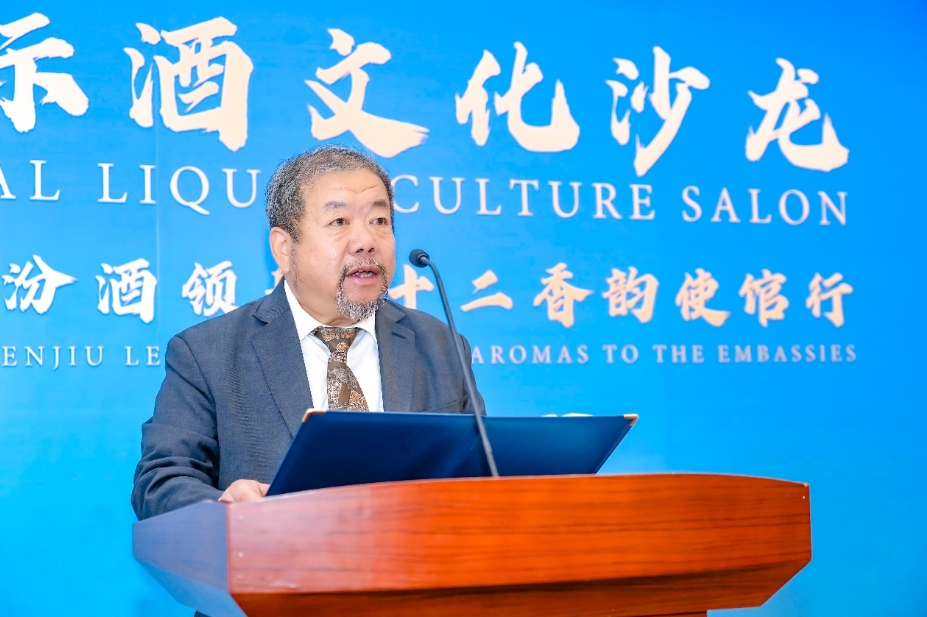
Group 1 - The event "2025 International Wine Culture Salon and Fenjiu Leading Twelve Aroma Embassy Tour" aims to enhance Sino-Albanian friendship through cultural exchange via fine wine and food [3][5] - The first event took place at the Thai Embassy in China, receiving positive feedback for exploring the fusion of Thai cuisine and Chinese Baijiu [3] - The event at the Albanian Embassy further solidifies the friendship between China and Albania, promoting trade cooperation in consumer goods [3][5] Group 2 - Albanian Ambassador Riza Poda highlighted the unique flavor of Rakija, a traditional Albanian spirit, and expressed hopes for deepening ties with China through this event [3][5] - Fenjiu, a representative of Chinese traditional liquor, has gained international recognition since winning a gold medal at the 1915 Panama International Exposition, now exported to over 70 countries [5] - The tasting session introduced the twelve aroma types of Chinese Baijiu, allowing guests to experience the rich flavors and cultural exchange between Chinese and Albanian spirits [7]

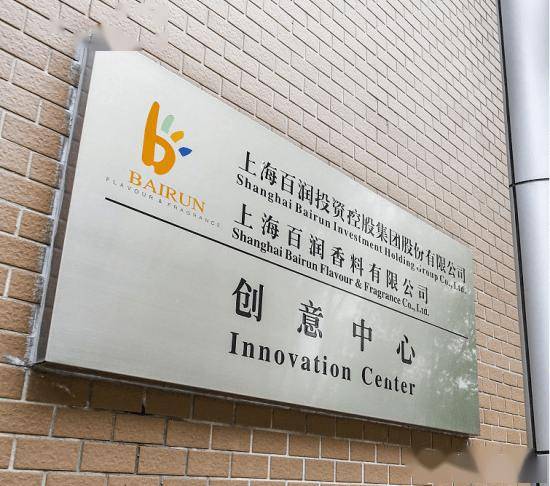
百润股份高管李永峰担任副总经理不满1年 2024年薪酬却比董事长高?
Sou Hu Cai Jing· 2025-06-19 06:00
Core Viewpoint - Baijun Co., Ltd. reported a decline in both revenue and net profit for the year 2024, while executive compensation saw an increase, raising questions about management practices and performance alignment [1][3]. Financial Performance - The company achieved revenue of approximately 3.048 billion yuan, representing a year-on-year decrease of 6.61% [3]. - The net profit attributable to shareholders was about 719 million yuan, down 11.15% compared to the previous year [3]. Executive Compensation - Executive compensation for 2024 was notably high, with Vice President Li Yongfeng earning 1.697 million yuan, surpassing other executives [3]. - Other vice presidents, Ma Liang and Lin Liying, received salaries of 1.645 million yuan and 1.56 million yuan, respectively [3]. - Chairman Liu Xiaodong's salary was reported at 1.38 million yuan, while the board secretary Wang Chen earned 131,500 yuan [3]. Management Background - Li Yongfeng, born in 1973 and holding a Master's degree in Business Administration, has a relevant background in the company's core business [3]. - He worked at Shanghai Baijun Investment Holding Group from 2016 to September 2021, serving as the General Manager of the Flavor Division [3]. - Li was promoted to Vice President in September 2024, raising questions about whether his reported salary reflects the full year or only the period after his promotion [3]. Shareholding Information - Despite Li Yongfeng's high salary, he holds only 28,000 shares, significantly lower than Lin Liying's 3.768 million shares [3].

投资策略报告:2025年消费新趋势与投资机会深度分析-20250618
Jianghai Securities· 2025-06-18 11:09
Group 1 - The report highlights the significant growth of China's consumption market, which reached 48.8 trillion yuan in 2024, with a year-on-year increase of 3.5% [10][11] - Service retail sales in China grew by 6.2% in 2024, outpacing goods retail sales by 3 percentage points, indicating a shift towards service consumption [10][18] - The penetration rate of new energy vehicles (NEVs) is expected to exceed 50% by 2025, driven by policy support and technological innovation, with sales growth projected at nearly 30% [23][71] Group 2 - The traditional consumption sectors are experiencing diverse growth, particularly in the automotive sector, where NEVs are the main growth driver, with sales of 1.29 million units in 2024, a year-on-year increase of 35.5% [21][22] - The home appliance market saw significant growth in 2024, with total revenue reaching 1.95 trillion yuan, a 5.6% increase from the previous year, supported by government policies [28][30] - The liquor industry is entering a phase of stock competition, with high-end brands like Moutai and Wuliangye showing stable revenue, while overall production has been declining since 2016 [33][39] Group 3 - The report identifies emerging consumption trends, such as the pet economy, which is projected to exceed 300 billion yuan in 2024, driven by increased pet ownership and higher spending per pet [59][60] - The潮玩 (trendy toy) industry is expected to grow at a compound annual growth rate of 24% from 2022 to 2026, with retail sales projected to reach 110.1 billion yuan by 2026 [62][74] - The beauty economy, encompassing cosmetics, personal care, and medical aesthetics, is also expanding, with the cosmetics retail sales reaching 114.9 billion yuan in the first quarter of 2025, a 3.2% year-on-year increase [69][70]
展会+销场+活动,酒博会火力全开“促消费”
Sou Hu Cai Jing· 2025-06-18 08:22
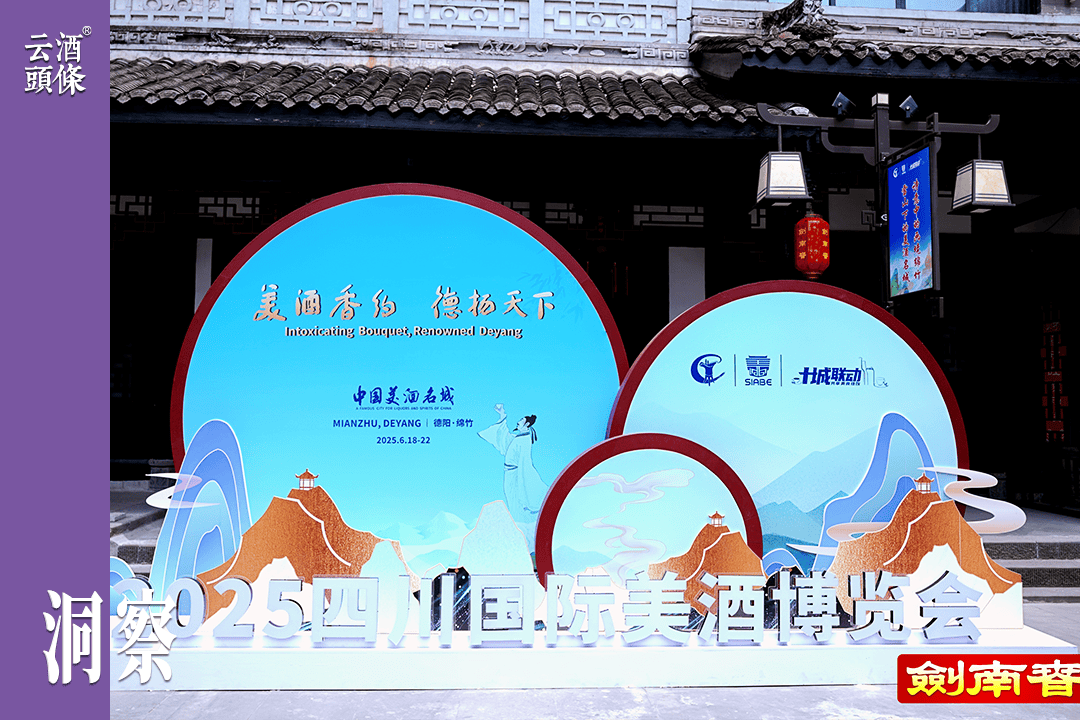
Core Insights - The liquor industry is becoming a leader in boosting consumption, with significant growth observed during the 618 shopping festival, particularly on platforms like Tmall and JD, where major brands like Jian Nan Chun saw a sales increase of 284% [2] - The Sichuan International Wine Expo, held in Mianzhuz City, gathered over 100 renowned liquor companies from more than 10 countries, focusing on activating liquor consumption through various activities [2][4] Industry Growth - Online liquor sales have shown double-digit growth across various categories, including domestic white liquor, wine, and yellow wine during the 618 shopping festival [2] - The Mianzhuz region, known for its favorable conditions for liquor production, has been recognized as a "Chinese Famous Liquor City" and a "World Famous Liquor Specialty Region," with 106 liquor enterprises contributing significantly to production and revenue [14] Event Highlights - The wine expo featured five immersive exhibition areas showcasing a variety of liquor types, creating a vibrant atmosphere that highlighted the cultural significance of liquor [3] - A series of 22 events were organized during the expo, including the "Hua Xia Aesthetics Conference" and discussions on the high-quality development of the liquor industry, emphasizing cultural value and industry trends [7][9] Cultural Significance - The expo emphasized the cultural heritage of liquor production, with activities led by national-level inheritors of intangible cultural heritage, promoting the craftsmanship of liquor making [4][9] - Jian Nan Chun's historical significance was showcased through events that connected its 1500-year legacy with modern innovations, including AI technology to enhance cultural storytelling [9][18] Production Capacity - Jian Nan Chun has expanded its production capabilities with the establishment of a new eco-friendly distillery, increasing its capacity by 50,000 tons of quality base liquor [16] - The region's unique geographical and climatic conditions contribute to the high quality of its liquor, supported by a long-standing tradition of craftsmanship [14][18]
这一板块,盘中拉升!
Zhong Guo Ji Jin Bao· 2025-06-18 02:58
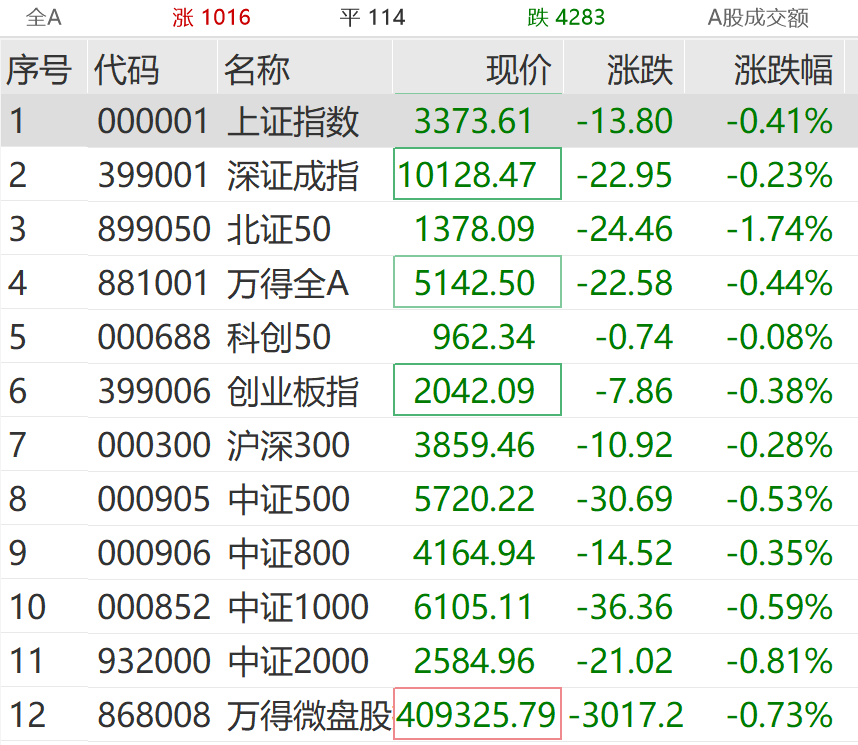
Market Overview - A-shares opened slightly lower on June 18, with all major indices in the red and over 4200 stocks declining [1] - The Shanghai Composite Index fell by 0.41% to 3373.61, while the Shenzhen Component decreased by 0.23% to 10128.47 [2] Sector Performance - The food and beverage sector showed initial strength, particularly in liquor stocks, with notable gains from companies like Mogaos, Huangtai Wine, and Jinzhongzi Wine, all hitting the daily limit [5][6] - The photovoltaic inverter, liquor, military, and digital currency sectors experienced localized rallies, while rare earth permanent magnet stocks saw significant pullbacks [3][11] Liquor Industry Insights - During the "618" shopping festival, several e-commerce platforms initiated aggressive price cuts on liquor, with high-end products like Feitian Moutai seeing price drops, which has become a key market variable [7] - Specific liquor stocks such as Mogaos, Huangtai Wine, and Jinzhongzi Wine reported increases of approximately 10% [6] Oil and Gas Sector Activity - The oil and gas sector was notably active, with companies like Zhun Oil and Beiken Energy experiencing substantial gains, attributed to rising international oil prices amid escalating geopolitical tensions in the Middle East [8][9] Defense and Military Sector - The defense and military sector saw significant upward movement, with stocks like Changcheng Military Industry hitting the daily limit and others like Beifang Longzhong and Jiekang Equipment rising over 10% [10] Consumer Sector Weakness - The broader consumer sector faced challenges, with retail stocks declining, particularly in the small commodity market, where Xiaoshangpin City dropped over 9% [11][12] - The beauty and personal care sector also experienced declines, with several companies reporting drops exceeding 5% [13] Rare Earth Sector Decline - Rare earth permanent magnet stocks faced notable declines, with companies like Beikong Technology nearing the daily limit down, and others like Zhongke Magnetic and Keheng shares dropping over 9% [15][16]




酒税提高至90%!或将为越南带来9400万美元的收入!
Sou Hu Cai Jing· 2025-06-17 12:49
Core Viewpoint - Vietnam's new tax policy on alcoholic beverages, increasing the tax rate from 65% to 90%, is expected to significantly impact the country's beer industry and reshape the Southeast Asian alcohol consumption landscape [2][3][12]. Tax Policy Changes - The Vietnamese National Assembly approved a tax increase on alcoholic beverages, with the tax rate set to rise to 90% by 2031, starting with a gradual increase to 70% by 2027 [3][12]. - Alcoholic beverages with an alcohol content over 20% will face a 90% tax rate, while those below 20% will see an increase from 35% to 60% [3][7]. Industry Impact - The tax increase is likely to severely affect Vietnam's already struggling beer industry, leading to stock price fluctuations among alcohol companies [5][12]. - Heineken has already suspended operations at one of its breweries in Vietnam in response to declining demand and initial tax proposals [5]. Market Dynamics - Vietnam is the second-largest beer market in Southeast Asia, but sales have been declining significantly in recent years [5]. - The wine market in Vietnam is small, accounting for only about 1% of total alcohol consumption, with beer and spirits making up 91% and 8%, respectively [9]. Growth Potential - Despite the tax increase, the wine market in Vietnam is projected to grow, with an expected market size of $382.2 million by 2029 and a compound annual growth rate of 11.5% [11]. - The rising middle class, currently 15% of the population, is expected to double by 2026, increasing demand for quality and imported wines [11]. Consumer Preferences - Over 65% of consumers prefer red wine, while white wine and sparkling wine are gaining popularity, particularly in southern Vietnam [16]. - The market is becoming more premium as wealth increases, with consumers increasingly choosing based on taste rather than trends [16]. Regional Context - Vietnam's market offers a stable export option for European producers amid global trade tensions, with Chilean wines being the most popular [13][14].
糖业帝国的余晖–古巴朗姆酒的生存危机 是否是广西的机会
Sou Hu Cai Jing· 2025-06-16 06:46
Core Insights - The Cuban rum industry, once thriving, is facing an unprecedented crisis due to the collapse of its sugar industry, which is essential for rum production [2][3][6] - Sugar production in Cuba has drastically decreased from over 8 million tons in the late 1980s to approximately 350,000 tons in the 2022/23 season, with projections for the 2024/25 season dropping below 200,000 tons, marking the lowest levels since the 19th century [2][3] Sugar Industry Crisis - The sharp decline in sugar production highlights a structural crisis within an industry that was once a pillar of the Cuban economy, now producing only 1/40th of its peak output [3] - The shortage of sugar has led to a critical lack of molasses, the key ingredient for rum production, affecting both local distilleries and international partnerships [3][4] - Various factors such as U.S. sanctions, energy shortages, mismanagement, insufficient investment, aging equipment, natural disasters, and labor shortages have contributed to the industry's decline [3] International Collaboration Challenges - The crisis has impacted successful international collaborations, such as the Havana Club brand, which has grown from 400,000 cases to over 4 million globally since 1993 [4] - Even major international companies like Pernod Ricard and Diageo are struggling to secure raw materials, raising concerns about the sustainability of rum production in the future [4] Regulatory and Economic Implications - Strict regulations in Cuba prohibit the import of spirits or production materials, exacerbating the industry's challenges and threatening the country's economic image [6] - The lack of molasses not only poses an economic issue but also jeopardizes one of Cuba's last significant sources of hard currency [6] Alternative Solutions in Guangxi, China - In contrast, Guangxi, China, is exploring a different path for its sugar industry by developing a rum production project that integrates the entire value chain from sugarcane to rum [7] - The region is investing in modern production facilities and innovative practices, aiming to create a circular economy that utilizes all by-products of sugarcane [7][9] - Guangxi's rum industry is projected to generate significant economic value, with efforts to enhance marketing, brand recognition, and consumer culture to compete with international giants [9] Conclusion - The crisis in the Cuban rum industry reflects broader economic challenges, emphasizing the need for investment, technological innovation, and flexible policies to remain competitive in a globalized market [10]