科技股

Search documents
黄金白银,能抄底了吗?
Sou Hu Cai Jing· 2026-02-02 11:54
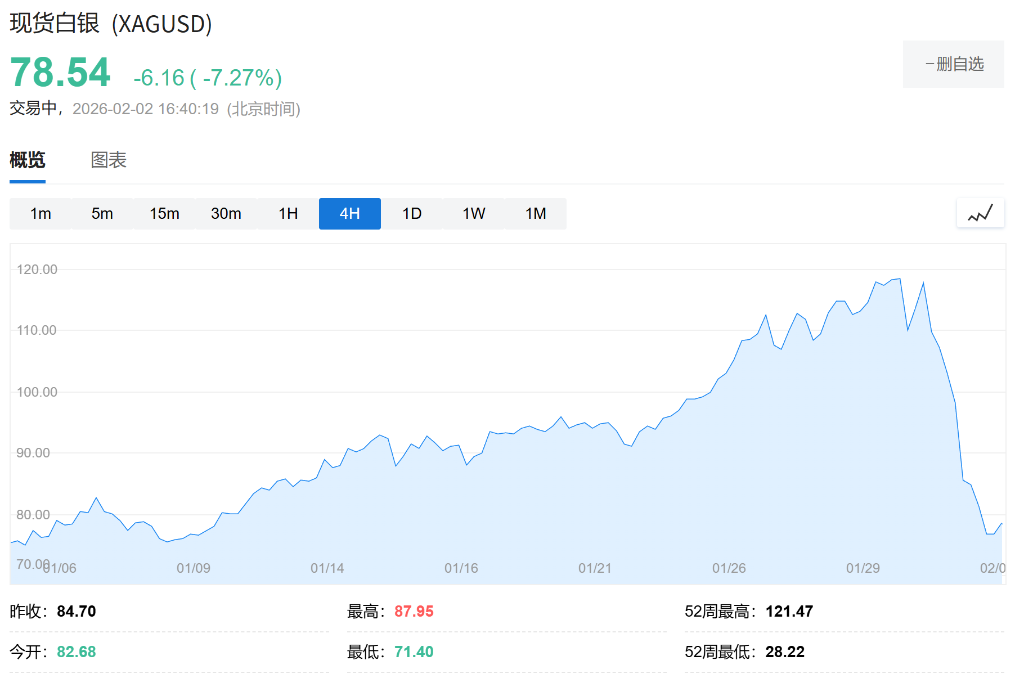
周一的贵金属市场延续周五下跌趋势,现货黄金一度跌到4400美元关口。 现在的局面非常清晰:资金获利了结,杠杆资金正在被强制出清。 现货白银也一度跌到71美元附近。 多家研究机构认为,尽管长期的地缘博弈和债务逻辑未变,但短期内,不要试图在雪崩时伸手去接"带血的筹码"。此时的下跌是市场在测试新任美联储主 席的底线,也是对前期疯狂投机情绪的暴力修正。 金银暴跌:不仅是沃什,更是去杠杆的连锁反应 本次暴跌并非单一因素所致,而是政策预期、交易拥挤度与交易所干预的共振。 1. 导火索:沃什获提名,鹰派预期升温。 华泰证券与天风证券均指出,特朗普提名凯文·沃什(Kevin Warsh)为新任美联储主席是直接触发剂。沃什被视为"鹰派",其核心主张包括"降息+缩表"。 天风证券补充,沃什曾在2006-2011年任职期间以"通胀鹰派"著称,市场担忧其上任后美联储独立性危机降温,导致美元反弹,流动性收紧预期压制了贵 金属。 2. 机制性杀跌:交易所联手"降温"。 华泰证券与财通证券强调了交易所干预的影响。CME(芝商所)和上期所几乎同时提高保证金比例。CME在1月底连续两次上调黄金和白银保证金,其中 白银从11%上调至15%;上期 ...


黄金白银,能抄底了吗?
华尔街见闻· 2026-02-02 10:13
周一的贵金属市场延续周五下跌趋势,现货黄金一度跌到4400美元关口。 现货白银也一度跌到71美元附近。 现在的局面非常清晰: 资金获利了结,杠杆资金正在被强制出清。 多家研究机构认为,尽管长期的地缘博弈和债务逻辑未变, 但短期内,不要试图在雪崩时伸手去接"带血的筹码"。 此时的下跌是市场在测试新任美联储主席 的底线,也是对前期疯狂投机情绪的暴力修正。 金银暴跌:不仅是沃什,更是去杠杆的连锁反应 本次暴跌并非单一因素所致,而是政策预期、交易拥挤度与交易所干预的共振。 1. 导火索:沃什获提名,鹰派预期升温。 华泰证券与天风证券均指出,特朗普提名凯文·沃什(Kevin Warsh)为新任美联储主席是直接触发剂。沃什被视为"鹰派",其核心主张包括"降息+缩表"。 天风证券补充,沃什曾在2006-2011年任职期间以"通胀鹰派"著称,市场担忧其上任后美联储独立性危机降温,导致美元反弹,流动性收紧预期压制了贵金属。 2. 机制性杀跌:交易所联手"降温"。 华泰证券与财通证券强调了交易所干预的影响。CME(芝商所)和上期所几乎同时提高保证金比例。CME在1月底连续两次上调黄金和白银保证金,其中白银 从11%上调至15%; ...

黄金单日蒸发 4 万亿美元,科技股被迫陪葬,抄底窗口何时开启?
3 6 Ke· 2026-02-02 09:55
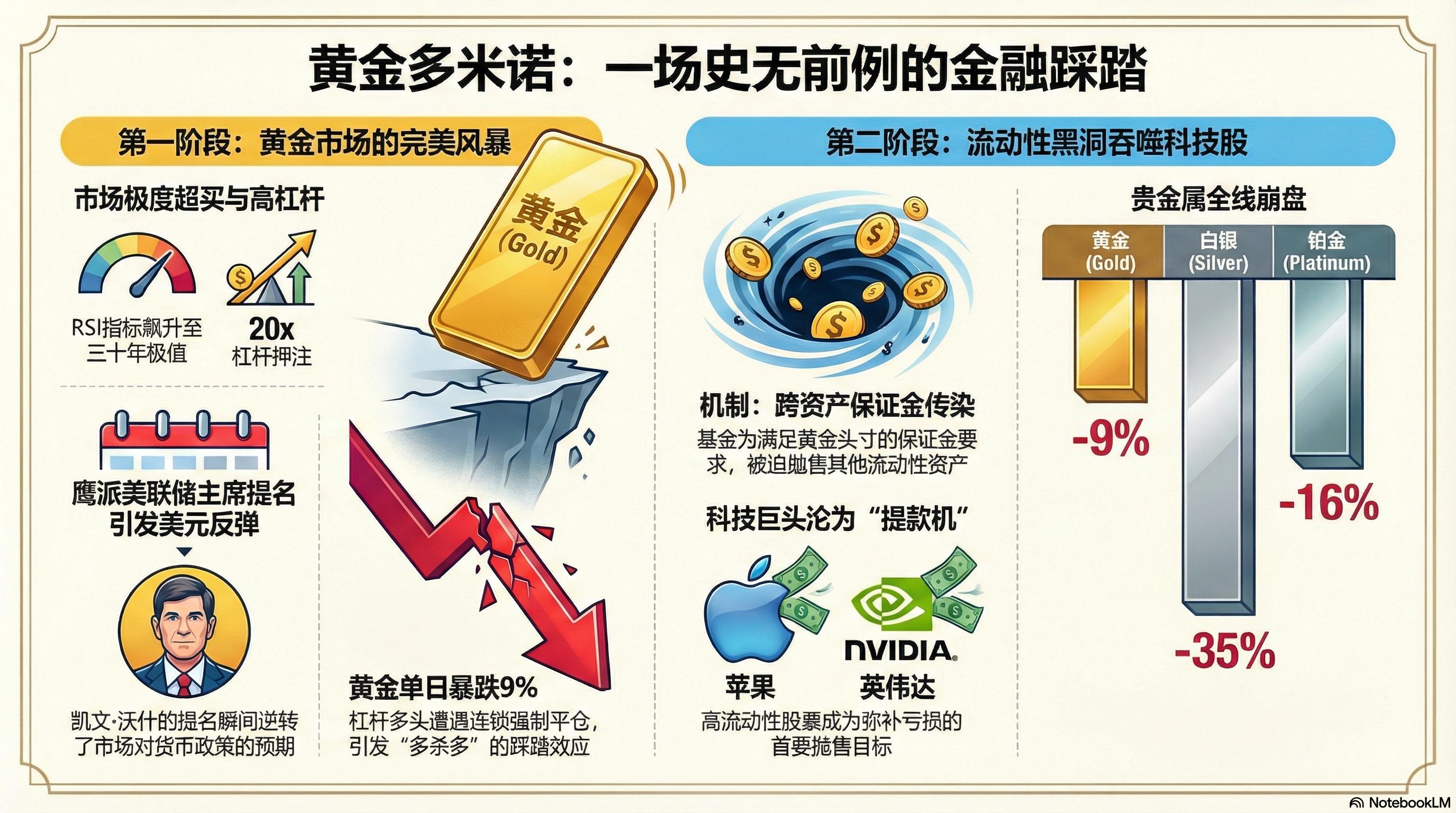
划重点: 1)贵金属 1 月底的暴跌并非基本面的溃败,而是高杠杆多头的集体谢幕。2026 年初,过度超买的黄金在凯文·沃什入主联储的预期下闪崩,演变为吞噬一切 的流动性黑洞。为弥补黄金头寸的巨额亏损,对冲基金被迫抛售流动性极佳的科技巨头,导致纳斯达克陪葬。 2)沃什对美元信用的强硬捍卫,让此前盛行的"美元崩溃论"遭遇冷水。历史总是在恐慌中押韵,正如 2008 与 2020 年的洗盘,黄金往往在流动性危机初期 率先补跌,以此完成对投机资金的终极出清。 3)抄底不仅需要勇气,更考验对时机的精准拿捏。当下需紧盯美元指数的斜率拐点与 CME 保证金的下调信号,确认"飞刀"是否已经落地。当市场为了生 存而不得不卖出心爱之物时,往往正是价值回归的最佳伏击点。 2026 年 1 月底,贵金属多头们经历了职业生涯中最黑暗的一天。 曾被奉为"乱世金律"的避险资产,在短短数十小时内演绎了一场史诗级溃败。现货黄金市值蒸发近 4 万亿美元,白银、铂金、钯金更是以两位数的跌幅垂直 落水。这种量级的波动,令无数信奉"通胀买金"逻辑的投资者目瞪口呆。 这会是贵金属牛市的终结,还是物理资产的一次"极端排毒"?在 RockFlow 投研团队看 ...
金银“史诗级巨震”之后,可以抄底了吗?
Hua Er Jie Jian Wen· 2026-02-02 09:06
Core Viewpoint - The precious metals market continues to decline, with silver dropping 7% and gold falling 4.7%, breaching the $4500 mark, indicating a significant market correction driven by profit-taking and forced liquidation of leveraged positions [1][4]. Group 1: Market Dynamics - The recent drop in precious metals is attributed to multiple factors, including policy expectations, trading congestion, and exchange interventions [5]. - The nomination of Kevin Warsh as the new Federal Reserve Chairman has heightened hawkish expectations, leading to a stronger dollar and tighter liquidity, which negatively impacts precious metals [5][10]. - Exchanges like CME and SHFE have raised margin requirements, contributing to the market's downward pressure [5][7]. Group 2: Speculative Positioning - Prior to the crash, silver was one of the most crowded long positions globally, with extreme speculative positioning indicated by a 14-day RSI for gold exceeding 90, marking a historic high [7]. - The volatility index for silver reached 111, the highest on record, suggesting a precarious market environment where any reversal in sentiment could lead to severe deleveraging [7][10]. Group 3: Macro Influences - Concerns over profitability in AI tech stocks, such as those reported by Microsoft and Tesla, have led to a risk-off sentiment in the U.S. stock market, prompting some investors to liquidate precious metals to maintain liquidity [10]. Group 4: Future Outlook - Despite the short-term turmoil, institutions believe the long-term bullish logic for precious metals remains intact, supported by ongoing demand from central banks and concerns over U.S. debt sustainability [11][13]. - The market is expected to experience a period of wide fluctuations, with cautious buying sentiment prevailing in the near term [13][14]. Group 5: Investment Timing - Investors are advised to be patient and wait for volatility to decrease before entering the market, with specific indicators such as implied volatility dropping below 20% being suggested as potential entry points [16]. - Historical data indicates that gold typically sees an average pullback of about 8% over approximately 18 days after reaching a peak, providing a reference for potential timing [16]. - There is a warning regarding the risk of price discrepancies between spot and futures markets, particularly for silver, which may still have room for further declines [16].



贵金属:欲戴王冠,必承其重
Fang Zheng Zhong Qi Qi Huo· 2026-02-02 05:18
Group 1: Report Industry Investment Rating - Not provided in the content Group 2: Core Viewpoints of the Report - The underlying logic of the current precious metals bull market is global de - dollarization, which remains intact. Central bank gold purchases continue [81]. - Despite Trump's nomination of Warsh as the new Fed chair, the Fed is expected to continue cutting interest rates, leading to a decline in real US Treasury yields and benefiting gold and silver. Fed balance - sheet reduction is difficult to implement [81]. - The impairment of the US dollar's credit is due to multiple factors and is likely to enter a medium - to - long - term decline. 2026 is a big year for US Treasury issuance, with the total scale expected to exceed $40 trillion [81]. - Gold and silver are being redefined as anti - inflation assets and important components of global asset allocation. Silver's supply - demand contradiction remains unresolved, and it may have better price elasticity and return in 2026 [81]. - In the short term, there is a need for a technical correction, but the medium - to - long - term upward trend remains unchanged [81]. Group 3: Summary by Directory I. Market Review 1. Gold - In January 2026, the global gold market had a spectacular performance. London gold broke through the $5000 mark and reached nearly $5600, then had a significant drop. However, both London gold and Shanghai gold had cumulative gains of over 10%. Factors influencing the market included increased geopolitical uncertainty, accelerated de - dollarization, the Fed's inaction, the end of a series of negative factors, and Trump's appointment of a new Fed chair [14]. 2. Silver - In January 2026, the silver market also had an epic performance, with a more violent fluctuation. It had a cumulative gain of over 30%. The driving factors were similar to those of gold, and the potential risk of overseas delivery was also priced in. It also had a significant correction at the end of the month [17]. II. Macro Logic 1. Change in the Pricing Logic of Precious Metals - The traditional relationship between US Treasury real yields and gold has changed since 2023. The US debt, deficit, and the impairment of the US dollar's credit are becoming the new pricing anchors for gold. The pricing logic has shifted from the financial to the monetary attribute [21]. 2. De - dollarization Trend - The US dollar index has been declining since 2025, indicating a long - term decline in the US dollar premium. The "Triffin Dilemma" and the "Sea Lake Manor Agreement" are related to the US's economic strategy, which may lead to a reduction in the US dollar's status as a reserve currency. Global central banks have been de - dollarizing and increasing their gold holdings [24]. 3. Weakening of the Safe - haven Attributes of the US Dollar and US Treasuries - The US dollar and US Treasuries have started to show risk - asset characteristics, with the US stock, bond, and currency markets experiencing multiple sell - offs. Gold and silver's safe - haven attributes have been highlighted [28]. 4. Expansion of US Treasury Debt - The US Treasury debt has been expanding rapidly, with the total expected to exceed $40 trillion in 2026. This has led to a diversion of global safe - haven funds to gold, silver, and other assets [30]. 5. Gold as a Hedge against Credit Risk - Gold and silver have become the ultimate choice to hedge against the risks of the global credit currency system due to high global debt and the weakening of the US dollar's credibility [32]. 6. US Dollar Cycle - The US dollar has an approximately 17 - year cycle, and currently, it is at the start of a downward cycle. A decline in the US dollar index is expected to boost gold prices [34]. 7. US Economic and Policy Situation - The US GDP showed certain growth in 2025, consumer confidence improved in January 2026, the labor market cooled down, and inflation remained above the Fed's target. The Fed's independence has been challenged, and the market has different expectations for its policy [37][39][40]. 8. Redefinition of Gold - Gold has both "safe - haven" and "risk - asset" attributes. It can resist inflation and is an important part of global asset allocation [43]. III. Fundamental Logic 1. Central Bank Gold Purchases - In 2025, global central bank gold purchases reached a high level, though the pace slowed down. Some central banks increased their holdings, while others sold gold. De - dollarization is expected to continue in 2026, and central bank gold purchases will remain a fundamental demand for gold [49]. 2. Gold Investment Demand - In 2025, global gold total demand reached a record high, mainly driven by investment demand. Gold ETFs and physical gold investment demand increased, while gold jewelry demand declined in quantity but increased in value. Gold supply also increased [52]. 3. Silver Supply - The silver supply side has strong constraints, with limited growth in mineral and recycled silver. In 2025 and 2026, the total supply is expected to increase slightly [55]. 4. Silver Demand - Industrial demand accounts for nearly 60% of total silver demand. In 2025, total silver demand is expected to decline slightly, and industrial demand has different trends in different fields. AI is expected to be an important source of future demand growth [58]. 5. Silver Supply - Demand Gap - The silver market has been in short supply for five consecutive years, and the gap is expected to continue in 2026. The available inventory is extremely limited, and the price elasticity is high [62]. 6. Gold - Silver Ratio - The gold - silver ratio reflects the premium of gold over silver in terms of safe - haven demand. It is affected by economic cycles, inflation, and other factors. Currently, the ratio has dropped to a relatively low level, and there is room for further adjustment [63][64]. 7. Asset Management and ETF Holdings - For gold, the non - commercial net long position in the COMEX market has decreased, while the holdings of the largest gold ETF have increased. For silver, both the non - commercial net long position in the COMEX market and the holdings of the largest silver ETF have decreased [68][71]. 8. Technical Analysis - The monthly chart of London gold shows an upward trend, and the weekly chart of London silver shows a correction within the upward channel [76][77]. IV. Summary and Outlook - In February, the price ranges of London gold, Shanghai gold, London silver, and Shanghai silver are predicted. After the adjustment, there may be medium - to - long - term investment opportunities, and it is recommended to buy on dips [80].
沃什接掌美联储后,“强势美元”时代将终结?全球资产该投向何处
Sou Hu Cai Jing· 2026-01-31 10:47
当地时间1月31日,美国总统特朗普宣布提名凯文·沃什担任下一任美联储主席。美联储现任主席鲍威尔的任期尚未结束,但这一提前布局已在华 尔街引发争议。 现年55岁的沃什曾是美联储历史上最年轻的理事之一,以在2008年金融危机期间充当华尔街与华盛顿的"联络人"而闻名。(红星新闻相关报 道:) ▲沃什被提名为下一任美联储主席 有分析认为,如果仅仅将此视为一次人事更迭,便误读了特朗普政府的真正意图,沃什的上台可能意味着,为了重振美国制造业,特朗普政府正试图终 结"强势美元"时代,并将货币政策从属于国家增长战略,一个旨在通过弱势美元重振美国制造业的"海湖庄园三角战略"隐约成型。 "华盛顿-东京-首尔"三角 复刻"里根式"货币策略? 2025年11月,沃什曾撰文抨击现任美联储领导层"思维僵化",认为美联储高估了通胀风险,却低估了人工智能(AI)带来的生产力爆发。他主张即使在经济 增长强劲时也可以降息,因为AI的普及将降低单位劳动力成本,从而抑制通胀。 意大利资深评论员费德里科·兰皮尼分析,美元的未来或许并不由华盛顿的埃克尔斯大楼(美联储总部大楼)决定,而是由佛罗里达的海湖庄园决定。 分析称,这让人联想到1985年的"广场协 ...

帮主郑重:市场“用脚投票”回应美联储新掌门,背后在担忧什么?
Sou Hu Cai Jing· 2026-01-31 00:05
Group 1 - The market reacted negatively to the nomination of Kevin Walsh as the next Federal Reserve Chairman, with major U.S. stock indices, particularly the Nasdaq, experiencing a nearly 1% decline, indicating that this leadership change may signal a significant shift in global capital flows and market dynamics [1][3] - Concerns in the market center around two key terms: "hawkish" and "uncertainty." Walsh is known for his strong stance on inflation, which associates him with faster interest rate hikes, and analysts suggest he may provide less clear guidance than his predecessor, Powell, leading to increased market volatility [3][4] - The implications for A-shares are significant, as the Federal Reserve's monetary policy acts as a global liquidity control mechanism, affecting the strength of the dollar and foreign capital flows, which in turn influences the pricing of core assets in the A-share market [3] Group 2 - Investors are advised to reassess their holdings in "interest rate-sensitive" assets, particularly high-valuation tech growth stocks and sectors reliant on global liquidity, to evaluate their resilience in a potentially tighter global interest rate environment [3][4] - There is an increased emphasis on the "endogenous" and "certainty" of assets, suggesting that companies driven by domestic policies with stable cash flows will become more attractive as external macroeconomic noise increases [3][4] - The market is expected to experience heightened volatility due to the ambiguity of the Federal Reserve's policy path, necessitating cautious position management and strict profit-taking and stop-loss disciplines [4]

股指期货将震荡整理白银、铜、铝、锡期货价格再创历史,新高,黄金、白银、铜、铝、镍、锡期货将偏弱宽幅震荡,原油、燃料油期货将偏强宽幅震荡,焦煤期货将震荡偏强
Guo Tai Jun An Qi Huo· 2026-01-30 13:57
1. Report Industry Investment Rating No relevant information provided. 2. Core Viewpoints of the Report - Through macro - fundamental and technical analyses, the report predicts the trends of various futures contracts on January 30, 2026, and the overall trends of futures main (continuous) contracts in January 2026 [2][3]. 3. Summary by Related Catalogs 3.1 Futures Market Outlook - **January 30, 2026 Futures Main Contract Outlook**: - Index futures (IF2603, IH2603, IC2603, IM2603) will fluctuate and consolidate, with specific resistance and support levels provided [2]. - Gold (AU2604), silver (AG2604), copper (CU2603), aluminum (AL2603), nickel (NI2603), tin (SN2603), and lithium carbonate (LC2605) futures will have a weak and wide - range fluctuation, and silver, copper, aluminum, and tin will reach new highs [2]. - Coking coal (JM2605) futures will fluctuate strongly [2]. - Crude oil (SC2603) and fuel oil (FU2603) futures will have a strong and wide - range fluctuation [2]. - **January 2026 Futures Main (Continuous) Contract Outlook**: - Index futures (IF, IH, IC, IM) will generally show a strong or strong - fluctuating trend, and IM will reach a new high [5]. - Gold (AU), silver (AG), copper (CU), aluminum (AL), tin (SN), and lithium carbonate (LC) futures main continuous contracts will be strongly fluctuating and reach new highs [5]. - Nickel (NI) futures main continuous contract will be strongly fluctuating [5]. - Crude oil (SC) futures main continuous contract will have a strong and wide - range fluctuation [5]. - Coking coal (JM2605) will have a wide - range fluctuation [5]. 3.2 Macro News and Trading Tips - **Domestic News**: - Sino - British leaders met, reaching a series of positive results, including promoting bilateral comprehensive strategic partnership, establishing a financial working group, and China considering visa - free policies for British citizens. China also reduced the import tariff on whisky from 10% to 5% [6]. - The State Council issued a work plan to cultivate new growth points in service consumption, targeting key service consumption areas such as transportation, housekeeping, and online audio - visual [6]. - The Spring Festival travel rush in 2026 is expected to see 9.5 billion cross - regional trips, a record high. Highways will be free for small cars during the Spring Festival, and the railway group introduced new refund policies [6]. - The 2026 National Spring Festival Cultural and Tourism Consumption Month was launched, with about 30,000 cultural and tourism consumption activities, over 360 million yuan in consumption vouchers, and various preferential measures [7]. - The Ministry of Civil Affairs and the Ministry of Finance advanced the central government's subsidy funds for assisting people in difficulty in 2026, amounting to 141 billion yuan, and implemented "small - scale and rapid relief" [7]. - **International News**: - The U.S. Congress Senate failed to advance a government funding bill, and the U.S. federal government is at risk of a partial shutdown [7]. - U.S. President Trump said that Russian President Putin agreed to suspend air strikes on Ukraine for a week due to cold weather. Trump also plans to announce the nomination for the next Fed chair next week and reopen the Venezuelan airspace [8]. - The U.S. trade deficit in November 2025 was $56.8 billion, a 95% increase from the previous month. Exports decreased by 3.6% to $292.1 billion, and imports increased by 5% to $348.9 billion [8]. - Iran will hold a military exercise in the Strait of Hormuz from February 1 to 2, including live - fire shooting [8]. - South Africa is considering imposing a maximum 50% tariff on imported vehicles from China and India [8]. 3.3 Commodity Futures - Related Information - On January 29, the CME Group raised the margin for COMEX copper futures by 20% and the initial margin for COMEX 100 gold futures from 5% to 6%, effective after the close on January 30 [8]. - In 2025, global gold demand reached 5,002 tons, a record high, with a total demand value of $555 billion. Gold investment demand reached 2,175 tons, and gold ETFs increased by 801 tons [9]. - On January 29, international precious metal futures generally rose, with COMEX gold futures up 1.32% to $5,410.80 per ounce and COMEX silver futures up 1.98% to $115.78 per ounce [9]. - On January 29, U.S. and Brent crude oil futures rose, with geopolitical risks driving up supply - disruption expectations [9]. - Venezuela's National Assembly passed a bill to reform the oil law, allowing private and foreign investment in the oil industry [9]. - On January 29, London base metals showed mixed results, with LME copper up 4.73%, LME zinc up 2.65%, and LME nickel up 1.37%, while LME tin fell 2.6% [10]. - On January 29, the on - shore RMB against the US dollar closed at 6.946, down 7 basis points, and the night - session closed at 6.9506. The central parity rate was 6.9771, down 16 basis points [10]. - The U.S. Treasury added 10 economies to the foreign - exchange monitoring list [10]. - On January 29, the U.S. dollar index fell 0.20% to 96.16, and most non - U.S. currencies rose [11]. 3.4 Futures Market Analysis and Outlook - **Index Futures**: - On January 29, IF2603, IH2603, and IM2603 showed different trends, with short - term upward or downward pressures [11][12][13]. - IC2603 had a short - term decline, with reduced upward momentum and increased downward pressure [13]. - A - shares had a narrow - range consolidation on January 29, with different performances among major indices [14]. - The Hong Kong Hang Seng Index rose on January 29, reaching a nearly 4 - year high [14]. - U.S. and European stock markets had mixed performance on January 29 [15]. - **Gold Futures**: - On January 29, AU2604 had a significant increase, reaching a new high. During the night - session on January 29 - 30, it declined, with increased short - term downward pressure [34][35]. - The precious metal market had large fluctuations on January 29 [36]. - **Silver Futures**: - On January 29, AG2604 rose significantly, reaching a new high. During the night - session on January 29 - 30, it had a wide - range decline, with increased short - term downward pressure [39][40]. - **Copper Futures**: - On January 29, CU2603 rose significantly, reaching a new high. During the night - session on January 29 - 30, it continued to rise, with increased short - term downward pressure [47]. - **Aluminum Futures**: - On January 29, AL2603 had a weak rise, reaching a new high. During the night - session on January 29 - 30, it continued to rise, with increased short - term downward pressure [51]. - **Nickel Futures**: - On January 29, NI2603 rose slightly, with short - term upward momentum [59]. - **Tin Futures**: - On January 29, SN2603 rose slightly, with short - term upward momentum [62]. - **Lithium Carbonate Futures**: - On January 29, LC2605 declined slightly, with increased short - term downward pressure [68]. - **Coking Coal Futures**: - On January 29, JM2605 rose, with short - term upward momentum [72]. - **Crude Oil Futures**: - On January 29, SC2603 rose, with short - term upward momentum [79]. - **Fuel Oil Futures**: - On January 29, FU2603 rose, with short - term upward momentum [84].
财富不平等加剧,美国K型经济特征空前显著
Xin Lang Cai Jing· 2026-01-30 12:45
Core Insights - The economic gap between the wealthy and the poor in the United States is continuously widening, with economists indicating that this trend shows no signs of ending [1][25] - The "K-shaped economy," which has been a focal point for consumers, business leaders, policymakers, and investors since the COVID-19 pandemic, is now considered a core characteristic of the U.S. economy rather than a temporary trend [1][25] Economic Disparity - The Gini coefficient, a key measure of wealth concentration, has reached a 60-year high, reversing the trend of decline seen during the pandemic [4][29] - As of the third quarter of 2025, the wealth held by the richest 1% of Americans is projected to reach nearly 32% of the nation's total wealth, while the bottom 50% holds only 2.5% [8][31] - The share of GDP allocated to employee compensation has fallen to its lowest level in over 75 years, indicating that ordinary workers are receiving a smaller portion of the economic "pie" [8][31] Consumer Behavior - The economic divide is directly influencing consumer spending habits, with high-income households increasing their expenditure on luxury goods and services, while low-income households are cutting back on non-essential spending [11][34] - Households earning less than $75,000 are spending a lower percentage on travel and experiences compared to 2019, while those earning over $150,000 are increasing their spending in these areas [11][34] - The relative total spending of the top 20% of earners has reached a multi-decade high, while the remaining 80% have seen their spending drop to historical lows [12][34] Structural Issues - The K-shaped economic structure is viewed as a fundamental issue rather than a cyclical one, with roots tracing back to economic policies from decades ago [16][25] - The decline in unionization rates has weakened workers' bargaining power, contributing to economic disparity [16][36] - The economic recovery post-COVID has disproportionately benefited high-income individuals, with stock market gains further widening the wealth gap [17][37] Future Outlook - Economists predict that wealth inequality will continue to worsen, exacerbated by policies that cut welfare programs for the poor [21][40] - Concerns are raised about the sustainability of a K-shaped economy, with experts warning that relying on high-income consumers for economic growth is problematic [22][41] - The U.S. economy is seen as fragile, dependent on a few key sectors for growth, which raises concerns about its long-term stability [24][43]

金银闪崩、外围震动,A股真的“扛得住”吗?
3 6 Ke· 2026-01-30 10:09
Core Viewpoint - The A-share market demonstrated resilience amidst global market turmoil, particularly following a significant drop in international gold and silver prices, indicating strong underlying support mechanisms. Group 1: Impact of Global Market Events - International gold and silver experienced a dramatic drop, with gold falling from a high of $5,626 to below $5,100, marking a maximum decline of over 8%, while silver dropped from $121.6 to $107.7, with a maximum decline exceeding 12% [4] - Despite the external shocks, A-shares did not follow the downward trend, with the Shanghai Composite Index down only 0.96%, the Shenzhen Component down 0.66%, and the ChiNext Index rising by 1.27% [3] Group 2: A-share Market Resilience - A-shares were supported by four key factors: 1. Policy and liquidity support, including the release of consumption-boosting policies and a net injection of 700 billion yuan by the central bank, which helped stabilize market expectations [7] 2. Optimized funding structure, with northbound capital showing a net inflow of 32.68 billion yuan on the day and a total of 234.68 billion yuan for the week, indicating confidence from long-term investors [8] 3. Strong fundamentals and valuation advantages, with an overall earnings growth forecast of 42.3% for A-shares, particularly in sectors like non-ferrous metals and petrochemicals, which have growth rates exceeding 60% [9] 4. Strong risk isolation capabilities, as the decline in the precious metals sector was seen as a localized adjustment rather than a systemic risk for A-shares [10] Group 3: Market Outlook and Strategy - The A-share market is expected to experience minor fluctuations due to external influences and pre-holiday liquidity concerns, but these do not indicate a "crash" [14] - Investors are advised to focus on stable sectors such as consumer goods and state-owned enterprises, while avoiding high-risk areas like precious metals and high-leverage sectors [12]