
自动驾驶

Search documents
陈昱晋升管理合伙人那天,我跟他聊了3小时
投中网· 2026-03-13 09:22
Core Viewpoint - The article discusses the investment strategies and personal experiences of Chen Yu, a managing partner at Yunqi Capital, emphasizing the importance of understanding technology and market trends in venture capital investment [4][6][34]. Group 1: Investment Strategy - Chen Yu maintains a consistent track record of investing in one unicorn or publicly listed company each year, with notable investments including MiniMax, Yuanrong Qixing, and PingCAP [6][34]. - The investment approach is defined by the ability to understand and identify opportunities in technology-driven sectors, adapting to market changes while focusing on software-driven innovations [32][34]. - The firm has shifted its focus towards AI and hardware, particularly in the context of the recent AI boom, with a strategic emphasis on combining physical AI and digital AI [51][52]. Group 2: Personal Background and Philosophy - Chen Yu's background as a programmer and his experiences at Google shaped his understanding of technology and venture capital, leading him to pursue a career in investment [10][12][13]. - He believes that a person's sense of security, often derived from financial stability, is crucial for achieving personal freedom and success [22][27]. - The article highlights Chen's unique ability to switch between different personal and professional states, allowing him to build long-term relationships with entrepreneurs [23][24]. Group 3: Market Trends and Challenges - The current investment landscape is characterized by a narrow focus on AI, overseas expansion, and hardware, making it challenging to find diverse investment opportunities [48][49]. - The competition for projects in the AI sector is intense, driven by a limited number of viable options and the need for funds to be deployed effectively [49][50]. - Chen Yu notes that the investment community is increasingly recognizing the potential of younger entrepreneurs, leading to a strategic initiative at Yunqi Capital to invest in founders born after 1998 [53][56].


首站广州!小马智行Robotaxi接入腾讯出行服务
Guang Zhou Ri Bao· 2026-03-13 03:55
Group 1 - The core point of the article is the announcement of Pony.ai's integration with Tencent's transportation service mini-program, allowing users in Guangzhou to call autonomous vehicles for safe and convenient travel experiences [1] - This collaboration marks a significant step for Pony.ai in advancing the commercialization of Level 4 autonomous driving since the strategic partnership with Tencent Cloud was established in April 2025 [1] - Users can access the service through the "Tencent Transportation Service" or the "Transportation Service" entry within the WeChat app, enhancing user accessibility [1] Group 2 - Since its launch in Guangzhou in 2017, Pony.ai has become a key promoter of autonomous driving services, being the first to initiate such services in the Nansha District [2] - Pony.ai has expanded its operations to major cities like Beijing, Shanghai, Guangzhou, and Shenzhen, with over a thousand autonomous vehicles in its fleet and partnerships with various domestic and international companies [2] - Future plans include deepening collaboration with Tencent Cloud in areas such as cloud services, map data, information security, and smart cabin ecosystems, while also expanding the autonomous driving service to more cities and scenarios [2]

Contrary Research:《2026年科技趋势报告》,352页重磅
欧米伽未来研究所2025· 2026-03-13 00:38
Core Insights - The report from Contrary Research highlights that artificial intelligence (AI) is evolving from a singular technological issue to a comprehensive restructuring force affecting energy, manufacturing, defense, and human relationships [2] AI Model Competition - The report emphasizes the rapid advancements in AI foundational models, predicting that by 2030, top AI systems in software engineering, biology, and mathematics will achieve near-perfect accuracy on their respective benchmarks [3] - Key players in the AI model landscape include Google, Meta, Microsoft, and OpenAI, which have dominated foundational model releases from 2014 to 2024, with academic institutions following closely [4] Trust Issues in Evaluation Systems - The report addresses a crisis of trust in current evaluation systems, citing instances of undisclosed participation in benchmark tests and allegations of artificially inflated scores [5] - It presents a paradox in computational economics, where training power consumption has doubled every six months since 2010, while the actual computational power required for equivalent performance has significantly decreased [5] AI Commercial Penetration - As of May 2025, approximately 10% of U.S. companies have integrated AI into their products or services, while around 44.8% have subscribed to some form of AI model or platform [6] - The revenue from enterprise AI is projected to grow from $1.7 billion in 2022 to $37 billion in 2024, reflecting a growth rate exceeding three times [6] Infrastructure Competition - The demand for computational power is driving an unprecedented scale of infrastructure development, with major cloud service providers expected to spend nearly $100 billion quarterly by Q2 2025 [8] - Global capital expenditures on data centers, cloud computing, and AI-specific infrastructure are projected to reach $1.3 trillion by 2027, potentially amounting to 17% of U.S. GDP from 2025 to 2030 [8] Energy Consumption Concerns - U.S. data centers consumed 183 terawatt-hours of electricity in 2024, projected to rise to over 426 terawatt-hours by 2030, which could account for more than 10% of total U.S. electricity consumption [10] - The report highlights nuclear energy as a potential alternative, noting that most new nuclear capacity is being built in China, while the U.S. has seen a stagnation in new approvals [10] Industrial Restructuring - The report outlines a significant industrial restructuring, with China surpassing the U.S. as the largest manufacturing nation and having more robots installed than the rest of the world combined [11] - The U.S. defense industrial base is described as being in crisis, with significant shortages in key military supplies and a stark contrast in manufacturing capabilities compared to China [12] Social Trends and AI Companionship - The report discusses the rise of loneliness as a social trend, with increased solitary time among Americans, particularly among younger demographics [13] - AI companions are emerging as a response to this social void, with a significant percentage of Gen Z users expressing a belief that AI can replace human companionship [14]

对标小米SU7 Ultra!追觅汽车全系展出,价格或超60万元;宝马集团2025年净利润同比下降3%丨汽车交通日报
创业邦· 2026-03-12 10:22
Group 1 - The core viewpoint of the article highlights the advancements and competitive positioning of various automotive companies, particularly in the electric and autonomous vehicle sectors [2][3][4]. Group 2 - Chasing Car showcased its entire lineup at AWE 2026, with models priced between 600,000 to 700,000 yuan, targeting a sporty market segment and achieving a 0-100 km/h acceleration in 1.8 seconds with a range of 1000 km [2]. - NVIDIA's CEO Jensen Huang demonstrated the company's DRIVE AV autonomous driving platform in a 22-minute video, successfully completing a journey without human intervention [2]. - BMW Group reported a 3% decline in net profit for 2025, with total revenue of 133.45 billion euros, a 6.3% decrease year-on-year, despite a slight increase in vehicle deliveries [3]. - Nissan, Uber, and Wayve announced a collaboration to develop robot taxis, planning to launch a pilot project in Tokyo by the end of 2026 using Nissan Leaf electric vehicles equipped with Wayve technology [4].

近期在中国新增了两个持仓!巨头Baillie Gifford旗舰基金两位掌舵人,畅聊软件重估、自动驾驶及SpaceX等热点问题
聪明投资者· 2026-03-12 07:05
Core Viewpoint - The article discusses the investment strategies and insights of the fund managers from Scottish Mortgage Trust, highlighting their recent investments in innovative companies in China and their perspectives on AI and software stocks [5][6][59]. Investment in Chinese Companies - The company has recently added two positions in China: Xiaohongshu, a digital community platform with approximately 350 million users, and MiniMax, an AI model company that achieves 90% of the performance of leading US models at a lower cost [59][60]. - The current exposure to China is about 12%, with a focus on innovative companies that offer attractive valuations [62]. Insights on Software Stocks - The fund managers emphasize the importance of understanding the recent decline in software stocks by analyzing the underlying changes in the market, particularly the advancements in AI's ability to write software [12][13]. - They believe that the production of software will significantly increase due to AI, leading to new investment opportunities, while also recognizing the need to reassess value distribution within the software ecosystem [15]. AI Investment Strategy - The investment approach in AI is diversified across the entire value chain, including hardware (NVIDIA, ASML, TSMC), infrastructure (Anthropic, Amazon Web Services), and application layers [16][18]. - The managers stress the importance of not placing all bets on a single AI path, instead opting for a portfolio that includes various growth themes beyond AI, such as luxury brands and energy transition [19]. SpaceX and AI Integration - SpaceX is viewed as a potential monopolistic supplier of AI capabilities due to its ability to reduce the cost of entering space, which is crucial for expanding AI's computational power [41][42]. - The company aims to deploy significant power generation capabilities in space, which could lead to a substantial increase in AI processing capacity [43][48]. Market Dynamics and Competition - The managers discuss the competitive landscape for companies like Meituan, which is seen as a critical infrastructure provider for local services in China, despite facing increased competition from rivals like JD and Alibaba [71][72]. - Ant Group is recognized for its essential role in China's financial infrastructure, having navigated regulatory challenges to resume growth [78][80]. Resilience of the Portfolio - The current portfolio is designed to be more resilient compared to previous downturns, with companies focusing on improving operational efficiency and profitability [97][98]. - The diversity of investment themes and geographical exposure contributes to the overall robustness of the portfolio [100].







黄仁勋亲测英伟达自动驾驶平台,全程无人工接管
第一财经· 2026-03-12 04:45
Core Insights - NVIDIA showcased its full-stack autonomous driving software platform, DRIVE AV, through a 22-minute video featuring CEO Jensen Huang and VP of Automotive Business, Wu Xinzhou, demonstrating a successful autonomous drive to San Francisco without human intervention [1] Group 1 - NVIDIA's DRIVE AV platform was utilized in a real-world scenario, highlighting its capabilities in autonomous driving technology [1]


黄仁勋亲测英伟达Alpamayo辅助驾驶系统,全程无人工接管
Huan Qiu Wang Zi Xun· 2026-03-12 03:10
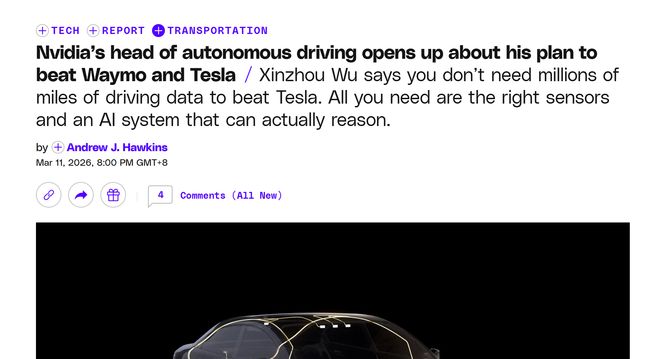
Core Insights - Nvidia's CEO Jensen Huang recently tested the company's developed driver assistance system, Alpamayo, in a Mercedes vehicle, demonstrating the company's advancements in autonomous driving technology [1][3] - The test journey from Woodside to downtown San Francisco showcased the vehicle's ability to handle various road conditions without human intervention, highlighting Nvidia's technical capabilities in the autonomous driving sector [1][3] Group 1: Technology and Development - Nvidia has been deeply involved in the autonomous driving sector, providing core chip products to companies like Tesla and developing AI driving functions for partners such as Mercedes and Lucid [3] - The Alpamayo solution integrates AI models, simulation blueprints, and datasets to support Level 4 autonomous driving under specific conditions, which Huang referred to as a "ChatGPT moment for physical AI" [3] - Nvidia combines end-to-end AI models with traditional engineering techniques to enhance safety verification and create a robust safety framework for its autonomous driving systems [3][4] Group 2: Sensor Fusion and Cost Management - Nvidia employs a multi-sensor fusion approach, integrating cameras, radar, ultrasonic sensors, and optional lidar for higher-end models, which is crucial for handling extreme driving scenarios [4] - The company aims to reduce R&D and production costs through vertical integration, offering a basic version focused on cost-effectiveness and a high-end version with lidar for advanced driving needs [4] Group 3: Simulation Technology - To compete with companies like Tesla and Waymo, Nvidia focuses on simulation technology as a core infrastructure for autonomous driving development, utilizing neural reconstruction and data augmentation to enhance training [5] - The goal is to create an autonomous driving system with reasoning capabilities that minimizes reliance on extensive real-world driving data, with ongoing development of a visual-language-action model to integrate various learning aspects [5]
智联汽车系列深度之46:希迪智驾(03881)深度:技术领跑,无人矿卡迎东风
Shenwan Hongyuan Securities· 2026-03-12 02:02
Core Insights - The report highlights the significant growth potential in the autonomous mining truck sector, driven by increasing penetration rates and regulatory support, with projections indicating a rise from 7% in 2024 to 24% in 2026, and reaching 55% by 2030 [2][12] - The report emphasizes the high entry barriers in the autonomous mining solutions market, including technological complexity, customer loyalty, product reliability, and industry-specific experience [2][12] - The company, Xidi Zhijia, is positioned as a leading player in the closed-environment autonomous driving solutions market, with a projected revenue growth from 9.81 billion RMB in 2025 to 34.98 billion RMB by 2027 [3][12] Summary by Sections Industry Overview - The autonomous mining sector is transitioning from pilot projects to a necessity for improving efficiency and safety in mining operations, with government mandates supporting the adoption of robotic solutions [2][12] - The report outlines the expected growth trajectory of autonomous mining trucks, indicating a significant market opportunity as the technology matures and regulatory frameworks become more supportive [2][12] Company Analysis - Xidi Zhijia has a strong technological foundation, with a high percentage of R&D personnel (54.1%) and a focus on a light-asset business model that enhances profitability [3][12] - The company has delivered 304 autonomous mining trucks as of the first half of 2025, with a backlog of orders valued at 584 million RMB, reflecting strong demand [3][12] - Financial performance shows a revenue of 408 million RMB in the first half of 2025, marking a year-on-year growth of 57.9%, despite an adjusted loss of 110 million RMB [3][12] Competitive Positioning - Xidi Zhijia is projected to be the third-largest autonomous mining technology company in China by revenue in 2024, holding approximately 12.9% market share in the domestic autonomous mining truck solutions market [3][12] - The company’s strategy involves synergistic development across three business areas: autonomous driving, high-performance perception, and V2X technology [3][12] Future Projections - Revenue forecasts for Xidi Zhijia are optimistic, with estimates of 9.81 billion RMB in 2025, 18.97 billion RMB in 2026, and 34.98 billion RMB in 2027, based on increasing market penetration and demand for autonomous solutions [3][12] - The report assigns a "Buy" rating to the company, reflecting confidence in its growth potential and market positioning [3][12]
计算机行业事件点评:智驾或进新道交法,依法上路与定责将助力产业繁荣
Bank of China Securities· 2026-03-12 01:10
Investment Rating - The industry investment rating is "Outperform" [11] Core Viewpoints - The acceleration of policy relaxation for autonomous driving and the promotion of large-scale application are key topics at the 2026 National Two Sessions. The current autonomous driving industry in China is transitioning from "pilot" to "large-scale application," with legal legitimacy being a critical bottleneck [1][3] - Multiple representatives have proposed accelerating the improvement of laws and regulations related to autonomous driving to clarify the legality of autonomous vehicles on the road. The U.S. House of Representatives passed the "2026 Autonomous Driving Act," significantly relaxing restrictions on vehicles without steering wheels and pedals, which serves as a reference for China to expedite its legislative process in this field [1][3] Summary by Relevant Sections Industry Investment Rating - The report rates the industry as "Outperform," indicating expectations for the industry index to perform better than the benchmark index over the next 6-12 months [11] Key Recommendations - The clarification of the legality for autonomous vehicles is expected to benefit third-party automotive testing companies. The report suggests paying attention to leading smart testing companies such as China Automotive Research, as well as autonomous driving-related companies including Desay SV, Zhongke Chuangda, Siwei Tuxin, Pony.ai, WeRide, and Hezhima Intelligent [3] Legislative and Regulatory Insights - The report emphasizes the need for legislative support to facilitate the commercialization of autonomous driving. Suggestions include revising the "Road Traffic Safety Law" to clarify the legality of autonomous vehicles, expediting the formulation of mandatory national standards, and introducing insurance products suitable for autonomous driving within the existing vehicle insurance framework [1][3]
申万宏源证券晨会报告-20260312
Shenwan Hongyuan Securities· 2026-03-12 00:43
Group 1: Core Insights - The report highlights the increasing demand for autonomous mining trucks in China, driven by a projected rise in penetration rates from 7% in 2024 to 24% in 2026, and reaching 55% by 2030 [2][3][13] - The report emphasizes the high entry barriers in the autonomous mining sector, including technological complexity, customer loyalty, product reliability, and industry experience [2][3][13] - The company, Xidi Zhijia, is positioned as a leading player in the closed-environment autonomous driving solutions market, with a projected revenue growth from 9.81 billion RMB in 2025 to 34.98 billion RMB by 2027 [3][13] Group 2: Company Performance - Xidi Zhijia delivered 304 autonomous mining trucks in the first half of 2025, with a backlog of orders valued at 584 million RMB, achieving a revenue of 408 million RMB, representing a year-on-year growth of 57.9% [3][13] - The company operates on a light-asset business model, which contributes to a relatively high gross margin, and is expected to maintain a market share of approximately 12.9% in the autonomous mining truck solutions market by 2024 [3][13] - The report projects that Xidi Zhijia will achieve an adjusted loss of 110 million RMB in 2025, with a loss rate reduced to 27% [3][13] Group 3: Market Outlook - The report anticipates a stable revenue growth for the company, with expected revenues of 9.81 billion RMB, 18.97 billion RMB, and 34.98 billion RMB for the years 2025, 2026, and 2027 respectively [3][13] - The report assigns a "Buy" rating to Xidi Zhijia, based on a price-to-sales ratio of 9x for 2026, reflecting the company's strong market position and growth potential [3][13]