TMT

Search documents
科创板100ETF(588120)涨超1.2%,科技板块中长期逻辑获多重验证
Mei Ri Jing Ji Xin Wen· 2026-01-05 08:11
Group 1 - The core viewpoint is that the long-term logic of the technology sector remains validated, with the TMT sector showing superior profit growth compared to the overall A-share market, similar to previous years like 2013, 2015, and 2020-2021 [1] - The current global technology cycle is supported by significant capital expenditure expansion from major global tech giants, which is a key driver for the technology sector [1] - The commercial aerospace sector is entering a new phase with low-orbit satellite constellations becoming a new battleground for major powers, transitioning from an "investment incubation period" to a "profit realization period" [1] Group 2 - The oil and chemical industry is experiencing a restructuring of supply dynamics due to "anti-involution" policies, alongside a reduction in capital expenditure and emerging demand driving an upward cycle in industry prosperity [1] - The rise in non-ferrous metal prices is attributed to a combination of macroeconomic conditions, industry fundamentals, capital allocation, and geopolitical factors, leading to a historic mismatch between supply and demand in emerging industries [1] - The Science and Technology Innovation Board 100 ETF (588120) tracks the Science and Technology 100 Index (000698), which includes 100 mid-cap securities from the Science and Technology Board, reflecting the overall performance of mid-cap securities in the technology sector [2]
资本市场月报2026年1月-20260105
Ping An Securities Hongkong· 2026-01-05 06:31
Group 1: Global Stock Market Performance - The global stock indices in 2025 exhibited a clear "divergent upward" trend, with the South Korean Composite Index leading at 75.6% growth, significantly higher than other markets[4] - The second tier of performance was concentrated in Hong Kong and Northeast Asian markets, including the Hang Seng Index and Nikkei 225, with growth rates ranging from 23.0% to 31.1%[4] - European markets showed moderate performance, while global benchmarks and U.S. tech-related indices remained relatively strong[4] Group 2: Hong Kong Stock Market Insights - The Hong Kong Hang Seng Industry Index displayed a "strong structure, weak diffusion" characteristic, with materials leading at 161.3% growth, while defensive sectors like utilities and telecommunications lagged[6] - In 2025, the Hong Kong IPO market welcomed 117 new listings, raising approximately HKD 285.7 billion, with notable first-day performance from Nobikang (2635.HK) at 363.75%[9] - The largest fundraising project was CATL (3750.HK), which raised around HKD 41 billion, while 685 companies announced additional share placements, expected to raise about HKD 361.8 billion, mainly in TMT and financial sectors[9] Group 3: U.S. Economic Overview - In Q3 2025, the U.S. GDP growth rate was 4.3%, exceeding expectations of 3.3%, driven by resilient private consumption and improved net exports[10] - Personal consumption expenditures contributed 2.4 percentage points to GDP growth, indicating strong consumer resilience despite tariff impacts[10] - Market expectations for interest rate cuts have shifted to April and July 2026, with anticipated reductions of 25 basis points each[10] Group 4: Chinese Economic Trends - Industrial profits in China showed a slight year-on-year increase of 0.1% from January to November 2025, with notable growth in high-tech manufacturing sectors[11] - The solar and semiconductor industries are experiencing a new wave of growth, supported by policy adjustments and rising prices in key materials[11] - The government initiated a venture capital fund of HKD 100 billion to stimulate investment in high-tech sectors, including AI and quantum technology[11]
2026年港股首个交易日恒生科技指数涨超4%领跑全球市场!多重利好催化港股科技行情,港股纯粹“硬科技”标的港股通科技ETF(159262)涨超4%
Sou Hu Cai Jing· 2026-01-05 02:16
Group 1 - The Hong Kong stock market experienced a significant rise on the first trading day of 2026, with the Hang Seng Index recovering above 26,000 points, closing up by 2.76% [1] - The offshore RMB exchange rate against the US dollar broke 6.97, reaching a new high since May 2023, which encouraged capital inflow into Hong Kong stocks [1] - The listing of Wallen Technology, known as the "first GPU stock" in Hong Kong, saw a substantial increase on its debut, boosting market sentiment towards hard technology, semiconductors, and AI sectors [1] Group 2 - Analysts from Galaxy Securities noted that the strengthening of the RMB and the performance of the Hong Kong stock market during the holiday period could enhance investor confidence, potentially leading to an early start of the spring market rally [2] - The 2026 outlook suggests a bullish trend for the Hong Kong stock market, with a projected net profit growth rate of 7.3% for Hong Kong Stock Connect constituent stocks, particularly in the information technology, consumer discretionary, and healthcare sectors [2] - The appreciation of the RMB is expected to attract global capital back to Hong Kong stocks, further supporting valuation recovery [2] Group 3 - The Hong Kong Stock Connect Technology ETF (159262) saw a significant increase, with a 4.07% rise as of January 5, 2026, and a total inflow of 9.48 billion RMB over the past eight trading days [3][4] - The ETF closely tracks the Hang Seng Stock Connect Technology Index, which focuses on technology-related companies listed in Hong Kong, excluding pharmaceuticals, automobiles, and home appliances [3] - The valuation of the index is at a historical low, with a price-to-book ratio of 3.36, indicating strong value for investors [3] Group 4 - Major AI leaders such as Tencent, Alibaba, and Xiaomi collectively account for over 42% of the ETF's weight, with Tencent alone representing nearly 15% [4] - The concentration of core "hard technology" stocks like SMIC and Hua Hong Semiconductor contributes to a robust technology leader group within the ETF [4]
国泰海通 · 晨报260105|元旦“微度假”热度高
国泰海通证券研究· 2026-01-04 13:14
Macro Insights - The New Year's holiday saw a significant increase in travel, with inter-regional mobility growing by 19.5% year-on-year, reaching a recent high. Short-distance "micro-vacations" have become mainstream, with strong performance in service consumption, particularly in entertainment. However, product consumption has declined due to the waning effects of year-end sales [4]. - Real estate sales are showing marginal declines, although the easing of purchase restrictions in first-tier cities has released some demand. Infrastructure and construction are still constrained by insufficient new projects [4]. - The port operations remain stable, but there is a divergence in domestic import freight rates and the Baltic Dry Index (BDI). Most industries are experiencing a decline in operating rates, with petrochemicals and automotive sectors showing weak performance due to rising costs and falling demand, while emerging sectors like lithium batteries and photovoltaics are performing well [4]. - The Producer Price Index (PPI) is generally rising, while the Consumer Price Index (CPI) shows mixed results. The RMB exchange rate has surpassed 7.0, with funding rates and government bond yields trending upward [4]. Strategy Insights - The A-share market is expected to see a "spring opening red" as it closed at 3968.84 points in 2025, marking an 18.41% annual increase. The market sentiment has shifted towards optimism, with expectations of a potential interest rate cut in the U.S. in 2026 [8]. - The influx of incremental capital, particularly through A500 ETF and insurance funds, is expected to solidify liquidity. The government has emphasized the need to stabilize and improve real estate market expectations, indicating a proactive approach to boosting growth [8][9]. - The central bank's fourth-quarter meeting highlighted the importance of price signals for promoting stable economic growth and reasonable price recovery, with a gradual emergence of price increases in certain sectors due to improved demand and supply constraints [10]. Industry Comparisons - The technology sector, particularly in AI and emerging industrialization trends, is expected to see strong growth. The domestic chip technology breakthroughs and storage price increases are anticipated to continue, with a focus on companies with global competitive advantages [11]. - Non-bank financial institutions are likely to benefit from increased demand for wealth management and the migration of household deposits, with recommendations for insurance and brokerage firms [11]. - The cyclical sectors are showing signs of improvement, with low valuations and positioning, benefiting from policies aimed at expanding domestic demand and stabilizing the real estate market. Recommendations include tourism services, hotels, and consumer goods [11]. - Specific themes to watch include AI applications, robotics, commercial aerospace, and domestic consumption, with a focus on new consumption patterns and service sectors [11].


固收-2026年度策略-时光倒流
2025-12-31 16:02
Summary of Key Points from Conference Call Industry Overview - The discussion primarily revolves around the Chinese economy and its comparison with Japan, emphasizing that the economic conditions and corporate investments in China are distinct from Japan's past experiences [1][3] - The focus is on the structural performance of the Chinese market, particularly in the TMT (Technology, Media, and Telecommunications) sector, which is becoming increasingly significant [1][6] Core Insights and Arguments - High-quality development is emphasized, prioritizing sustainability over reliance on infrastructure and real estate, which have diminished in importance for A-shares [1][5] - The correlation between memory prices and A-shares is highlighted, with a reported correlation of 0.76, indicating that memory prices are more relevant for investment decisions than real estate prices [6][7] - The contribution of real estate to GDP is declining, with its impact now less significant than that of some software and information sectors [8] - The relationship between housing prices and interest rates is unstable, with historical examples showing varying trends [9] - Consumer behavior is affected by real estate market fluctuations, but this impact varies significantly across different regions [10] - Export data is crucial for asset pricing, but over-reliance on it can lead to misjudgments, as seen in past economic cycles [11] Important but Overlooked Content - The global inflation transmission mechanism indicates a reversal of long-term deflation expectations in China, challenging previous assumptions about the economy [12] - Anticipated monetary policy adjustments for 2026 include a potential rate cut and reserve requirement ratio reduction, but significant credit expansion is unlikely [13] - The bond market faces challenges such as spread issues and changing commercial models, with a forecasted 10-year government bond yield range of 1.7% to 2.1% for 2026 [2][18] - Investment opportunities for 2026 include timing for government bond purchases, EVE indicator management, and changes in fiscal debt structure, with an overall increase in risk appetite due to rising stock proportions in financial products [19]
2026年1月份投资策略报告:春季行情或逐步开启-20251231
Dongguan Securities· 2025-12-31 09:31
Market Overview - In December 2025, the A-share market exhibited a "high-level fluctuation and structural switching" pattern, with the Shanghai Composite Index rising by 2.06%, the Shenzhen Component Index by 4.17%, and the ChiNext Index by 4.93% [8][13][45] - The market sentiment improved significantly towards the end of December, with the Shanghai Index achieving eleven consecutive gains, driven by easing concerns over AI bubbles and favorable policy expectations for 2026 [8][45] Economic Environment Analysis - Global economic indicators showed signs of stabilization but with a slowdown, as evidenced by the marginal decline in the US and Eurozone PMI indices [19][39] - The Federal Reserve's interest rate cut in December marked the third reduction of the year, with expectations for a slower pace of future cuts in 2026 due to internal divisions within the FOMC [20][44] - Domestic economic indicators reflected weak internal growth momentum, with November's industrial value-added growth at 4.8% and fixed asset investment declining by 2.6% year-on-year [21][25] Policy Direction - The Central Political Bureau and the Central Economic Work Conference set the tone for 2026, emphasizing a more proactive macroeconomic policy aimed at enhancing growth and addressing risks [29][33] - The focus on expanding domestic demand and optimizing supply was reiterated, with a commitment to maintaining a fiscal deficit rate around 4% to support economic stability and transformation [31][32] Sector Allocation - Recommendations for sector allocation in January include overweighting mechanical equipment, TMT (Technology, Media, and Telecommunications), electric power equipment, and non-ferrous metals [46] - The mechanical equipment sector is expected to benefit from increased demand in robotics and infrastructure projects, while the TMT sector may see growth driven by rising raw material prices and technological advancements [46][48]
科技行情未完待续?双创板块2026年展望
Sou Hu Cai Jing· 2025-12-31 07:25
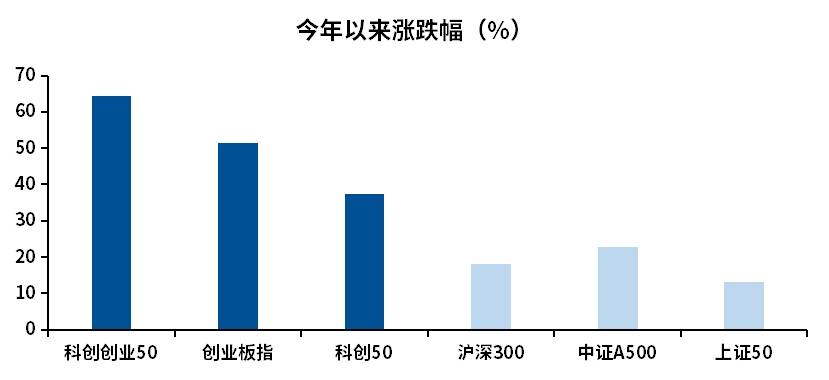
Group 1 - The core viewpoint of the article is that the dual innovation sector (Science and Technology Innovation Board + Growth Enterprise Market) has become a shining main line in the domestic market, with the Science and Technology Innovation 50 Index showing remarkable performance in 2025, and there are expectations for new opportunities in 2026 [1][8] Group 2 - In 2025, the dual innovation sector emerged as a core force driving the growth style of A-shares, with the Science and Technology Innovation 50 Index achieving an annual increase of 64.32%, significantly outperforming major indices like CSI 300 (18.21%) and CSI 500 (22.78%) [2][5] - The trading volume of the Science and Technology Innovation 50 Index increased by 120.68% compared to 2024, indicating strong market recognition of hard technology core assets [2][5] Group 3 - The excellent performance of the dual innovation sector in 2025 can be attributed to several factors: 1. An upward industrial cycle and improved profitability, with technology breakthroughs and performance landing in hard technology sectors creating a virtuous cycle [5] 2. A relatively loose funding environment, enhanced by the Federal Reserve's interest rate cuts, which increased risk appetite for growth-style investments [5] 3. Policy dividends supporting the deepening of the technology-driven national strategy, with the "14th Five-Year Plan" promoting self-reliance in technology benefiting key industries like semiconductors and AI [5][8] Group 4 - For 2026, the dual innovation sector is expected to benefit from a dual drive of policy and industrial upgrades, with key focus areas including: 1. The domestic substitution and profitability realization of the AI industry chain, driven by the continuous expansion of AI applications and increasing semiconductor demand [9] 2. Supply-demand optimization and profitability improvement in industries like photovoltaics and power batteries, as "anti-involution" policies aim to correct vicious competition and promote structural reforms [12] Group 5 - The Science and Technology Innovation 50 Index, which includes 50 major strategic emerging companies from the Science and Technology Innovation Board and Growth Enterprise Market, covers nearly 90% of the electronic, power equipment, pharmaceutical, and communication sectors, providing a balanced exposure to core growth sectors [13] - The E Fund Science and Technology Innovation ETF (159781) is highlighted as a convenient tool for investors to track the index performance and capture the benefits of new productive forces and technological advancements, with a current scale of 11.99 billion [13]
野村-结构分化进入下半场
野村· 2025-12-29 15:51
Investment Rating - The report maintains a structural investment focus, emphasizing opportunities in high-value manufacturing, aesthetic exports, and passive fund inflows, particularly in the context of improving liquidity in the market [1][6][24]. Core Insights - The A-share market is expected to continue its structural differentiation into 2026, driven by industry prosperity, corporate profitability, and internal and external demand dynamics [1][3][9]. - The profitability forecast for the CSI 300 index has been raised to 7.2% for 2026 and 8.4% for 2027, indicating that market growth will increasingly rely on fundamental factors rather than valuation expansion [4][22]. - The TMT sector has maintained high trading activity, becoming a significant market driver, with passive funds contributing to increased liquidity [8][26]. Summary by Sections Market Performance and Trends - The A-share market is projected to be driven by breakthroughs in AI technology and geopolitical developments, with a focus on a "barbell strategy" that balances growth and dividend assets [2][3]. - Structural differentiation is anticipated to manifest in three areas: industry prosperity, corporate profitability, and internal/external demand dynamics [3][9]. Profitability Forecast - The profitability of the CSI 300 index has been adjusted upward, with forecasts of 7.2% and 8.4% for 2026 and 2027, respectively, indicating a reliance on fundamental growth rather than valuation expansion [4][22]. Capital Flow Characteristics - Key capital flow characteristics include the export of high-value manufacturing goods, aesthetic exports, and the passive nature of incremental capital, particularly following the implementation of the OCI policy [6][24]. - The total scale of OCI accounts for major insurance companies increased by nearly 41 billion yuan in the first half of 2025 compared to the end of 2024, highlighting the growing appeal of dividend-centric state-owned enterprises [6]. Sectoral Performance - The technology sector's net profit share has been increasing, while the financial and real estate sectors have seen declines in revenue and profit shares [10][11][12]. - Companies with over 20% of revenue from overseas have shown significant growth in both revenue and net profit, reflecting the impact of external demand on A-share performance [14][15]. Future Market Expectations - The market is expected to continue exhibiting fundamental differentiation, influenced by technological innovation, corporate leadership disparities, and enhanced external demand [16][20]. - The baseline scenario includes a neutral to accommodative stance from the Federal Reserve and ongoing structural adjustments in domestic policy [17]. Recommended Investment Directions - Three key areas for investment are identified: high-end manufacturing, globalization of Chinese consumer products, and the passive inflow of incremental capital [24][25]. - High-end manufacturing is expected to leverage global R&D and capital advantages, while Chinese consumer products are anticipated to gain traction in overseas markets through effective marketing strategies [25].
九连阳!谁在推A股冲向4000点?
格隆汇APP· 2025-12-29 08:16
Core Viewpoint - The A-share market has shown strong performance recently, with the Shanghai Composite Index rising for nine consecutive trading days and surpassing 3900 points, indicating a robust influx of capital into the market [2]. Group 1: Reasons for Strength - The first reason for the recent strength in the A-share market is macro liquidity and policy expectations, with a supportive fiscal and monetary policy anticipated for 2026, which is expected to enhance market risk appetite [4]. - The second reason is the expectation of new economic drivers for the upcoming year, particularly in high-tech manufacturing and equipment manufacturing, which align with the "14th Five-Year Plan" and provide a fundamental anchor for market growth [5][6]. - The third reason is the healthy rotation within the market, with a broad-based structural rotation rather than reliance on a single sector, indicating a sustainable upward momentum [7][8]. Group 2: Market Rotation Dynamics - The market has experienced a clear cyclical rotation between high-growth sectors led by AI and value sectors represented by large-cap blue chips, creating a repetitive market pattern [9]. - This rotation is driven by multiple factors, including valuation constraints, policy rhythms, capital behavior, and macro expectations, reflecting a rational choice in response to different macro environments [10]. - Quantitatively, the market has completed at least two full cycles of growth and value style switching since September 2024, with clear trajectories observed [11]. Group 3: A500 Index Insights - The CSI A500 index has emerged as a significant player in the market, with a net inflow of 960.65 billion yuan since December, indicating a shift towards more balanced and stable investment styles [14]. - The A500 index is strategically positioned to adapt to market conditions, combining defensive and offensive characteristics, and covers a broad range of industries, making it a core asset for investors [18][24]. - The index has shown resilience during market fluctuations, outperforming the Shanghai Composite Index during growth phases and experiencing less volatility during value recovery phases [19][21]. Group 4: Investment Opportunities - The A500 index offers a balanced investment option that includes both emerging sectors and established companies with stable cash flows, appealing to long-term investors seeking to capitalize on China's economic growth [22][24]. - The A500 ETF has become a mainstream tool for market participants, providing diverse options for long-term capital allocation in the A-share market [25].

A股跨年行情已经启动,新的主线浮出水面
Zheng Quan Shi Bao Wang· 2025-12-29 03:07
Group 1 - The article highlights that 39 out of 360 industry/theme ETFs reached new highs in December, with established sectors like telecommunications and non-ferrous metals reflecting North American AI infrastructure and resource logic, while new sectors like commercial aerospace ETFs are gaining attention during market fluctuations [2] - The focus on sectors such as chemicals and engineering machinery indicates a shift in China's manufacturing competitiveness towards pricing power, while sectors related to anti-involution, like new energy and steel, are also showing signs of recovery [2] - The investment strategy suggests a preference for sectors with low heat and concentration but potential for long-term ROE improvement, such as chemicals, engineering machinery, and new energy, alongside a keen observation of the trend of RMB appreciation [3] Group 2 - The article discusses the favorable conditions for the spring market rally, emphasizing liquidity-driven characteristics in the A-share market, with expectations for a surge in the CSI A500 ETF towards year-end [3] - It notes that the spring market is supported by loose liquidity, with private equity making concentrated purchases and the RMB's appreciation benefiting market liquidity [3] - The potential for a spring rally is further supported by upcoming events like the Spring Festival and the Two Sessions, which may enhance risk appetite [3] Group 3 - The article indicates that the RMB's appreciation post "breaking 7" is expected to have a positive impact on both the currency and capital markets, with a potential for a spring rally [4][5] - It outlines four key logic points regarding the impact of RMB appreciation on industry allocation, including benefits for industries with high import reliance, those with significant foreign currency liabilities, and domestic demand-driven sectors [5] - The article suggests that the current market conditions do not show clear signs of a bull market peak, with internal policies remaining supportive and external risks easing [6] Group 4 - The article identifies new investment themes emerging in the commodity market and real industry chains, highlighting the increasing consumption of physical goods in manufacturing sectors and the strengthening of China's manufacturing advantages [7] - It recommends focusing on industrial resource products that resonate with AI investment and global manufacturing recovery, as well as sectors like equipment exports and domestic manufacturing recovery [7] - The article emphasizes the importance of capital market expansion and the potential for non-bank financial sectors to benefit from improving asset returns [7] Group 5 - The article states that the A-share market's cross-year rally has begun, driven by positive signals from the Shanghai Composite Index and optimistic institutional investor expectations [8] - It highlights the importance of sectors like non-ferrous metals and AI computing, with commercial aerospace being a primary market focus [8] - The article suggests that the spring market may see a structural and rapid rotation of sectors, with a recommendation for investors to adopt a low-buying strategy [12]