Trusts

Search documents
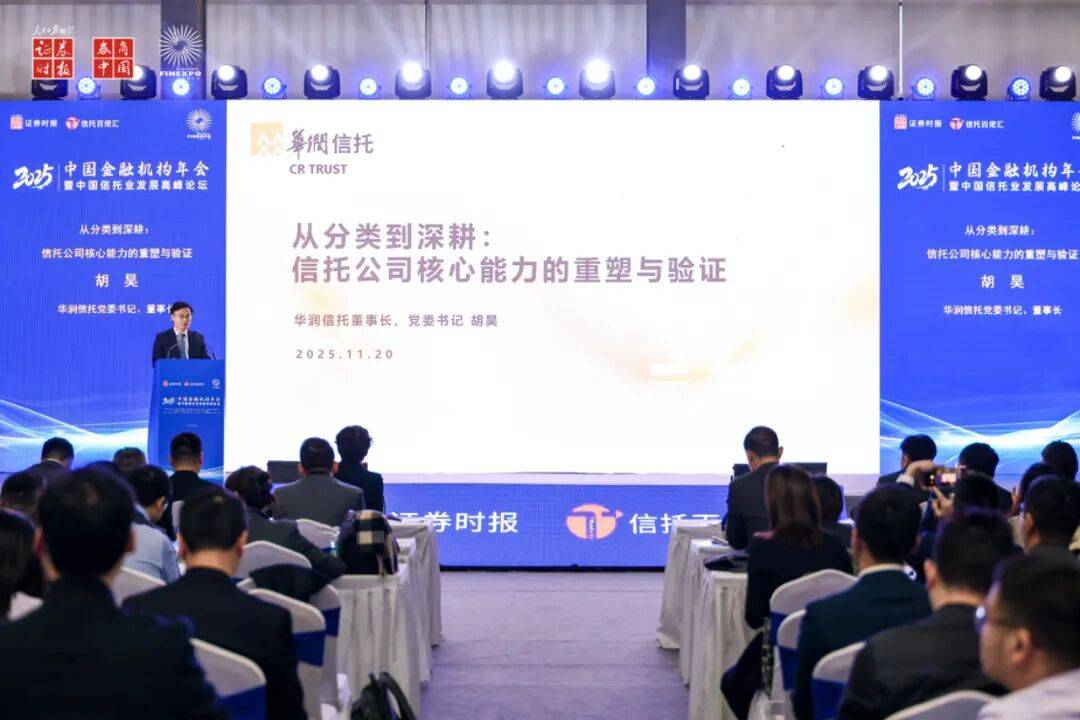
华润信托董事长胡昊:信托业转型进入核心能力系统性重塑的新阶段
Sou Hu Cai Jing· 2025-12-04 14:40
Core Viewpoint - The speech emphasizes the transformation of the trust industry, moving from mere business adjustments to a systematic reshaping of core capabilities, driven by recent policies and the need to enhance quality over quantity in the context of building a financial powerhouse [2][3]. Group 1: Transformation of the Trust Industry - The current transformation of the trust industry is characterized by a shift from quantitative expansion to qualitative improvement, focusing on core capabilities and adhering to policies [2]. - The core tasks of transformation include returning to the essence of trust, reshaping core capabilities, and fulfilling the political and social responsibilities of finance [2]. Group 2: Four Dimensions of Reshaping - The four dimensions of reshaping are value, business, organization, and spirit, which collectively support the construction of core capabilities aligned with the role of trustees [3]. - Value reshaping involves deepening three role positions: being a long-term partner to the real economy, a faithful steward of people's wealth, and a foundational platform for social trust [3]. - Business reshaping focuses on three main areas: asset management trusts, asset service trusts, and public welfare trusts, with an emphasis on differentiated products and services [3][4]. Group 3: Organizational and Cultural Restructuring - Organizational restructuring aims to create an agile and efficient system that enhances four key capabilities: investment research, operational service, risk management, and technological innovation [4]. - Cultural restructuring integrates a trust culture that emphasizes honesty, prudence, and compliance, ensuring that every employee embodies the trust culture [4]. Group 4: Measuring Success and Future Collaboration - The effectiveness of the reshaping efforts will be measured against regulatory requirements and the ability to gain professional trust from clients, as well as resilience through market cycles [7]. - The ultimate goal is to build a collaborative ecosystem with banks, brokerages, and insurance companies, enhancing the overall financial service capability and trust's unique role in supporting national strategies and the real economy [7].

中航信托被罚款30万元 向不符合监管要求的项目提供融资
Xi Niu Cai Jing· 2025-12-04 12:52
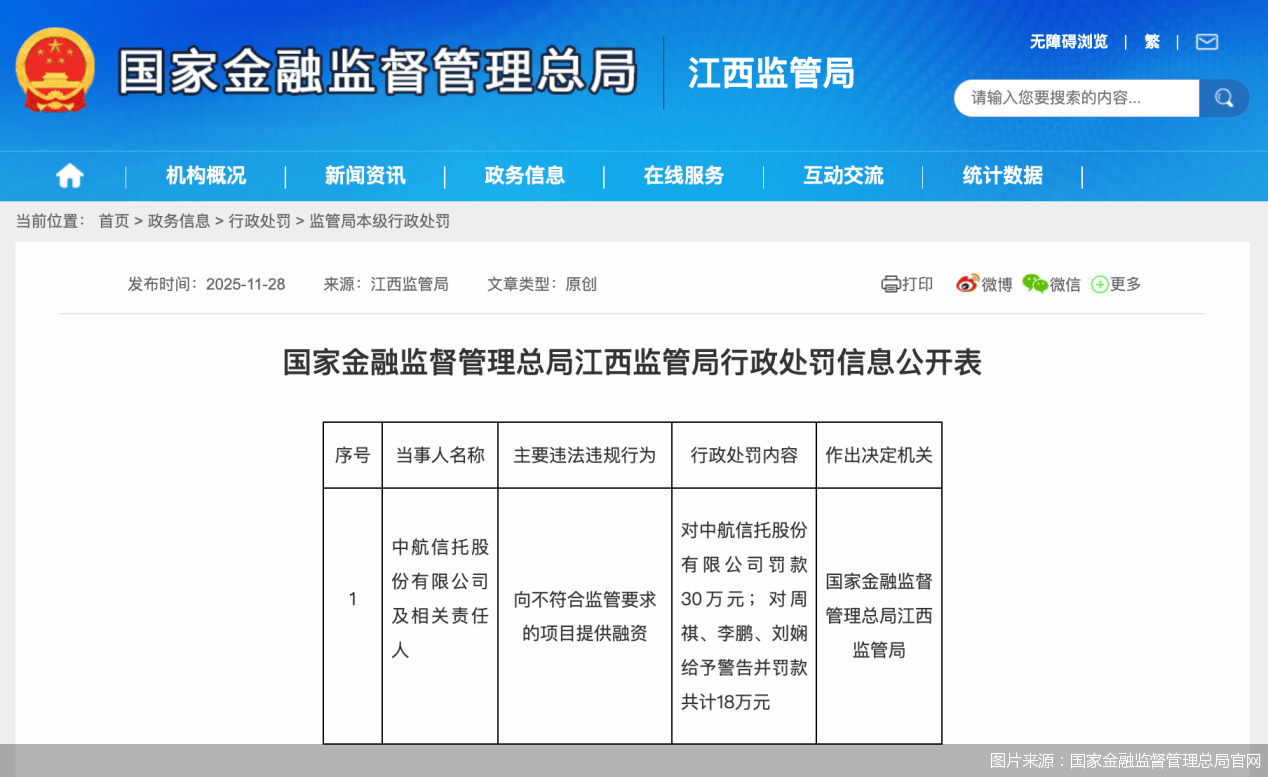
| 序号 | 当事人名称 | 主要违法违规行为 | 行政处罚内容 | 作出决定机关 | | --- | --- | --- | --- | --- | | 1 | 中航信托股 份有限公司 | 向不符合监管要求 的项目提供融资 | 对中航信托股份 有限公司罚款 30万元;对周 | 国家金融监督 | | | 及相关责任 | | | 管理总局江西 | | | | | 祺、李鹏、刘娴 | | | | 人 | | | 监管局 | | | | | 给予警告并罚款 | | | | | | 共计18万元 | | 中航信托目前处于被接管状态。4月份,中航信托在官网发布公告称,为提升公司经营管理效能,经股东会、董事会审议通过,该公司与建信信托有限责任 公司、国投泰康信托有限公司签订了《委托服务协议》,聘请上述两家公司为该公司日常经营管理提供服务。 11月28日,据国家金融监督管理总局江西监管局披露的行政处罚信息公开表,中航信托股份有限公司(下称"中航信托")因向不符合监管要求的项目提供融 资,被罚款30万元。同时,相关责任人周祺、李鹏、刘娴被给予警告并被罚款共计18万元。 中航信托表示:"本公司相关的债权债务关系、信托法律关系不 ...

“十四五”信托新力量:光大信托支撑地方经济社会高质量发展新图景
Zhong Guo Jin Rong Xin Xi Wang· 2025-12-04 08:26
转自:新华财经 作为金融央企信托机构,光大兴陇信托有限责任公司(以下简称"光大兴陇信托")"十四五"时期积极锚 定"共同富裕"这一时代命题,以"金融向善"为核心理念,立足自身使命担当深耕主业、做精专业,创新 探索信托赋能乡村振兴新范式,深度融入地方社会民生建设大局,聚焦公益慈善发展、地方特色产业培 育、基础设施完善、民生福祉提升等关键领域,全力为地方经济社会高质量发展注入信托力量。 乡村振兴:筑牢基础设施建设之基 基础设施是乡村振兴的"硬支撑"。全面推进乡村振兴,既要激活产业"引擎",又要筑牢基建"基石"。 为深入贯彻"十四五"规划提出的"坚持农业农村优先发展、全面推进乡村振兴",光大兴陇信托以服务特 色小镇建设为抓手,为浙江省第一批37个特色小镇之一——绍兴黄酒小镇的保护、修缮和提升以及区域 内的道路、管线、景观绿化等市政配套设施,提供了有效的资金支持。 特色小镇作为集聚自然、文化、创新资源的新载体,是承载大项目、好项目的新平台,也是浙江创新发 展的战略选择,更要协同各方力量,打通资源要素流通堵点,以资源整合释放金融服务潜能。 数据显示,截至2024年末,公司存续实体经济信托业务规模约4765.77亿元,占 ...
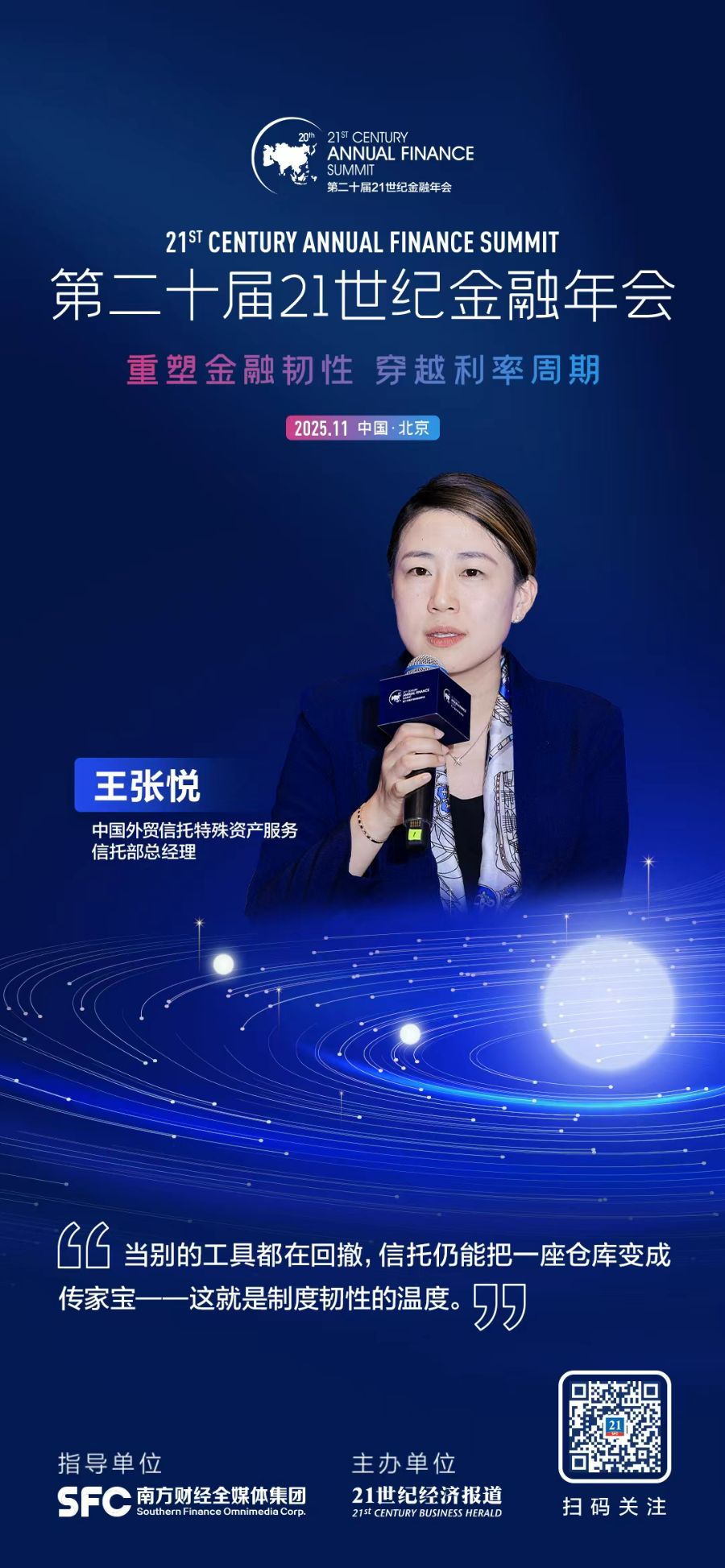
中国外贸信托王张悦:信托能提供其他金融工具难以替代的解决方案
2 1 Shi Ji Jing Ji Bao Dao· 2025-12-02 12:01
Core Insights - The "20th Century Financial Annual Conference" highlighted the growing importance of real estate trusts as a tool for connecting family security, corporate transformation, and trust services to the real economy [1] Group 1: Industry Trends - There is an increasing demand for trust tools among individuals, families, and enterprises, especially as the "14th Five-Year Plan" shifts focus to funding needs [4] - The implementation of the real estate trust registration system in Beijing is a significant regulatory advancement, with the first registrations completed by China Foreign Trade Trust and Guotou Taikang Trust [4][5] Group 2: Social Value of Real Estate Trusts - Real estate trusts can address issues related to aging families and provide financial security through asset isolation and support [5] - They can facilitate reasonable inheritance planning for high-net-worth individuals by placing properties into trusts [5] Group 3: Economic Impact - Real estate trusts are seen as a means to support the real economy, with potential applications in risk management and service trusts [6] - The ability to securitize real estate assets can alleviate corporate burdens and assist in structural adjustments [6] Group 4: Business Models - Real estate trusts can be categorized into asset management trusts and service trusts, with different revenue models based on asset type and management capabilities [6] - Service trusts targeting families generate income correlated with scale, while risk management trusts rely on the expertise of trust companies [6] Group 5: Challenges and Future Directions - Market education is necessary as public awareness of trust tools remains low, with only a small percentage of the elderly familiar with them [7] - Cost issues related to tax burdens on trust cases may deter families and enterprises from establishing real estate trusts [7] - Expansion of pilot programs and increased participation from trust companies are recommended to address market education and cost challenges [7]
平安信托: 搭建养老生态 打造中国式养老的“深圳样本”
Jin Rong Shi Bao· 2025-12-02 02:07
Core Viewpoint - Ping An Trust and Ping An Zhenyi Nian have launched a new "insurance + trust + elderly care service" ecosystem model, integrating financial and elderly care resources to manage retirement funds independently, ensuring targeted payments and risk isolation throughout the entire aging process [1][2] Group 1: Strategic Cooperation and Government Role - The strategic cooperation is a significant exploration by the Shenzhen Futian District government and local financial institutions to implement central leadership directives on elderly care services, focusing on improving people's livelihoods and innovating work mechanisms [2] - The local government is promoting a mechanism that combines "government leadership" with "market and social collaboration," encouraging social capital to enter the elderly care service system [2] Group 2: Advantages of Trust Companies in Elderly Finance - Trust companies are seen as natural guardians of long-term interests, providing risk isolation for retirement funds and flexible distribution mechanisms, which can cater to the needs of wealth inheritance across generations [2][3] Group 3: New Trust Model Features - The upgraded Ping An Trust elderly service trust model will achieve four major functional advancements: 1. The "safety deposit box" function for fund management, ensuring the security of retirement funds against various risks [4] 2. The "amulet" function for wealth inheritance, allowing clients to flexibly arrange payment methods and meet both retirement and inheritance needs [4] 3. The "expressway" function for service payments, enabling seamless payment for elderly care services through trust accounts [5] 4. The "universal access" function for ecological services, integrating various resources to meet comprehensive financial and non-financial needs throughout the aging process [5] Group 4: Commitment to the Elderly Care Industry - The collaboration between Ping An Trust and Ping An Zhenyi Nian embodies the principle of "finance for the people," aiming to provide a replicable model for the elderly care industry and contribute to addressing the challenges of an aging population [5]

“托管”期间惹风波!中航信托被罚30万元,祸起违规提供融资
Sou Hu Cai Jing· 2025-12-01 12:19
Core Viewpoint - China Aviation Trust Co., Ltd. has been fined for providing financing to projects that do not meet regulatory requirements, highlighting ongoing compliance issues and a decline in operational performance [1][4][6] Regulatory Actions - China Aviation Trust was fined 300,000 yuan for providing financing to non-compliant projects, with related personnel fined a total of 180,000 yuan [4][6] - The company has faced multiple penalties since 2018 for similar violations, including a 400,000 yuan fine in 2024 for lending to companies without the necessary qualifications [5][6] Company Background - China Aviation Trust, formerly known as Jiangxi Jiangnan Trust Co., Ltd., was established as a foreign-invested enterprise and has a registered capital of 6.466 billion yuan, managing assets exceeding 600 billion yuan [5] - The major shareholders are China Aviation Investment Holding Co. (84.42%) and Overseas Chinese Bank (15.58%) [5] Financial Performance - The company has experienced a significant decline in revenue and net profit since 2021, with total revenue dropping from 3.488 billion yuan in 2021 to 1.238 billion yuan in 2023, a decrease of 64.5% [8] - Net profit fell from 1.679 billion yuan in 2021 to approximately 83.87 million yuan in 2023, reflecting a nearly 90% decline [8] Operational Challenges - In 2025, China Aviation Trust entered a "trustee" status, with its operations managed by other trust companies, indicating a loss of management capability [7][9] - The company has been criticized for its poor performance in fulfilling housing delivery obligations, further complicating its operational challenges [8] Recommendations for Improvement - Experts suggest that China Aviation Trust should conduct a comprehensive audit to clarify its financial status and improve operational performance [9] - There is a need for enhanced transparency and stricter adherence to legal regulations to rebuild trust with investors and regulators [9]
审计委员会行使监督职能有助于提升治理效力
Zheng Quan Ri Bao· 2025-11-30 16:13
Core Viewpoint - The recent trend of financial institutions in China, such as Northeast Securities and China Aviation Fund, abolishing their supervisory boards reflects a significant shift in internal governance structures, driven by the new Company Law effective from July 2024, which allows for the audit committee to assume the supervisory board's responsibilities [1][2]. Group 1: Background and Context - Financial institutions established supervisory boards to prevent power abuse through financial and performance oversight, but issues such as lack of independence and professionalism have led to their marginalization [1]. - The new Company Law provides a legal basis for financial institutions to optimize governance structures by allowing the audit committee to take over the supervisory board's functions [1]. Group 2: Implications of the Change - The transition from supervisory boards to audit committees is expected to enhance governance efficiency by resolving overlapping supervisory functions, which previously led to unclear responsibilities and resource wastage [2]. - Audit committees, typically composed of independent directors with financial and risk management backgrounds, are seen as more capable of providing effective oversight compared to the often internally dominated supervisory boards [2]. - The integration of the audit committee within the board of directors allows for earlier involvement in major decision-making processes, thereby strengthening risk control from the outset [2]. Group 3: Challenges Ahead - While the audit committee is positioned to enhance internal governance, it faces the challenge of ensuring accountability not only to the management but also to the board of directors, which is crucial for effective oversight [2].

监管批复!华信信托进入破产程序
Sou Hu Cai Jing· 2025-11-28 12:32
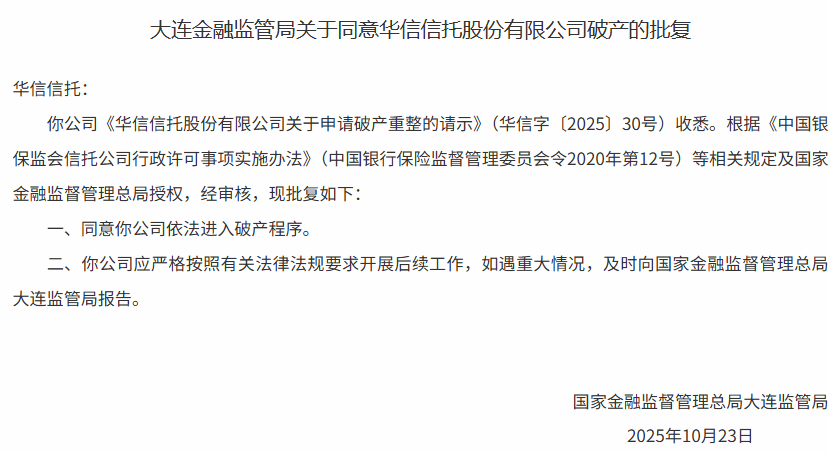
【大河财立方消息】11月28日消息,大连金融监管局近日批复,同意华信信托股份有限公司(以下简称华信信托)依 法进入破产程序。 华信信托风险处置工作已有数年。2019年,华信信托被列入6家高风险信托公司之列;2020年4月,华信信托因"资金 池"业务违规被监管叫停,同年9月,华信信托持续发布多只产品延期兑付公告,11月,华信信托面向全国征集战略投 资者,拟引入单一或多家战略投资者。 2021年,原银保监会工作组进驻华信信托。此后华信信托分别进行两次信托受益权转让,累计兑付本金9.2%,剩余 90.8%本金展期。 今年8月,华信信托风险处置迎来关键进展。彼时,华信信托发布公告称,收到大连安鼎企业管理有限公司(简称收 购公司)致函。根据来函,收购公司将按照风险处置的整体安排,于2025年9月25日前收购符合资格的个人投资者的 信托受益权,委托公司公告并协助处理相关签约事宜。华信信托重组方有关信息至此也得以明确。 公开资料显示,华信信托成立于1981年,注册资本66亿元,是辽宁省唯一一家信托公司。 责编:李文玉 | 审核:李震 | 监审:古筝 ...
粤财信托魏薇:服务信托仍是蓝海 期待以细水长流的方式陪伴客户
2 1 Shi Ji Jing Ji Bao Dao· 2025-11-28 04:56
Core Viewpoint - The trust industry is entering a new development cycle driven by internal dynamics and changing client demands, despite the challenges posed by declining market interest rates and traditional asset management pressures [1][2]. Group 1: Industry Transformation Drivers - The trust industry is experiencing a transformation driven by clear regulatory policy directions, particularly the enhanced importance of asset service trusts in the new "three-category" business framework [1]. - The demand for stable and professional wealth management tools is increasing among family clients, who are seeking solutions to manage their wealth in a complex environment [2]. Group 2: Real Estate Trust Insights - The Guangdong pilot program for real estate trusts features three key characteristics: pre-registration for properties not immediately ready for delivery, no restrictions on trust companies from outside the region, and the ability to combine pre-registration with will trusts for smoother asset transfer [3]. - Trust companies are motivated to engage in real estate trusts not solely for direct property income but also due to the trust placed in them by clients who entrust significant assets [3][4]. Group 3: Equity Trust Perspectives - In the equity trust sector, income is derived not only from setup and management fees but also from dividend distributions, which are essential for wealth transfer to beneficiaries [5]. - The long-term operation of equity trusts can lead to the accumulation of management fees through prudent asset allocation and reinvestment of dividend funds into trust company products [5]. Group 4: Future Outlook - The expectation is for continuous improvement in regulatory frameworks, allowing wealth managers to support clients in the long-term transmission of family values and core assets [5].
信托业“去监事会“提速,两家上市信托公司走完流程
Sou Hu Cai Jing· 2025-11-28 04:19
Core Viewpoint - The reform of trust companies is entering a substantive implementation phase, marked by the cancellation of supervisory boards in two listed companies, Shandong Guoxin and Jianyuan Trust, transitioning to an audit committee model for governance [2][3]. Group 1: Company Actions - Shandong Guoxin announced the cancellation of its supervisory board effective November 10, with responsibilities transferred to the audit committee [2][3]. - Jianyuan Trust completed its supervisory board cancellation process, receiving regulatory approval on November 11, with the audit committee taking over its functions [3]. - Both companies followed a structured process from regulatory approval to charter amendment and transfer of powers, ensuring a smooth transition in governance [3]. Group 2: Industry Trends - The cancellation of supervisory boards aligns with regulatory trends and aims to enhance governance efficiency by reducing overlapping functions [4][5]. - The new governance model is expected to resemble the single-tier board system of major international financial institutions, facilitating better alignment with global standards [5]. - The regulatory framework has been updated to allow trust companies to establish audit committees in place of supervisory boards, providing a clear operational pathway for governance optimization [6]. Group 3: Future Outlook - The industry anticipates that more trust companies will follow suit in the next 3-5 years, with the audit committee model becoming the mainstream choice [8]. - The new Company Law allows limited liability companies to opt for audit committees, clearing obstacles for industry transformation [8]. - Companies that have completed governance adjustments must remain vigilant against the risk of superficial implementation, ensuring that audit committees are effective rather than merely symbolic [8].