云计算

Search documents
七巨头“财报本周亮剑:AI万亿豪赌迎生死大考,华尔街已举“惩罚之锤
Zhi Tong Cai Jing· 2026-01-25 23:59
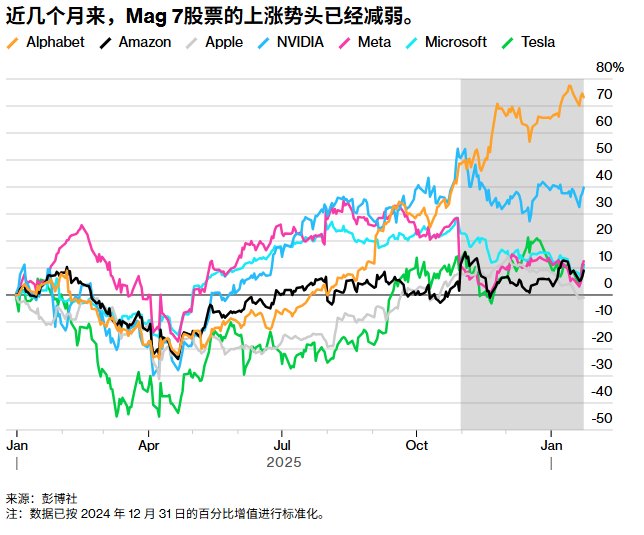
Core Viewpoint - Investors are focusing on niche stocks in the artificial intelligence sector, with upcoming earnings reports from major tech companies serving as a critical indicator for the continuation of this strategy into 2026 [1] Group 1: Performance of Major Tech Companies - The "Tech Seven" companies, including Google, Amazon, Apple, Meta Platforms, Microsoft, Nvidia, and Tesla, have significantly influenced the stock market over the past three years, but skepticism is growing regarding their AI investments and returns [1] - As of October 29, 2025, five of the seven companies saw their stock prices decline, underperforming the S&P 500 index, with only Google and Amazon showing gains [1] - The group is expected to report a 20% profit growth for Q4, marking the slowest growth since early 2023, indicating pressure to demonstrate returns on substantial capital expenditures [3][6] Group 2: Shift in Investor Focus - Following the decline of the Tech Seven index, traders have shifted their attention to companies benefiting from funding from these tech giants, with stocks like Sandisk, Micron Technology, and Western Digital seeing significant price increases [2] - The performance of these smaller companies is attributed to expectations of economic growth and attractive valuations, suggesting a broader market shift towards performance-driven investments [2] Group 3: Earnings Reports and Expectations - Major companies like Microsoft, Meta Platforms, and Tesla are set to release earnings reports soon, with Alphabet and Nvidia following later, which will provide insights into various sectors including cloud computing and digital advertising [2][3] - Microsoft’s Azure business has shown remarkable growth, with a 39% revenue increase in Q1, driven by demand for AI model training, and expectations for continued growth in the upcoming quarter [5] Group 4: Capital Expenditure and Investor Sentiment - Major tech companies are projected to increase capital expenditures to approximately $475 billion by 2026, up from $230 billion in 2024, raising investor expectations for returns [6] - The market is cautious, as companies that fail to meet growth targets may face significant stock price declines, as evidenced by Meta Platforms' 11% drop following its capital expenditure announcement [6] Group 5: Market Dynamics and Valuation - The Tech Seven companies dominate the S&P 500 index, accounting for over one-third of its total weight, making it challenging for investors to avoid these stocks [7] - Despite the recent performance issues, the expected price-to-earnings ratio for the Tech Seven is 28, aligning with historical averages, indicating that these stocks are not overly expensive [10]






数年来首次,云计算巨头开始“逆市”涨价,或带来全行业重估
Xuan Gu Bao· 2026-01-25 23:31
Group 1 - Amazon Web Services (AWS) has raised the price of its EC2 machine learning capacity blocks by approximately 15%, with the p5e.48xlarge instance hourly cost increasing from $34.61 to $39.80 [1] - This price increase marks a significant shift in the cloud services industry, breaking a two-decade trend of declining prices, indicating that if cloud service providers successfully implement price hikes without significant customer loss, subsequent increases may become easier [1] - The rising demand for artificial intelligence tokens is expected to drive a price increase trend from upstream to CPUs and cloud services, with AWS leading the way in breaking industry norms, potentially leading to a valuation restructuring for cloud computing and related service providers [1] Group 2 - Companies that may benefit from the cloud computing price increase trend include UCloud, Deepin Technology, Hongjing Technology, Capital Online, Shunwang Technology, Wangsu Science and Technology, and Qingyun Technology [2] - In the database sector, companies such as Star Ring Technology, Dameng Data, Haima Data, Taiji Co., SuperMap Software, and Torus Technology are also highlighted as potential beneficiaries [2]

从“七巨头信仰”到“用表现说话” 下周美股面临财报生死局
Ge Long Hui A P P· 2026-01-25 14:26
Core Viewpoint - The "Big Seven" tech companies—Alphabet, Amazon, Apple, Meta, Microsoft, Nvidia, and Tesla—have led the stock market for most of the past three years, but this trend reversed by the end of 2025 as Wall Street began to question the substantial investments made in artificial intelligence and the timeline for returns on these investments [1] Group 1: Stock Performance - An index tracking the Big Seven reached a record high on October 29, but since then, five of these companies have seen their stock prices decline, underperforming the S&P 500 index [1] - Only Alphabet and Amazon have maintained an upward trajectory, with Alphabet's stock increasing nearly 20% [1] Group 2: Market Sentiment - Darrell Cronk, Chief Investment Officer at Wells Fargo Wealth and Investment Management, stated that tech stocks have become a "show me" story, indicating that funds will flow back into the tech sector if large tech companies continue to deliver strong performance [1] - Upcoming earnings reports from Microsoft, Apple, Tesla, and Meta will provide insights into the health of various sectors, including cloud computing, electronic devices, software, and digital advertising [1]

金山云(03896):前瞻:预计25Q4AI云高增长,26年延续高资本开支
GF SECURITIES· 2026-01-25 08:52
Investment Rating - The investment rating for the company is "Buy" with a current price of 6.46 HKD and a target value of 10.49 HKD [4]. Core Insights - The company is expected to experience high growth in AI cloud services, with a projected revenue increase of 22% year-on-year for 2025, reaching 9.48 billion RMB, and continuing to grow by 28.8% in 2026 [7][11]. - The AI public cloud revenue is anticipated to grow significantly, with a year-on-year increase of 119% in 2025 and 85% in 2026, contributing to 44% of total revenue by 2026 [7][11]. - The collaboration with Xiaomi's ecosystem is expected to enhance revenue, with contributions from this partnership projected to approach the upper limit of related transactions in 2025 [7]. - The company is expected to maintain high capital expenditures exceeding 10 billion RMB in 2026 due to strong demand [7]. Financial Projections - Revenue projections for the company are as follows: - 2023: 7,047 million RMB - 2024: 7,785 million RMB - 2025E: 9,481 million RMB - 2026E: 12,215 million RMB - 2027E: 14,687 million RMB - The growth rates are projected at -13.8% for 2023, 10.5% for 2024, 21.8% for 2025, 28.8% for 2026, and 20.2% for 2027 [3][10]. - Adjusted EBITDA is expected to improve significantly, reaching 2,292 million RMB in 2025 and 4,072 million RMB in 2026 [3][10]. Valuation - The company is valued based on a price-to-sales (P/S) ratio of 6 for AI cloud services and 2 for non-AI cloud services, leading to a target price of 10.49 HKD per share [11].
格陵兰岛争端标志“欧美脱钩”?欧洲准备应对“美国技术封锁”
Hua Er Jie Jian Wen· 2026-01-25 02:19
Core Viewpoint - The article discusses the geopolitical tensions between the U.S. and Europe, highlighting a potential "decoupling" as Europe seeks to reduce its reliance on American technology infrastructure due to fears of U.S. government intervention [1][2][3]. Geopolitical Tensions - The relationship between the U.S. and Europe is deteriorating, with Trump's threats regarding Greenland symbolizing a deeper rift in shared values [2]. - European officials are increasingly concerned about the potential for U.S. administrative actions that could disrupt access to critical services, leading to a defensive economic strategy [2][3]. Legislative and Business Responses - The European Parliament has passed a "technological sovereignty" resolution, advocating for prioritizing European products in public procurement and supporting local cloud service providers [1][3]. - European officials are pushing for U.S. cloud service providers to ensure that critical industry clients can easily transition to local infrastructure in case of service disruptions [4]. Market Dynamics - Despite efforts for independence, European customers are projected to spend nearly $25 billion on services from the top five U.S. cloud companies in 2024, representing 83% of the European market [3]. - Major U.S. tech companies are responding by restructuring and launching services aimed at addressing European data sovereignty concerns [5]. Policy Shifts and Market Risks - The policy environment for U.S. tech companies in Europe is becoming increasingly challenging, with initiatives from France and Germany aimed at enhancing technological independence [6]. - The potential shift towards substantial market barriers for U.S. tech firms could lead to a reevaluation of their valuations, as a significant portion of their revenues comes from Europe [6].
亚马逊将裁员30000人!
Xin Lang Cai Jing· 2026-01-24 06:24
Core Insights - Amazon plans to lay off approximately 30,000 corporate employees by the end of January 2026, which represents about 8.5% to 10% of its 350,000 corporate workforce [2] - The layoffs will affect multiple departments, including Amazon Web Services (AWS), retail, Prime Video, and Human Resources [2] - CEO Andy Jassy stated that the layoffs aim to streamline operations, reduce bureaucracy, and reshape company culture, rather than being driven by financial considerations or artificial intelligence [2] Summary by Categories Layoff Details - The upcoming layoffs are expected to be similar in scale to the 14,000 positions cut in October of the previous year, which was half of the initial target of 30,000 [2] - The total number of Amazon's global employees exceeds 1.5 million [2] Management Perspective - Andy Jassy clarified that the previous layoffs were not primarily due to the impact of artificial intelligence but were related to cultural fit within the company [2] - The layoffs are part of a broader initiative to reduce white-collar workforce significantly but selectively [2]

亚马逊计划下周进行数千人规模的企业裁员
Xin Lang Cai Jing· 2026-01-24 01:07
Group 1 - Amazon is set to initiate a new round of layoffs next week, potentially affecting thousands of corporate employees [1] - In October, Amazon announced layoffs of 14,000 employees aimed at streamlining management levels and reducing bureaucratic redundancy [1] - The upcoming layoffs are expected to be similar in scale to those in October, bringing the total number of layoffs to 30,000 [1] Group 2 - Affected departments include Amazon Web Services (AWS), Prime Video, retail, and human resources [1] - CEO Andy Jassy stated that the layoffs are not due to AI replacing human labor but are intended to address cultural issues arising from rapid expansion [2] - Jassy emphasized the need to simplify management layers that have led to unclear responsibilities [2]
大模型卷价格没意义,AI竞争关键是“卖场景”!腾讯云高管发声
券商中国· 2026-01-23 14:48
Core Viewpoint - The article discusses the shift in the competitive logic of the domestic cloud computing market as artificial intelligence (AI) moves from technical demonstrations to practical applications within industries, emphasizing the importance of integrating AI into business processes to create measurable commercial value by 2026 [2]. Group 1: Competitive Logic Shift - The initial phase of AI competition focused on selling resources, particularly GPU computing power, but many clients did not fully understand how AI could reduce costs and improve efficiency [3]. - By 2025, the market's focus shifted from survival to seizing new AI opportunities, with competition now centered on application rather than underlying resources [3]. - Tencent Cloud's revenue structure shows a significant shift, with approximately 25% of revenue coming from SaaS, contrasting with other cloud providers that primarily focus on infrastructure services [3]. Group 2: Ecosystem Partner Transformation - Tencent Cloud estimates that 30%-40% of its ecosystem partners have begun exploring AI business opportunities, but transitioning from resource resellers to value service providers presents challenges [4]. - Partners face two main pain points: internal consensus and execution issues, and the need to shift from price-based sales to value-based sales, requiring a deep understanding of customer business scenarios [4]. - Tencent Cloud's strategy has evolved from merely opening technology capabilities to integrating technology with business through collaborative exploration of vertical industry scenarios [4]. Group 3: International Expansion and Value Competition - In addition to the competitive domestic market, "going global" has become a common strategy for cloud providers and partners seeking growth, with Tencent Cloud's international business growing by 30% year-on-year [5]. - Key factors for winning overseas clients include advanced audio and video technology, competitive pricing, and professional localized service support [5]. - Tencent Cloud's executives reject the notion of engaging in price wars, emphasizing that the focus should be on delivering core value to customers rather than competing on price [5].


1月23日行情解读:美超级风暴周,Fed决议+科技巨头财报双重对决,反弹遇压下的生死局
Xin Lang Cai Jing· 2026-01-23 13:09
Group 1 - The core viewpoint of the article highlights that the recent market rebound in U.S. stocks is merely a technical correction and does not signify a reversal of the prevailing weak trend [1][5] - Major tech companies such as Nvidia, Oracle, Microsoft, Meta, Apple, and Amazon have shown signs of fatigue, with some stocks even facing downward break risks [1][5] - The upcoming earnings reports from key players like Microsoft, Meta, Tesla, Apple, and Amazon will be critical in assessing the real economic conditions of the AI industry, consumer electronics, and cloud computing sectors [2][7] Group 2 - The Federal Reserve's interest rate decision is anticipated to have significant implications, with the U.S. GDP revised up to 4.4%, indicating stronger-than-expected economic resilience [3][7] - The market's expectations for interest rate cuts have been pushed back to June, as the core PCE remains moderate, and any indication from Powell of not rushing to cut rates could lead to further market volatility [3][7] - Investors in Nasdaq and Dow ETFs should be cautious, as the current rebound may be limited, and there are potential risks associated with the upcoming "seasonal line defense" [3][7]
上海30家领跑:收获 IPO 公司最多的五大城市还有谁?
Sou Hu Cai Jing· 2026-01-23 13:06
Core Insights - In 2025, a total of 277 companies are expected to go public in domestic and international markets in China, with a concentrated geographical distribution among five cities: Shanghai, Beijing, Suzhou, Shenzhen, and Hangzhou, which together account for 37.5% of the total IPOs [2] Group 1: IPO Distribution by City - Shanghai leads with 30 IPOs, followed by Beijing with 27, Suzhou with 18, Shenzhen with 16, and Hangzhou with 13 [3] - The concentration of IPOs in these cities reflects their industrial structure and development direction [2] Group 2: Shanghai's Internationalization - Shanghai's 30 listed companies show a strong internationalization trend, with 20 companies choosing to list on the Hong Kong Stock Exchange (HKEX), representing two-thirds of its total [5] - This distribution aligns with Shanghai's positioning as an international financial center, catering to companies seeking global financing and brand influence [5] Group 3: Beijing's Global Perspective - Beijing ranks second with 27 IPOs, showcasing a globalized listing strategy, including 15 on HKEX and 4 on NASDAQ, the highest among all cities [6] - As a technology innovation hub, Beijing's strengths in AI and biomedicine drive companies to seek international benchmarks and valuations [6] Group 4: Suzhou's Balanced Approach - Suzhou's 18 IPOs are distributed across various exchanges: 6 on HKEX, 5 on the Shanghai Stock Exchange (SSE), 4 on the Shenzhen Stock Exchange (SZSE), and 3 on the Beijing Stock Exchange (BSE) [7] - This balanced distribution reflects Suzhou's manufacturing base and diverse industrial ecosystem, allowing companies to choose platforms based on their development stages [7] Group 5: Shenzhen's Preference for HKEX - Shenzhen, with 16 IPOs, shows a clear preference for HKEX, with 11 companies listing there, which is 2.75 times the number listed on SZSE [8] - The choice aligns with Shenzhen's characteristics as a hub for electronic information and technology innovation, facilitating connections with international markets [9][10] Group 6: Hangzhou's Diverse Pathways - Hangzhou, ranking fifth with 13 IPOs, exhibits a diverse listing strategy, with 7 on HKEX, 3 on SSE, 2 on SZSE, and 1 on NASDAQ [11][12] - As a center for digital economy, Hangzhou's companies seek international capital, reflected in their significant presence on HKEX and NASDAQ [13][14][16] Group 7: Summary of Trends - The IPO distribution in major cities in 2025 not only reflects quantity but also correlates with local industrial structures, city positioning, and capital strategies [17] - Shanghai's financial center status, Beijing's tech innovation, Suzhou's manufacturing foundation, Shenzhen's innovation ecosystem, and Hangzhou's digital economy strengths are evident in their respective listing choices [17]