水产养殖

Search documents
南海水产研究所副所长张殿昌:重点培育饲料效率高、耐粗饲料的水产品种,降低养殖成本
Nan Fang Nong Cun Bao· 2025-08-26 13:32
Core Viewpoint - The South China Sea Fisheries Research Institute emphasizes the need to cultivate high feed efficiency and rough feed-resistant aquatic species to reduce aquaculture costs [1][3]. Group 1: Recommendations for Marine Ranching Development - Zhang Dianchang proposed two major recommendations for the development of marine ranching in Guangdong Province [3]. - The focus should be on core species such as golden pomfret, which are key to deep-sea farming in Guangdong [5]. Group 2: Comprehensive Technological Initiatives - A full-chain industrial technology breakthrough is necessary, covering seven key areas [6]. - Strengthening the breeding of breakthrough new varieties is essential, with a focus on high feed efficiency and rough feed resistance [8]. - For instance, reducing the feed conversion ratio for golden pomfret from 2.2 to 1.5 could lower the cost by 3-4 yuan per kilogram and reduce fishmeal usage by 20% [9]. Group 3: Technological Development and Support - Development of controlled indoor breeding technology to ensure stable supply of seedlings throughout the year [10]. - Breakthroughs in equipment technology, such as adjustable gravity net cages, are crucial for ensuring the safety of facilities and fish [10]. - Precision nutrition feed technology should be developed to create suitable feed for different growth stages, further lowering feed conversion ratios [11]. Group 4: Disease Control and Brand Building - Establishing a comprehensive disease control system, including rapid pathogen detection and efficient vaccine development, is vital [11]. - Enhancing brand building to increase the value of Guangdong's marine ranching industry is also recommended [12]. Group 5: Technology Transfer and Collaboration - Strengthening deep innovation cooperation between universities, research institutions, and enterprises is necessary for technology transfer [13]. - Utilizing the South China Sea Fisheries Technology Innovation Alliance to support the development of core technologies and equipment for modern marine ranching [14]. - Establishing a national marine ranching engineering research center to promote joint investment in R&D by government and enterprises [16].


评论丨以大省之责,绘就岭南农业现代化新图景
Nan Fang Nong Cun Bao· 2025-08-26 10:04
Core Viewpoint - Guangdong province is leading the modernization of agriculture in China, with a total agricultural output value of 970.1 billion yuan, positioning itself as a key player in national food security and agricultural innovation [4][16]. Group 1: Agricultural Output and Industry Structure - Guangdong's agricultural sector includes 5,507 leading enterprises and generates 1.63 trillion yuan in processing revenue, showcasing a robust industrial foundation [5]. - The province's agricultural output is crucial for the food supply of 1.4 billion people in China, emphasizing its role as a major agricultural supplier [14]. Group 2: Challenges and Development Goals - Despite significant achievements, Guangdong faces challenges such as small-scale specialty industries, weak biological seed industry, limited agricultural machinery application, and product homogeneity [7][8]. - The province aims to achieve the "14th Five-Year" agricultural modernization goals through initiatives like the "Hundred Million Thousand Project," focusing on key areas such as aquaculture and marine seed industry [18][19]. Group 3: Innovation and Technology - Innovation is essential for agricultural modernization, with a focus on technological empowerment, chain integration, and policy innovation [11]. - Guangdong is addressing challenges in biological breeding technology by integrating resources from universities and enterprises to achieve breakthroughs in areas like gene editing and smart breeding [28]. Group 4: Collaborative Efforts and Policy Innovation - The province is promoting a collaborative model that connects leading agricultural enterprises with local farmers to enhance income and employment opportunities [41]. - Policy innovations such as "agricultural insurance + futures" mechanisms are being explored to support the agricultural sector and improve financial access for farmers [36][50]. Group 5: Future Outlook - Guangdong is committed to transforming agricultural modernization into tangible results, focusing on both industrial prosperity and rural revitalization [54]. - The province's agricultural modernization efforts are characterized by a proactive approach, aiming to navigate challenges and seize opportunities in the agricultural landscape [56].
海大集团董事长薛华:打造水产育种“远洋舰”
Nan Fang Nong Cun Bao· 2025-08-26 09:03
Core Viewpoint - The chairman of Haida Group, Xuehua, emphasizes the importance of technological innovation in building a modern agricultural industry system, particularly in the field of aquatic breeding and food security [4][5][6]. Group 1: Aquatic Breeding Strategy - Haida Group aims to create a "deep-sea breeding flagship" by enhancing collaboration between breeding enterprises and research institutions to tackle the challenges of deep-sea breeding [9][12]. - The company has established a comprehensive commercial breeding system that covers major economic species consumed nationally, focusing on breakthroughs in factory-based and deep-sea breeding [10][11]. Group 2: Modern Aquaculture Facilities - The company proposes the construction of "super factories" for near-sea aquaculture to overcome traditional aquaculture limitations and achieve controllable production [13][14]. - Factory-based aquaculture is seen as a modern approach to enhance efficiency and reduce risks, especially in the context of marine ranching [15][16]. Group 3: Feed Supply and Market Position - Haida Group is currently the world's largest feed producer, with an expected feed volume of over 30 million tons this year, aiming to be the first agricultural enterprise to reach this milestone [18]. - The company plans to increase research investment to improve feed supply, particularly focusing on the nutritional needs of marine aquaculture species [20][21]. Group 4: Future Growth Targets - Over the next five years, Haida Group aims to double the growth of its main business segments, with a target revenue of over 200 billion yuan by 2030 and feed sales reaching 51.5 million tons [22][23].

潮州饶平:“潮”向深蓝,让“饶平鱼”游向世界餐桌
Nan Fang Nong Cun Bao· 2025-08-25 16:03
Core Viewpoint - The article highlights the innovative practices in Raoping County, Guangdong, focusing on transforming traditional fishing methods into modern, sustainable aquaculture, thereby enhancing economic benefits and ecological sustainability [6][7][16]. Group 1: Aquaculture Innovations - Raoping County has implemented a "wood to plastic" demonstration project, introducing new square plastic net cages to replace traditional wooden fish rafts, addressing issues of damage, pollution, and low efficiency [6][7]. - A total of 317 deep-water plastic net cages have been deployed, with 4.2 million fish fry released, projecting an annual output value of 650 million yuan [12][16]. - The county has established a provincial-level flower bass breeding farm, achieving a significant leap in breeding technology and producing 8 million fry, filling a gap in the province [22][30]. Group 2: Economic Development Strategies - Raoping County is focusing on "technology empowerment, ecological priority, and full-chain integration" to develop its marine economy, aiming to turn the ocean into a "blue granary" [15][16]. - The county's aquaculture industry, including shrimp and abalone fry, has a combined annual output value of 477 million yuan and 600 million yuan respectively, with products being sold to various provinces [36]. - The county is also investing 2.12 billion yuan in a modern pre-prepared food industrial park, enhancing product value and market competitiveness [60][62]. Group 3: Environmental Sustainability - Raoping County has developed a comprehensive marine ranch construction plan for 2023-2025, designating areas for aquaculture and conservation, freeing up approximately 200,000 acres for nearshore aquaculture [38][39]. - The county is actively removing traditional wooden fish rafts, with plans to phase out 59,000 units, promoting a shift to more sustainable practices [48][50]. - The focus on deep-sea aquaculture is expected to yield nearly 700 million yuan in output value, with 520 deep-water net cages already in operation [52][51]. Group 4: Tourism and Economic Diversification - Raoping County is developing coastal tourism, creating premium tourism routes and exploring recreational projects, which has led to the successful designation of the West Australia Island scenic area as a national AAA-level tourist attraction [63][65]. - The integration of tourism with the marine economy is aimed at stimulating new economic growth and expanding the reach of Raoping's seafood products to global markets [62][66].
科技赋能岭南特色现代农业,省农科院多领域发力支撑产业体系建设
Nan Fang Nong Cun Bao· 2025-08-25 10:30
Core Viewpoint - The article discusses the acceleration of agricultural modernization in Guangdong Province, driven by technological innovation and the establishment of a modern agricultural industry system focusing on Lingnan特色农业 [2][4]. Group 1: Policy and Strategic Initiatives - Guangdong Province has introduced action plans such as the "Guangdong Province Modernization Industry System 2025 Action Plan" and the "Modern Agricultural Industry Cluster Cultivation Action Plan (2025-2027)" to promote the development of Lingnan特色现代农业 [3][4]. - The goal is to create "千百十" billion-level industrial clusters, establishing a modern agricultural industry system that is structurally sound, complete in its supply chain, and has distinct advantages [5][6]. Group 2: Technological Innovation in Seed Industry - The Guangdong Academy of Agricultural Sciences emphasizes seed industry innovation as a key component of agricultural modernization, developing a comprehensive innovation system from variety cultivation to technical integration and deep processing [10][11]. - The Academy has achieved significant results in rice breeding, with 41 major rice varieties cultivated and promoted over an area exceeding 10 million mu, establishing Guangdong as a leader in rice seed innovation [15][16]. Group 3: Livestock and Aquaculture Innovations - The Academy has established a national key laboratory for pig and poultry breeding and has developed the "Lingnan Yellow Chicken No. 5," addressing critical industry challenges and achieving a market share of 15% [20][21]. - Innovations in ecological farming practices have led to the reconstruction of modern桑基鱼塘生态循环 systems, promoting sustainable aquaculture and enhancing resource utilization efficiency [24][31]. Group 4: Value Chain Extension in Specialty Agriculture - The Academy has made strides in the lychee industry by developing ultra-low temperature preservation technology, allowing for year-long storage and addressing seasonal sales issues [36][37]. - In the tea industry, the "Yinghong No. 9" variety has become the dominant cultivar, with a planting area of 154,400 mu, significantly increasing brand value and annual output per mu [42][44]. Group 5: Future Directions - The Academy plans to continue empowering Lingnan特色现代农业 through initiatives such as enhancing seed innovation capabilities, advancing digital agriculture, and supporting modern marine ranching construction [45][48].
乳山创新“数字+绿色+金融”服务模式,完成首批牡蛎碳汇交易
Qi Lu Wan Bao Wang· 2025-08-25 04:39
Group 1 - The unique geographical location and ecological environment of Rushan City contribute to the exceptional quality of Rushan oysters, with the local government promoting high-quality development of the oyster industry through various initiatives [1] - In 2023, Rushan City was selected as the first domestic demonstration zone for the "Sustainable Development Finance to Assist Rural Micro and Small Enterprises" project by the United Nations Development Programme, focusing on the oyster industry and exploring innovative service models combining "digital, green, and finance" [2] - The establishment of a carbon trading mechanism for oysters marks a transition from theoretical research to practical ecological benefits, with the first carbon trading transaction occurring on August 12, 2025, involving five companies [2] Group 2 - The development of the "blue carbon economy" has significant ecological, financial, and social implications, promoting environmentally friendly oyster farming practices and enhancing the ecological value of oyster cultivation [3] - The carbon trading mechanism is expected to innovate financial products related to oyster carbon credits, strengthening financial empowerment in the industry [3] - The Rushan oyster carbon trading initiative is anticipated to enhance brand recognition, expand market reach, and create more job opportunities, contributing to the harmonious development of the social economy and ecological environment [3]
让碧海银滩成为金山银山
人民网-国际频道 原创稿· 2025-08-25 02:11
Core Viewpoint - The article emphasizes the transformation of Aojiao Village in Fujian Province into a thriving community through the development of marine industries while maintaining ecological balance, showcasing the principle that "green mountains and clear waters are also golden mountains and silver mountains" [3][6][11] Industry Overview - Aojiao Village has developed five main industries: marine fishing, aquaculture, seafood processing, e-commerce, and rural tourism, leveraging its coastal resources for economic growth [2][7] - The fishing industry has transitioned from wooden boats to steel vessels, with 640 fishing boats generating an annual output value of 330 million yuan [7] - Aquaculture in the village includes 138 high-end farms, with an annual output value of 3.7 billion yuan [7] - Seafood processing has evolved from primary to deep processing, with 38 processing plants, including Haiyuan Seafood, which generated 500 million yuan last year [7] - E-commerce has seen the establishment of 117 businesses, employing 532 skilled workers, with annual sales reaching 350 million yuan [7] - The village also features 41 seaside homestays with over 700 beds to cater to diverse tourist needs [7] Environmental Initiatives - Aojiao Village has implemented an integrated waste management system to address pollution, ensuring that waste from marine activities is properly collected and processed [4][5] - The local government conducts regular inspections of industrial enterprises to mitigate environmental hazards [4] - Efforts in pollution prevention and ecological protection have led to cleaner seawater and beaches, supporting marine biodiversity and local livelihoods [5][11] Economic Development - The village has embraced a model of harmonious coexistence with the sea, transforming marine resources into economic opportunities through sustainable practices [6][9] - The local economy is supported by a complete industrial chain from fishing to export, providing direct employment opportunities for residents [10] - Innovative practices such as live-streaming sales of seafood have modernized traditional fishing and selling methods, significantly increasing business scale and revenue [10][11]
铭记历史 缅怀先烈|盐湖映初心 热土谱新篇
Bei Jing Ri Bao Ke Hu Duan· 2025-08-25 02:04
Core Viewpoint - The article highlights the historical significance of Yanchi County during the Anti-Japanese War, emphasizing its contributions through salt production and the ongoing legacy of revolutionary spirit in the region. Group 1: Historical Context - Yanchi County, located at the intersection of four provinces, played a crucial role during the Anti-Japanese War by producing essential resources such as salt, fur, and licorice, which supported the economy of the Shaanxi-Gansu-Ningxia border area [1][3]. - The region has a salt production history of over 2000 years, and during the war, it became a vital economic lifeline, with the Central National Economic Department calling for increased salt production to alleviate economic hardships [3]. Group 2: Economic Contributions - From 1938 to 1943, approximately 12.5 billion kilograms of salt were transported from Yanchi, which not only met local needs but also facilitated trade by exchanging salt for food, clothing, and other essential goods [3]. - The local economy has evolved, with current agricultural practices including the breeding of Yanchi sheep, which has become a significant source of income for over half of the rural residents, with a breeding population of 3.3 million [6]. Group 3: Cultural Legacy - The revolutionary spirit is preserved through educational initiatives, with nearly 100,000 participants engaging in red history studies in the first half of the year, fostering a connection to the region's past [4]. - The story of the Anti-Japanese War and the contributions of local soldiers is actively shared through community events and educational programs, ensuring that the history and values are passed down to future generations [5]. Group 4: Modern Developments - The region is now diversifying its agricultural output, with the introduction of high-value products such as South American white shrimp, leveraging the unique saline conditions for better quality [7]. - The transformation of saline land into productive agricultural areas is evident, with 12,000 acres of saline land now supporting various high-value industries, achieving both ecological and economic benefits [7].
盘活集体经济“小能手”
Ren Min Ri Bao Hai Wai Ban· 2025-08-25 01:21
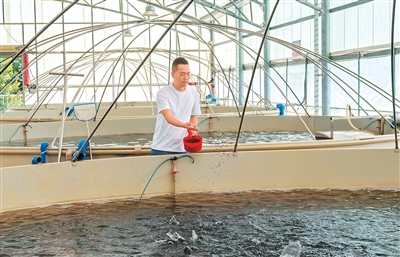
Core Viewpoint - The article highlights the transformation of rural collective economy in Longjing Village, Chengdu, through the efforts of Zhu Shilong, who has taken on the role of a rural collective economic manager, focusing on modernizing agricultural practices and enhancing community income [1][9]. Group 1: Background and Personal Journey - Zhu Shilong, a native of Longjing Village, returned to his hometown after working in the manufacturing sector, driven by a desire to improve local agricultural practices [2][3]. - The village, with over 6,000 acres of land, faced challenges in agricultural development due to a high number of residents working outside the village and a lack of modern farming techniques [3]. Group 2: Establishment of Collective Enterprises - In 2020, the village established Chengdu Jingcheng Agricultural Development Co., Ltd., with Zhu Shilong appointed as the manager, aiming to strengthen the collective economy and increase villagers' income [3][4]. Group 3: Modernization of Fish Farming - Zhu identified traditional fish farming methods as inefficient, prompting a shift towards factory-style high-density fish farming, which has shown significantly higher profitability [4][5]. - The company secured 4 million yuan (approximately 0.57 million USD) for constructing a modern fish farming facility, which was completed in 2023 [5][6]. Group 4: Agricultural Socialization Services - Zhu initiated agricultural socialization services by investing in modern farming equipment, which improved production efficiency and generated over 600,000 yuan (approximately 85,000 USD) in revenue from servicing 9,000 acres of farmland in 2024 [7][8]. - The company plans to further invest in agricultural machinery to enhance productivity and profitability [7][8]. Group 5: Economic Impact and Future Prospects - The revitalization of collective resources has led to an increase in village income, with projected earnings of over 2 million yuan (approximately 285,000 USD) from revitalized assets in 2024 [8]. - The establishment of a cold storage facility is expected to generate an additional 400,000 yuan (approximately 57,000 USD) in revenue annually [8].

农村集体经济经理人:盘活集体经济“小能手”
Xin Hua Wang· 2025-08-25 00:00
Core Viewpoint - The article highlights the transformation of rural collective economy in Longjing Village, Chengdu, driven by the efforts of Zhu Shilong, a rural collective economic manager, who focuses on modernizing agricultural practices and enhancing community welfare through innovative farming techniques and machinery [5][12]. Group 1: Background and Role of Zhu Shilong - Zhu Shilong, a native of Longjing Village, returned to his hometown after working in the equipment manufacturing industry, motivated by a desire to improve local agricultural practices [6][7]. - The role of rural collective economic managers, a new profession recognized by the Ministry of Human Resources and Social Security, involves managing economic activities to develop and strengthen rural collective economies [5][6]. Group 2: Agricultural Development Initiatives - Zhu identified the need for modernization in the village's traditional fish farming practices, which were yielding low profits due to outdated methods [9][10]. - The establishment of Chengdu Jingcheng Agricultural Development Co., Ltd. in 2020 marked a significant step towards collective economic growth, with Zhu appointed as the manager [8][9]. - The company shifted focus to factory-style high-density fish farming, which has shown potential for higher profitability, with projections of nearly 2 million yuan in profit per greenhouse annually [10][11]. Group 3: Technological Integration and Community Impact - Zhu led initiatives to enhance agricultural mechanization, purchasing various agricultural machinery and training local operators to improve efficiency [12]. - The company provided agricultural services to over 9,000 acres of farmland, generating over 600,000 yuan in revenue, demonstrating the positive impact of mechanization on productivity [12]. - The establishment of a cold storage facility and the revitalization of idle village resources have further contributed to the economic growth of Longjing Village, with expected annual revenues of around 400,000 yuan from the cold storage alone [12].