银行

Search documents
浙商证券浙商早知道-20260317
ZHESHANG SECURITIES· 2026-03-17 11:23
Market Overview - On March 17, the Shanghai Composite Index fell by 0.85%, the CSI 300 decreased by 0.73%, the STAR Market 50 dropped by 2.23%, the CSI 1000 declined by 2.33%, and the ChiNext Index decreased by 2.29%. In contrast, the Hang Seng Index rose by 0.13% [3][4] - The best-performing sectors on March 17 were non-bank financials (+1.28%), banks (+0.85%), food and beverage (+0.55%), and real estate (+0.37%). The worst-performing sectors included telecommunications (-4.69%), electronics (-2.97%), defense and military (-2.57%), machinery and equipment (-2.5%), and basic chemicals (-2.47%) [3][4] - The total trading volume for the A-share market on March 17 was 22,246 billion yuan, with net outflow of southbound funds amounting to 11.481 billion Hong Kong dollars [3][4] Important Insights Fixed Income - The report on fixed income by Hu Jianwen highlights a positive outlook on cash substitutes, with an increased degree of optimism regarding cash alternatives driven by the actual decline in R007 [5] - The market's perception is that there is a growing recognition of the potential impact of regulatory changes on monetary policy transmission [5] Macroeconomic Analysis - The macroeconomic report indicates that the GDP weekly high-frequency prosperity index for the week ending March 14 is at 5.2%, a slight increase from the previous value of 4.9% [6] - The market's view suggests a potential downward trend in the fundamentals, with the overall sentiment remaining stable [6]
市场分析:金融光伏行业领涨,A股小幅整理
Zhongyuan Securities· 2026-03-17 11:00
Market Overview - On March 17, the A-share market experienced a slight correction after reaching a high, with the Shanghai Composite Index encountering resistance at 4108 points[2] - The Shanghai Composite Index closed at 4049.91 points, down 0.85%, while the Shenzhen Component Index fell 1.87% to 14039.73 points[7] - Total trading volume for both markets was 22,247 billion yuan, slightly lower than the previous trading day[7] Sector Performance - Financial, photovoltaic equipment, automotive parts, and chemical fiber sectors performed well, while communication equipment, sports, electronic chemicals, and components lagged behind[3] - Over 80% of stocks in the two markets declined, with notable gains in insurance, steel, coal, chemical fiber, and real estate services[7] Valuation Metrics - The average price-to-earnings (P/E) ratios for the Shanghai Composite and ChiNext indices are 16.84 times and 49.38 times, respectively, above the median levels of the past three years[3] - The trading volume is above the median daily trading volume of the last three years, indicating a robust market activity[3] Economic Factors - The primary market pressure stems from overseas factors, including escalating tensions in the Middle East and rising oil prices, which have raised concerns about "stagflation" and suppressed risk appetite[3] - The Federal Reserve's interest rate cut expectations have been delayed, leading to increased volatility in U.S. Treasury yields, which affects high-valuation tech growth stocks globally[3] Policy Outlook - Domestic macroeconomic policies are becoming clearer, providing a solid bottom line for the market, with the central bank indicating a flexible approach to reserve requirement ratio (RRR) and interest rate cuts to maintain liquidity[3] - The support from the Central Huijin Investment Company is expected to boost market confidence in future trends[3] Investment Recommendations - Investors are advised to closely monitor macroeconomic data, changes in overseas liquidity, and policy developments[3] - Short-term investment opportunities are suggested in the financial, photovoltaic equipment, automotive parts, and chemical fiber sectors[3]

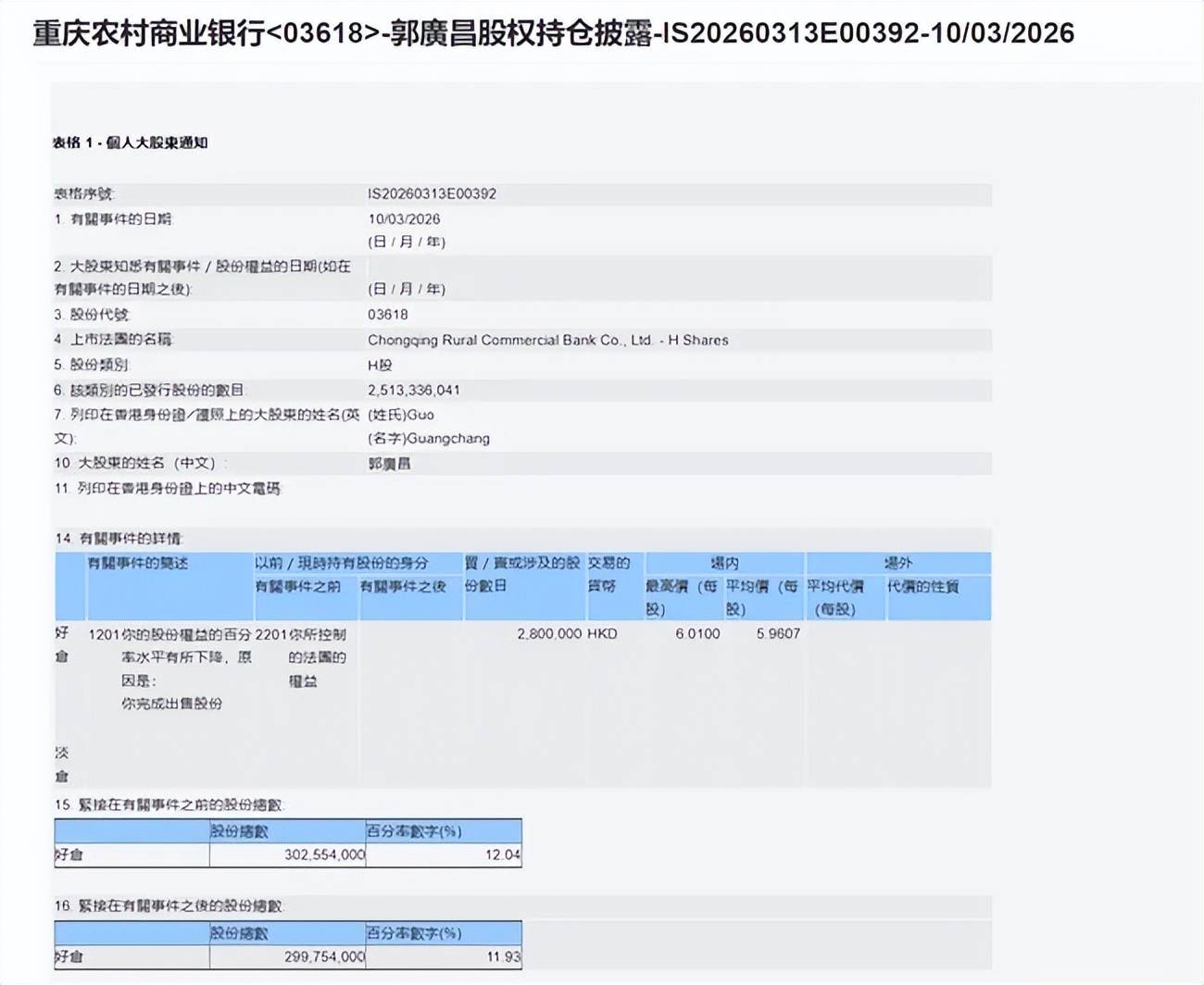
郭广昌两次减持重庆农商行套现超4500万,旗下复星国际债务微升至2221亿元
Sou Hu Cai Jing· 2026-03-17 10:50
Core Viewpoint - Fosun International Holdings Ltd. has reduced its stake in Chongqing Rural Commercial Bank by 2.8 million shares at a price of HKD 5.9607 per share, totaling approximately HKD 16.69 million, resulting in a new holding of about 300 million shares, representing 11.93% of the bank's total shares [1] Group 1: Shareholding Changes - Fosun International's recent reduction in shares marks the second time Guo Guangchang has decreased his stake in Chongqing Rural Commercial Bank [1] - Following the latest transaction, Fosun's total shareholding in Chongqing Rural Commercial Bank is approximately 300 million shares, down from 326 million shares previously held [4] Group 2: Financial Performance of Chongqing Rural Commercial Bank - Chongqing Rural Commercial Bank reported a revenue of CNY 21.658 billion for the first three quarters of 2025, reflecting a year-on-year growth of 0.67%, which is above the average growth rate of A-share rural commercial banks [9] - The bank's net profit attributable to shareholders reached CNY 10.694 billion, with a year-on-year increase of 3.74% [9] - The bank's total assets amounted to approximately CNY 1.66 trillion, growing by 9.3% compared to the previous year, and it became the first financial institution in Chongqing to surpass CNY 1 trillion in deposits [9]



满仓率创新高
第一财经· 2026-03-17 10:39
Market Overview - The three major A-share indices collectively declined, with the Shanghai Composite Index briefly supported around 4050 points but ultimately closing at 4049.91 points, breaking below the 5-day and 10-day moving average support, indicating a clear bearish signal in the short term [4]. - The total trading volume of the two markets was 2 trillion yuan, down 5.05%, reflecting a continuous decrease in market activity and a decline in risk appetite among investors [5]. Fund Flow Analysis - There was a net outflow of 2.01 billion yuan from institutional funds, while retail investors saw a net inflow of 302 million yuan, indicating a divergence in investment behavior between institutions and retail investors [6]. - Institutions are focusing on rational portfolio adjustments and defensive allocations, taking profits from previously high-performing technology growth sectors and increasing positions in undervalued defensive sectors such as banks and securities [7]. Investor Sentiment - Retail investors displayed a contrarian approach, actively participating in the market during the adjustment phase, focusing on low-position layouts and maintaining their holdings, which contrasts with the more cautious stance of institutional investors [7]. - The overall sentiment among retail investors remains relatively positive, as they seek structural allocation opportunities despite the market downturn [7]. Sector Performance - The market exhibited a broad decline in individual stocks, with a poor profit-making effect. However, sectors such as insurance, precious metals, and banking showed gains, while real estate was active. In contrast, sectors like CPO, communication equipment, and semiconductors experienced declines [10].

存储芯片+昇腾+算力租赁,这家公司获净买入
摩尔投研精选· 2026-03-17 10:18
Market Overview - The market experienced fluctuations throughout the day, with the Shenzhen Component Index falling over 1% and the ChiNext Index dropping over 2% [1] - Trading volume shrank, with the total turnover of the Shanghai and Shenzhen markets at 2.21 trillion, a decrease of 117.5 billion compared to the previous trading day [1] - Over 4,500 stocks in the market declined, indicating a weak rotation of market hotspots [1] Sector Performance - The financial sector showed resilience, with insurance and banking stocks leading the gains. Notable performers included Aijian Group hitting the daily limit, and China CITIC Bank, New China Life Insurance, and China Pacific Insurance all closing higher [1] - The chemical sector was also active, with Chitianhua achieving three consecutive limit-ups, and Sanfangxiang, Jinzhengda, and Luhua Technology all hitting the daily limit [1] - The real estate sector saw a slight increase, with Zhongzhou Holdings and Jingneng Real Estate both reaching the daily limit [1] Declining Sectors - The computing hardware and semiconductor sectors faced significant declines, with the CPO concept stocks collectively adjusting downwards. Stocks such as Changguang Huaxin, Dekeli, Robotec, and Guangku Technology experienced substantial drops [1] Institutional Activity - Institutional participation remained consistent with the previous day, with 26 stocks having net buy/sell amounts exceeding 10 million. There were 14 net buys and 12 net sells [2] - Notable net purchases included Langke Technology at 230 million, Xinghuan Technology at 119 million, and Xiangming Intelligent at 7.719 million. Conversely, significant net sells included Zhaoyan Pharmaceutical at 202 million, Zhongci Electronics at 76.24 million, and Zhongfu Shenying at 67.82 million [2]





中国工商银行取得文本内容发布方法专利
Sou Hu Cai Jing· 2026-03-17 10:16
Group 1 - The core point of the article is that the Industrial and Commercial Bank of China (ICBC) has obtained a patent for a method, device, electronic equipment, and storage medium related to the publication of text content, with the authorization announcement number CN116486486B and an application date of April 2023 [1] Group 2 - ICBC was established in 1985 and is located in Beijing, primarily engaged in monetary financial services [1] - The registered capital of ICBC is approximately 35.64 billion RMB [1] - According to data analysis, ICBC has invested in 28 enterprises, participated in 10,981 bidding projects, has 969 trademark information entries, and holds 5,000 patent information entries, along with 79 administrative licenses [1]

中国建设银行取得交易数据校验方法专利
Sou Hu Cai Jing· 2026-03-17 10:16
Group 1 - The State Intellectual Property Office of China has granted a patent to China Construction Bank Corporation and Jianxin Financial Technology Co., Ltd. for a method of "transaction data verification, electronic devices, and storage media," with authorization announcement number CN116012014B, applied for on December 2022 [1] - China Construction Bank Corporation, established in 2004 and located in Beijing, primarily engages in monetary financial services, with a registered capital of 26,160,038.1459 thousand RMB. The company has invested in 37 enterprises, participated in 44,982 bidding projects, and holds 1,895 trademark records and 5,000 patent records, along with 149 administrative licenses [1] - Jianxin Financial Technology Co., Ltd., founded in 2018 and based in Shanghai, focuses on software and information technology services, with a registered capital of 172,972.9729 thousand RMB. The company has invested in 6 enterprises, participated in 4,487 bidding projects, and possesses 294 trademark records and 5,000 patent records, in addition to 10 administrative licenses [1]

普跌调整,延续缩量
Tebon Securities· 2026-03-17 09:58
Market Overview - The A-share market experienced a broad decline, with major indices showing a downward trend and market sentiment significantly cooling. The Shanghai Composite Index closed at 4049.91 points, down 0.85%, while the Shenzhen Component Index fell 1.87% to 14039.73 points. The ChiNext Index and the STAR 50 Index also saw declines of 2.29% and 2.23%, respectively, indicating pressure on the technology growth sector [2][5]. - The total trading volume in the A-share market reached 2.22 trillion yuan, marking a continuous four-day decline in trading volume. Only 863 stocks rose, while 4541 stocks fell, highlighting a significant deterioration in market profitability [2][5]. Sector Performance - Financial consumption sectors, including non-bank financials, banks, food and beverage, and real estate, showed positive performance with gains of 1.34%, 0.81%, 0.58%, and 0.29%, respectively. The insurance sector led the market with a 2.10% increase, attributed to a technical rebound and potential benefits from a favorable interest rate environment due to the Federal Reserve's easing cycle [5]. - In contrast, the technology sector faced substantial adjustments, with telecommunications, electronics, and computer sectors declining by 4.58%, 2.94%, and 2.65%, respectively. The optical module index plummeted by 7.74%, driven by profit-taking pressures and a shift in funds from high-valuation tech stocks to undervalued value stocks amid global market risk aversion [5]. Future Market Outlook - The A-share market is expected to continue its structural trend, influenced by macroeconomic conditions and policy support. The ongoing transformation of the Chinese economy and increased policy support provide a fundamental backing for the market. However, external uncertainties, particularly from geopolitical tensions, may suppress market sentiment [7]. - The upcoming intensive disclosure period for annual reports in late March could lead to further adjustments if company performances do not meet expectations. The market is anticipated to see a divergence between value and growth styles, with low-valuation, high-dividend value stocks likely to be more resilient compared to high-valuation growth stocks facing greater adjustment pressures [7]. Bond Market - The government bond futures market saw a slight increase, indicating a stabilization trend. The 30-year government bond futures (TL2606) rose by 0.13% to close at 110.69 yuan, with a trading volume of 683.39 billion yuan. The 10-year bond futures (T2606) increased by 0.05%, closing at 108.14 yuan, with a trading volume of 612.27 billion yuan [9]. - The central bank's net injection of 115 billion yuan through reverse repos has contributed to a stable market outlook, with Shibor rates generally declining, reflecting a continued liquidity surplus in the banking system [9]. Commodity Market - The commodity index fell by 0.39%, with significant differentiation among various products. Precious metals and chemical products saw gains, while pulp and agricultural products experienced declines. Notably, alumina prices rose by 3.40% due to supply contraction expectations from Guinea's discussions on controlling market output [9][11]. - The platinum market also saw a rise of 4.27%, driven by policy support for hydrogen energy development, which is expected to boost platinum demand [11]. Trading Hotspots - Key sectors to watch include AI applications, commercial aerospace, nuclear fusion, quantum technology, brain-computer interfaces, robotics, and consumer goods, with a focus on technological advancements and policy support driving growth in these areas [12][14]. - The brokerage sector is also highlighted due to high trading volumes in the A-share market, with potential changes in trading regulations to be monitored [12]. Summary of Core Thoughts - The report indicates that the A-share market is likely to maintain a structural trend amid external uncertainties, with a focus on annual report performances. The bond market is expected to benefit from continued proactive fiscal policies, while the commodity market will be influenced by geopolitical risks and supply-demand dynamics [14][15].
美国私募信贷危机警报未解除!
第一财经· 2026-03-17 09:54
Core Viewpoint - The troubles in the U.S. private credit sector are ongoing, highlighted by a lawsuit involving Western Alliance and Jefferies Financial Group, which exposes the risks banks face in this area [3][6]. Group 1: Lawsuit and Bank Exposure - Western Alliance has accused Jefferies' subsidiary of failing to repay loans related to the bankrupt First Brands Group, claiming Jefferies knowingly entered into new loan agreements despite the company's issues [6][7]. - The lawsuit reveals how U.S. banks have contributed to the growth of private credit and the potential consequences of its collapse, with banks' exposure to private credit nearing $300 billion over the past year [6][8]. - Concerns arise from the opaque nature of private credit and the complexity of banking operations, as noted by experts [6][8]. Group 2: Market Reactions and Stock Performance - Investor anxiety over the risks in the U.S. banking sector has led to significant declines in bank stocks, with the Nasdaq KBW Bank Index dropping nearly 10% since the beginning of 2026, compared to a 2% decline in the S&P 500 [6][8]. Group 3: Default Rate Concerns - Analysts warn that the default rate for direct loans in private credit could rise to around 8%, the highest level since the pandemic, due to high leverage in the software industry and an increase in maturing debts [9][10]. - The software sector represents the largest exposure in business development companies (BDCs), with approximately 26% of their portfolios allocated to this industry [9][10]. Group 4: Redemption Requests and Fund Limitations - The rising anxiety has led to an increase in redemption requests from private credit funds, prompting firms like Morgan Stanley and Cliffwater LLC to limit redemption amounts due to requests exceeding their quarterly thresholds [10][11]. - UBS predicts that the negative narrative surrounding AI's disruptive potential will become more evident in low-quality credit assets with high refinancing needs in early 2026 to 2027 [10][11].

法国巴黎银行力争在2030年计划下实现资产管理业务增长
Xin Lang Cai Jing· 2026-03-17 09:42
Group 1 - The core objective of BNP Paribas is to nearly double the pre-tax profit of its asset management division by 2030 following the acquisition of AXA's asset management business for €5.1 billion (approximately $5.87 billion) [1][3] - The bank aims to achieve a return on tangible equity of 13% by 2028, which is a key profitability indicator for the overall bank [1][3] - The pre-tax profit of the asset management division is expected to increase from €820 million last year to nearly double by 2030 [1][3] Group 2 - The asset management division manages over €1.6 trillion, making it one of the largest asset management institutions in Europe [2][4] - The bank targets an average annual growth of over 5% in asset management scale during the planning period, which is expected to drive revenue growth at an average annual compound rate of approximately 4% [2][4] - By 2030, the bank aims to achieve a cumulative net inflow of approximately €350 billion [2][4] - By 2029, revenue synergies are projected to contribute €150 million to profit, while cost synergies are expected to add around €400 million [2][4]