半导体制造

Search documents
斯达半导:发行可转换公司债券申请获受理
Xin Lang Cai Jing· 2025-10-29 11:38
斯达半导公告,公司于2025年10月29日收到上海证券交易所出具的《关于受理斯达半导体股份有限公司 沪市主板上市公司发行证券申请的通知》。上交所对公司报送的募集说明书及相关申请文件进行了核 对,认为申请文件齐备,符合法定形式,决定予以受理并依法进行审核。公司本次向不特定对象发行可 转换公司债券事项尚需通过上交所审核,并获得中国证监会同意注册后方可实施。 ...

德国芯片,短缺严重
半导体芯闻· 2025-10-29 10:40
Group 1 - The core issue highlighted is the increasing material shortages faced by German electronics and optics manufacturers due to tightening global regulations on rare earth elements, with 10.4% of companies reporting supply bottlenecks in October, up from 7.0% in July and 3.8% in April [1] - The Ifo Institute indicates that only 5.5% of companies in the entire manufacturing sector reported supply issues, suggesting that the problem is more acute in the electronics and optics sectors [1] - The German automotive industry is experiencing significant supply chain disruptions, with Volkswagen warning of potential production halts due to ongoing supply chain issues, although current chip shortages have not yet impacted production [1] Group 2 - The semiconductor and raw material issues are occurring in a year marked by plummeting industry profits and frequent layoffs, highlighting the broader challenges faced by European suppliers reliant on internal combustion engine technologies [2] - The disparity in supply chains for electric vehicle components, such as magnets, chips, and batteries, poses a significant threat to Germany's automotive industry and its overall prosperity [2] - Despite efforts to diversify procurement in the semiconductor sector following the 2021 chip shortage, risks remain, as the complexity of modern vehicles now requires thousands of different semiconductors [2]

10亿买来10亿卖,德龙汇能再易主
Tai Mei Ti A P P· 2025-10-29 08:49
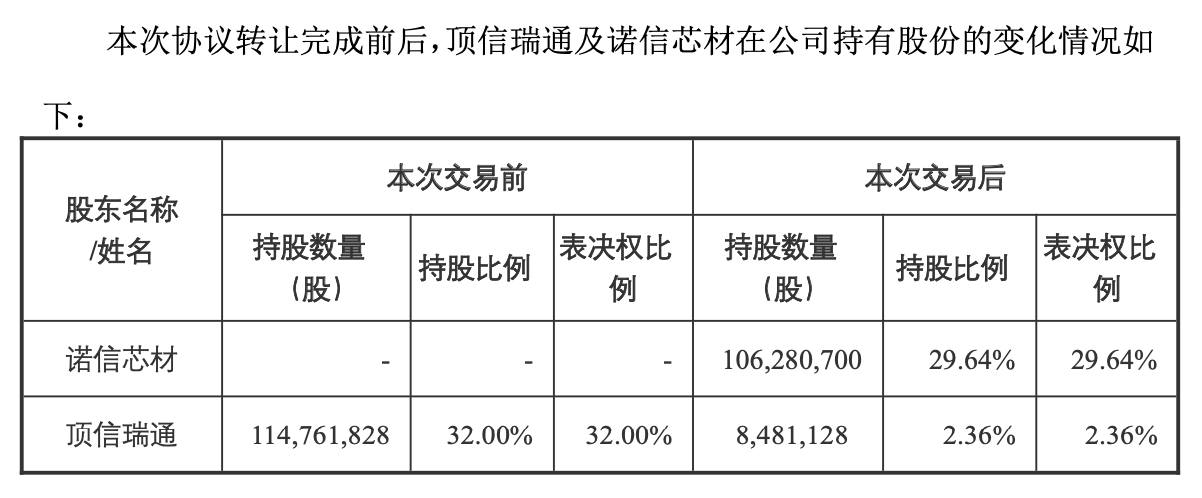
Core Viewpoint - Delong Huineng (000593.SZ) experienced a stock price surge following the announcement of a change in control, with shares closing at 9.58 yuan, marking a significant market reaction to the news of a new major shareholder [1] Summary by Sections Shareholder Change - Delong Huineng announced that its controlling shareholder, Beijing Dingxin Ruitong Technology Development Co., Ltd., signed a share transfer agreement with Dongyang Noxin Chip Material Enterprise Management Partnership (Limited Partnership), transferring 106 million shares, representing 29.64% of the total share capital, for a total consideration of 1 billion yuan at a price of 9.41 yuan per share [1][2] - After the transfer, Noxin Chip Material will hold 29.64% of the shares, while Dingxin Ruitong's stake will decrease to 2.36% [1][3] Background of New Shareholder - Noxin Chip Material was established on July 24, 2025, with a registered capital of 1.008 billion yuan and has not yet commenced business operations [3] - The ultimate control of Noxin Chip Material lies with Sun Weijia, who also controls other semiconductor-related enterprises, suggesting potential strategic moves in the semiconductor sector following the acquisition [4][7] Historical Context of Delong Huineng - Delong Huineng has undergone four ownership changes since its listing, with its business focus shifting multiple times, originally starting as a retail company before transitioning to pharmaceuticals and then to gas and energy [8][9] - The company was renamed from Datong Gas to Delong Huineng in 2022, reflecting its current focus on integrating traditional gas operations with new energy initiatives, including hydrogen and solar energy [9][11] Financial Performance - Despite revenue growth from 631 million yuan in 2018 to 1.737 billion yuan in 2024, the company has faced challenges in profitability, with cumulative losses of 208 million yuan during the same period [11] - The company is currently involved in legal proceedings regarding a subsidiary's failure to meet profit commitments, which may impact its financial stability [11]

安世半导体出口受阻,引发全球车企芯片短缺
Guo Ji Jin Rong Bao· 2025-10-29 08:49
Core Viewpoint - The global automotive industry is facing a renewed production crisis due to a semiconductor shortage, exacerbated by the Dutch government's takeover of Nexperia, a chip manufacturer, citing national security concerns, which has led to export restrictions from China [1][2]. Group 1: Impact on Automotive Manufacturers - Honda's assembly plant in Ontario, Canada, has announced a production cut of 50% starting October 27, with plans to halt production for a week beginning October 30 [1]. - Multiple Honda "mass production" plants in North America have begun implementing emergency measures, including temporary shutdowns, in response to the semiconductor supply chain issues [2]. - Volvo's CEO highlighted that while the affected components are not strategic, their abundance means that shortages could halt production [3]. Group 2: Semiconductor Supply Chain Issues - The Dutch government invoked a law not used since 1952 to prevent Nexperia from making any adjustments to its assets or operations for one year, following China's export control measures on specific components [2]. - Nexperia generated approximately $2 billion in revenue last year, with around 60% coming from the automotive sector, indicating its significant role in the supply chain [3]. - Barclays warned that some automotive suppliers may run out of inventory in the coming days, with the chip shortage potentially impacting production as early as this week [3]. Group 3: Broader Industry Implications - The German Mechanical Engineering Industry Association (VDMA) cautioned that the impact of Nexperia's export suspension could extend beyond the automotive sector to include power generation, engineering machinery, and agricultural machinery [3]. - U.S. automakers like Ford and General Motors are in discussions with the Trump administration to find solutions before production is significantly affected [3].

欧盟放狠话:再不给稀土,就对中国动用非常手段,中方反应很硬气
Sou Hu Cai Jing· 2025-10-29 08:04
Core Viewpoint - The European Union (EU) is expressing strong rhetoric against China regarding rare earth exports, but internal divisions and dependencies may hinder any substantial action against China [1][5][40]. Group 1: EU's Response to China's Rare Earth Export Controls - The EU's aggressive stance follows China's tightening of rare earth export controls in early October, with French President labeling it as "economic coercion" and urging the EU to utilize its "anti-coercion tool" [5][40]. - The EU's "anti-coercion tool" requires the agreement of 15 member states representing 65% of the population to activate, but it has never been used, indicating a lack of real commitment [5][17]. - The EU's reliance on China for rare earth materials is significant, with 90% of its rare earth magnets imported from China, leading to potential self-harm if tensions escalate [7][11]. Group 2: Internal Divisions within the EU - Internal discord is evident, with France advocating for a tough stance while Germany is reluctant to support aggressive measures due to its economic ties with China [9][15]. - Germany's automotive industry heavily relies on the Chinese market, making it cautious about any actions that could disrupt trade [11][13]. - Eastern European countries are also concerned about energy and market access, further complicating a unified EU response [15][17]. Group 3: Semiconductor Issues and Dutch Actions - The Netherlands has exacerbated tensions by invoking Cold War-era laws to take control of a Chinese-owned semiconductor company, citing national security [19][23]. - The semiconductor company, formerly part of Philips, holds a significant market share in automotive components, raising concerns for European car manufacturers about supply chain disruptions [21][25]. - China's swift response to restrict exports of specific components from the semiconductor company has left European carmakers anxious about potential production halts [25][27]. Group 4: China's Position and Negotiation Prospects - China maintains a steady stance, asserting that its export controls are standard practices and not aimed at any specific country, aligning with international norms [29][30]. - China's dominance in rare earth production, with 92.3% of global refining capacity, poses challenges for the EU in finding alternative suppliers [32][34]. - Upcoming negotiations between China and the EU are expected to address multiple issues, including rare earth exports and the semiconductor situation, highlighting the need for a balanced approach [36][38]. Group 5: Conclusion on Future Relations - The EU's contradictory position of wanting to impose countermeasures while simultaneously seeking concessions from China reflects its internal conflicts and dependency issues [40][42]. - The importance of cooperation over confrontation is emphasized, as both sides have interlinked supply chains that could lead to mutual harm if tensions escalate [42][44].

思特威:第三季度净利润3.03亿元,同比增长145.14%
Xin Lang Cai Jing· 2025-10-29 07:45
Group 1 - The core viewpoint of the announcement is that the company has shown significant growth in both revenue and net profit for the third quarter and the first three quarters of the year [1] Group 2 - The company's revenue for the third quarter reached 2.531 billion yuan, representing a year-on-year increase of 44.56% [1] - The net profit for the third quarter was 303 million yuan, reflecting a year-on-year growth of 145.14% [1] - For the first three quarters, the total revenue amounted to 6.317 billion yuan, which is a 50.14% increase compared to the same period last year [1] - The net profit for the first three quarters was 699 million yuan, showing a year-on-year increase of 155.99% [1]

机构风向标 | 豪威集团(603501)2025年三季度已披露持股减少机构超60家
Xin Lang Cai Jing· 2025-10-29 02:17
Core Insights - Haowei Group (603501.SH) reported its Q3 2025 results, revealing that 156 institutional investors hold a total of 403 million shares, representing 33.38% of the company's total equity [1] - The top ten institutional investors collectively own 28.92% of the shares, with a decrease of 3.23 percentage points compared to the previous quarter [1] Institutional Holdings - The number of public funds that increased their holdings this period is 58, with a total increase ratio of 0.98% [2] - Conversely, 59 public funds reduced their holdings, accounting for a decrease ratio of 1.08% [2] - A total of 22 new public funds disclosed their holdings this period, while 764 public funds did not disclose their holdings compared to the previous quarter [2] Foreign Investment - One foreign fund, Goldman Sachs International - proprietary funds, reduced its holdings slightly this period [2]

一个辍学生,同时挑战ASML和台积电
半导体行业观察· 2025-10-29 02:14
Core Viewpoint - The article discusses the emergence of Substrate, a startup founded by James Proud, which aims to revolutionize semiconductor manufacturing by developing a new technology that could significantly reduce production costs and challenge established players like ASML and TSMC [2][4][15]. Group 1: Company Overview - Substrate has raised over $100 million from investors, including Peter Thiel's Founders Fund, and is valued at over $1 billion [4]. - The company plans to establish a manufacturing facility in the U.S. to reduce reliance on overseas suppliers, aligning with national security priorities [4][17]. - Substrate's technology involves using a particle accelerator as a light source for a new type of lithography, which could potentially match the resolution of ASML's advanced machines [12][15]. Group 2: Technology and Innovation - The startup aims to combine proprietary particle accelerator technology with custom lithography tools to achieve commercial viability [12][15]. - Substrate claims its machines can print features at 12 nanometers, comparable to the latest high-NA EUV machines from ASML [13][15]. - The company has demonstrated its system at national laboratories, creating complex patterns on wafers [13]. Group 3: Challenges and Market Position - Substrate faces skepticism from industry experts regarding its ability to replicate the complex semiconductor supply chain within three years [4][8]. - The company has encountered challenges in securing funding from government initiatives, with initial requests for over $1 billion being denied [8]. - Despite the challenges, Substrate's founders believe that their approach could provide a viable alternative in the semiconductor market, especially as the U.S. seeks to bolster its domestic manufacturing capabilities [18].


贵州振华风光半导体股份有限公司 2025年第三季度报告
Shang Hai Zheng Quan Bao· 2025-10-28 22:55
Core Viewpoint - The company has reported a total of 44,917,258.73 yuan in credit impairment losses and asset impairment losses for the third quarter of 2025, reflecting a cautious approach to financial reporting and asset management [8][13]. Financial Data - The financial report for the third quarter of 2025 is unaudited, and the company has confirmed that the financial information is true, accurate, and complete [3][2]. - The company has recognized a total of 44,967,898.98 yuan in credit impairment losses for the third quarter, indicating a focus on managing credit risk effectively [9]. Asset Impairment - The company conducted impairment testing on various assets and recognized credit impairment losses and asset impairment losses totaling 44,917,258.73 yuan for the third quarter [8][13]. - The company has a low historical bad debt loss rate, with cumulative bad debt losses of only 0.18 million yuan over the past three years, suggesting strong credit management practices [9]. Shareholder Meeting - The company will hold its second extraordinary general meeting of 2025 on November 18, 2025, to discuss various resolutions, including the approval of financial reports and other significant matters [17][20]. - The meeting will utilize both on-site and online voting methods to facilitate shareholder participation [19][21]. Cash Management - The company has approved the use of up to 155 million yuan of temporarily idle raised funds for cash management, aimed at enhancing the efficiency of fund utilization while ensuring the safety of the funds [51][52]. - The cash management strategy includes investing in low-risk, liquid financial products, which aligns with the company's goal of maximizing shareholder returns [60][62]. Audit Firm Appointment - The company plans to renew its appointment of Da Xin Certified Public Accountants for auditing services, pending approval from the shareholders' meeting [64][66]. - Da Xin has extensive experience in the industry, with a strong track record in providing auditing services to numerous companies [66][69].

欧洲人面子论扎心:安世风波,让欧洲终于明白了中国决心
Sou Hu Cai Jing· 2025-10-28 19:13
Core Viewpoint - The semiconductor dispute initiated by the Dutch government has led to a crisis in the European automotive industry, highlighting the severe dependency on Chinese semiconductor supplies and the misjudgment of China's response capabilities [1][3][10]. Group 1: Dutch Government Actions - On September 30, the Dutch government invoked the Cold War-era "Commodity Supply Law" to take control of Nexperia, a semiconductor company, freezing its global assets and transferring 99% of its shares to third-party custody without public hearings [5]. - The Dutch government justified its actions by citing "national security" concerns, leading to the removal of Chinese executives and the appointment of Dutch management [6][8]. - The actions were reportedly influenced by pressure from the United States, which had just imposed new export controls on the parent company, Wingtech Technology [8]. Group 2: Chinese Response - In response to the Dutch government's actions, the Chinese Ministry of Commerce imposed export controls on chips produced at Nexperia's Chinese factory, effectively cutting off supplies to Europe [10][11]. - Nexperia's Chinese operations declared independence, reinstating the ousted Chinese CEO and shifting production to serve the domestic market only [11]. Group 3: Impact on the Automotive Industry - The immediate impact was felt by major automotive manufacturers, with Volkswagen's production lines halted due to a lack of power semiconductors from Nexperia, putting thousands of jobs at risk [13]. - The crisis escalated, with BMW reporting losses of up to €1 billion per month due to chip shortages, and other manufacturers like Volvo and Nissan facing significant production delays [15]. - The European automotive industry faced a broader crisis, with over 5,000 vehicles' production disrupted and losses exceeding €1 billion [15]. Group 4: European Response and Consequences - The Dutch government found itself in a difficult position, having legally taken control of Nexperia but lacking access to its core production capabilities, which remained in China [19]. - The crisis led to significant layoffs in the semiconductor transport sector, with a 40% drop in shipments through Rotterdam and over 3,000 job losses in Dutch companies reliant on Nexperia [19]. - Pressure mounted from German and French automotive companies on the Dutch government to resolve the dispute, indicating internal divisions within the EU [20].