
智能汽车

Search documents
德赛西威:川行致远S6系列低速无人车已获得客户订单
Zheng Quan Shi Bao Wang· 2025-09-19 08:09
Group 1 - The core point of the article is that Desay SV (002920) has announced the launch of its low-speed unmanned vehicle series, the Chuanxing Zhiyuan S6, and has received related customer orders [1] Group 2 - The Chuanxing Zhiyuan S6 series is part of the company's efforts to expand its product offerings in the unmanned vehicle market [1] - The announcement was made on September 19, indicating a timely response to market demands [1] - The company utilized an interactive platform to communicate this development, highlighting its engagement with stakeholders [1]
A股异动|东软集团一字涨停 新增56亿项目定点
Ge Long Hui A P P· 2025-09-19 06:53
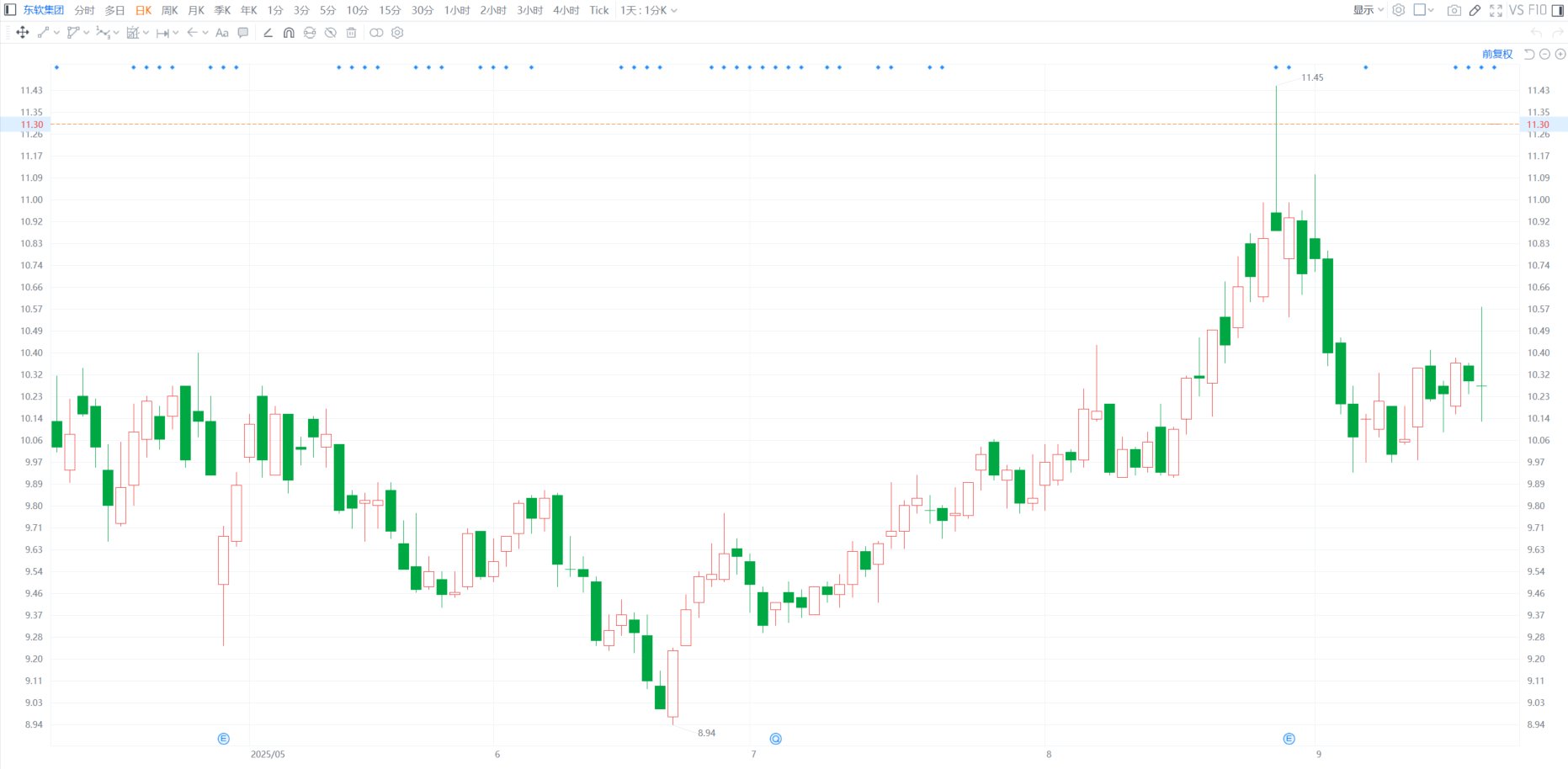
Group 1 - Dongsoft Group (600718.SH) experienced a limit-up increase, currently priced at 11.3 yuan, with over 230,000 orders and a transaction volume of 250 million yuan, resulting in a market capitalization of 13.45 billion yuan [1] - The company received a notification from a well-known domestic automotive manufacturer, designating Dongsoft as a supplier for intelligent cockpit domain controllers [1] - The products will be used in multiple models equipped with the Qualcomm 8397 platform, expected to start mass production in the fourth quarter of 2026, with a lifecycle of approximately four years, and a total supply amounting to around 5.6 billion yuan [1] Group 2 - Huatai Securities reported that Dongsoft Group is advancing its intelligent strategy, accelerating the productization and commercialization of AI business [1] - The intelligent automotive business is driving revenue growth, with ongoing efforts to strengthen overseas deployment [1] - The initial results of the company's AI business layout are promising, indicating potential for long-term business realization and value release, maintaining a "buy" rating [1]


另付费才能加热方向盘,让车主寒心
Qi Lu Wan Bao· 2025-09-19 06:32
Core Viewpoint - The automotive industry is increasingly adopting a "hardware embedded + software subscription" business model, where consumers must pay extra to unlock certain features of their vehicles after purchase, leading to dissatisfaction among buyers [1][2]. Group 1: Business Model - The "hardware embedded + software subscription" model allows car manufacturers to create additional revenue streams through after-sales services [1]. - Consumers may feel that they are not fully owning their vehicles, as they must pay extra to access features that are already installed [1]. Group 2: Consumer Rights and Transparency - It is essential for car manufacturers and dealers to clearly communicate which features are permanently free and which require additional payment before the sale [2]. - Misleading marketing practices, such as presenting features as free when they are not, can damage consumer trust and lead to dissatisfaction [3]. Group 3: Consumer Sentiment - Consumers expect to fully utilize the features of their purchased vehicles without additional costs, and feeling like they are merely "long-term renters" can lead to negative perceptions of the brand [3]. - Providing high-quality services and transparent information is crucial for fostering consumer loyalty and willingness to pay for additional features [3].
因潜在缺陷 小米召回部分SU7标准版 共计116887辆
Zhi Tong Cai Jing· 2025-09-19 06:24
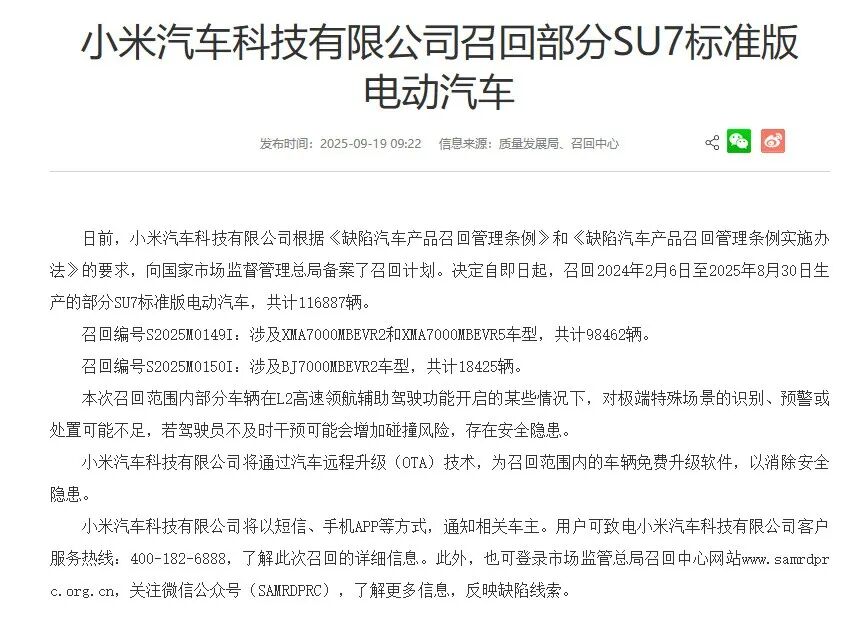
Group 1 - Xiaomi Auto Technology Co., Ltd. has initiated a recall of 116,887 units of its SU7 standard electric vehicles produced between February 6, 2024, and August 30, 2025, due to safety concerns related to the L2 highway navigation assistance feature [1] - The recall includes two specific models: 98,462 units of XMA7000MBEVR2 and 18,425 units of BJ7000MBEVR2, with the main issue being insufficient recognition and response to extreme scenarios, potentially increasing collision risks [1] - The company plans to address the safety issue through over-the-air (OTA) software updates for the recalled vehicles [1] Group 2 - The Xiaomi SU7 is the first mass-produced model from Xiaomi Group, positioned as a pure electric mid-to-large sedan, officially launched on March 28, 2024, with cumulative deliveries exceeding 250,000 units by June 6, 2025 [2] - The Ministry of Industry and Information Technology has proposed a draft for safety requirements for intelligent connected vehicles, which aims to establish mandatory standards for L2 intelligent driving systems, enhancing industry regulation and consumer awareness [2] - According to Guotai Junan, the sales of new passenger cars equipped with combination driving assistance systems in China reached 7.76 million units from January to July 2025, indicating a growing market for intelligent driving technologies [2] Group 3 - CITIC Securities notes that the new standards will impose stricter safety requirements on intelligent driving systems, particularly for driver monitoring systems (DMS), which may significantly increase the entry barriers for L2 intelligent driving [3] - The regulatory changes are expected to guide the intelligent automotive industry towards high-quality and safe development, benefiting hardware related to intelligent driving safety, automotive testing institutions, and leading players in the intelligent driving sector [3]

小米汽车,大规模召回SU7!原因公布
Zhong Guo Zheng Quan Bao· 2025-09-19 05:08
Group 1 - Xiaomi Auto has initiated a recall of 116,887 units of the SU7 standard electric vehicles produced between February 6, 2024, and August 30, 2025, due to safety concerns related to the L2 highway navigation assistance feature [2] - The recall includes two specific models: 98,462 units of XMA7000MBEVR2 and 18,425 units of BJ7000MBEVR2, with the recall being executed through Over-The-Air (OTA) software upgrades to address the identified safety issues [2][3] - This is the second recall within the year, with the first recall involving 30,931 units due to software synchronization issues affecting the smart parking assistance feature, indicating ongoing software strategy challenges for Xiaomi Auto [2][3] Group 2 - As of July 2025, Xiaomi SU7's cumulative delivery has exceeded 300,000 units, and with August deliveries, the total is approximately 360,000 units, highlighting rapid growth in delivery despite the recalls [3] - The second recall's scale, approximately 3.8 times larger than the first, raises concerns about the brand's reliability and the implications for consumer trust, as 41% of sold vehicles are affected [3] - Industry analysts note that the expansion of software issues from low-speed to high-speed scenarios reflects broader challenges faced by the smart automotive sector in rapidly evolving driver assistance technologies [3]
小米汽车 大规模召回SU7!原因公布
Zhong Guo Zheng Quan Bao· 2025-09-19 04:56
Core Viewpoint - Xiaomi Auto has initiated a recall of 116,887 SU7 standard electric vehicles due to potential safety risks associated with the L2 highway navigation assistance feature, which may not adequately recognize or respond to extreme scenarios [4][5]. Group 1: Recall Details - The recall affects vehicles produced between February 6, 2024, and August 30, 2025, specifically involving 98,462 units of the XMA7000MBEVR2 model and 18,425 units of the BJ7000MBEVR2 model [4]. - The company will utilize Over-The-Air (OTA) technology to provide free software upgrades to rectify the identified safety issues [4][5]. Group 2: Previous Recalls - This is not the first recall for Xiaomi Auto; a previous recall in January involved 30,931 vehicles due to software issues affecting the smart parking assistance feature [5]. - The second recall's scale is approximately 3.8 times larger than the first, highlighting a significant increase in the number of affected vehicles as the company's delivery volume rises [5]. Group 3: Industry Implications - Analysts note that the expansion of software issues from low-speed to high-speed scenarios indicates broader challenges within the smart automotive industry regarding the rapid iteration of assistance features [5]. - The reliance on OTA updates for recalls raises concerns about long-term brand trust, as it reflects underlying product defects that need to be addressed [5].

港股芯片、智能汽车、互联网集体走强!港股科技50ETF(159750)涨超2%,融资余额创新高
Ge Long Hui· 2025-09-19 03:38
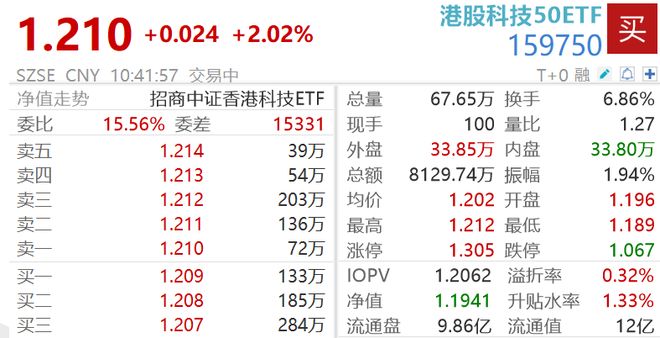
Group 1 - Hong Kong technology stocks showed strong performance on September 19, with significant gains in chip, smart car, and internet sectors, including a rise of over 12% for Hongteng Precision and over 5% for NIO-SW, Hua Hong Semiconductor, and SenseTime-W [1] - The Hong Kong Technology 50 ETF (159750) increased by 2.02%, with a trading volume exceeding 81 million yuan, marking a net inflow of 65.32 million yuan the previous trading day and a record high in financing balance at 40.86 million yuan [1] Group 2 - Alibaba's Pingtouge PPU chip matches key parameters of Nvidia's H20 chip and surpasses the A800 chip, while S&P Global announced a strategic partnership with Alibaba Cloud to introduce AI-ready data into China [3] - Baidu's Kunlun division secured a billion-level AI server order, with a contract value exceeding competitors, and Goldman Sachs analysts noted significant progress in Baidu's latest AI model, Wenxin Yiyan X1.1 [3] - The Hang Seng Technology Index constituents are projected to have a compound annual growth rate of 23% in earnings over the next three years, outperforming the S&P Technology Index and NASDAQ [3] Group 3 - In the recent interim reporting season, the Hang Seng Technology Index demonstrated stronger profitability, with a revenue growth rate of 14.43% compared to the Hang Seng Index's 2.45%, and a net profit growth of 16.18% versus a decline of 1.12% for the Hang Seng Index [6] - The return on equity (ROE) for the Hang Seng Technology Index increased by 3.04 percentage points to 13.5%, while the ROE for the Hang Seng Index and other indices showed relatively stable increases [6] - Goldman Sachs maintains an overweight rating on A-shares and H-shares, focusing on themes such as "China's top ten private enterprises," AI, and shareholder returns [6] Group 4 - The Hong Kong Technology Index (931674) has outperformed the Hang Seng Technology Index, with a cumulative increase of 133.57% since its base date of December 31, 2014, compared to the Hang Seng Technology Index's 111.14% increase [7]

港股芯片、智能汽车、互联网概念集体走强!港股科技50ETF(159750)涨超2%,融资余额创新高
2 1 Shi Ji Jing Ji Bao Dao· 2025-09-19 03:27
Group 1 - Hong Kong technology stocks showed strong performance on September 19, with significant gains in chip, smart car, and internet sectors, including a rise of over 12% for Hongteng Precision and over 5% for NIO-SW, Hua Hong Semiconductor, and SenseTime-W [1] - The Hong Kong Technology 50 ETF (159750) increased by 2.02%, with trading volume exceeding 81 million CNY, and recorded a net inflow of 65.32 million CNY on September 18, marking a new high since its listing [1] - Major Chinese tech companies are gaining attention, with Alibaba's self-developed AI chip showcased on CCTV, reportedly matching key parameters of NVIDIA's H20 chip and surpassing the A800 chip [2] Group 2 - The Hang Seng Technology Index demonstrated stronger profitability during the recent earnings season, with a revenue growth rate of 14.43% compared to a 2.45% growth for the Hang Seng Index, while net profit growth for the Hang Seng Technology Index was 16.18% [3] - The cumulative increase of China's "Tech Ten Sisters" from the end of 2023 to February 12, 2025, is projected to exceed that of the US "Tech Seven Giants" during the same period [3] - The Hong Kong Technology Index has outperformed the Hang Seng Technology Index, with a cumulative increase of 133.57% since December 31, 2014, compared to 111.14% for the Hang Seng Technology Index [3] Group 3 - Future potential for the Hong Kong stock market to reach new highs is identified in three areas: AI technology and new consumption, continuous inflow of southbound funds, and the impact of monetary policy changes in the US and China [5] - The ongoing credit expansion and the "anti-involution" policy are expected to accelerate supply-side adjustments, leading to a gradual recovery in related industries [5]
智能汽车新生态:“智行”方能“致远”
Zhong Guo Qi Che Bao Wang· 2025-09-19 01:30
Core Insights - The global smart automotive industry is experiencing intensified competition and collaboration, with countries racing in technology development and evolving market access rules [1][3] - The "2025 Smart Automotive New Ecology Forum" held in Wuhan aimed to discuss the construction of a new ecosystem for smart vehicles, highlighting the need for deep exploration of key issues such as technological bottlenecks in autonomous driving and data security regulations [1][3] Industry Trends - The integration of AI and advanced technologies is transforming vehicles into intelligent mobile spaces, shifting competition from functionality to user experience [3][4] - The automotive ecosystem in Wuhan is robust, with a significant presence of over 10 vehicle manufacturers and 1,200 parts suppliers, and a projected production capacity of 1.47 million new energy vehicles by 2024 [3][4] Technological Challenges - The industry faces critical challenges, including high-end chip shortages and the need for AI model and software ecosystem development, which compel domestic companies to innovate independently [3][5] - Current autonomous driving technology is likened to a "10-year-old child," indicating that while there are advancements, comprehensive leadership requires multi-faceted approaches in technology, concepts, and business models [5][6] AI Integration - AI tools are significantly enhancing efficiency in automotive design processes, reducing traditional timelines from weeks to days or even minutes [4][6] - Embracing AI as an auxiliary tool is seen as essential for the industry's evolution, despite potential job reductions in some areas [6] Collaborative Approaches - The integration of vehicle-road collaboration and single-vehicle intelligence is emphasized as a complementary strategy rather than opposing paths, crucial for the successful deployment of advanced autonomous driving [6] - Continuous breakthroughs in key technologies and collaboration among academia, industry, and research are necessary to ensure steady progress in automotive intelligence [6]

中信证券:“史上最难”L2国标征求意见,智驾功能安全性有望提升
Xin Lang Cai Jing· 2025-09-19 00:24
Core Viewpoint - The release of the draft "Safety Requirements for Combination Driving Assistance Systems of Intelligent Connected Vehicles" by the Ministry of Industry and Information Technology on September 17 indicates a significant advancement in the enforcement of mandatory standards for Level 2 (L2) autonomous driving systems, which will likely increase the entry barriers for L2 autonomous driving technology [1] Group 1 - The new standards impose stricter safety requirements on autonomous driving systems and regulate the Driver Monitoring System (DMS) [1] - The regulatory changes are expected to guide the intelligent vehicle industry towards high-quality and safe development [1] - Companies involved in hardware related to driving safety, automotive testing institutions, and leading players in autonomous driving are likely to benefit from these changes [1]
