
服务业

Search documents
8月美PMI增值创近三年新高
Shang Wu Bu Wang Zhan· 2025-08-22 16:03
Core Insights - The U.S. Manufacturing Purchasing Managers' Index (PMI) reached 53.3 in August, marking the best performance since May 2022 [1] - Both manufacturing and services demand showed strong performance, although sales growth remains weak [1] - Tariff wars have led companies to pass production costs onto consumers, contributing to a significant increase in finished goods inventory, which is at its highest level since 2007 [1]
2025年1-7月全国吸收外资4673.4亿元人民币
Shang Wu Bu Wang Zhan· 2025-08-22 09:12
Core Insights - In the first seven months of 2025, China saw the establishment of 36,133 new foreign-invested enterprises, marking a year-on-year increase of 14.1% [1] - However, the actual utilized foreign capital amounted to 467.34 billion RMB, reflecting a year-on-year decrease of 13.4% [1] Industry Analysis - The manufacturing sector attracted 121.04 billion RMB in actual foreign investment, while the service sector received 336.25 billion RMB [1] - High-tech industries accounted for 137.36 billion RMB in actual foreign investment, with notable growth in specific sectors: e-commerce services (up 146.8%), aerospace equipment manufacturing (up 42.2%), chemical pharmaceuticals manufacturing (up 37.4%), and medical instruments manufacturing (up 25.5%) [1] Source Region Insights - Investment from the ASEAN region to China increased by 1.1% [1] - Significant growth in foreign investment from Switzerland (up 63.9%), Japan (up 53.7%), and the UK (up 19.5%) was noted, including data from free port investments [1]
【环球财经】日经225指数微涨0.05%
Xin Hua Cai Jing· 2025-08-22 07:28
Market Performance - The Tokyo stock market indices closed higher on August 22, with the Nikkei 225 index rising by 0.05% and the Tokyo Stock Exchange Price Index increasing by 0.58% [1][2] - The Nikkei index gained 23.12 points, closing at 42633.29 points, while the Tokyo Stock Exchange index rose by 17.92 points to close at 3100.87 points [2] Investor Behavior - After three consecutive days of decline, increased buying activity from investors led to a slight rise in the indices, with early trading showing minor fluctuations around the previous day's closing prices [1] - The stabilization of the Tokyo Stock Exchange index during the midday session was noted, while the Nikkei index faced pressure from sell-offs in high-priced technology stocks before turning positive towards the end of the trading day [1] Sector Performance - Most of the 33 industry sectors on the Tokyo Stock Exchange saw gains, particularly in the insurance, securities and commodity futures trading, and banking sectors [2] - Conversely, eight sectors, including chemicals, air transportation, and services, experienced declines on the same day [2] Economic Indicators - The release of Japan's Consumer Price Index for July heightened investor expectations for a potential interest rate hike by the Bank of Japan, which in turn supported the banking sector's performance [1]
欧元区8月PMI数据好于预期 经济展现韧性但挑战犹存
Huan Qiu Wang· 2025-08-22 02:21
Group 1 - Eurozone composite PMI rose from 50.9 in July to 51.1 in August, exceeding analyst expectations of 50.6 [2] - Manufacturing PMI increased from 49.8 to 50.5, marking the first time since June 2022 that it surpassed the neutral level of 50, also above the expected 49.5 [2] - Service sector PMI slightly decreased to 50.7 but remained in the expansion zone [2] Group 2 - Germany's composite PMI unexpectedly accelerated to a five-month high of 50.9, with manufacturing PMI jumping to 49.9, nearing expansion territory [2] - Manufacturing output index in Germany rose to 52.6, indicating growth [2] - France's composite PMI improved from 47.4 to 49.8, although still below the neutral line, it was better than expected [2] Group 3 - The impact of US trade policies is becoming evident, with Eurozone manufacturing foreign orders declining for the second consecutive month, influenced by US tariff policies [3] - European Central Bank President Christine Lagarde noted that the new 15% tariff on most EU goods is slightly higher than previous predictions but lower than more severe scenarios [3] - Recent PMI data provides more evidence for ECB policymakers, with expectations that the ECB will maintain the key deposit rate at 2% in September [3]

欧元区8月综合PMI创15个月新高,制造业活动三年来首现扩张
Xin Hua Cai Jing· 2025-08-21 23:54
Group 1 - The Eurozone's business activity growth accelerated in August, with the composite PMI rising to 51.1, up from 50.9 in July, marking the highest level since May 2024 and exceeding the expected value of 50.7 [1] - The manufacturing PMI in the Eurozone increased to 50.5, the first return to expansion territory in three years, with the output sub-index reaching 52.3, the fastest growth in nearly three and a half years [1] - The services PMI slightly decreased to 50.7, indicating a slight slowdown in expansion [1] Group 2 - Germany's private sector activity improved slightly in August, primarily supported by better-than-expected manufacturing performance, with the manufacturing PMI rising to 49.9, the highest level since June 2022 [2] - New factory orders in Germany saw significant growth, although export sales experienced a slight decline for the first time in five months [2] - The services PMI in Germany fell to 50.1, reflecting a small decline in new business volume and indicating stagnation in growth momentum [2] Group 3 - France's overall business activity remained stable in August, with the manufacturing PMI rising to 49.9, the highest level since January 2023, despite challenges from weakened international competitiveness and trade environment issues [2] - The services PMI in France improved to 49.7, the highest level in a year, indicating a narrowing decline in output and a slowdown in the contraction of new business [3] - Employment in the French services sector showed improvement, with companies increasing both permanent and temporary hiring [3] Group 4 - Moody's analysts believe that while tariffs may weigh on the Eurozone economy, they are not sufficient to derail it [4]
牛市坐实了!全球首次!1万亿度电背后,藏着中国经济的什么密码?
Sou Hu Cai Jing· 2025-08-21 18:25
Core Insights - The article highlights that China's electricity consumption in July surpassed 1 trillion kilowatt-hours for the first time, marking a historic milestone both nationally and globally [1][4][9] - This surge in electricity usage is attributed not only to extreme heat but also to robust economic activity, particularly in the manufacturing and service sectors [6][9] Electricity Consumption Growth - In July, the total electricity consumption reached 1.02 trillion kilowatt-hours, a year-on-year increase of 8.6%, indicating significant growth compared to previous years [4][6] - The second industry saw a 4.7% increase in electricity consumption, outpacing the overall average, with high-tech and equipment manufacturing leading the charge [6][9] - The third industry experienced a 10.7% growth in electricity usage, reflecting a vibrant service sector supported by continuous consumer activity [6][9] Contribution of Clean Energy - Nearly one-quarter of the electricity consumed in July came from clean energy sources, such as hydropower, wind, and solar, showcasing a significant shift in the energy structure [7][9] - This transition to cleaner energy sources is a crucial step towards ensuring energy security and promoting sustainable development [7][9] Economic Resilience and Upgrading - The record electricity consumption serves as an indicator of the resilience and vitality of the Chinese economy, with strong performance in both manufacturing and services [9][11] - The growth in electricity usage in high-tech manufacturing reflects a transition from "Made in China" to "Intelligent Manufacturing in China," highlighting the ongoing industrial upgrade [9][11] Future Outlook - The article suggests that maintaining high electricity consumption levels may become the norm, driven by ongoing economic recovery and potential climate change impacts [10][12] - Challenges such as ensuring stable electricity supply during extreme weather and increasing the proportion of clean energy remain critical areas for development [10][11]
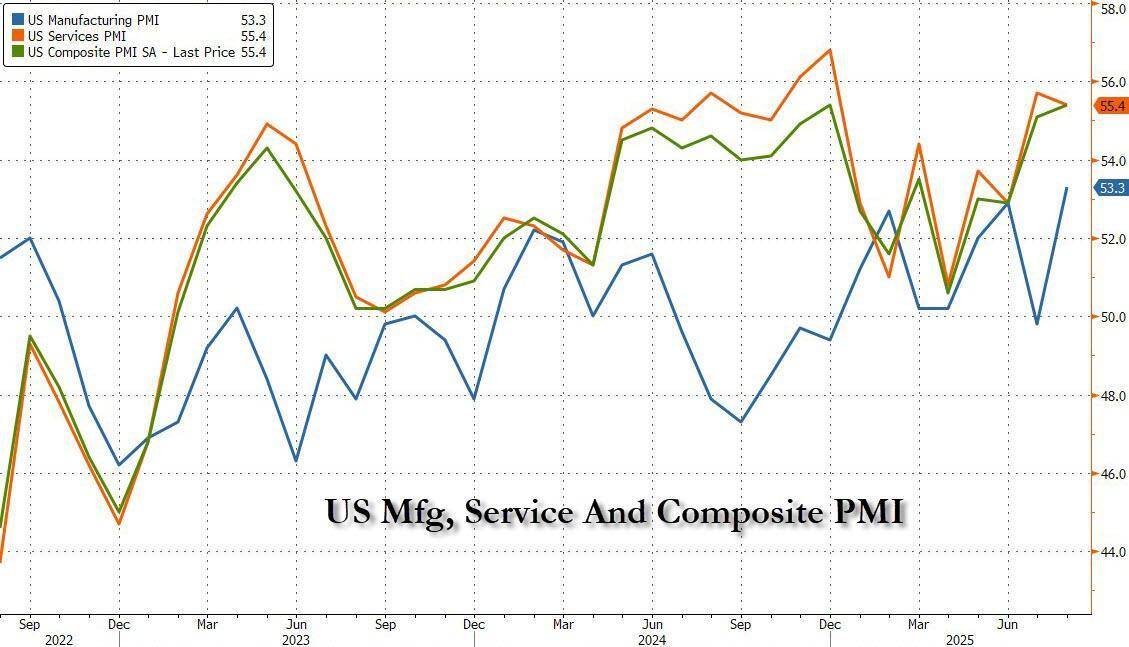
美国8月Markit制造业PMI意外创三年多新高,通胀压力加剧
Sou Hu Cai Jing· 2025-08-21 15:26
Group 1 - The core viewpoint of the article indicates that the U.S. manufacturing PMI has expanded at its fastest pace in over three years due to stronger demand, which has also pushed the composite PMI, including services, to its highest level of the year in August [1][7] - The initial reading of the U.S. August Markit manufacturing PMI is 53.3, the highest since May 2022, surpassing expectations of 49.7 and the previous value of 49.8. Both manufacturing output and backlog orders have reached their highest levels since mid-2022, while new orders have risen to their highest level since February 2024 [3][4] - The strong demand has led manufacturers to accelerate hiring, with employment growth reported as the strongest since March 2022 [4] Group 2 - The U.S. August Markit services PMI initial value is 55.4, a two-month low, but still indicates healthy business activity. The sales index has shown the fastest growth of the year, while the unfinished business index remains at its strongest level since May 2022 [6] - The composite PMI for August is 55.4, marking a nine-month high, exceeding expectations of 53.5 and the previous value of 55.1. The report indicates that rising import tariffs have pushed the sales price index to a three-year high, with consumers bearing the cost pressure as service firms' charge index also reaches a three-year peak [6][8] - Analysts suggest that the latest Markit PMI data reflects strong demand in the U.S. as the second half of the year begins, contributing to an optimistic economic outlook but also intensifying ongoing inflationary pressures [7] Group 3 - Chris Williamson, Chief Business Economist at S&P Global Market Intelligence, states that the strong PMI reading for August further indicates robust performance by U.S. businesses in the third quarter, aligning with an annualized growth rate of 2.5%, which is higher than the average growth rate of 1.3% in the first two quarters of the year [8] - Both manufacturing and service sectors report stronger demand, but they face challenges in meeting sales growth, leading to a significant increase in backlog orders and record growth in finished goods inventory due to concerns over future supply conditions [8] - The rebound in demand has spurred a surge in hiring, enhancing companies' pricing power, which has led to increased pass-through of tariff-related cost increases to customers, resulting in inflationary pressures reaching a three-year high [8]
欧元区8月综合PMI创15个月新高 制造业活动三年来首现扩张
Xin Hua Cai Jing· 2025-08-21 15:23
Core Insights - Eurozone's composite PMI for August rose to 51.1, up from 50.9 in July, marking the highest level since May 2024 and exceeding the expected value of 50.7 [1] - Manufacturing PMI increased to 50.5 from 49.8, indicating a return to expansion for the first time in three years, with the output sub-index reaching 52.3, the fastest growth in nearly three and a half years [1] - Services PMI slightly decreased to 50.7 from 51.0, indicating a slight slowdown in expansion [1] Economic Activity - Economic activity in the Eurozone has shown improvement in both manufacturing and services sectors, with growth accelerating slightly over the past three months [1] - Stability in service sector sales price inflation may provide some comfort to the European Central Bank [1]
美国8月商业活动加速 制造业PMI升至53.3创三年新高
智通财经网· 2025-08-21 15:06
Group 1 - The core viewpoint of the articles indicates that the U.S. business activity accelerated significantly in August, primarily driven by a strong recovery in the manufacturing sector [1][2] - The S&P Global U.S. Composite PMI output index rose to 55.4 in August, up from 55.1 in July, marking the highest level since December of the previous year and indicating continued expansion in the private sector [1] - The manufacturing PMI surged to 53.3, reversing the contraction seen in July (49.8) and exceeding market expectations for a second consecutive month of contraction [1][2] Group 2 - Chris Williamson, Chief Business Economist at S&P Global Market Intelligence, noted that the strong PMI reading supports a robust performance by U.S. businesses in Q3, with the economy expanding at an annualized rate of 2.5%, higher than the average of 1.3% in the first half of the year [2] - There is an increase in both manufacturing and service sector demand, but companies are struggling to meet sales growth, leading to a rise in unfinished orders at the fastest pace since early 2022 [2] - The input cost index rose to a three-month high of 62.3, and prices for goods and services reached a three-year high, indicating a significant increase in inflationary pressures [2]
【环球财经】欧元区8月综合PMI创15个月新高 制造业活动三年来首现扩张
Xin Hua Cai Jing· 2025-08-21 14:41
Group 1 - Eurozone's composite PMI for August rose to 51.1, up from 50.9 in July, marking the highest level since May 2024 and exceeding the expected value of 50.7 [1] - Manufacturing PMI in the Eurozone increased to 50.5, the first return to expansion territory in three years, with the output sub-index reaching 52.3, the fastest growth in nearly three and a half years [1] - Service sector PMI slightly decreased to 50.7, indicating a slight slowdown in expansion [1] Group 2 - Germany's manufacturing PMI for August improved to 49.9, up from 49.1 in July, indicating a gradual approach to stability, supported by a significant rise in new factory orders [2] - New orders in Germany's manufacturing sector grew at the fastest pace since March 2022, although export sales saw a slight decline for the first time in five months [2] - Germany's service sector PMI fell to 50.1, reflecting a small decline in new business volume after a recent increase, indicating stagnation in growth momentum [2] Group 3 - France's manufacturing PMI for August rose to 49.9, significantly up from 48.2 in July, marking the highest level since January 2023, despite challenges from weakened international competitiveness and trade environment issues [2] - France's service sector PMI improved to 49.7, the highest level in a year, showing a reduction in the rate of output decline and a slowdown in the contraction of new business [3] - The employment situation in France's service sector showed improvement, with companies increasing both permanent and temporary hiring, marking the strongest employment growth since April 2024 [3] Group 4 - ECB President Lagarde noted that recent trade agreements have alleviated some global uncertainties, with a strong labor market and domestic demand being key drivers of Eurozone growth [3] - Moody's analysts believe that while tariffs may weigh on the Eurozone economy, they are not sufficient to derail it [4]