
电子商务

Search documents
高盛指拼多多低基数效应提供价值重估空间 维持“买入”评级
Xin Lang Cai Jing· 2025-11-19 05:29
Core Viewpoint - Goldman Sachs reported that Pinduoduo (PDD.US) had mixed results in Q3, with operating profit achieving year-on-year growth for the first time in 2025, but online advertising revenue growth fell to single digits, significantly below expectations [1] Financial Performance - The company's management remains cautious, reiterating plans to accelerate reinvestment, which may lead to quarterly performance volatility [1] - Investment and equity income exceeded expectations, indicating improvements in the unit economics and profit margins of the Temu division [1] Revenue and Profit Forecasts - Goldman Sachs lowered its revenue forecasts for Pinduoduo for 2025 and 2026 by 2% to 3%, while raising the adjusted net profit forecast for 2025 by 4% [1] - However, net profit forecasts for the subsequent two years were reduced by 8% and 9%, primarily due to increased investments in the domestic platform ecosystem and intensified competition and regulatory changes faced by Temu [1] Future Projections - The firm expects Pinduoduo's adjusted net profit to decline by 15% in Q4 and to grow by 14% in 2026, with a projected 30% year-on-year growth in net profit for 2027 [1] Target Price Adjustment - Goldman Sachs adjusted its target price for Pinduoduo from $157 to $147, maintaining a "Buy" rating, and continues to anticipate that low base effects in the coming years will provide valuation re-rating opportunities [1]

大行评级丨大和:上调拼多多目标价至160美元 重申“买入”评级
Ge Long Hui· 2025-11-19 05:26
大和上调拼多多2025至2027年每股盈利预测6%至30%,以反映低于预期的销售与营销费用;重申"买 入"评级,目标价从145美元上调至160美元。 大和发表研报指,拼多多第三季调整后净收入超出市场预期的30%。展望未来,虽然拼多多将持续投资 其生态系统,但大和认为拼多多旗下跨境电商平台Temu亏损减少及国内业务更严格的成本控制,将支 持其净利润率按年稳定,并为2026年利润率改善留下空间。 ...
淘宝闪购联合阿里健康上线“居家闪检”
Zhong Guo Jin Rong Xin Xi Wang· 2025-11-19 05:23
Core Viewpoint - Alibaba Health and Taobao Flash Purchase have launched a new service called "Home Flash Testing," which allows users to conduct professional-level respiratory virus and bacteria testing from home, providing timely reports to ease the pressure on healthcare systems during flu season [1][2]. Group 1 - The "Home Flash Testing" service is currently in trial operation in four cities: Beijing, Shanghai, Guangzhou, and Hangzhou [1]. - Users can book the service through the Taobao App, where trained couriers will deliver sampling kits and assist in sample collection, with results available online within an average of three hours [1]. - The "Respiratory Virus and Bacteria 12-in-1 Test" covers 12 common respiratory pathogens, including various strains of influenza and COVID-19, addressing diverse testing needs during peak seasons [1]. Group 2 - The launch of "Home Flash Testing" represents a deep collaboration between Taobao Flash Purchase and Alibaba Health in the localized healthcare service sector [2]. - Future plans include integrating more professional medical services into instant retail scenarios, aiming to create a seamless "testing—medical—pharmacy" service loop for more convenient and efficient local health services [2].


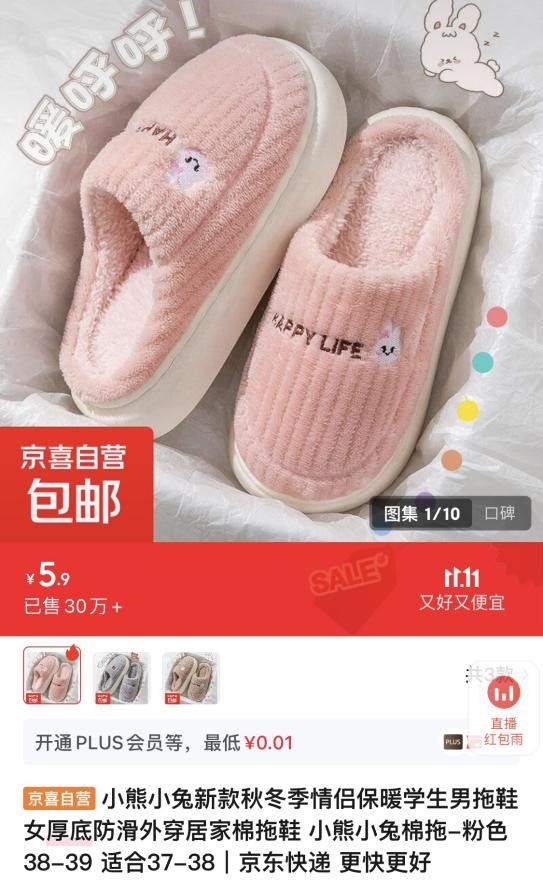
京东11.11点燃服饰消费热情 京喜自营拖鞋、内裤、冲锋衣等热销
Zhong Jin Zai Xian· 2025-11-19 03:23
Core Insights - JD's Jingxi self-operated clothing products performed exceptionally well during the 11.11 shopping festival, leveraging a "source direct procurement, factory direct supply" model to create multiple bestsellers [1][3][5] Group 1: Sales Performance - The "Little Bear and Little Rabbit" cotton slippers sold 500,000 pairs, setting a new sales record for cotton slippers on the platform [1] - A cotton sleepwear set with built-in chest pads achieved sales of 3,000 units in just one day, surpassing previous sales records [3] - Women's underwear made from Xinjiang cotton reached over 20,000 units sold within 24 hours of launch [5] Group 2: Product Quality and Supply Chain - Jingxi self-operated products benefit from strict quality control and reduced intermediaries, enhancing price competitiveness and enabling merchants to achieve volume-based efficiency [1][5] - The collaboration with the Puning underwear industry, leveraging 30 years of weaving experience, ensures high cost-performance and reliable quality through comprehensive supply chain management [5] Group 3: Market Strategy and Future Plans - Jingxi self-operated aims to deepen connections with 260 national industrial belts, achieving a tenfold increase in transaction volume and creating nearly 300,000 jobs [9] - The company plans to support 500,000 factories in industrial belts to achieve stable sales and create 5 million jobs over the next three years [9]


金荣中国:美ADP就业数据再度走低,金价触底反弹加剧震荡
Sou Hu Cai Jing· 2025-11-19 01:52
Market Overview - International gold prices experienced a rebound on November 18, closing at $4,052.90 per ounce after reaching a high of $4,081.92 and a low of $3,997.99 [1] Employment Data - According to ADP Research, U.S. companies cut an average of 2,500 jobs per week in the four weeks ending November 1, with major layoffs announced by companies like Amazon and Target [3] - Challenger, Gray & Christmas Inc. reported that planned layoffs reached the highest level for any October in over 20 years [3] - The U.S. Labor Department reported that initial jobless claims totaled 232,000 for the week ending October 18, consistent with mid-September levels [3] Federal Reserve Insights - The probability of a 25 basis point rate cut by the Federal Reserve in December is 48.9%, while the probability of maintaining the current rate is 51.1% [5] - By January, the cumulative probability of a 25 basis point cut is 49.7%, with a 31.9% chance of no change and an 18.4% chance of a 50 basis point cut [5] Technical Analysis - Gold prices showed a V-shaped recovery after hitting a low of $3,997, with a subsequent rise to $4,081 during the trading session [6] - The daily chart indicates a small bullish candle with a long lower shadow, suggesting stability above the 40-day moving average [6] - Short-term indicators are showing signs of a bottoming pattern, while the four-hour chart indicates a consolidation phase below the 60-day moving average [6] Trading Strategy - The trading strategy suggests cautious high short and low long positions, with specific entry and exit points outlined for both aggressive and conservative traders [10]

拼多多20251118
2025-11-19 01:47
Summary of PDD Holdings Conference Call Company Overview - **Company**: PDD Holdings - **Industry**: E-commerce Key Points and Arguments Financial Performance - In Q3 2025, PDD Holdings reported total revenue of **1,080.3 billion RMB**, a **9%** year-over-year increase, driven by growth in online marketing services and transaction services [4][10] - Online marketing services and other business revenue reached **533 billion RMB**, growing **8%** year-over-year, despite increased market competition and investments in the merchant ecosystem [2][4] - Transaction service revenue for Q3 was **549 billion RMB**, reflecting a **10%** increase year-over-year [9] - Total operating costs rose to **468 billion RMB**, with operating profit at **250 billion RMB** [9][10] - Non-GAAP operating profit was **271 billion RMB**, with a profit margin of **25%**, down from **27%** year-over-year [10] Strategic Initiatives - PDD is investing heavily in the agricultural supply chain, with agricultural CR growing **47%** year-over-year and a **30%** increase in post-2000 agricultural merchants [2][6] - The company launched a **10 billion RMB** subsidy and **20 billion RMB** traffic support during the "Harvest Season" to boost agricultural sales [2][6] - To combat homogenization in competition, PDD initiated a **100 billion RMB** support plan to enhance service quality and operational efficiency for merchants [2][7] Market Challenges and Regulatory Environment - PDD faces challenges from trade policies, tax regulations, and data security, prompting the company to strengthen internal capabilities and compliance [3][12] - The management acknowledges that these regulatory uncertainties could impact both short-term and long-term financial performance [12] Future Outlook - Management believes the online retail industry is entering a new investment cycle, focusing on creating unique value and high-quality services for consumers [11] - PDD plans to continue investing in its platform ecosystem, including the **1,000 billion RMB** support plan, despite potential short-term financial fluctuations [11][15] - The company aims to adapt to changing market conditions and consumer demands through technological upgrades and service enhancements [8][15] Agricultural and Merchant Ecosystem Investments - PDD has made significant investments in the agricultural sector, enhancing distribution efficiency and supporting farmers [5][6] - The company has initiated strategic measures like the **1,000 billion RMB** support plan to modernize agriculture and improve logistics for remote areas [13][14] Consumer Trends - Recent observations indicate a positive trend in consumer spending, with e-commerce demand improving during promotional periods [15] - PDD is committed to long-term growth, even if it means sacrificing short-term profits to build a sustainable platform ecosystem [15] Additional Important Information - The company has established a merchant protection committee to optimize the operating environment for merchants [11] - PDD's focus on high-quality development and social responsibility is evident in its initiatives aimed at rural revitalization and industry upgrades [13][14]
美联储巴尔金:劳动力市场真实情况可能比数据显示的更弱
Sou Hu Cai Jing· 2025-11-19 00:02
钛媒体App 11月19日消息,美国里士满联储主席巴尔金对通胀前景表示乐观,同时指出劳动力市场可能 比现有数据显示的更疲软。巴尔金强调,新增就业与招聘职位数量下降,加之失业救济申领数据基本持 平,表明就业市场趋缓。"我们的调研表明,劳动力市场可能比这些数字反映的更弱,"巴尔金在周二于 弗吉尼亚州温彻斯特发表的讲话中表示。"如果你问企业如今如何看待劳动力市场,他们会说'平衡'。 但当他们进一步解释这种'平衡'时,情况似乎并非如此。"巴尔金提到,亚马逊、Verizon和Target等大型 企业近期的裁员公告"让人对劳动力市场更加谨慎"。他还表示,企业联系人对里士满联储的反馈让他认 为,"通胀仍略高,但不太可能大幅上升"。在会后接受采访时,巴尔金表示他同意美联储主席鲍威尔关 于12月是否降息"远未成定局"的说法。(广角观察) ...
徐州市铜山区宗廷廷电子商务商行(个体工商户)成立 注册资本20万人民币
Sou Hu Cai Jing· 2025-11-18 23:50
Core Viewpoint - A new individual business named Xu Zhou Tong District Zong Ting Ting E-commerce Business has been established, focusing on various services and retail sectors [1] Group 1: Company Overview - The business is registered with a capital of 200,000 RMB [1] - The legal representative of the business is Zong Ting Ting [1] Group 2: Business Scope - The business operates in several licensed and general project areas, including life beauty services, clothing retail, cosmetics retail, nail services, and cultural activities [1] - Additional services include market marketing planning, corporate image planning, social economic consulting, food sales (only pre-packaged food), housekeeping services, wedding ceremony services, takeaway delivery services, and personal internet live streaming [1]
京东欲重塑本地生活赛道
Xin Lang Cai Jing· 2025-11-18 20:13
Core Insights - JD Group's founder Liu Qiangdong announced the launch of "JD Review" and "JD True List," along with an independent app for "JD Takeout," marking a strategic shift in the local services sector aimed at addressing growth bottlenecks and industry pain points [2][3] Group 1: Independent App Launch - The decision to launch an independent JD Takeout app is intended to resolve the issue of hidden entry points that led to significant traffic loss in the past [3] - The new app will provide core users and frequent users with greater convenience, allowing direct access to services and integrating multiple functions such as "instant retail + reviews + travel + shopping" [3][4] Group 2: Trust and Review System - JD Review and JD True List aim to reshape the consumer trust system, with Liu emphasizing that these services will "never be commercialized" to avoid conflicts of interest [3][4] - The innovative "AI All-Net Review" model will analyze millions of reviews from various platforms to present a comprehensive view of merchants or products [4] Group 3: Ecosystem Integration - The launch of the review function is seen as a way to complete the ecosystem for local life and instant retail, integrating content with the transaction system for efficient conversion [5][6] - JD's third-quarter report showed a 213.7% year-on-year increase in new business revenue, indicating significant investment and growth potential in instant retail and high-frequency services [5] Group 4: User Experience and Engagement - JD Review's interface is designed similarly to content communities like Xiaohongshu, allowing users to share experiences and directly link to JD Takeout for orders [6] - The integration of real consumption scenarios in content generation enhances credibility and matches user needs, potentially increasing order conversion rates [6]

持续发力本地生活服务赛道 京东正式推出京东外卖App
Zheng Quan Ri Bao· 2025-11-18 16:17
Core Insights - JD Group has made significant moves in the local lifestyle sector by launching its own food delivery app and expanding into travel services, aiming to create a comprehensive local lifestyle platform [1][2] - The new JD Delivery app integrates various services such as food delivery, instant retail, reviews, travel, and shopping, enhancing user accessibility and engagement [1] - JD Review and JD True Ranking have been introduced to improve content ecology, with JD Review offering five sub-channels for local lifestyle evaluations and JD True Ranking utilizing AI for user-generated content analysis [1][2] Summary by Sections Local Lifestyle Expansion - JD has launched the JD Delivery app to provide a one-stop local lifestyle service, addressing previous user engagement issues by separating food delivery from the "Instant Delivery" brand [1] - The app aims to facilitate user access and reduce traffic loss by being an independent platform [1] Integration of Content and Commerce - JD Review integrates content with the transaction system, allowing users to seamlessly transition from browsing reviews to making purchases, thus breaking down barriers between review and e-commerce platforms [2] - The use of AI to analyze vast amounts of data for generating reviews enhances the credibility of the platform while maintaining a non-commercialized approach [2] Challenges and User Engagement - Challenges include established user habits, high conversion costs, and the need for a balance between app functionality and user-friendliness to prevent user attrition [3] - JD's entry into the food delivery market has already shown positive effects, with high repurchase rates and increased user activity across other services [5] New Product Launch - JD introduced its self-operated coffee brand "Seven Fresh Coffee," aiming to provide fresh and healthy coffee experiences, with plans for rapid expansion in Beijing [4] - The coffee brand serves as a strategic tool for driving offline traffic and enhancing JD's local service network [4] Market Dynamics - The integration of high-frequency services like food delivery is seen as a key strategy for boosting user engagement and supporting lower-frequency retail transactions [6] - JD's ongoing investments in local lifestyle services are driven by the need to leverage traffic and enhance user experience in a competitive market [6]