京东真榜

Search documents
京东宣布:未来5年将投入220亿元新建15万套“小哥之家”,春节9天投入13亿元发福利!“去年有15万名外卖全职骑手加入”
Mei Ri Jing Ji Xin Wen· 2026-02-13 14:19
Group 1 - JD Group released a New Year letter highlighting the progress of its various subsidiaries over the past year and summarizing its innovative business developments in delivery, local life, and AI for 2025 [1] - In the past year, 150,000 full-time delivery riders joined JD, and the company plans to invest 22 billion yuan over the next five years to build 150,000 "Rider Homes" [1] - By December 2025, JD aims to provide 28,000 housing units for frontline employees, covering 145 cities nationwide [1] - JD has launched several innovative businesses in local life and offline retail, including Seven Fresh Kitchen, Seven Fresh Coffee, Seven Fresh Food Mall, JD Travel, JD True Ranking, JD Home Services, and JD Discount Supermarket [1] - During the Spring Festival, JD will invest over 1.3 billion yuan in welfare subsidies for its employees, exceeding national legal standards [1] Group 2 - JD Group has established a comprehensive layout in the AI sector, including intelligent computing infrastructure, models, platforms, scenarios, and products [2] - The company plans to continuously invest in AI over the next three years, aiming to create a trillion-yuan scale AI ecosystem [2] - Over the next five years, JD intends to procure 3 million robots, 1 million unmanned vehicles, and 100,000 drones to fully integrate into the logistics supply chain [2]

京东集团发布2026年新春贺信:始终在成长,永远有梦想!
Zhong Jin Zai Xian· 2026-02-13 12:52
Core Viewpoint - JD Group emphasizes its commitment to growth and innovation while enhancing employee welfare and social responsibility in its New Year message [1][8]. Group 1: Employee Welfare and Social Responsibility - The company plans to invest over 1.3 billion yuan during the Spring Festival to provide benefits exceeding national standards for its employees, including full-time delivery riders [1]. - JD has signed labor contracts and provided social insurance for its 150,000 full-time delivery riders, a first in the domestic food delivery industry [1]. - The company aims to invest 22 billion yuan over the next five years to build 150,000 "homes for riders" to support employees living away from home [1]. Group 2: Business Development and Innovation - JD has developed a stable daily sales platform and a strong brand-building platform, achieving the highest product lifecycle return rates [2]. - The company has launched various innovative services and products, including "JD FASHION" and new local living services, to meet diverse consumer needs [3]. - JD's global fresh food distribution network allows for rapid delivery of international products to Chinese consumers, enhancing the shopping experience [3]. Group 3: Technological Advancements - The company has made significant investments in AI, creating a comprehensive infrastructure that enhances supply chain efficiency and decision-making capabilities [5]. - JD plans to procure 3 million robots, 1 million unmanned vehicles, and 100,000 drones over the next five years to enhance logistics and supply chain operations [5]. - The company has integrated AI into various consumer products, making it a core value driver for growth [5]. Group 4: International Expansion - JD is expanding its logistics network to cover 23 countries, enhancing its global presence and integrating its supply chain technology into local markets [6]. - The company is committed to a long-term internationalization strategy, aiming to build a unique competitive advantage through its global supply chain capabilities [6]. Group 5: Talent Development - JD has opened 35,000 job positions for young talents and launched a program to recruit top technical talents globally [7]. - The company emphasizes practical training and collaboration with educational institutions to enhance employee skills and innovation [7]. Group 6: Company Growth and Achievements - Over the past decade, JD's ranking in the Fortune Global 500 has improved from 366 to 44, reflecting its growth in the Chinese consumer market [8]. - The company continues to focus on social responsibility and innovation, positioning itself as a benchmark for private enterprises in China [8].
京东集团发布2026年新春贺信
Zheng Quan Ri Bao Wang· 2026-02-13 12:49
Core Viewpoint - JD Group emphasizes its commitment to growth and innovation, focusing on social responsibility and technological advancement to enhance its supply chain and customer service capabilities [1][10]. Group 1: Social Responsibility and Community Support - The company plans to invest 22 billion in the next five years to build 150,000 "Xiao Ge Homes" for its delivery personnel, ensuring they feel at home even when away from their families [3]. - JD has actively responded to disasters in various regions by providing essential supplies and donations, and has expanded its team to support the elderly and disabled, aiming to create more job opportunities for them [3][4]. Group 2: Business Innovation and Product Development - JD has launched several innovative business models, including "Seven Fresh Kitchen" and "JD Travel," to better meet diverse consumer needs and enhance its market competitiveness [4]. - The company has introduced over 100 new specialty drugs through JD Health and has successfully operated a high-standard logistics base in the UAE [4][5]. Group 3: Supply Chain and Logistics - JD has developed a global fresh food distribution network, enabling rapid delivery of products like fresh lychees from Guangdong to Europe within 48 hours [5]. - The company has established a leading super supply chain capability, focusing on efficiency and cost optimization through technological advancements [5][6]. Group 4: Technological Advancements and AI Integration - JD has made significant strides in AI, creating a comprehensive framework that includes infrastructure, models, platforms, and applications, enhancing decision-making capabilities across its supply chain [6][7]. - The company plans to invest in 3 million robots, 1 million unmanned vehicles, and 100,000 drones over the next five years to further enhance its logistics capabilities [7]. Group 5: International Expansion and Workforce Development - JD views internationalization as a crucial strategy for future growth, aiming to build a competitive global supply chain [8]. - The company has provided 28,000 housing units for frontline employees and has invested 7 billion in Beijing to create comfortable living spaces for young talents [8][9]. Group 6: Organizational Development and Talent Management - JD is focused on innovation, collaboration, and efficiency, aiming to enhance organizational capabilities and employee performance through AI technology [9]. - The company has opened 35,000 job positions for young talents and initiated a program to recruit top technical talent globally [9].


京东未来5年将投入220亿元建15万套“小哥之家”,还有300万台机器人在路上
Mei Ri Jing Ji Xin Wen· 2026-02-13 12:17
Group 1 - The core message of JD Group's New Year letter highlights the progress made in various business segments over the past year and outlines future investments in areas such as delivery, local life services, and artificial intelligence (AI) [1][2] - In the past year, JD Group added 150,000 full-time delivery riders and plans to invest 22 billion yuan to build 150,000 "rider homes" over the next five years [1] - JD Group is launching several innovative businesses by 2025, including Seven Fresh Kitchen, Seven Fresh Coffee, Seven Fresh Food Mall, JD Travel, JD True Ranking, JD Home Services, and JD Discount Supermarket, focusing on local life and offline retail [1] Group 2 - JD Group will invest over 1.3 billion yuan during the nine-day Spring Festival period to provide benefits and subsidies exceeding national legal standards for its workforce, including delivery, customer service, and newly hired full-time riders [1] - The company has established a comprehensive layout in the AI sector, including intelligent computing infrastructure, models, platforms, scenarios, and products, leveraging the JoyAI model to create diverse intelligent agents and applications [1] - Over the next three years, JD Group will continue to invest in AI, aiming to create a trillion-yuan scale AI ecosystem, and plans to procure 3 million robots, 1 million unmanned vehicles, and 100,000 drones for logistics supply chain applications [2]

15万套房,刘强东甩出王炸!
Xin Lang Cai Jing· 2025-12-13 03:23
Core Insights - JD.com announced a significant investment of 22 billion yuan over the next five years to build 150,000 "Xiao Ge Homes" for delivery workers, utilizing leasing, self-construction, and housing security funds as support methods [2][18] - The initiative aims to provide housing security for delivery riders and couriers, addressing their needs and enhancing their stability in urban environments [5][21] Group 1: Employee Welfare and Retention - JD.com has already provided 28,000 housing units for frontline employees, with the new goal indicating that at least 200,000 employees will benefit from this initiative in the future [5][21] - The company emphasizes that retaining employees is crucial for operational success, as the quality of service and order timeliness depend on the workforce [6][24] - By meeting the genuine needs of employees, JD.com aims to create a sustainable workforce that can drive the growth of its delivery services [8][24] Group 2: Business Strategy and Market Positioning - JD.com is redefining the delivery business model from a focus on algorithms and subsidies to a model centered on supply chain efficiency and service quality [10][26] - The company leverages its established supply chain advantages, which have been built since 2007, to enhance its competitive edge in the local lifestyle market [10][26][27] - JD.com's approach contrasts with other platforms that primarily focus on short-term gains through subsidies and commission-based revenue [9][31] Group 3: Long-term Vision and Industry Impact - The investment in employee welfare is seen as a long-term strategy that could reshape the competitive landscape of local services, moving away from cost-cutting measures [15][31] - JD.com’s commitment to employee well-being is expected to foster a positive cycle where improved service quality leads to greater customer satisfaction and loyalty [31][32] - The initiative serves as a reminder to the industry that true competitive advantage lies in creating value rather than merely focusing on immediate profits [15][32]
花35亿港元在香港买楼后,刘强东迎来第6个IPO,年内持续活跃在大众视野
Sou Hu Cai Jing· 2025-12-11 11:42
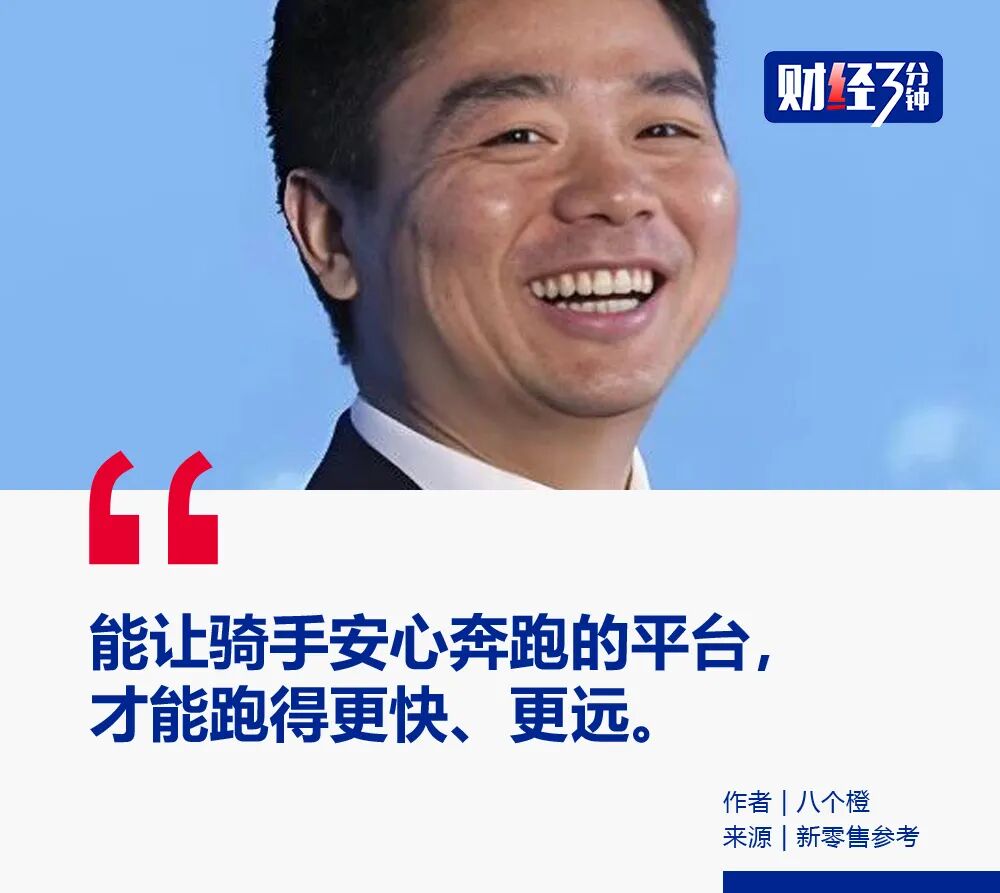
Core Viewpoint - JD Industrial, under the leadership of Liu Qiangdong, has successfully listed on the Hong Kong Stock Exchange, marking the sixth company in the "JD System" to go public, with a market capitalization of HKD 37.748 billion at the closing price of HKD 14.1 per share [1][4]. Group 1: Company Overview - JD Industrial is recognized as a leading provider of industrial supply chain technology and services in China, originating from JD Group's enterprise business launched in 2013 [3][4]. - The company has over 8.1 million SKUs across 80 product categories, projecting revenues of RMB 141.35 billion, RMB 173.36 billion, and RMB 204 billion for the years 2022, 2023, and 2024, respectively, with a compound annual growth rate of 20.13% [4]. Group 2: Financial Performance - In the first half of this year, JD Industrial achieved revenues of RMB 103 billion, representing an 18.9% year-on-year growth, and a net profit of RMB 4.5 billion, up 55.2% year-on-year [5]. - After a loss of approximately RMB 1.3 billion in 2022, the company turned profitable in 2023, with a projected net profit of RMB 762 million in 2024 [4]. Group 3: IPO Journey - JD Industrial's IPO journey faced multiple challenges, with four submissions to the Hong Kong Stock Exchange before successfully listing on December 11, 2023 [5]. - Prior to the IPO, JD Group invested nearly HKD 3.5 billion in real estate in Hong Kong, indicating a strategic commitment to the region [5]. Group 4: Strategic Partnerships and Expansion - JD Industrial has established strategic collaborations with various entities, including partnerships with Nanjing's industrial development platforms to enhance industrial internet and smart procurement services [6][8]. - The company has also expanded its footprint in Suzhou and launched its first physical store, JD Hardware City, in Kunshan [10].

美团没有被彻底拖住
36氪· 2025-11-30 23:53
Core Insights - The article discusses the intense competition in the food delivery market, highlighting that there are no clear winners in the ongoing battle, particularly in Q3 2025, where both Alibaba and Meituan faced significant losses [4][10]. - Meituan's core local business segment reported a revenue decline of 2.8% year-on-year, resulting in an operating loss of 14.1 billion yuan, marking its first loss since Q4 2022 [4][9]. - Alibaba's aggressive strategy led to a profit drop of approximately 30 billion yuan, with significant investments in subsidies that have nearly exhausted their planned 50 billion yuan budget [10]. Meituan's Performance - Meituan's operating profit for its core local business was 14.6 billion yuan in Q3 2024, contrasting sharply with a loss of 14.1 billion yuan in the same period this year, indicating a significant shift in financial performance [9]. - The increase in sales and marketing expenses by 90.9% to 35.9% of revenue reflects the high cost of maintaining market share amid fierce competition [9][10]. - Despite the losses, Meituan's average order value (AOV) remains significantly higher than competitors, with over 70% market share in orders above 30 yuan [10]. Competitive Landscape - The competition has intensified with new entrants and existing players like Alibaba and JD.com increasing their efforts in the food delivery and local services market [13]. - Douyin (TikTok) is emerging as a formidable competitor, with its life services projected to exceed 800 billion yuan in GTV by 2025, narrowing the gap with Meituan [13]. - The article notes that both Alibaba and Meituan are still in the process of optimizing their user experience (UE) and expanding their instant retail offerings [11][12]. New Business Developments - Meituan's new business segment saw a revenue increase of 15.9% year-on-year to 28 billion yuan, although operating losses increased by 24.5% to 1.3 billion yuan [17]. - The company is expanding its offline retail efforts, with initiatives like the "Happy Monkey" discount supermarket and "Little Elephant" supermarket gaining traction [18]. - Meituan's overseas business, particularly in Brazil, is set to launch in December, with significant investments aimed at capturing market share in a competitive landscape dominated by iFood [19][20]. Future Outlook - Meituan's management expresses confidence in maintaining efficiency and market share despite ongoing losses, emphasizing the importance of patience and strategic focus [7][15]. - The company aims to leverage its strengths in high-value orders and continue exploring new opportunities in both domestic and international markets [10][20].

美团没有被彻底拖住
36氪未来消费· 2025-11-29 12:23
Core Insights - The article highlights the intense competition in the food delivery sector, indicating that there are no clear winners in the ongoing battle, particularly in Q3 2025, where major players like Alibaba, Meituan, and JD.com are facing significant challenges and losses [3][5][8]. Summary by Sections Food Delivery Battle - Alibaba's aggressive strategy led to a profit drop of approximately 30 billion yuan, gaining market share but lacking evidence of successful e-commerce synergy [3][8]. - Meituan experienced a decline in market share and reported an operating loss of 14.1 billion yuan, marking its first loss since Q4 2022 [3][5]. - JD.com has reduced its investment in food delivery, focusing on user experience optimization instead [3]. Financial Performance - Meituan's core local business saw a significant shift, with operating profit dropping from 14.6 billion yuan to a loss of 14.1 billion yuan due to increased user incentives and marketing expenses [7]. - Meituan's sales costs rose by 23.7%, and marketing expenses surged by 90.9%, indicating a heavy reliance on subsidies to maintain market share [7]. - Alibaba's total profit dropped by 30 billion yuan in Q3, with a substantial portion of its planned 50 billion yuan subsidy nearly exhausted [8]. Market Dynamics - The competition has led to a significant change in market dynamics, with Alibaba and Meituan nearly equal in market share, while JD.com has lost about 8% [8]. - Both platforms are now focusing on high-value orders, with Meituan holding over 70% market share for orders above 30 yuan [8]. - The article notes that the intense competition has led to a temporary decrease in subsidy levels, allowing Meituan to regain some market share [8]. New Business Ventures - Meituan's new business segment reported a 15.9% revenue increase to 28 billion yuan, despite a 24.5% rise in operating losses [15]. - The company is expanding its offline retail efforts, with new stores like Xiaoxiang Supermarket and the discount store Happy Monkey [15]. - Meituan's overseas expansion continues, with Keeta achieving profitability in Hong Kong and launching operations in Brazil [16][18]. Future Outlook - Meituan's management expresses confidence in maintaining efficiency and market share despite ongoing losses [5][13]. - The company is preparing for a winter campaign to boost various metrics, including new store openings and promotional activities [12]. - The article concludes that while the core local business faces challenges, Meituan is committed to exploring new opportunities and maintaining its operational rhythm [18].

美团Q3财报出炉,活跃用户数增超20%,但净亏损达160亿元
2 1 Shi Ji Jing Ji Bao Dao· 2025-11-28 11:05
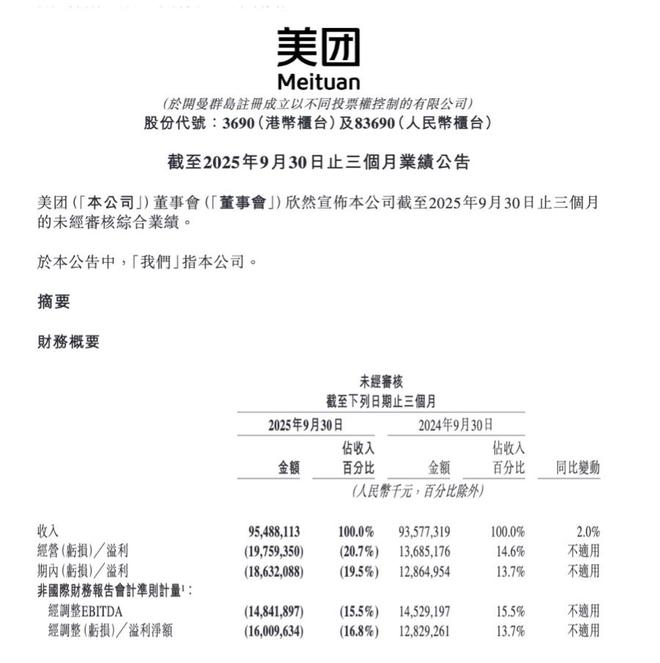
Core Insights - Meituan reported a significant net loss in Q3, marking the first operational loss in its core business in three years, primarily due to intensified subsidy wars in the industry [1] - The company's revenue for the quarter reached 95.5 billion RMB, a year-on-year increase of 2%, but the adjusted net loss amounted to 16 billion RMB [1][5] - Despite financial pressures, Meituan's user base continues to grow, with over 800 million transaction users and a significant increase in daily active users [1] Financial Performance - Meituan's core local commerce segment generated revenue of 67.4 billion RMB but incurred an operational loss of 14.1 billion RMB due to increased direct subsidies in the food delivery sector [1] - Sales costs surged by 23.7%, rising from 56.8 billion RMB in the same quarter last year to 70.3 billion RMB, with the cost-to-revenue ratio increasing from 60.7% to 73.6% [1] - The adjusted EBITDA for the quarter was a loss of 14.8 billion RMB, reflecting the financial strain on the company [3] Market Competition - The local lifestyle sector is experiencing fierce competition, with various platforms like Alibaba's Gaode Map and JD.com launching initiatives to capture market share through substantial subsidies [5] - Recent reports indicate a cooling in the price war within the food delivery sector, with Alibaba's Taobao Flash Purchase entering an efficiency optimization phase [5] - Meituan's stock has declined by 32.42% year-to-date, reflecting the impact of these competitive pressures on its market performance [5]

本地生活服务竞争转向价值深耕
Jing Ji Ri Bao· 2025-11-27 21:10
Core Insights - JD Group has launched a series of initiatives including an independent JD Takeout app, JD Review, and JD True Ranking, indicating its intention to reshape the local lifestyle market and shift competition from price subsidies to user value [2][3] - The industry is transitioning into a phase of stock competition, with low online penetration in local lifestyle services, suggesting significant potential for digital transformation [2][3] Group 1: Competitive Landscape - The competition logic is being restructured, with platforms focusing on user experience rather than price wars, emphasizing who understands and serves users better [2][3] - Companies are moving from single-point competition to building open and symbiotic ecological platforms, relying on overall resilience and innovation for success [3] Group 2: Technological and Trust Factors - Technology, including AI and big data, is deeply integrated into the service chain, enabling personalized services through precise demand analysis, becoming a key competitive differentiator [3] - The value of trust systems is becoming prominent, with real reviews and transparent processes replacing traffic exposure as the basis for user decision-making [3] Group 3: Industry Evolution - JD's approach acts as a catalyst for the industry, moving away from subsidy-driven growth towards a focus on service quality, ultimately benefiting consumers and quality merchants [3][4] - The shift towards a value-oriented competition is guiding the local lifestyle sector from "wild growth" to "meticulous cultivation," with a focus on user value and building a win-win ecosystem [4]