
债券

Search documents
10月债券市场发债超6.3万亿元
Ren Min Ri Bao Hai Wai Ban· 2025-12-01 22:11
债券市场对外开放方面,截至10月末,境外机构在中国债券市场的托管余额3.8万亿元,占中国债券市 场托管余额的比重为1.9%。其中,境外机构在银行间债券市场的债券托管余额3.7万亿元;分券种看, 境外机构持有国债2.0万亿元、占比54.7%,同业存单0.8万亿元、占比20.9%,政策性银行债券0.8万亿 元、占比20.1%。 货币市场运行方面,10月份,银行间同业拆借市场成交6.8万亿元,同比减少19.0%,环比减少26.7%; 债券回购成交131.5万亿元,同比减少5.2%,环比减少17.8%。交易所标准券回购成交46.5万亿元,同比 增加9.8%,环比减少18.2%。10月份,同业拆借加权平均利率1.39%,环比下降6个基点;质押式回购加 权平均利率1.40%,环比下降6个基点。 (责编:岳弘彬、牛镛) 关注公众号:人民网财经 债券市场运行方面,10月份,银行间债券市场现券成交26.6万亿元,日均成交1.5万亿元,同比增加 10.2%,环比增加3.9%。单笔成交量在500万—5000万元的交易占总成交金额的48.06%,单笔成交量在 9000万元以上的交易占总成交金额的45.68%,单笔平均成交量4177. ...
欧债收益率集体上涨,英国10年期国债收益率涨4.1个基点
Mei Ri Jing Ji Xin Wen· 2025-12-01 21:48
Core Viewpoint - European bond yields collectively increased on December 1, with notable rises in various countries' 10-year government bonds [1] Group 1: Yield Changes - The UK 10-year government bond yield rose by 4.1 basis points to 4.479% [1] - The French 10-year government bond yield increased by 7.5 basis points to 3.482% [1] - The German 10-year government bond yield went up by 6.1 basis points to 2.748% [1] - The Italian 10-year government bond yield climbed by 6.9 basis points to 3.467% [1] - The Spanish 10-year government bond yield rose by 6.4 basis points to 3.225% [1]
不到半月 日本再遭股债“双杀”
Zhong Guo Xin Wen Wang· 2025-12-01 17:17
Core Viewpoint - Japan's financial markets faced significant declines on December 1, with the Nikkei 225 index dropping by 1.89% and bond prices plummeting, indicating growing concerns over the government's fiscal policies and potential interest rate hikes [1][2]. Group 1: Stock Market Performance - The Nikkei 225 index opened high but fell sharply, with intraday losses exceeding 1,000 points, ultimately closing down by 1.89% [1]. - The market's decline is attributed to investor worries regarding the fiscal situation under Prime Minister Fumio Kishida's administration [1]. Group 2: Bond Market Dynamics - Japanese government bond prices experienced a significant drop, with the two-year bond yield rising by 2.5 basis points to 1.015%, the highest level since 2008 [1]. - The yield on the 10-year newly issued government bonds reached 1.840%, marking the highest level since June 2008 [1]. - The Ministry of Finance plans to increase the issuance of short-term bonds to support the economic stimulus plan, which may exert pressure on short-term sovereign bonds [1]. Group 3: Monetary Policy Outlook - There are indications that the Bank of Japan may consider interest rate hikes, as Governor Kazuo Ueda mentioned weighing the pros and cons of such a decision [1]. - Despite the cautious tone from the Bank of Japan, there is speculation that a rate hike could occur in December, while maintaining a generally accommodative monetary policy environment [1][2]. - The current fiscal expansion policies under Kishida's government raise concerns about potential inflation acceleration and a significant increase in mid-term government bond issuance, which could disrupt supply-demand balance [2].
年内科创债发行规模达3.18万亿元 精准赋能科创企业
Zheng Quan Ri Bao· 2025-12-01 16:25
在明明看来,今年科创债发行主要有以下特点:一是发行主体多元化,国企、金融机构、股权投资机构、民营企业等均参 与其中;二是发行规模显著提升,且融资成本较低,利率中枢低于一般信用债;三是投向明确,资金主要用于人工智能、半导 体、生物医药等前沿领域。 "从发行期限结构来看,科创债发行期限丰富,可以满足不同资金需求,其中,1年至3年期科创债发行规模最大。"姚宇彤 说。 本报记者 孟珂 今年以来,截至12月1日,共有3004只科技创新债券(以下简称"科创债")正式发行,发行规模合计达3.18万亿元,发行数 量及总规模相较去年同期分别增长85%和98%,为科技创新企业提供了有力的资金支持。 中信证券首席经济学家明明在接受《证券日报》记者采访时表示,今年科创债发行明显提速,发行主体及发行规模扩容显 著。发行科创债有助于帮助企业融资,为科创企业提供中长期资金,缓解融资难问题。同时,可以增加债券市场品种,满足多 元投资需求,助力资本市场创新。引导资金流向科技创新领域,提高政策传导效率。 发行主体多元化 5月7日,中国人民银行、证监会联合发布《关于支持发行科技创新债券有关事宜的公告》,从丰富科技创新债券产品体系 和完善科技创新债 ...
2026年宏观利率及12月债市展望
2025-12-01 16:03
Summary of Conference Call Notes Industry Overview - The macroeconomic outlook for December 2025 indicates a weakening influence of the equity market on the bond market, with overall weak performance and reduced trading volume expected in the equity market. Seasonal factors typically lead to increased fiscal spending and loose monetary policy in December, which may result in a downward trend in interest rates [1][4][3]. Key Points and Arguments - **Monetary Policy**: The monetary policy is expected to maintain a supportive stance, with a high probability of interest rates declining in December due to seasonal patterns. However, the impact of upcoming important meetings on the market needs to be monitored [1][4]. - **Credit Spread**: The 1-5 year non-financial credit spread has returned to the 30th percentile of the past 24 years, indicating a thin safety cushion. The compression of non-financial medium to long-term credit spreads may face challenges due to year-end regulatory changes [5][3]. - **Fiscal Policy for 2026**: The fiscal policy is projected to maintain a certain level of spending intensity, with a deficit rate expected between 4% and 4.5%. The net financing scale of government debt may reach approximately 14.5 trillion yuan [12][10]. - **Investment and Consumption Outlook**: Investment and consumption are expected to recover moderately in 2026, but inflation remains an uncertain factor. The PPI decline is expected to narrow, while CPI may return to positive growth [7][16]. - **Interest Rate Projections**: The after-tax yield on 10-year government bonds is anticipated to fluctuate between 1.7% and 1.9%, with a median estimate between 1.75% and 1.95% [2][19]. - **Investment Strategy**: In a low-interest-rate environment, a focus on coupon strategies is recommended, along with opportunities for phase-based trading. The overall economic recovery is expected to be moderate, supporting a low-interest-rate environment [21][15]. Additional Important Insights - **Economic Structure Transition**: The current macroeconomic policy framework emphasizes structural transformation, with a focus on medium to long-term planning and industrial policy, aiming for sustainable growth while stabilizing short-term economic conditions [9][14]. - **Fourth Quarter Economic Support**: There is a significant amount of new funding (1 trillion yuan) allocated for the fourth quarter, which includes policy financial tools and local government debt limits, aimed at boosting economic growth [8][11]. - **Inflation Risks**: Inflation is identified as a key uncertainty for the bond market in 2026, with potential short-term volatility due to rising prices, although the overall macro policy aims to prevent financial system stagnation [16][20]. This summary encapsulates the essential insights from the conference call, focusing on the macroeconomic outlook, fiscal and monetary policies, investment strategies, and potential risks in the bond market.
俄罗斯即将发行人民币主权债券 业内:丰富人民币计价的主权产品样本
Sou Hu Cai Jing· 2025-12-01 12:50
俄罗斯即将在本国发售首只以人民币计价的主权债券,期限为3至7年,票面周期为182天,每张债券面 值为1万元人民币。 业内认为,该举措是人民币国际化在地化运用的一个重要示范。 根据俄罗斯财政部官网,俄罗斯财政部宣布计划首次发行以人民币计价的俄罗斯联邦政府债券。投资者 将获得两期以人民币计价的固定票面收益联邦债券,期限为3至7年,票面周期为182天,每张债券面值 为1万元人民币。 实际上,历史上已有多个国家发行过以人民币计价的主权债,包括英国、韩国、波兰、匈牙利、印度尼 西亚、阿联酋的沙迦酋长国等。 例如,英国政府官网显示,2014年10月,英国政府成功在伦敦发行了以人民币计价的主权债券。2015年 12月,韩国政府在中国银行间债券市场发行30亿元三年期人民币债券,中标利率为3.00%。据悉,这是 首只境外主权国家在中国境内发行"熊猫债"。 发行规模及票面利率将根据定于2025年12月2日进行的认购申请簿收集结果确定,技术性配售计划于 2025年12月8日进行。投资者可选择以人民币或俄罗斯卢布购买债券并收取相关收益。 2016年8月,波兰在中国银行间债券市场成功发行三年期人民币主权债券30亿元。这笔债券是波兰首次 ...
资金流向,生变!
Zhong Guo Zheng Quan Bao· 2025-12-01 12:35
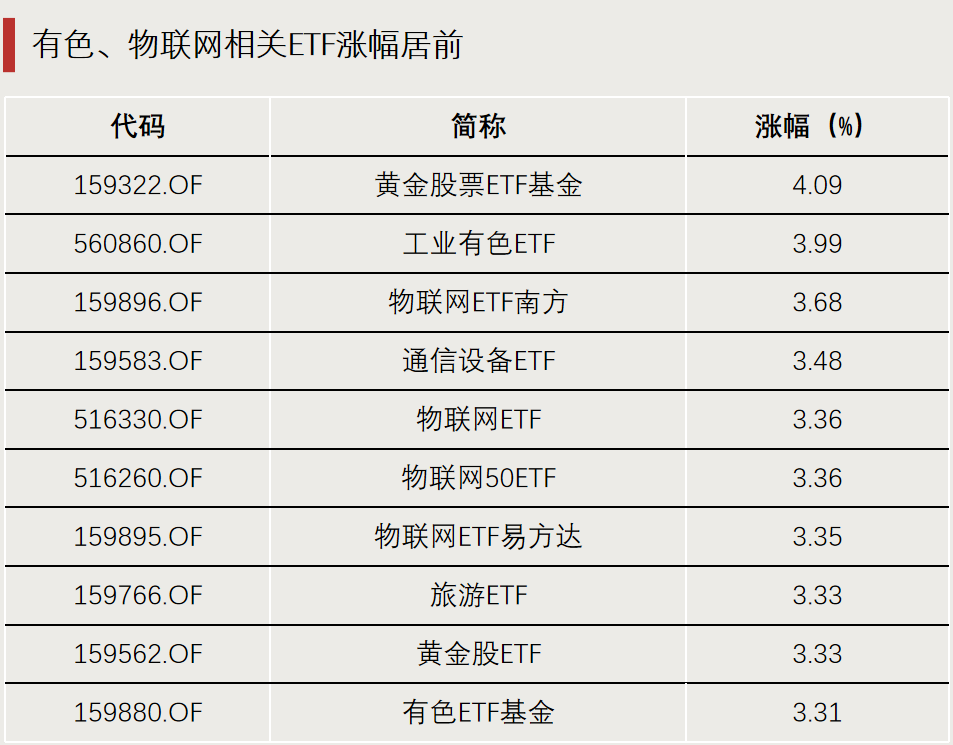
01 12月1日,市场震荡拉升,沪指重返3900点上方。有色金属板块爆发,科技题材持续活跃,带动相关ETF上涨,涨幅前十的ETF中,有4 只有色、黄金相关ETF以及4只物联网相关ETF。 02 近期,债市持续震荡,债券相关ETF成交活跃。12月1日,成交额前十的ETF中,除1只短融ETF和2只货币ETF外,其余均为债券相关 ETF。科创债ETF成交持续活跃,4只科创债ETF成交额超90亿元。 03 核心资产迎来增量资金。11月28日,资金净流入居前的ETF中,出现上证50ETF(510050)、中证500ETF(510500)等产品。 有色、物联网相关ETF涨幅居前 12月1日,有色金属板块爆发。涨幅前十的ETF中4只为有色、黄金相关ETF,其中,黄金股票ETF基金涨超4%,在所有ETF中涨幅最 高。工业有色ETF涨近4%。 科技题材表现活跃,通信设备、物联网等相关ETF涨幅居前。涨幅居前的ETF中,有4只为物联网相关ETF。 对于今日大涨的有色金属板块,业内人士分析称,有色金属行业大涨的主要原因是,美联储降息预期升温导致流动性宽松预期增强,叠 加供给紧张和需求增长支撑价格上涨。 跌幅方面,12月1日,多只跨 ...

政府债周报(11/30):结存限额化债规模已逾2700亿-20251201
Changjiang Securities· 2025-12-01 10:46
Report Industry Investment Rating No relevant content provided. Core Viewpoints The report focuses on the issuance of local government bonds, including the issuance scale, types, and progress of different periods, as well as the issuance progress of special bonds [1][5]. Summary by Directory 1. Local Bond Actual Issuance and Forecast Issuance - **Actual Issuance and Pre - issuance Disclosure**: From December 1st to December 7th, local bonds are expected to be issued at 1087.2 billion yuan, including 504.4 billion yuan of new bonds (113.9 billion yuan of new general bonds and 390.5 billion yuan of new special bonds) and 582.8 billion yuan of refinancing bonds (413.1 billion yuan of refinancing general bonds and 169.7 billion yuan of refinancing special bonds). From November 24th to November 30th, local bonds were issued at 3513.6 billion yuan, including 2340.2 billion yuan of new bonds (87.5 billion yuan of new general bonds and 2252.7 billion yuan of new special bonds) and 1173.4 billion yuan of refinancing bonds (687.7 billion yuan of refinancing general bonds and 485.6 billion yuan of refinancing special bonds) [1][5]. - **Comparison of Planned and Actual Issuance**: The report presents the planned and actual issuance of local bonds in different months and regions through multiple figures, showing the differences between planned and actual issuance in different periods and regions [21][22]. 2. Local Bond Net Supply - **New Bond Issuance Progress**: As of November 30th, the issuance progress of new general bonds is 91.02%, and that of new special bonds is 101.81% [27]. - **Refinancing Bond Net Supply**: The report shows the cumulative scale of refinancing bonds minus local bond maturities as of November 30th through a figure [27]. 3. Special Bond Issuance Details - **Special Refinancing Bond Issuance Statistics**: As of November 30th, the fifth - batch second - round special refinancing bonds total 20000.00 billion yuan, the sixth - round special refinancing bonds total 2712.79 billion yuan, and an additional 513.43 billion yuan will be issued next week. The top three regions in the fifth - batch second - round disclosure scale are Jiangsu (2511.00 billion yuan), Hunan (1288.00 billion yuan), and Henan (1227.00 billion yuan) [5]. - **Special New Special Bond Issuance Statistics**: As of November 30th, the special new special bonds in 2025 total 13508.41 billion yuan, and since 2023, a total of 25387.05 billion yuan has been disclosed. The top three regions in the disclosure scale are Jiangsu (2440.35 billion yuan), Hubei (1377.69 billion yuan), and Xinjiang (1311.70 billion yuan). The top three regions in the 2025 disclosure scale are Jiangsu (1289.00 billion yuan), Guangdong (1192.68 billion yuan), and Yunnan (729.97 billion yuan) [6]. 4. Local Bond Investment and Trading - **Primary - Secondary Spread**: The report shows the primary and secondary spreads of local bonds through figures, including the spreads of different maturities and their changes [38]. - **Regional Secondary Spread**: The report presents the regional secondary spreads of local bonds through a figure [39]. 5. New Special Bond Investment Direction - **Project Investment Monthly Statistics**: The report shows the investment direction of new special bonds through a figure, and the latest month's statistics only consider the issued new bonds [40].
【公募基金】全球风偏环比提升,债市回调后待情绪修复——泛固收类公募基金指数跟踪周报(2025.11.24-2025.11.28)
华宝财富魔方· 2025-12-01 10:13
Market Overview - The bond market showed weak performance last week, with the 1-year government bond yield remaining at 1.40%, the 10-year yield rising by 2.46 basis points to 1.84%, and the 30-year yield increasing by 2.75 basis points to 2.19%. This trend was influenced by the recovery in equity market sentiment and events related to Vanke's bond extension, leading to a short-end fluctuation and a weakening long-end [3][14] - The current bond market configuration offers a phase of improved cost-effectiveness, with limited room for further significant yield increases. The recommendation is to adopt a trading strategy focused on wave operations while extending the duration of interest rate bonds and positioning in liquid credit bonds, awaiting a recovery in market sentiment [3][14] Public Fund Market Dynamics - The China Securities Regulatory Commission (CSRC) has introduced a draft for public consultation regarding the pilot program for commercial real estate investment trusts (REITs), indicating an upcoming expansion in the REITs market [17] Fund Index Performance Tracking - The Money Enhanced Index rose by 0.02% last week, with a cumulative return of 4.35% since inception [19] - The Short-term Bond Fund Index remained flat, with a cumulative return of 4.50% since inception [4][19] - The Medium to Long-term Bond Fund Index decreased by 0.10%, with a cumulative return of 6.75% since inception [5][19] - The Low Volatility Fixed Income + Fund Index rose by 0.02%, with a cumulative return of 4.25% since inception [6][19] - The Medium Volatility Fixed Income + Fund Index increased by 0.44%, with a cumulative return of 5.61% since inception [7][19] - The High Volatility Fixed Income + Fund Index rose by 0.38%, with a cumulative return of 7.29% since inception [8][19] - The Convertible Bond Fund Index increased by 0.24%, with a cumulative return of 21.33% since inception [9][19] - The QDII Bond Fund Index rose by 0.12%, with a cumulative return of 10.33% since inception [10][19] - The REITs Fund Index increased by 0.74%, with a cumulative return of 33.22% since inception [11][19]

利率债周报:上周债市整体走弱,收益率曲线呈现熊陡走势-20251201
Dong Fang Jin Cheng· 2025-12-01 08:51
Report Industry Investment Rating No information provided in the content. Core Viewpoints - Last week, the bond market weakened overall, with long - term bond yields rising significantly. Affected by rumors of new regulations on public fund sales and the stock market's shock recovery, market sentiment weakened further, and bond fund redemption pressure increased. However, on Friday, the bond market recovered due to the weakening expectation of November PMI and the increasing expectation of loose monetary policy. The yield curve steepened upward as short - term bond yields rose less than long - term ones because of the loose funding situation. [2] - This week (the week of December 1st), the bond market will continue to fluctuate. The November manufacturing PMI is still in the contraction range, and the weak fundamental pattern remains unchanged, which is generally favorable to the bond market. December is a traditional allocation month, and institutional investors such as insurance companies may make advance arrangements, providing some support to the bond market. However, due to the uncertainty of the new regulations on public fund sales, stock market disturbances, and weak expectations of interest rate cuts, market sentiment is generally cautious, and the bond market's reaction to fundamental positives will be limited. In the short term, it is difficult for the bond market to break through the volatile market. [2] Summary by Directory 1. Last Week's Market Review 1.1 Secondary Market - The bond market weakened overall last week, with long - term bond yields rising significantly. The 10 - year Treasury bond futures main contract fell 0.30% cumulatively last week. On Friday, the 10 - year Treasury bond yield rose 2.46bp compared with the previous Friday, and the 1 - year Treasury bond yield rose slightly by 0.09bp, with the term spread continuing to widen. [3] - From November 24th to 28th, the bond market showed different trends each day. It was generally under pressure from Monday to Thursday due to various factors such as stock market performance and rumors of new regulations. On Friday, it recovered due to the weakening expectation of November PMI and the increasing expectation of loose monetary policy. [3] 1.2 Primary Market - Last week, 140 interest - rate bonds were issued, an increase of 64 compared with the previous week. The issuance volume was 716 billion yuan, an increase of 229.5 billion yuan, and the net financing amount was 477.5 billion yuan, an increase of 134.3 billion yuan. The issuance volume of Treasury bonds, policy - financial bonds, and local government bonds increased compared with the previous week. The net financing amount of local government bonds increased, while that of Treasury bonds and policy - financial bonds decreased. [9] - The subscription demand for interest - rate bonds last week was generally acceptable. The average subscription multiple of 4 issued Treasury bonds was 2.52 times, that of 20 issued policy - financial bonds was 3.80 times, and that of 116 issued local government bonds was 18.59 times. [13] 2. Last Week's Important Events - In November, China's manufacturing PMI index was 49.2%, up 0.2 percentage points from October, in line with market expectations mainly due to the recent efforts of growth - stabilizing policies and positive results from China - US economic and trade talks. The non - manufacturing PMI was 49.5%, down 0.6 percentage points from October. Looking forward, the manufacturing PMI index may decline in December due to factors such as the impact of US high tariffs on global trade and China's exports and the continued adjustment of the domestic real - estate market. [13] 3. Real - Economy Observation - Most high - frequency data on the production side declined last week, including blast furnace operating rates, petroleum asphalt plant operating rates, daily pig iron production, and semi - steel tire operating rates. [14] - On the demand side, the BDI index continued to rise, while the CCFI index declined slightly. The sales area of commercial housing in 30 large and medium - sized cities continued to increase slightly. [14] - In terms of prices, pork prices first rose and then fell, showing an overall downward trend, while most commodity prices rose, including copper, crude oil, and rebar prices. [14] 4. Last Week's Liquidity Observation - The central bank's net injection of funds through open - market operations last week was 435.8 billion yuan. [25] - R007 and DR007 both rose, the inter - bank certificate of deposit issuance rate of joint - stock commercial banks rose, the national and joint - stock direct - discount rates for various terms rose, the volume of pledged repurchase transactions decreased significantly, and the leverage ratio in the inter - bank market first decreased and then increased, showing an overall downward trend. [26][27][28]