
保险业

Search documents
上海国际金融中心一周要闻回顾(11月10日—11月16日)
Guo Ji Jin Rong Bao· 2025-11-16 05:14
Group 1 - The 2025 Shanghai Stock Exchange International Investor Conference opened on November 12, focusing on "Value Leading, Open Empowerment - New Opportunities for International Capital Investment and Mergers" with participation from over 100 renowned investment institutions and nearly 400 representatives [1] - The China Securities Index launched the Asia Select 100 Index and the Asia Select 100 Dividend Focus Index at the conference, providing benchmarks for investment in major Asian markets [2] - The Sci-Tech Innovation Board reported a significant 75% year-on-year increase in net profit for Q3, with "hard tech" companies increasing R&D investments in key industries such as integrated circuits, artificial intelligence, and biomedicine [3] Group 2 - The 19th Golden Investment Conference featured a special event focused on the Changxing Marine Equipment Industrial Park, discussing the promotion of inclusive finance and the optimization of the business environment [4] - Hang Seng Bank (China) and China Construction Bank launched a digital RMB merchant payment service in Hong Kong, expanding the application of digital RMB in retail consumption [5] - The Shanghai branch of Bank of Communications facilitated the first mBridge digital currency remittance for Sinochem International, marking a breakthrough in cross-border payment using central bank digital currencies [6] Group 3 - The Export-Import Bank of Shanghai achieved its first credit issuance in the commercial aerospace sector, marking a significant milestone [8] - Cathay Financial Holdings, together with Bank of China and China Pacific Insurance, launched a cross-border financial service plan to support Chinese enterprises' overseas operations [9] - The Shanghai Clearing House signed a strategic cooperation agreement with the Shanghai Commodity Warehouse Receipt Registration Company to enhance collaboration in commodity clearing [10] Group 4 - The China Securities Regulatory Commission chairman visited financial regulatory bodies in France and Brazil to discuss capital market cooperation [11] - The People's Bank of China released the "Interbank Market Brokerage Business Management Measures" to enhance regulation and transparency in the interbank market [13] - The People's Bank of China reported on the implementation of a moderately loose monetary policy, maintaining ample liquidity and supporting economic recovery [14] Group 5 - As of the end of October, the total social financing stock was 437.72 trillion yuan, with a year-on-year growth of 8.5% [15] - The broad money (M2) balance reached 335.13 trillion yuan, growing by 8.2% year-on-year, while the narrow money (M1) balance was 112 trillion yuan, up by 6.2% [15] - The cross-border RMB settlement amount for the current account reached 1.41 trillion yuan in October [17]
巴菲特,退休前大动作!罕见大举买入→
Mei Ri Jing Ji Xin Wen· 2025-11-16 03:17
Core Viewpoint - Berkshire Hathaway, led by Warren Buffett, continues to sell off Apple shares while investing $4.3 billion in Alphabet, reflecting a strategic shift in its investment approach [1][4][7]. Group 1: Stock Transactions - In Q3, Berkshire Hathaway reduced its Apple holdings from 280 million shares to 238.2 million shares, selling nearly three-quarters of its original 905 million shares [5][6]. - The total market value of Berkshire's stock portfolio increased to $267 billion, up 3.4% from the previous quarter [4]. - Berkshire also sold shares in American Bank, Verizon, and DaVita, while increasing its stake in Chubb by 429,000 shares [4][6]. Group 2: Investment in Alphabet - Berkshire established a new position in Alphabet by purchasing 17.84 million shares, making it the company's tenth-largest holding [7]. - Alphabet's stock has surged 46% this year, driven by strong growth in its cloud business amid the AI boom [7]. - Alphabet reported Q3 revenue of $102.35 billion, a 16% year-over-year increase, exceeding Wall Street expectations [7]. Group 3: Leadership Transition - Warren Buffett will hand over the CEO position to Greg Abel by the end of the year, expressing confidence in Abel's leadership [2][10]. - Buffett acknowledged his regret for not investing in Google earlier, despite recognizing its advertising potential [9]. Group 4: Market Outlook - Buffett has expressed concerns about the high valuations in the stock market, noting that the total market capitalization of publicly traded stocks relative to the GNP has reached historical highs [5]. - Berkshire holds a record cash reserve of $381.6 billion, indicating a cautious approach to current market conditions [11].



巴菲特,退休前大换仓!
Zheng Quan Shi Bao· 2025-11-15 08:31
Core Viewpoint - Berkshire Hathaway, led by Warren Buffett, has significantly reduced its Apple holdings while establishing a new position in Alphabet, indicating a potential shift in investment strategy as Buffett prepares to step down as CEO [1][3]. Group 1: Investment Changes - As of the end of Q3, Berkshire Hathaway held 41 stocks with a total market value of $267 billion, up 3.4% from the previous quarter [2]. - Apple remains the largest holding at approximately $60.66 billion, but Berkshire has reduced its stake from 280 million shares to 238.2 million shares, selling nearly three-quarters of its previous 905 million shares [2]. - Berkshire also reduced its holdings in Bank of America by 37.19 million shares and increased its position in Chubb by 4.29 million shares [2]. - A new position of 17.84 million shares in Alphabet has made it the tenth largest holding for Berkshire [2]. Group 2: Management Transition and Strategy - Buffett's impending retirement has led to speculation about a change in investment style, with Todd Combs and Ted Weschler, who are more active in tech stocks, likely influencing the decision to invest in Alphabet [3]. - Historically, Buffett has been reluctant to invest in pure tech companies, but the new management may adopt a different approach [3]. - Alphabet's stock has risen 46% this year, outperforming other major tech companies, and its Q3 revenue reached $102.35 billion, a 16% year-over-year increase, exceeding Wall Street expectations [3]. Group 3: Company Outlook - Buffett expressed confidence in Berkshire's ability to withstand economic changes and highlighted the company's record cash holdings of $381.6 billion [4]. - Despite a nearly 10% increase in stock price this year, Berkshire has underperformed compared to the S&P 500's 16.7% gain [5].
巴菲特,退休前大换仓!
证券时报· 2025-11-15 08:27
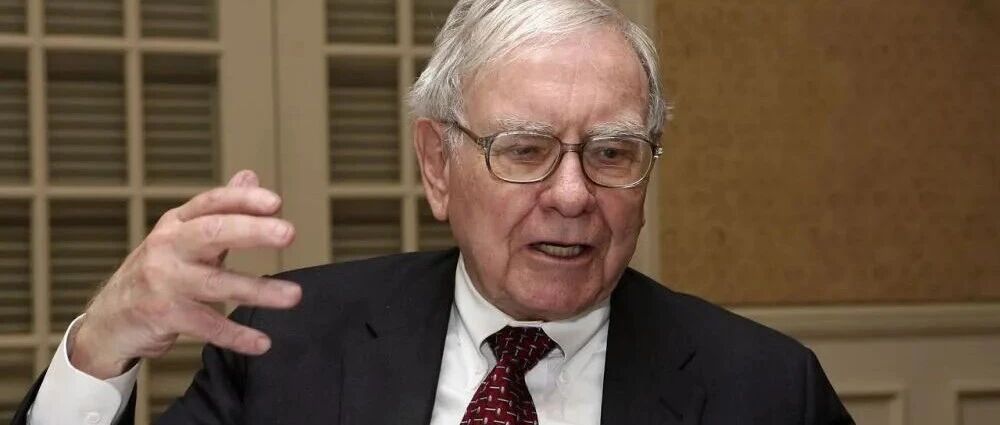
建仓谷歌母公司 Alphabet 。 11月15日,"股神"巴菲特领导的伯克希尔·哈撒韦公布了第三季度的13F报告。和此前一天提交的10Q报告一致,巴菲特在第三季度继续大量卖出苹果股票。不过同 时,巴菲特还买入了不少谷歌母公司Alphabet的股份。由于巴菲特将于年底卸任伯克希尔公司CEO一职,有分析认为,此次改变被认为公司的投资风格将有所改 变。 建仓谷歌母公司Alphabet 报告显示,截至第三季度末,伯克希尔共持有41只股票,总持仓市值为2670亿美元,较前一季度的2580亿美元有所提升,提升幅度为3.4%。 苹果仍然是其第一大持仓,持仓市值约为606.6亿美元,但是伯克希尔该季度的苹果持仓已经从2.8亿股降至2.382亿股,目前已出售了其曾持有的9.05亿股中的近四 分之三。巴菲特对苹果的减持动作早从2024年就已经开始。此前,苹果持仓规模曾一度占伯克希尔投资组合的50%以上。 在前十大持仓中,伯克希尔还减持了3719万股美国银行股票,增持了429万股安达保险股票。过去一年多来,伯克希尔的美国银行持股已经从去年中的10.3亿股降至 5.68亿股,降幅接近45%。此外,伯克希尔清仓了美国四大房地产开发商 ...
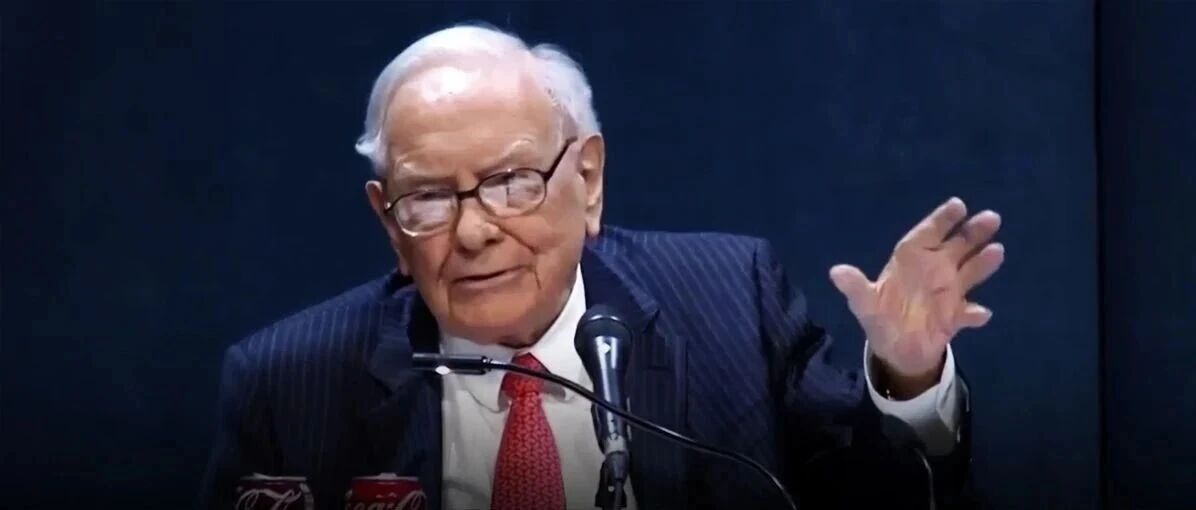
巴菲特最新持仓披露
新华网财经· 2025-11-15 03:50
Core Viewpoint - Berkshire Hathaway, led by Warren Buffett, has made significant changes to its investment portfolio in the third quarter, including substantial sales of Apple stock and new investments in Alphabet, reflecting a cautious stance on high valuations in the stock market [2][5]. Group 1: Portfolio Changes - As of the end of the third quarter, Berkshire held 41 stocks with a total market value of $267 billion, an increase of 3.4% from the previous quarter [4]. - The company increased its holdings in 6 stocks and reduced its positions in 5 stocks, while establishing a new position of 17.84 million shares in Alphabet and completely selling out of D.R. Horton [4][8]. - Berkshire has been a net seller of stocks for 12 consecutive quarters, indicating concerns about the high valuations in the U.S. stock market [3][5]. Group 2: Apple Stock Reduction - Apple remains Berkshire's largest holding with a market value of approximately $60.66 billion, but the number of shares has decreased from 280 million to 238.2 million, representing a reduction of nearly three-quarters of its original 905 million shares [7]. - The proportion of Apple in Berkshire's portfolio has dropped from over 50% to 22.69% [7]. - Buffett's reduction in Apple stock has been attributed to tax reasons, but there are speculations that it also reflects concerns about Apple's high valuation [7]. Group 3: Investment in Alphabet - Berkshire's new investment in Alphabet, totaling 17.84 million shares, makes it the company's tenth-largest stock holding [8]. - This move is surprising given Buffett's traditional value investing approach and cautious stance towards high-growth tech stocks, suggesting a shift in investment strategy possibly influenced by other investment managers within Berkshire [8][10]. - Alphabet's stock has surged by 46% this year, driven by robust growth in its cloud business amid the AI boom [9].
10月份经济数据解读:物价超预期回暖,经济结构分化加剧
Caixin Securities· 2025-11-14 12:46
Report Industry Investment Rating No relevant content provided. Core Viewpoints of the Report - Policy effects are gradually emerging, with obvious economic structural changes, including improved price data, high production - end prosperity, accelerated transformation of new and old drivers, effective "trade - in" policies, and optimized manufacturing investment structure [4][5]. - There is insufficient demand for entity financing, and residents' consumption willingness and ability still need to be improved, with weak real - economy financing demand, the real estate sector dragging down the economy, and economic data awaiting trend - based improvement [4][6]. - The economy is expected to continue a mild recovery in 2025, with high - end manufacturing and green transformation investment growing, the external environment improving marginally, and short - term policies likely in an observation period [4][24]. - Investment suggestions include re - balancing the equity market style, a likely volatile bond market, and increased differentiation in the commodity market [4]. Summary by Directory 1. 10 - month Economic Overview - The macro - economy cooled in October, with economic repair structure differentiation intensifying. Policy effects led to economic structural changes, while entity financing demand was insufficient, and economic data awaited improvement [5][6]. 2. Interpretation of 10 - month Economic Sub - data - Manufacturing PMI declined seasonally, with both supply and demand slowing. High - tech and equipment manufacturing, and consumer goods industries supported the manufacturing sector, while high - energy - consuming industries declined. The service industry expanded, and the construction industry declined [7][8]. - Fixed - asset investment decreased year - on - year, but manufacturing investment continued to grow. The real estate sector dragged down investment, while high - end and green - related manufacturing investment increased [9]. - The consumption end maintained a mild recovery, with the double - festival effect and "Double Eleven" boosting consumption. However, high base numbers and weak resident leverage may limit growth [10]. - Exports turned negative year - on - year in October, mainly due to high base numbers and weak external demand. Exports are expected to be under short - term pressure but remain resilient [10][11][12]. - Real estate sales continued to bottom out, with both sales area and investment declining. The industry is expected to improve with further policy support [13]. - The production end remained resilient, with high - tech and equipment manufacturing driving growth [14]. - PPI turned positive month - on - month for the first time this year, with supply - side policies taking effect. PPI is expected to maintain a mild upward trend [17][19]. - Social financing growth slowed in October, with both positive and negative aspects. M1 growth may have reached its peak this year, and there was a shift in deposits [20]. 3. Future Economic Outlook - Overseas, short - term liquidity may improve, but data shortages increase policy uncertainty. The probability of the Fed cutting interest rates in December has decreased [22]. - Domestically, short - term policy intensification is less necessary, and long - term policies focus on high - quality development [23]. - The economy is expected to continue a mild recovery in 2025, with high - end manufacturing and green transformation driving growth, the external environment improving, and short - term policies in an observation period [24]. 4. Investment Suggestions - Equity market: Short - term, it may fluctuate. Focus on North American power transformation, high - dividend stocks, "anti - involution" sectors, new consumption, and "15th Five - Year Plan" key areas [25][26][28]. - Bond market: It may remain volatile in the short term. A dumbbell - shaped strategy is recommended [29]. - Commodity market: Differentiation is intensifying. Precious metals are bullish in the long term but may be volatile in the short term, and crude oil may remain weakly volatile [30].
三峡人寿18.54%股权拟无偿划转,重庆发投跃居第一大股东
Guo Ji Jin Rong Bao· 2025-11-14 12:25
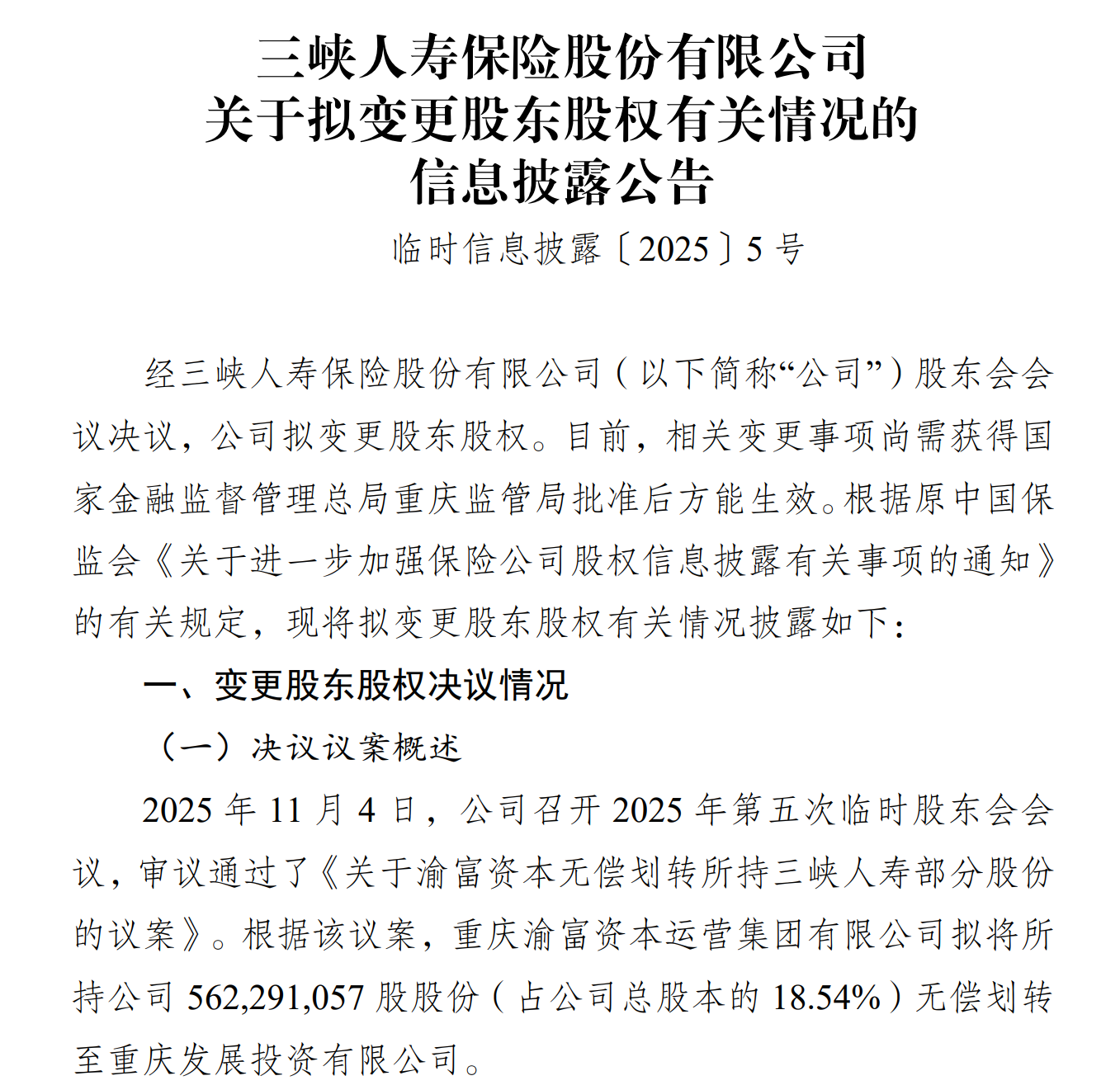
Core Viewpoint - The ownership structure of Sanxia Life Insurance has changed significantly, with Chongqing Development Investment Co., Ltd. becoming the largest shareholder after a transfer of shares from Chongqing Yufu Capital, which has seen its stake reduced [3][4]. Shareholding Changes - After the transfer, Yufu Capital holds 404.9 million shares, reducing its stake to 13.35%, while Chongqing Development Investment now holds 1 billion shares, increasing its stake to 33% [3][4]. - The share transfer is a non-compensatory transaction and does not involve any payment [4]. Company Background - Sanxia Life Insurance, established in December 2017, is the only life insurance company headquartered in Chongqing and is a state-owned financial enterprise [4]. - Yufu Capital, founded in February 2004, has a registered capital of 10 billion yuan and focuses on asset acquisition and related investments authorized by the Chongqing government [4]. - Chongqing Development Investment, established in August 2018, has a registered capital of 20 billion yuan and engages in various investment and management activities [4]. Financial Performance - From 2018 to 2020, Sanxia Life's insurance business revenue increased from 0.11 million yuan to 11.02 million yuan, but it has since declined to 3.33 million yuan in 2024 [5]. - The company has reported net losses from 2018 to 2024, totaling 906 million yuan, with a notable loss of 252 million yuan in 2024 [6]. - In the first three quarters of 2025, the company achieved an insurance business revenue of 42 million yuan, a 46% year-on-year increase, while reducing its net loss to 169 million yuan compared to the previous year [6]. Management Issues - The position of General Manager at Sanxia Life has been vacant for nearly seven years, with temporary leaders appointed since the departure of the last approved General Manager in 2018 [6].
【财闻联播】理想汽车内部问责,处理18人!公务员录用体检标准放宽
券商中国· 2025-11-14 12:15
Macro Dynamics - The EU has agreed to cancel the tax exemption policy for small packages, primarily targeting the influx of cheap Chinese goods into the EU. The Chinese Foreign Ministry expressed hope that the EU would adhere to market economy principles and provide a fair and transparent business environment for all companies, including those from China [2] Regulatory Updates - The Ministry of Commerce and three other departments issued a notice to strengthen the management of second-hand car exports, emphasizing strict controls on new cars being exported under the guise of second-hand vehicles. Starting January 1, 2026, vehicles registered for less than 180 days will require additional documentation for export, including a service confirmation letter from the manufacturer [3] Economic Data - In October, the industrial added value of enterprises above designated size in China grew by 4.9% year-on-year, with a month-on-month increase of 0.17%. From January to October, the year-on-year growth was 6.1% [4][5] Financial Sector - By the end of Q3 2025, the total assets of China's banking financial institutions reached 474.3 trillion yuan, a year-on-year increase of 7.9%. Large commercial banks accounted for 43.9% of this total, with their assets growing by 10% year-on-year [6] Market Performance - On November 14, A-shares saw a collective decline, with the Shanghai Composite Index dropping by 0.97% and the ChiNext Index falling by 2.82%. The total trading volume in the Shanghai and Shenzhen markets was approximately 1.958 trillion yuan, a decrease of about 83.88 billion yuan from the previous trading day [9] Company News - Zhang Wenfeng has been appointed as the director and general manager of State Grid Corporation of China, while also being relieved from his previous roles at China Huaneng Group [11] - Li Auto has held internal accountability for two quality incidents, resulting in the reprimand of 18 individuals [12] - Anshi China has assured that it can still provide full salaries and benefits to all employees despite external challenges [13] - Industrial Fulian responded to rumors of order or outlook downgrades, stating that current project progress and delivery schedules are normal, with new products being developed successfully [14]


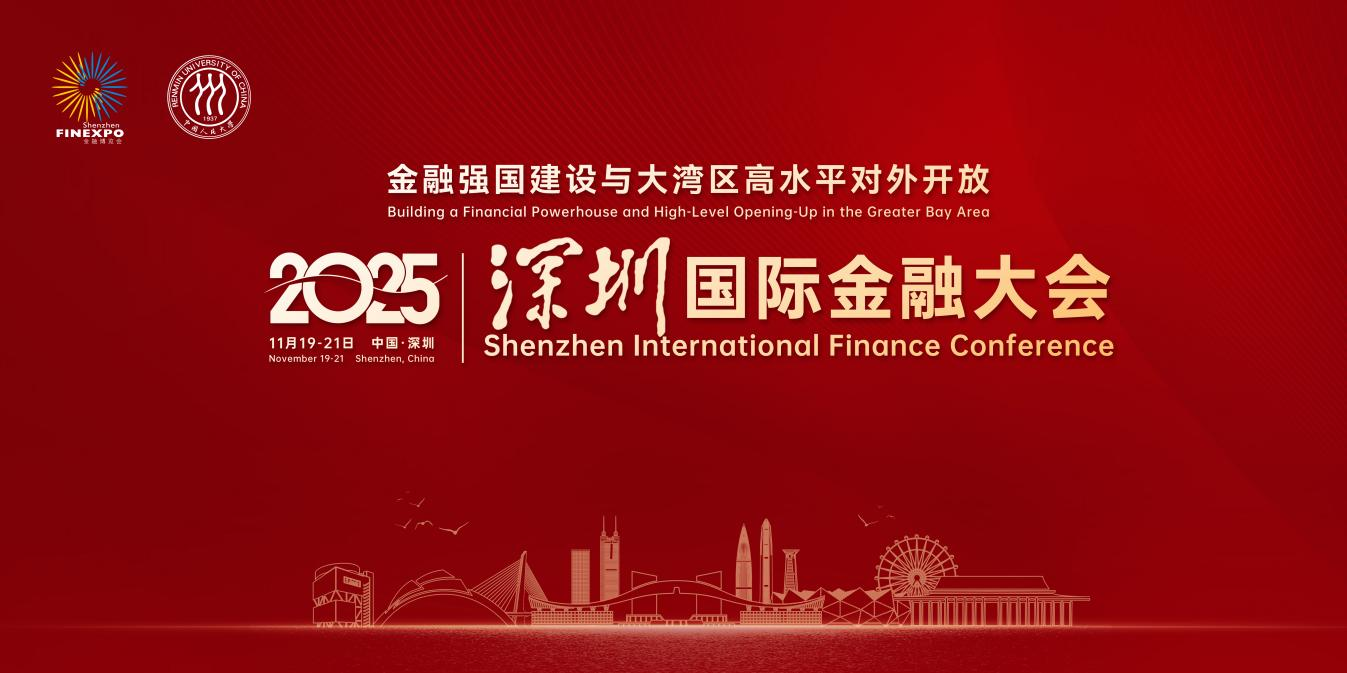
四大亮点抢先看!2025深圳国际金融大会即将开幕
Zheng Quan Shi Bao Wang· 2025-11-14 03:37
Core Viewpoint - The 2025 Shenzhen International Financial Conference, hosted by Renmin University of China, will take place from November 19 to 21, aiming to create a high-end dialogue platform to support Shenzhen's financial development and national financial strategy [1] Group 1: Conference Highlights - The conference will feature a forward-looking agenda designed to analyze financial development comprehensively, focusing on the "Financial Power" goal and the financial openness of the Guangdong-Hong Kong-Macao Greater Bay Area with a structured "1+4+8" agenda system [3] - A diverse and representative lineup of guests will participate, including officials from central financial offices, central banks, and international organizations, fostering high-level dialogue and providing international perspectives and professional support for Shenzhen's financial development [4] - The conference emphasizes practical approaches to promote the integration of finance and the real economy, inviting representatives from technology and manufacturing sectors to facilitate precise matching of industry needs and financial services [4] Group 2: Research Contributions - Authoritative institutions will release three high-quality research reports addressing key topics such as financial power construction, financial openness in the Greater Bay Area, and global financial governance, providing theoretical depth and practical insights [5] - The conference aims to summarize experiences from the Greater Bay Area and contribute to China's financial strategies, enhancing Shenzhen's influence in the international financial system [5]
转让底价17.36亿,中航集团打折出售中银三星人寿24%股权
Huan Qiu Lao Hu Cai Jing· 2025-11-14 03:16
Core Viewpoint - AVIC Group is transferring its 24% stake in Bank of China Samsung Life Insurance at a base price of 1.736 billion yuan, reflecting a decrease from the previous transfer price of 1.815 billion yuan [1][2] Group 1: Stake Transfer Details - The transfer deadline for the stake is set for December 8, 2023 [1] - AVIC Group has been a founding shareholder of Bank of China Samsung Life Insurance since its establishment in 2005, holding the stake for 20 years [1] - The previous transfer in December 2024 had a base price of 1.815 billion yuan, indicating a decrease of approximately 79 million yuan in the current transfer [1] Group 2: Corporate Strategy and Management Changes - The stake transfer aligns with the policy directive to "strictly control non-core investments, focus on primary responsibilities, and enhance the efficiency of state-owned capital allocation" [2] - AVIC Group's core asset is Air China, emphasizing its focus on the aviation sector [2] - A management change occurred at Bank of China Samsung Life Insurance, with the original chairman Ma Chaolong retiring and General Manager Qiu Zhikun taking over [2] Group 3: Financial Performance of Bank of China Samsung Life Insurance - The insurance business revenue for Bank of China Samsung Life Insurance is projected to grow from 17.326 billion yuan in 2022 to 29.862 billion yuan in 2024, with net profits increasing from 0.08 billion yuan to 4.83 billion yuan over the same period [2] - In the first three quarters of 2023, the company achieved insurance business revenue of 29.316 billion yuan, with net profit rising by 29.38% to 0.694 billion yuan [2] - As of the end of Q3 2023, total assets of Bank of China Samsung Life Insurance stood at 151.76 billion yuan, with a core solvency adequacy ratio of 166.92%, down 23.46% year-on-year, and a comprehensive solvency adequacy ratio of 225.37%, down 38.33% year-on-year [2]