
铁矿石

Search documents
铁矿石周报:铁水维持高位,铁矿偏强震荡-20250921
Guo Xin Qi Huo· 2025-09-20 23:30
1. Report Industry Investment Rating - Not provided 2. Core View of the Report - Affected by market sentiment, iron ore fluctuated at a high level this week. With the increase in production of domestic and imported iron ore, the port inventory decreased while the steel mill inventory increased due to pre - holiday restocking. The daily average hot metal output remained high, and although steel demand was weak, it had some resilience and was expected to maintain a certain profit under policy influence. The recommended operation strategy is to participate in the short - term long side [36]. 3. Summary by Directory 3.1 Part 1: Trend Review - **1.1 Iron Ore Main Contract Trend**: Affected by market sentiment, iron ore fluctuated at a high level this week [7]. - **1.2 Iron Ore Spot Trend**: The prices of various iron ore powders such as PB powder, super special powder, etc. are presented, showing price changes [11]. 3.2 Part 2: Basis and Spread - **2.1 Iron Ore Futures - Spot Spread Trend**: The main basis is -8, 01 - 05 spread is 21.5, pb - super special spread is 77, and barite - pb spread is 9 [16]. - **2.2 Ratio of Rebar to Iron Ore**: The rebar - iron ore ratio continued to be weak [19]. 3.3 Part 3: Supply - Demand Analysis - **3.1 Iron Ore Supply**: The weekly shipment of mainstream mines was 2126.3 tons, and the domestic mine capacity utilization rate was 61.65%. The production of domestic and imported iron ore increased compared to the previous period [22]. - **3.2 International Shipping Freight**: The shipping price from Port Hedland to Qingdao is 10.86 US dollars per ton, and from Tubarao, Brazil to Qingdao (BCI - C3) is 24.45 US dollars per ton. The Baltic Dry Index is 2205 [25]. - **3.3 Iron Ore Inventory - Imported Ore Inventory**: Port inventory is 13801.08 tons, Australian ore inventory is 5775.57 tons, Brazilian ore inventory is 5266.52 tons, iron ore arrival volume is 2269.4 tons, and trade ore inventory is 8980.59 tons [28]. - **3.4 Iron Ore Inventory - Steel Mill Inventory**: The iron ore port inventory was 1380.08 tons, a decrease of 48.39 tons compared to the previous period. The steel mill's imported iron ore inventory was 9309.43 tons, an increase of 316.38 tons compared to the previous period. The available days of imported iron ore for steel mills was 22 days, an increase of 2 days compared to the previous period, due to pre - holiday restocking [29]. - **3.5 Iron Ore Demand**: The daily average hot metal output was 241.02 tons, an increase of 0.47 tons compared to the previous period. The daily average port clearance volume remained at a relatively high level, and the hot metal output maintained a high level with stronger resilience than expected [32]. 3.4 Part 4: Outlook - Affected by market sentiment, iron ore fluctuated at a high level this week. The production of domestic and imported iron ore increased, port inventory decreased, and steel mill inventory increased due to pre - holiday restocking. The daily average hot metal output remained high. Although steel demand was weak, it had some resilience and was expected to maintain a certain profit under policy influence. The recommended operation strategy is to participate in the short - term long side [36].
铁矿石周报:铁水延续高位,关注商品整体氛围-20250920
Wu Kuang Qi Huo· 2025-09-20 14:27
1. Report Industry Investment Rating No relevant content provided. 2. Core View of the Report The iron ore price is expected to oscillate with a slight upward trend. In the short - term, the hot metal production remains strong, and the ore price is supported before steel mills reduce production. The positive market sentiment after the China - US leaders' call also has a positive impact on the ore price. Further observation of downstream demand recovery and inventory reduction speed is needed [11][14]. 3. Summary by Relevant Catalogs 3.1. Weekly Assessment and Strategy Recommendation - Supply: The global iron ore shipment volume was 35.731 million tons, a week - on - week increase of 8.169 million tons. Australia and Brazil's total iron ore shipment was 29.778 million tons, an increase of 6.482 million tons. Australia's shipment was 20.846 million tons, an increase of 2.622 million tons, with 18.362 million tons shipped to China, an increase of 3.049 million tons. Brazil's shipment was 8.932 million tons, an increase of 3.86 million tons. The arrival volume at 47 ports in China was 23.923 million tons, a decrease of 1.806 million tons; at 45 ports, it was 23.623 million tons, a decrease of 0.857 million tons [11][13]. - Demand: The daily average hot metal production was 2.4102 million tons, an increase of 0.047 million tons from last week. The blast furnace iron - making capacity utilization rate was 90.35%, an increase of 0.17 percentage points. The steel mill profitability rate was 58.87%, a decrease of 1.30 percentage points [11][13]. - Inventory: The total inventory of imported iron ore at 47 ports nationwide was 143.8168 million tons, a decrease of 0.7444 million tons. The daily average port clearance volume was 3.5103 million tons, an increase of 0.0664 million tons [11][13]. 3.2. Spot and Futures Market - Price Difference: The PB - Super Special powder price difference was 73 yuan/ton, a week - on - week change of - 18.0 yuan/ton. The Carajás fines - PB powder price difference was 129 yuan/ton, a change of + 3.0 yuan/ton. The Carajás fines - Jinbuba powder price difference was 173 yuan/ton, a change of + 2.0 yuan/ton. The ((Carajás fines + Super Special powder)/2 - PB powder) price difference was 28.0 yuan/ton, a change of + 10.5 yuan/ton [19][22]. - Feeding Ratio and Scrap Steel: The pellet feeding ratio was 15.05%, a change of - 0.25 percentage points. The lump ore feeding ratio was 12.28%, a change of + 0.4 percentage points. The sinter feeding ratio was 72.67%, a change of - 0.16 percentage points. The price of scrap steel in Tangshan was 2285 yuan/ton, with no change; in Zhangjiagang, it was 2130 yuan/ton, a change of + 50 yuan/ton [25]. - Profit: The steel mill profitability rate was 58.87%, a change of - 1.3 percentage points from last week. The PB powder import profit was - 14.01 yuan/wet ton [28]. - Freight: No specific data analysis on freight is provided in the summary part, only relevant charts are shown. 3.3. Inventory - Port Inventory: The inventory of imported iron ore at 45 ports was 138.0108 million tons, a change of - 0.4839 million tons. The pellet inventory was 291,240 tons, a change of + 3840 tons. The iron concentrate powder inventory was 1.02666 million tons, a change of - 0.05196 million tons. The lump ore inventory was 1.67176 million tons, a change of + 0.04523 million tons. The Australian ore port inventory was 5.77557 million tons, a change of - 0.03094 million tons. The Brazilian ore port inventory was 5.26652 million tons, a change of + 0.0383 million tons [35][38][41]. - Steel Mill Inventory: The steel mill's imported iron ore inventory was 9.30943 million tons, an increase of 0.31638 million tons from last week [46]. 3.4. Supply Side - Overseas Shipment: The latest 19 - port data shows that Australia's shipment to China was 17.367 million tons, a week - on - week increase of 2.445 million tons. Brazil's shipment was 8.693 million tons, an increase of 3.818 million tons. Rio Tinto's shipment to China was 6.372 million tons, a week - on - week increase of 1.388 million tons. BHP's shipment to China was 4.798 million tons, an increase of 0.272 million tons. Vale's shipment was 6.112 million tons, an increase of 2.591 million tons. FMG's shipment to China was 3.981 million tons, an increase of 0.715 million tons [51][54][57]. - Arrival and Import: The latest 45 - port arrival volume was 23.623 million tons, a week - on - week decrease of 0.857 million tons. In July, China's non - Australia and Brazil iron ore imports were 17.5216 million tons, a month - on - month increase of 2.1066 million tons [60]. - Domestic Mines: The domestic mine capacity utilization rate was 61.65%, a change of + 0.42 percentage points. The daily average iron concentrate powder output of domestic mines was 48,140 tons, a change of + 330 tons [66]. 3.5. Demand Side - Hot Metal Production and Capacity Utilization: The domestic daily average hot metal production was 2.4102 million tons, an increase of 0.047 million tons from last week. The blast furnace capacity utilization rate was 90.35%, an increase of 0.17 percentage points [71]. - Ore Clearance and Consumption: The 45 - port iron ore daily average clearance volume was 3.3917 million tons, a change of + 0.0789 million tons. The steel mill's imported iron ore daily consumption was 2.9745 million tons, a week - on - week increase of 0.008 million tons [74]. 3.6. Basis As of September 19, the calculated iron ore BRBF basis was 50.16 yuan/ton, and the basis rate was 5.85% [79].
北京铁矿石交易中心将推出进口铁矿石港口现货价格指数
Qi Huo Ri Bao Wang· 2025-09-20 09:57
长期以来,国际铁矿石定价机制一直被四大矿山所主导,形成高度集中的格局。他指出,高质量价格指 数的诞生需要凝聚产业链各环节企业的智慧、经验与力量。北铁中心组建了涵盖国内外钢厂、矿山、贸 易企业的专委会,彰显了打造客观、公正且具有广泛代表性的价格指数的决心,也是行业合力完善定价 机制的创举。他希望各成员单位携手促进指数编制过程的规范化与标准化,并在指数正式发布后探索应 用,共同推动形成科学合理的铁矿石定价机制。 中国钢铁工业协会副秘书长、北铁中心董事长石洪卫在铁矿石工作会议上表示,北铁中心运营的中国铁 矿石现货交易平台于2012年5月开市,目前会员企业超过600家,年交易量超过8000万吨,其中港口现货 近4500万吨。为更好发挥价格发现功能,北铁中心多次围绕港口现货指数建设工作与行业企业座谈研 讨,编制方案已基本成熟,进入上线前的冲刺阶段。 期货日报网讯(记者 曲德辉 见习记者 肖佳煊)9月18日,北京铁矿石交易中心(简称"北铁中心")召 开进口铁矿石港口现货价格指数(简称"北铁指数")专家委员会(简称"专委会")工作启动会。同日, 中国钢铁工业协会铁矿石工作委员会在北京组织召开铁矿石工作会议,分析当前铁矿石市 ...
铁矿四季报:供给爬坡与需求韧性的博弈
Zi Jin Tian Feng Qi Huo· 2025-09-19 12:46
1. Report Industry Investment Rating No relevant content provided. 2. Core Viewpoints of the Report - Static calculations suggest that China's iron ore imports in 2025 may first decrease and then increase, with a year - on - year reduction of 8.08 million tons (-0.5%) to 1.228 billion tons. The new production capacity of mines in Australia and Brazil is expanding more slowly than expected, and events such as abnormal weather significantly affect shipments. Shipments are expected to improve in the fourth quarter. The total supply will decrease by 7.95 million tons (-0.51%) to 1.525 billion tons. [5][102] - In terms of demand, in 2025, the decline in the real estate sector in China will slow down, infrastructure investment will show positive year - on - year growth, and the manufacturing industry will continue to improve. The annual iron ore demand is estimated to be 1.496 billion tons, a year - on - year increase of 55.52 million tons (+3.85%). Overseas, the pig iron production in major iron ore - importing countries is expected to decline slightly, while India's steel demand will continue to be strong. [5][102] - As of early September 2025, the inventory at 45 ports was 138 million tons. Although the mine production capacity is slowly expanding in 2025, unexpected events such as abnormal weather have a large impact on shipments. The demand growth is resilient, and hot metal production shows the characteristic of "no off - season". Static calculations indicate that the iron ore supply - demand situation is moving towards a looser state, and there is a high possibility of inventory accumulation in the fourth quarter, but short - term supply - demand tightness may still occur. [5][102] 3. Summaries According to Relevant Catalogs Supply - Global Shipment: From January to August 2025, the global daily average shipment was 4.28 million tons/day, a 0.5% decrease compared to 4.3 million tons/day in the same period of the previous year. The shipments from Australia and Brazil decreased significantly in the first quarter due to weather effects and then recovered to the previous year's level. The shipments from non - mainstream regions have been consistently low in recent years. [10] - Australia: From January to August 2025, Australia's global average daily shipment was 2.476 million tons/day, a 0.69% increase compared to the same period in 2024. The average daily shipment to China was 2.082 million tons/day, a 1.86% increase. The main production capacity increments in Australia in 2025 come from the Western Range (officially put into production on June 6, 2025) and the Onslow project (the capacity launch may be delayed until September due to road upgrades). If the weather remains normal, the iron ore shipments in the fourth quarter may maintain a certain increment. [13] - Major Australian Companies: - Rio Tinto: From January to August 2025, the average daily shipment was 804,000 tons/day, a 2.9% decrease compared to the same period in 2024. The Western Range project, which was fully put into production on June 6, 2025, is the main source of production capacity increment, but due to weather effects, the annual shipment target is affected. [17] - BHP: From January to August 2025, the average daily shipment was 791,000 tons/day, a 1.28% increase compared to the same period in 2024. In the 2025 fiscal year (July 2024 - June 2025), BHP's 100% equity production reached 29 million tons, a record high. The South Flank mine may be the main source of increment, with a stable annual production capacity of 80 million tons in the 2025 fiscal year. It is expected that BHP will achieve a high - level production in 2025, and there will be no new projects put into production in the fourth quarter. [22] - FMG: From January to August 2025, the average daily shipment was 517,000 tons/day, a 4.87% increase compared to the same period in 2024. In the 2025 fiscal year, the target range was broadened to 190 - 202 million tons. The Iron Bridge project was originally scheduled to reach full production in September 2025 but has been postponed to the 2028 fiscal year. [27] - Brazil: From January to August 2025, Brazil's average daily shipment was 1.0391 million tons/day, a 2.2% increase compared to the same period in the previous year. Vale's average daily shipment was 951,600 tons/day, a 1.02% decrease compared to the same period in the previous year. In the first half of 2025, Vale's total production was 151 million tons, a 0.3% year - on - year decrease. The production in 2025 is expected to be close to the lower limit of the target (about 325 million tons) mainly due to the licensing issues in the Serra Norte mining area restricting the increment. The Capanema project is expected to be put into production in the first half of 2025, adding 15 million tons of production capacity. The S11D +20 mining area is expected to release production capacity in 2026. [31] - Non - mainstream Regions: In 2025, the iron ore shipments from India decreased significantly, while Canada increased its exports due to cost reduction through new technologies, and South Africa's export increment was mainly due to the optimization of railway transportation capacity. From January to August 2025, Canada's average daily shipment was 164,500 tons/day, a 5.85% year - on - year increase, and South Africa's average daily shipment was 152,300 tons, a 3.8% year - on - year increase. [36][41] - China's Domestic Production: In the first seven months of 2025, China's cumulative iron ore production decreased by 3.28% year - on - year. In the fourth quarter, production is expected to recover, and the domestic iron concentrate powder production in 2025 is expected to increase by 0.05% year - on - year to 297 million tons. Some new production capacities (such as the first - phase project of Liaoning Sishanling Iron Mine and Hebei Macheng Iron Mine) have been postponed, and safety and environmental inspections in Northeast and North China have led to the phased shutdown of small and medium - sized mines. [5][51] Demand - Domestic: In 2025, the decline in the real estate sector will slow down, infrastructure investment will show positive year - on - year growth, and the manufacturing industry will continue to improve. The annual iron ore demand is estimated to be 1.496 billion tons, a year - on - year increase of 55.52 million tons (+3.85%). From January to July 2025, the estimated pig iron production was 617 million tons, a cumulative year - on - year increase of 4.32%. The estimated pig iron production in 2025 is 920 million tons, a year - on - year increase of 3.65%. [5][73] - Overseas: From January to July 2025, overseas pig iron production was 234 million tons, a year - on - year decrease of 2.31%. Among the main overseas regions, India's pig iron production continued to grow at a high rate of 7.05%, while the pig iron production in other major steel - producing countries mainly declined. [56] Inventory - Port Inventory: In the first half of 2025, due to the decline in overseas shipments and unexpected demand, the iron ore inventory at ports decreased significantly. As of September 2025, the total inventory in the iron ore industry chain decreased by about 13.6 million tons compared to the end of 2024 to 192 million tons. Looking ahead to the fourth quarter of 2025, with the release of new production capacities and the slow decline in downstream demand, the downward trend of iron ore inventory may be reversed. [86] - Variety - specific Inventory: Based on data from 15 major ports, while the total inventory is slowly decreasing, there is significant differentiation among varieties. The inventory of Brazilian ore first decreased and then increased, and the inventory of Australian ore has recently decreased significantly. The inventory of low - grade ore has decreased significantly, the overall level of medium - grade ore has increased, and the inventory of PB fines has started to reach a high level. [90] Price - In the absence of obvious incremental expectations for pig iron demand in major overseas countries and in China, the iron ore supply - demand balance will be achieved through price cuts and shipment reductions, and the cost support around $80 - 85 per ton is relatively strong. [94]



铁矿周报:终端需求转弱,矿价高位承压-20250919
Yin He Qi Huo· 2025-09-19 11:49
1. Report Industry Investment Rating - Not provided in the given content 2. Core View of the Report - This week, iron ore prices trended strongly. In the third quarter, global iron ore shipments contributed significant increments, with the mainstream mines' increments mainly from Brazil, while Australia's shipments were basically flat year-on-year. Non-mainstream shipments remained at a high level year-on-year and are expected to continue contributing certain increments. On the demand side, in August, infrastructure investment decreased by 5.9% year-on-year and continued to weaken rapidly month-on-month; manufacturing investment decreased by 1.3% year-on-year, and the growth rate of steel demand in the manufacturing industry slowed significantly, failing to sustain the high growth in the first half of the year. Compared with the first half of the year, the demand for construction steel continued to be weak, and the recent month-on-month decline in steel demand in the manufacturing industry has suppressed the current terminal steel demand. Overseas, from January to July, the consumption of iron elements increased by 2.7% year-on-year, with India's crude steel production increasing by 9.8% year-on-year, and overseas crude steel demand remained at a relatively high level. Overall, terminal demand is weakening in China while overseas steel use maintains high growth, and the valuation of iron ore remains high among the black commodities. The year-on-year increase in domestic terminal steel demand in August may be the lowest point of the year, and the steel demand in the domestic manufacturing industry is expected to gradually recover in September. However, the market may not have priced in the rapid weakening of terminal demand in the third quarter, and as market expectations fluctuate at high prices, iron ore prices may face pressure at high levels [3]. - Trading strategies: For single positions, focus on high-level hedging of spot; for arbitrage, adopt a wait-and-see approach; for options, also adopt a wait-and-see approach [3]. 3. Summary by Relevant Catalogs 3.1 Comprehensive Analysis and Trading Strategies - **Core Logic**: Terminal demand is showing a pattern of weakening in China and high growth overseas. The valuation of iron ore remains high, but prices may face pressure at high levels due to the rapid weakening of terminal demand in the third quarter not being priced in by the market [3]. - **Trading Strategies**: Single positions - high-level hedging of spot; Arbitrage - wait-and-see; Options - wait-and-see [3] 3.2 Iron Ore Core Logic Analysis 3.2.1 Supply Side - **Global Iron Ore Shipments**: Since 2025, the weekly average of global iron ore shipments has been 30.65 million tons, an increase of 0.7%/8.3 million tons year-on-year. Among them, Australia's weekly shipments were 17.62 million tons, a year-on-year decrease of 1.3%/8.4 million tons, and Brazil's weekly shipments were 7.42 million tons, a year-on-year increase of 3%/8 million tons. In terms of the shipments of mainstream mines in Australia and Brazil, since the beginning of 2025, Rio Tinto's shipments have decreased by 1.4%/3.2 million tons year-on-year, BHP's by 1.5%/3.1 million tons, FMG's have increased by 4.4%/6 million tons, and VALE's by 0.1%/0.2 million tons. The overall supply of the four major mines has been basically flat year-on-year. Last week, the shipments of mainstream mines in Brazil rebounded significantly as port maintenance ended and port shipments resumed. In the third quarter, most of the increments of mainstream mines came from Brazil, while Australia's shipments were basically flat year-on-year [11]. - **Non - mainstream Iron Ore Shipments**: Since 2025, the weekly average of non - Australian and non - Brazilian iron ore shipments has been 5.6 million tons, an increase of 4.4%/8.7 million tons year-on-year. The weekly average of non - mainstream iron ore shipments in Australia has been 2.34 million tons, a year-on-year decrease of 8.5%/8 million tons, and that in Brazil has been 2.05 million tons, a year-on-year increase of 12%/8.2 million tons. A $10 increase in the average of the Platts Index corresponds to an increase of about 30 - 40 million tons in non - mainstream ore production (annualized). Since the third quarter, non - mainstream ore shipments have improved, and the rapid decrease in shipments in the first half of the year has turned into an increase. In September, shipments remained at a high level year-on-year and are expected to continue contributing certain increments. Currently, the profit from non - mainstream shipments is good, and some mines may participate in hedging [13]. - **Port Inventory**: This week, the port inventory of imported iron ore decreased slightly month-on-month, and the amount of ships waiting at ports remained the same, but the steel mills replenished their stocks significantly, with the inventory increasing significantly year-on-year, resulting in a month-on-month increase of nearly 3 million tons in the total domestic inventory of imported iron ore. Since August, the total domestic inventory of iron elements has been continuously increasing, with an accumulation of about 9 million tons, mainly due to the high level of hot metal production and the decline in terminal steel demand, leading to a continuous weakening of the supply - demand fundamentals of iron ore. From the perspective of supply - demand projection, hot metal production is expected to remain at a high level in September, but the growth rate may slow down. With the month-on-month improvement in the steel demand of terminal manufacturing, the port inventory of imported iron ore is expected to remain balanced [23]. 3.2.2 Demand Side - **Domestic Demand**: Since the third quarter of 2025, domestic hot metal production has increased by 3.9%/7.3 million tons year-on-year, and crude steel production has increased by 4.6%/10 million tons year-on-year. Among them, the apparent demand for building materials has decreased by 7.1%/7 million tons year-on-year, the apparent demand for non - building materials has decreased by 0.6%/0.7 million tons year-on-year, and domestic crude steel consumption (excluding exports) has decreased by 3.7%/7.8 million tons year-on-year. Recently, the terminal steel inventory in China has been increasing month-on-month, while it was decreasing during the same period last year. Compared with the steel demand in the first half of the year, the steel demand in the manufacturing industry increased by more than 7% year-on-year in the first half, but has weakened relatively quickly on a month-on-month basis since the third quarter, suppressing the current terminal steel demand. In terms of infrastructure, in August, the year-on-year growth rate of large - scale infrastructure investment was - 6.4% (previous value - 1.9%), and that of small - scale infrastructure investment was - 5.9% (previous value - 5.1%), with infrastructure investment continuing to weaken rapidly month-on-month. In terms of manufacturing, in August, the year-on-year growth rate of manufacturing investment was - 1.3% (previous value - 0.3%), and the growth rate of steel demand in the manufacturing industry slowed significantly, failing to sustain the high growth in the first half of the year. The year-on-year increase in domestic terminal steel demand in August may be the lowest point of the year, and the steel demand in the domestic manufacturing industry is expected to recover on a month-on-month basis in September [29]. - **Overseas Demand**: From January to July, the consumption of overseas iron elements increased by 2.7% year-on-year, with India's crude steel production increasing by 9.8% year-on-year, and overseas crude steel demand remained at a relatively high level [29].
黑色系周报:铁矿石-20250919
Dong Ya Qi Huo· 2025-09-19 11:46
Report Industry Investment Rating - Not provided in the given content Core Viewpoint - Iron water production increased month-on-month, port inventories decreased, and steel mill inventories increased month-on-month. Iron water production has recovered to the pre-environmental restriction high. Coupled with the pre-holiday restocking expectation, the fundamentals of iron ore still have support. The Iron Ore 2601 contract is expected to fluctuate with an upward bias [6] Summary According to the Directory 1. Price and Spread - **Price**: The report presents price trends of various iron ore products such as iron ore index, lowest deliverable product converted to futures price, Platts Index (58%, 62%, 65%), Qingdao Port iron ore powders (65% Carajás fines, 61.5% PB fines, 56.5% Super Special fines), Hebei Qian'an 66% iron concentrate powder, scrap steel index, Shandong Yishui 62% pellet ore, and Qingdao Port 62.5% PB lump ore from 2016 to 2025 [14][18][20] - **Spread**: It shows the spreads between different iron ore contracts (1 - 5, 5 - 9, 9 - 1), high - medium grade spread (Platts 65% - 62%), 65% pellet premium, 62.5% lump ore premium, medium - low grade spread (Platts 62% - 58%), high - low grade spread (Platts 65% - 58%), index basis rate, basis of different contracts (01, 05, 09), hot - rolled coil index profit on the futures market, weighted average profit of five major steel products in Hebei and East China, rebar index profit on the futures market, and the spread between scrap steel and hot metal in North and East China from 2016 to 2025 [32][43][57] 2. Supply - **Domestic Production**: From January to August, the cumulative output of domestic raw ore was 67,810,420 tons, a year - on - year decrease of 4.2%. The national 266 mines' capacity utilization rate and daily output of iron concentrate powder are also presented from 2017 to 2025 [9][87] - **Imports**: In August, China imported 105.22 million tons of iron ore and its concentrates, a year - on - year increase of 3.78%. From January to August, the cumulative import was 801.62 million tons, a year - on - year decrease of 1.64%. The report also shows monthly import volume, cumulative import volume, and their year - on - year changes from 2019 to 2025. The weekly shipping volume from Australia and Brazil, weekly arrivals at 26 and 45 ports, BDI index, BCI index, and shipping freight rates from Western Australia to Qingdao and Brazil's Tubarão to Qingdao are also included [9][66][73] 3. Demand - **Production - related Demand**: The national 45 - port average daily ore handling volume and 247 steel mills' average daily hot metal production are presented from 2018 to 2025. The report also shows the cumulative and monthly output of pig iron from the National Bureau of Statistics, and their year - on - year changes from 2020 to 2025 [94][89] - **Consumption - related Demand**: It includes the daily consumption of domestic and imported iron ore powders by 64 steel mills, import ore sintering ratio, sinter ore charging grade, sinter ore, pellet ore, and lump ore charging ratios, 247 steel mills' blast furnace capacity utilization rate, blast furnace operating rate, and profitability rate from 2017 to 2025 [101][104][107] 4. Inventory - **Port Inventory**: The report shows the total inventory, trade ore inventory, non - Australian and Brazilian ore inventory, Australian ore inventory, Brazilian ore inventory, coarse powder inventory, lump ore inventory, pellet ore inventory, and inventory days at 45 ports from 2017 to 2025 [111][113][115] - **Steel Mill Inventory**: It includes the total imported ore inventory, imported ore inventory days of 247 steel mills, and the inventory of imported and domestic iron ore powders of 64 steel mills from 2020 to 2025. The iron concentrate powder inventory of 266 mines from 2019 to 2025 is also presented [126][128][130]
大中矿业:公司产品销售方案采用以销定产结合市场需求的方式确定
Zheng Quan Ri Bao· 2025-09-19 10:15
Group 1 - The company adopts a sales strategy based on market demand, determining production through annual long-term contracts to secure sales volume [2] - Pricing for sales is primarily referenced against the 62% iron ore Platts index and is adjusted periodically based on market indicators [2] - This approach ensures a stable long-term supply relationship while allowing the company to better follow market price fluctuations [2]

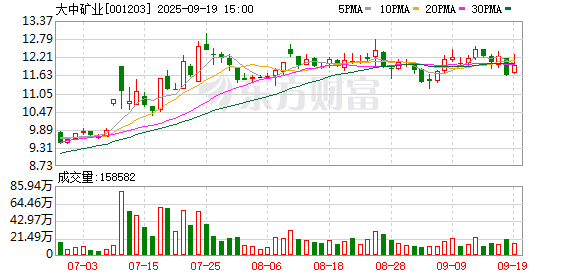
大中矿业:目前公司拥有铁矿、锂矿两大主要业务产线
Zheng Quan Ri Bao Wang· 2025-09-19 10:14
Core Viewpoint - The company, Dazhong Mining, has significant iron ore and lithium mining operations, with substantial reserves and production capacity projected for the near future [1] Group 1: Iron Ore Operations - The company has reported an increase in iron ore reserves to 690 million tons as of June 2025, based on the latest exploration results [1] - The iron ore production capacity is set at 14.8 million tons [1] - The company has been operating in the iron ore industry for over 20 years, indicating established expertise and stability in this sector [1] Group 2: Lithium Mining Operations - The company has lithium mining operations in Hunan and Sichuan, with registered lithium carbonate equivalent reserves exceeding 4.72 million tons [1] - The lithium resource reserves are ranked among the top in the country, suggesting a strong competitive position in the lithium market [1] - The lithium mining sector is currently in the construction phase, with specific production timelines to be announced in future company announcements [1]
大摩看好淡水河谷(VALE.US)2026年增长:铁矿石与铜矿业务双轮驱动
Zhi Tong Cai Jing· 2025-09-19 08:44
Core Viewpoint - Morgan Stanley's recent report on Vale (VALE.US) highlights discussions with CFO Marcelo Bacci regarding shareholder returns, railway operations, iron ore product flexibility, copper business growth strategies, and challenges in the nickel segment [1][2]. Group 1: Financial Strategies and Shareholder Returns - The company may distribute a special dividend if net debt falls below $15 billion, with expectations for this to occur by December 2025 if iron ore prices remain high and operations are stable [2][3]. - Management is optimistic about the Brazilian railway concession, despite previous unsuccessful negotiations with the government, and is focused on maintaining control over railway assets until 2057 [2][3]. Group 2: Market Outlook and Product Strategy - The iron ore market is expected to tighten by 2026, with prices projected to remain above $90 per ton, prompting Vale to invest in a flexible product portfolio with an annual capacity of 360 million tons [2][3]. - The company plans to focus on supplying high-silica iron ore to the Chinese market and introducing new mid-grade products, which could generate additional revenue [3]. Group 3: Copper and Nickel Business Developments - The copper business aims to increase production to 700,000 tons per year, primarily relying on internal resources rather than acquisitions, with the Manara project aligning with this growth strategy [3]. - Although the nickel segment has seen cost reductions, it has not yet reached breakeven, and there are no plans for expansion in Canada, with a preference for developing multi-metal mines instead [3].
铁矿石区间震荡 节前补库能否推动价格进一步走高
Jin Tou Wang· 2025-09-19 06:59
东海期货:市场再出限产传闻,成材产量小幅回落。上周铁水产量回升至240万吨上方,短期继续上涨 空间也有限。供应方面,本周全球铁矿石发运量环比回升816.9万吨,到港量环比回落85.7万吨,供应整 体维持高位。铁矿石港口库存也小幅下降63万吨。铁矿石价格仍以区间震荡思路对待。 据统计全国45个港口进口铁矿库存总量13801.08万吨,环比下降48.39万吨;日均疏港量339.17万吨,增 7.89万吨;在港船舶数量101条,增1条;全国47个港口进口铁矿库存总量14381.68万吨,环比下降74.44 万吨;日均疏港量351.03万吨,增6.64万吨。 9月18日,中国钢铁工业协会铁矿石工作委员会在北京组织召开铁矿石工作会议,分析当前铁矿石市场 形势,研究近期主要工作,围绕北京铁矿石交易中心即将推出的进口铁矿石港口现货价格指数进行了安 排部署。国内钢铁生产企业和铁矿石贸易企业铁矿石采购业务负责人参加会议。 机构观点 正信期货:昨日五大材产量下滑幅度较小,夜盘矿价震荡偏强。本周澳巴发运回升,到港继续走低,近 端供应环比收紧;需求方面,受唐山限产结束影响,铁水产量大幅回升,铁矿需求增加明显;库存来 看,疏港量大幅增 ...