
石油和天然气开采业

Search documents
【招银研究|宏观点评】关税冲击初显——中国物价数据点评(2025年4月)
招商银行研究· 2025-05-10 13:19
Group 1: CPI Inflation - The CPI inflation for April is -0.1% year-on-year, which is in line with the previous value and higher than market expectations of -0.3% [1] - Core CPI inflation remains stable, with a month-on-month increase of 0.2%, while year-on-year it holds steady at 0.5% [8] - Food prices have turned from decline to increase, with a month-on-month rise of 0.2% and a year-on-year decline narrowing by 1.2 percentage points to 0.2% [5][6] Group 2: PPI Inflation - The PPI inflation for April is -2.7% year-on-year, down 0.2 percentage points from the previous month, and -0.4% month-on-month, which is weaker than the historical average since 2017 [12] - The decline in PPI inflation is primarily due to tariff impacts, with energy prices being suppressed and some industries facing export obstacles [15] - New momentum industries show resilience, with prices in sectors like computer and electronic equipment manufacturing improving [15] Group 3: Forward Outlook - Looking ahead, the implementation of a package of financial policies on May 7 is expected to support consumption and stabilize the real estate market, potentially leading to a stabilization and gradual recovery of core CPI inflation [11] - The PPI inflation is projected to face downward pressure due to ongoing tariff uncertainties, but the recent financial policies may alleviate some of this pressure [20] - The expected CPI inflation midpoint for Q2 is around 0.2%, while the annual midpoint is projected at 0.4%; for PPI, the Q2 midpoint may drop to around -2.5%, with an annual midpoint of -2.4% [21]


4月中国PPI下降 部分工业行业价格向好
Huan Qiu Wang· 2025-05-10 09:26
Group 1 - In April, China's Producer Price Index (PPI) decreased by 0.4% month-on-month and 2.7% year-on-year, with the year-on-year decline widening by 0.2 percentage points compared to the previous month [1] - The decline in PPI is attributed to changes in the international trade environment and a rapid drop in prices of certain international bulk commodities, affecting domestic industry prices [1] - Specific sectors such as oil and gas extraction saw a price decrease of 3.1%, while refined petroleum products and chemical manufacturing prices fell by 2.5% and 0.6% respectively [1] Group 2 - Seasonal declines in energy prices were noted, with coal mining and processing prices dropping by 3.3% due to the end of heating season and traditional off-peak demand [1] - The electricity and heat production and supply sector experienced a price decrease of 0.3%, influenced by lower costs of new energy generation and increased wind power output [1] - Despite international factors exerting downward pressure, domestic macro policies aimed at boosting consumption and the growth of high-tech industries have led to increased demand in certain sectors, resulting in positive price changes in some areas [1] Group 3 - Policies promoting consumption and equipment upgrades are expected to lead to a recovery in prices for certain consumer goods and manufacturing products [2] - In April, the year-on-year price decline for household washing machines narrowed by 0.3 percentage points, while food manufacturing and new energy passenger vehicles also saw a reduction in their price decline by 0.2 percentage points [2] - The diversification of trade and market expansion has contributed to price increases or reduced declines in some export sectors, with integrated circuit packaging and testing prices rising by 2.7% and semiconductor device manufacturing prices increasing by 1.0% in April [2]
重磅数据发布!价格领域呈现积极变化
第一财经· 2025-05-10 09:14
Core Viewpoint - The article discusses the recent trends in China's Consumer Price Index (CPI) and Producer Price Index (PPI), highlighting the impact of international oil prices and domestic economic policies on these indices [1][2]. CPI Analysis - In April, the CPI showed a month-on-month increase of 0.1% after a previous decline of 0.4%, but year-on-year it decreased by 0.1% [1]. - The core CPI, excluding food and energy, rose by 0.5%, indicating stable inflation in essential goods [2]. - The year-on-year decline in CPI is attributed mainly to a significant drop in energy prices, which fell by 4.8%, with gasoline prices decreasing by 10.4%, contributing approximately 0.38 percentage points to the CPI decline [6]. PPI Analysis - The PPI decreased by 0.4% month-on-month and 2.7% year-on-year, with the latter decline widening by 0.2 percentage points compared to the previous month [7]. - The drop in PPI is influenced by international commodity price declines, particularly in oil and gas extraction, which saw a price drop of 3.1%, and refined petroleum products, which fell by 2.5% [7]. - Seasonal factors also contributed, with coal prices declining as demand decreased post-heating season [7]. Positive Price Changes - Despite the overall decline in CPI and PPI, certain sectors are experiencing positive price changes due to improved supply-demand dynamics and government policies promoting consumption [9]. - Industries such as black metal smelting and non-metallic mineral products saw a narrowing of year-on-year price declines, indicating a recovery in demand [9]. - High-tech industries are also benefiting, with prices for wearable smart devices and aircraft manufacturing increasing by 3.0% and 1.3%, respectively [10]. Trade and Export Impact - The diversification of trade and market expansion has led to price increases in some export sectors, such as integrated circuit packaging, which rose by 2.7% [10]. - The government emphasizes the importance of maintaining prices within a reasonable range to support both consumer spending and corporate profitability [10].

【广发宏观郭磊】如何看4月物价数据和央行货政报告对于价格的分析
郭磊宏观茶座· 2025-05-10 07:39
Core Viewpoint - The article discusses the current state of China's Consumer Price Index (CPI) and Producer Price Index (PPI), highlighting a slight decrease in both indices, indicating ongoing deflationary pressures in the economy. It emphasizes the need for effective demand stimulation and policy coordination to enhance economic recovery and stabilize prices. CPI Analysis - In April 2025, the CPI year-on-year change was -0.1%, consistent with the previous value, while the PPI year-on-year change was -2.7%, lower than the previous -2.5% [1][7] - The CPI month-on-month change was 0.1%, an improvement over the negative growth seen in February and March. Key price increases were driven by reduced imports affecting beef prices, increased travel activity during the May Day holiday, and rising gold prices [8][9] - Beef prices rose by 3.9% month-on-month in April, with the year-on-year decline narrowing by 5.9 percentage points. Travel-related costs, including airfare and accommodation, saw significant increases, contributing approximately 0.10 percentage points to the CPI month-on-month [8][9] PPI Analysis - The PPI month-on-month change was -0.4%, unchanged from March. Input price pressures remain significant, particularly in the oil and gas extraction sector, which saw a month-on-month decline of 3.1% [10][11] - The steel industry continues to face the necessity of capacity reduction, with black metal smelting prices decreasing by 1.0% month-on-month. The construction sector supports cement prices, while the automotive industry experiences ongoing price declines due to technological advancements and market competition [10][11] - The article anticipates that the PPI year-on-year decline may continue to widen due to elevated bases from May to July and external demand pressures affecting capacity utilization in certain industries [4][12] Policy Implications - The People's Bank of China (PBOC) emphasizes that the relationship between money supply and prices is complex and depends on supply-demand dynamics. Effective demand stimulation is crucial for price recovery, necessitating coordinated policies across various sectors [5][14] - The article suggests that optimizing the supply-demand ratio is essential for positive effects from monetary policy expansion. Key policy paths include boosting consumption, stabilizing local investment, and promoting technological and industrial innovation [6][15]

4月CPI同比下降0.1%,价格领域呈现积极变化
Di Yi Cai Jing· 2025-05-10 04:58
Economic Overview - The National Bureau of Statistics indicates that despite international input factors exerting downward pressure on prices in certain industries, China's economic foundation remains stable and resilient, with macro policies working in synergy to promote high-quality development [1][2] - In April, the Consumer Price Index (CPI) showed a month-on-month increase of 0.1% after a previous decline of 0.4%, while year-on-year, it decreased by 0.1% [1][4] - The Producer Price Index (PPI) experienced a month-on-month decline of 0.4%, with a year-on-year decrease of 2.7%, which is an expansion of the decline by 0.2 percentage points compared to the previous month [1][5] CPI Analysis - The core CPI, excluding food and energy prices, rose by 0.5% in April, maintaining a stable growth rate [2] - The year-on-year CPI decline is primarily influenced by a significant drop in international oil prices, with energy prices decreasing by 4.8% year-on-year, and gasoline prices falling by 10.4%, contributing approximately 0.38 percentage points to the CPI decline [4] PPI Analysis - The PPI's decline is attributed to international input factors affecting domestic industry prices, with global commodity prices, including Brent crude oil and LME copper, experiencing declines of 6.6% and 5.5% respectively [5][6] - Domestic energy prices are also seasonally declining, particularly in coal mining and processing, which saw a month-on-month decrease of 3.3% [6] Price Trends in Specific Industries - Certain industries are witnessing positive price changes due to improved supply-demand relationships, with construction and manufacturing sectors showing signs of recovery [7] - Prices in the black metal smelting and rolling industry and non-metallic mineral products industry have seen a narrowing of year-on-year declines by 1.4 and 1.0 percentage points respectively [7] - The prices of consumer goods and equipment manufacturing products are also rebounding, with household washing machines and new energy vehicles showing reduced year-on-year price declines [7][8] Export and Trade Impact - The ongoing diversification of trade is leading to price increases or reduced declines in some export sectors, such as integrated circuit packaging and testing, which saw a price increase of 2.7% [8] - The government emphasizes the importance of maintaining reasonable price levels to balance consumer spending and corporate profitability, with policies aimed at promoting price recovery [8]
重磅数据发布!现多项积极信号→
Zheng Quan Shi Bao· 2025-05-10 04:26
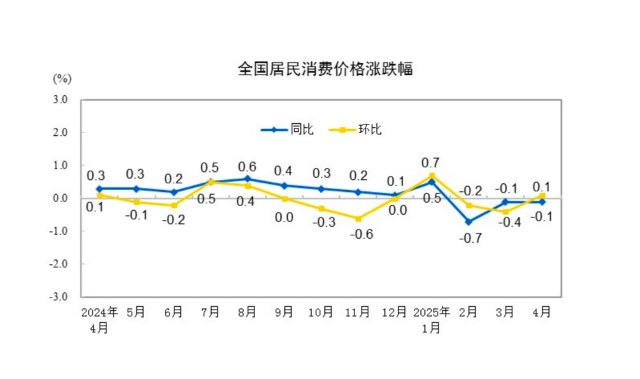
Group 1: Consumer Price Index (CPI) Insights - In April, the CPI increased by 0.1% month-on-month and decreased by 0.1% year-on-year, indicating a shift from decline to growth in the month-on-month comparison [1][3] - Food prices rose by 0.2%, while non-food prices increased by 0.1%, with service prices up by 0.3%, driven by seasonal factors and demand recovery [3][4] - The core CPI, which excludes food and energy, rose by 0.2% month-on-month and 0.5% year-on-year, reflecting stable supply-demand dynamics [3][10] Group 2: Producer Price Index (PPI) Trends - The PPI decreased by 0.4% month-on-month and 2.7% year-on-year, with the decline attributed to international input factors and seasonal drops in energy prices [1][9] - Certain industrial sectors showed signs of price stabilization, with black metal and non-metal mineral product prices experiencing reduced year-on-year declines [5][6] - The PPI's month-on-month decline was influenced by falling prices in the petroleum and natural gas extraction sectors, as well as in the non-ferrous metal industries [9][10] Group 3: Economic Policies and Market Dynamics - The People's Bank of China noted that policies aimed at expanding domestic demand are beginning to take effect, which is expected to support a moderate recovery in price levels [1][10] - Recent macroeconomic policies, including interest rate cuts and structural tools, are designed to stimulate domestic demand and support price stability [10] - The upcoming holiday seasons are anticipated to boost service prices, contributing to a potential recovery in the core CPI [10]
重磅数据发布!现多项积极信号→
证券时报· 2025-05-10 04:19
Core Insights - The Consumer Price Index (CPI) increased by 0.1% month-on-month in April, while year-on-year it decreased by 0.1%. The Producer Price Index (PPI) decreased by 0.4% month-on-month and by 2.7% year-on-year [1][2]. CPI Analysis - The month-on-month CPI change shifted from decline to increase, with a core CPI increase of 0.2% month-on-month and a stable year-on-year increase of 0.5%. This reflects the resilience of the economy [2][4]. - Food prices rose by 0.2%, and service prices increased by 0.3%, driven by seasonal factors and demand recovery during the holiday period [3][4]. PPI Analysis - The PPI's month-on-month decline of 0.4% was consistent with the previous month, influenced by international factors and seasonal declines in energy prices [8][10]. - Certain industrial sectors showed signs of price recovery, with reduced year-on-year declines in sectors such as black metal smelting and non-metallic mineral products [5][6]. Sector Performance - High-tech industries and construction activities contributed to a positive trend in some industrial prices, with specific sectors like wearable smart devices and aircraft manufacturing showing price increases [5][6]. - The international oil price decline negatively impacted domestic oil-related industries, leading to price drops in sectors such as petroleum extraction and refining [10]. Economic Outlook - The People's Bank of China anticipates that policies aimed at expanding domestic demand will support a moderate recovery in price levels [2][11]. - Recent monetary policies, including interest rate cuts and structural tools, are expected to stimulate domestic demand and support price stability [11].

重磅发布!↑0.1%
券商中国· 2025-05-10 02:53
Group 1 - The Consumer Price Index (CPI) turned from a decrease of 0.4% in the previous month to an increase of 0.1% in April, with a year-on-year decrease of 0.1% remaining unchanged from the previous month. The core CPI increased by 0.2% month-on-month and 0.5% year-on-year, maintaining stability [1][2] - Food prices increased by 0.2% month-on-month, exceeding seasonal levels by 1.4 percentage points, driven by factors such as reduced import volumes and seasonal supply changes [2] - The prices of air tickets, transportation rentals, hotel accommodations, and tourism services rose significantly, contributing approximately 0.10 percentage points to the month-on-month CPI increase [2] Group 2 - The Producer Price Index (PPI) decreased by 0.4% month-on-month, with the decline rate remaining the same as the previous month. This was primarily influenced by international input factors affecting domestic prices [4] - The prices in the petroleum and natural gas extraction industry fell by 3.1%, while the prices of refined petroleum products decreased by 2.5%, reflecting the impact of declining international oil prices [4] - Some industrial sectors showed signs of improvement, with the year-on-year price decline in black metal smelting and rolling industries narrowing by 1.4 percentage points [5] Group 3 - High-tech industries are experiencing growth, with prices in related sectors increasing. For instance, the price of wearable smart devices rose by 3.0%, and aircraft manufacturing prices increased by 1.3% [5][6] - The expansion of trade diversification is contributing to price increases or narrowing declines in some export sectors, such as integrated circuit packaging and testing, which saw a price increase of 2.7% [6]
中国石油天然气申请顶驱协议转换装置及方法专利,提高顶驱装置内部以及其与其他关键钻井装备的数据交互能力
Jin Rong Jie· 2025-05-03 03:16
北京石油机械有限公司,成立于1955年,位于北京市,是一家以从事专用设备制造业为主的企业。企业 注册资本42450.136611万人民币。通过天眼查大数据分析,北京石油机械有限公司共对外投资了3家企 业,参与招投标项目642次,财产线索方面有商标信息20条,专利信息923条,此外企业还拥有行政许可 223个。 中国石油集团昆仑制造有限公司,成立于2023年,位于石家庄市,是一家以从事石油、煤炭及其他燃料 加工业为主的企业。企业注册资本580000万人民币。通过天眼查大数据分析,中国石油集团昆仑制造有 限公司共对外投资了6家企业,参与招投标项目10次,专利信息26条。 中国石油集团长城钻探工程有限公司,成立于2008年,位于北京市,是一家以从事专业技术服务业为主 的企业。企业注册资本2770000万人民币。通过天眼查大数据分析,中国石油集团长城钻探工程有限公 司共对外投资了3家企业,参与招投标项目5000次,财产线索方面有商标信息16条,专利信息1696条, 此外企业还拥有行政许可21个。 金融界2025年5月3日消息,国家知识产权局信息显示,中国石油天然气集团有限公司申请一项名为"一 种顶驱协议转换装置及方法 ...

大庆石油申请抽油机微网微储绿电智能群控专利,解决现有的每台抽油机发电装置供电能力小等问题
Jin Rong Jie· 2025-05-02 04:34
专利摘要显示,本发明涉及采油工程技术领域,尤其涉及一种抽油机微网微储绿电智能群控系统,该系 统包括:市电电网和绿电发电系统通过执行单元连接直流母线,直流母线通过逆变单元分别连接若干台 抽油机;油井集控单元分别连接执行单元和逆变单元;油井集控单元用于通过执行单元获取、调节绿电 发电系统的实时发电电能大小和控制将市电电网和/或绿电发电系统的电能传输至直流母线,以及通过 逆变单元获取抽油机的实时运行状态,并根据实时运行状态调节绿电发电系统的实时发电电能与抽油机 运行时的实时用电电能达到平衡。以解决现有的每台抽油机发电装置只能针对一台抽油机进行供电,供 电能力较小,且在供电时需要频繁切换动力源导致抽油机电机容易被烧坏的问题。 金融界2025年5月2日消息,国家知识产权局信息显示,大庆石油管理局有限公司、中国石油天然气集团 有限公司申请一项名为"一种抽油机微网微储绿电智能群控系统"的专利,公开号 CN119891366A,申请 日期为2023年10月。 中国石油天然气集团有限公司,成立于1990年,位于北京市,是一家以从事燃气生产和供应业为主的企 业。企业注册资本48690000万人民币。通过天眼查大数据分析,中国石油 ...