券商

Search documents
港股速报|港股今日震荡回升 恒指重返26000点 大金融与科网股携手发力
Mei Ri Jing Ji Xin Wen· 2025-12-05 09:46
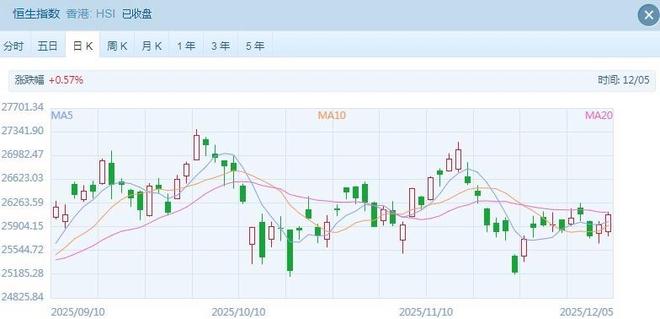
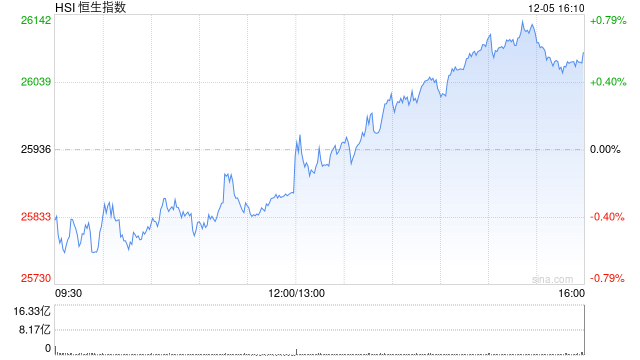
Market Performance - The Hong Kong stock market showed a rebound after an initial decline, with the Hang Seng Index successfully returning to the 26,000-point mark, significantly boosting market sentiment [1] - The Hang Seng Index closed at 26,085.08 points, up 149.18 points, a gain of 0.58% [2] - The Hang Seng Tech Index performed even better, closing at 5,662.46 points, up 47.03 points, a gain of 0.84% [3] Sector Performance - There was a clear divergence among sectors, with the large financial sector being the core driver of the afternoon market rally. Insurance stocks performed particularly well, with China Ping An (HK02318) rising over 6% and China Taiping (HK00966) increasing over 7% [5] - Brokerage stocks also saw gains, with Huatai Securities (HK06886), Shenwan Hongyuan Hong Kong (HK00218), and Hongye Futures (HK03678) all rising over 3% [5] - The tech sector saw broad gains, with Baidu Group-SW (HK09888) up over 5% and Kuaishou-W (HK01024) up over 2% [5] - The non-ferrous metals sector showed strong performance in the morning, with Jiangxi Copper (HK00358) rising over 6% [5] New Listings - Two new stocks were listed today: Tianyu Semiconductor (HK02658) and Yujian Xiaomian (HK02408), both of which saw significant declines of 30.17% and 27.84%, respectively, falling below their issue prices [5] Market Outlook - Hong Kong Yongfeng Financial Group noted that many investors are reluctant to engage in the market as the year-end approaches, with some investors looking to take profits after substantial gains throughout the year [7] - The outlook for the Hong Kong stock market in the first half of 2026 is optimistic, with potential catalysts including reassessment of China's economic growth momentum, currency exchange rates, price trends, and corporate earnings prospects [9] - Key events such as the Central Economic Work Conference in mid-December and the upcoming local and central meetings in the first quarter will serve as important observation windows for new policies [9]



A股午后直线拉升,原因找到了
Zhong Guo Ji Jin Bao· 2025-12-05 09:46
中国基金报消息,兄弟姐妹们啊,今天的A股,绝对突发!原本震荡的行情,到了下午一点半的时候,市 场遭到资金"偷袭",直线暴力拉升,让人目瞪口呆! 全市场的股民都在问:"究竟发生了什么事情?" 那么,按照基金君的惯例,这么大幅的波动,泰勒一定会找到原因跟大家汇报。 首先,午后13:30,在毫无征兆的情况下,三大指数直线拉升。 13147.68 +140.96 +1.08% 58.41 万球友关注 已收盘 12-05 15:04:00 北京时间 | 最高: 13164.48 | 今开:13020.29 | | --- | --- | | 最低: 12938.35 | 昨收:13006.72 | | 52周最高: 13806.69 | 上涨:2360 | | 52周最低: 9119.60 | 下跌:499 | | 成交量: 6.69亿手 | 换手:2.80% | | --- | --- | | 成交额:1.01万亿 | 量比: 1.02 | | 振幅:1.74% | 平盘: 57 | | 总市值: 42.07万亿 | | 分时 五日 日K 周K 月K 季K 年K 120分 60分 30分 15分 5分 1分 区间统计 ...
重磅利好!保险、券商联袂拉升
Zheng Quan Shi Bao Wang· 2025-12-05 09:44
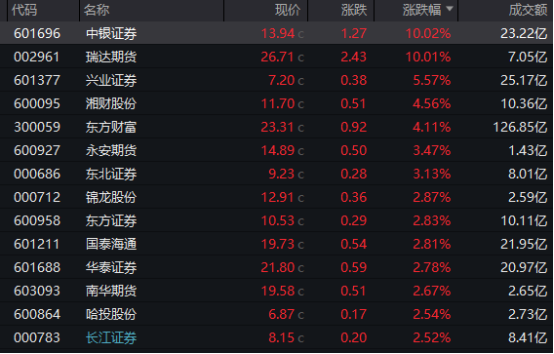
Market Overview - A-shares experienced a strong rally on the afternoon of the 5th, with the Shanghai Composite Index surpassing 3900 points, and the ChiNext Index rising over 1% [1] - The total trading volume in the Shanghai and Shenzhen markets reached 1.739 trillion yuan, an increase of 177.3 billion yuan compared to the previous day [1] Financial Sector Performance - The financial sector, particularly insurance and brokerage stocks, saw significant gains, with China Ping An rising nearly 6% and China Life increasing by nearly 5% [2][5] - Brokerage stocks also performed well, with Zhongyin Securities and Ruida Futures hitting the daily limit, and other firms like Industrial Securities and Dongfang Wealth rising over 4% [2][3] Insurance Sector Insights - The National Financial Regulatory Administration announced adjustments to risk factors for insurance companies, reducing the risk factor for certain long-term holdings in the CSI 300 Index from 0.3 to 0.27 [5][6] - This regulatory change is expected to encourage insurance companies to increase their equity investments, potentially bringing in over 1.2 trillion yuan in equity investment funds [6] Aerospace and Defense Sector - The aerospace and defense sector saw strong performance, with stocks like Aerospace Power and Aerospace Technology hitting the daily limit [7] - The successful launch of the Zhuque-3 rocket and the establishment of a dedicated regulatory body for commercial aerospace are expected to drive growth in this sector [9] Rare Earth Sector Activity - The rare earth sector experienced a notable surge, with stocks like Ningbo Yunsheng and Jinli Permanent Magnet hitting the daily limit [10] - The issuance of general export licenses for certain rare earth companies is anticipated to streamline export processes and boost demand in the industry [11][12]




重磅利好!保险、券商联袂拉升
证券时报· 2025-12-05 09:32
Market Overview - A-shares experienced a strong rally on the afternoon of the 5th, with the Shanghai Composite Index returning above 3900 points, and the ChiNext Index rising over 1% [1] - The total trading volume in the Shanghai and Shenzhen markets reached 17,390 billion yuan, an increase of 1,773 billion yuan compared to the previous day [1] Financial Sector Performance - The financial sector saw significant gains, with insurance stocks collectively surging; China Ping An rose nearly 6%, and China Life and China Pacific Insurance both increased by nearly 5% [3][5] - The brokerage sector also performed well, with Zhongyin Securities hitting the daily limit, and other firms like Industrial Securities and Ruida Futures rising over 5% [3][4] Key Stock Movements - The stock of Moer Thread (688795), which debuted on the Sci-Tech Innovation Board, soared over 500% during the day, closing up 425.46% at 600.5 yuan per share, with a market capitalization of 282.3 billion yuan [1] - The stock recorded a total trading volume of 15.31 billion yuan, making it the highest in A-share trading for the day [1] Insurance Sector Insights - The National Financial Regulatory Administration announced adjustments to risk factors for insurance companies, reducing the risk factor for stocks held over three years from 0.3 to 0.27 [6][7] - It is estimated that insurance funds will need to allocate 5 trillion to 6 trillion yuan in assets annually, potentially bringing in over 6 trillion yuan in equity investment funds over the next five years [7] Aerospace and Defense Sector - The aerospace and defense sector saw strong performance, with stocks like Hongxiang Co. and Chaojie Co. hitting the daily limit, and other companies like Aerospace Power and Aerospace Science & Technology also reaching their limits [9][10] - The recent successful launch of the Zhuque-3 rocket marks a significant milestone for China's commercial aerospace industry, which is expected to enter a phase of high-frequency launches starting in 2026 [11] Rare Earth Sector Activity - The rare earth sector showed notable activity, with stocks like Ningbo Yunsheng hitting the daily limit, and Jinli Permanent Magnet and Huicheng Environmental Protection rising over 8% [13][14] - The issuance of general export licenses for companies like Jinli Permanent Magnet and Ningbo Yunsheng is expected to streamline export processes and boost demand recovery in the rare earth permanent magnet industry [14][15]




非银板块领涨,新增量资金入市预期升温
Feng Huang Wang· 2025-12-05 09:01
Core Viewpoint - The A-share market showed stability in early trading, but experienced a significant rally in the afternoon driven by non-bank sectors, particularly insurance and brokerage stocks, despite weakness in AI hardware stocks [1][2]. Group 1: Market Dynamics - The trading sentiment in the A-share market improved significantly, with the Fujian sector continuing to rise, indicating a willingness among speculative funds to buy [2]. - The insurance sector, represented by China Ping An, and brokerage stocks, represented by Zhongyin Securities, saw substantial increases, leading to a rapid rise in major indices like the Shanghai Composite Index [2][3]. Group 2: Regulatory Impact - The National Financial Regulatory Administration announced a reduction in risk factors for insurance companies holding stocks in the CSI 300 and the CSI Low Volatility 100 indices, from 0.3 to 0.27 for holdings over three years, which is expected to expand the investment scale of insurance funds in A-shares [3]. Group 3: Trading Volume and Activity - A-share market trading volume reached 1.73 trillion yuan, an increase of 176.8 billion yuan from the previous trading day, reflecting a more than 10% rise in trading activity [4]. - The number of stocks with gains exceeding 9% in the Shanghai and Shenzhen markets surpassed one hundred, indicating heightened individual stock activity [4]. Group 4: Investment Themes - The main investment themes are diversifying, with brokerage stocks expected to remain active due to ongoing consolidation news and optimistic earnings forecasts [5]. - Resource stocks have begun to show activity, with copper and aluminum stocks breaking out of previous trading ranges, and gold stocks also becoming active [5]. - Other sectors such as commercial aerospace, food and beverage, and real estate are anticipated to attract incremental capital due to positive performance expectations and new policy developments [5].
港股收评:恒指涨0.58%、科指涨0.84%,科技及大金融股多数走高,券商股活跃
Sou Hu Cai Jing· 2025-12-05 08:24
Market Performance - The Hong Kong stock market opened lower but maintained an upward trend, with the Hang Seng Index closing up 0.58% at 26,085.08 points [1] - The Hang Seng Tech Index rose 0.84% to 5,662.46 points, while the China Enterprises Index increased by 1.01% to 9,198.3 points [1] - Major financial stocks saw significant gains, with China Ping An rising over 6% and other insurance stocks also increasing by more than 5% [1] Company News - Country Garden (02007.HK) has completed its debt restructuring, reducing its debt by over 90 billion yuan [2] - Longfor Group (03380.HK) has received debt restructuring offers for bonds with a total face value of 13.66 billion yuan [3] - Greentown China (03900.HK) reported a total contract sales amount of approximately 223.5 billion yuan for the first 11 months, a year-on-year decrease of 9.44% [4] - Hongyang Real Estate (01996.HK) reported a cumulative contract sales amount of 4.181 billion yuan for the first 11 months, down 47.87% year-on-year [5] - Sunac China (01918.HK) achieved a contract sales amount of approximately 33.89 billion yuan for the first 11 months, a decrease of 25.34% year-on-year [6] - China Overseas Macro Holdings (00081.HK) reported a cumulative contract sales amount of 29.615 billion yuan for the first 11 months, down 16.6% year-on-year [7] Pharmaceutical and Biotechnology Developments - Stone Four Pharmaceutical Group (02005.HK) received approval from the National Medical Products Administration for the registration of Bilastine and Picosulfate Sodium as raw materials for listed formulations [8] - Kelun-Botai Biotech (06990.HK) has entered into a strategic partnership with Crescent to jointly develop and commercialize cancer treatment methods, with an upfront payment of 80 million USD and potential milestone payments of up to 1.25 billion USD [8] Market Outlook - Guoyuan International notes uncertainty in the Federal Reserve's decision-making for December, influenced by recent hawkish tones from the Bank of Japan, which may create short-term external disturbances for the Hong Kong market [10] - According to CMB International, the pharmaceutical industry is expected to see a key turning point in 2025, with a stable outlook continuing into 2026 [10] - According to Everbright Securities, the Hang Seng Index's current P/E ratio is above the average of the past five years, indicating a recovery in overall valuation, while the tech index has room for growth [11]
午后突发!直线拉升,非银金融集体飙涨!发生了什么?
天天基金网· 2025-12-05 08:19
上天天基金APP搜索777注册即可领500元券包,优选基金10元起投!限量发放!先到先得! A股,午后爆发了! 12月5日下午开盘后,A股保险股持续拉升,中国太保涨超6%,中国平安涨超5%,中国人保、中国人寿等跟 涨。随后,券商股爆发,中银证券触及涨停,兴业证券涨超7%,湘财股份、东方财富、东北证券、华泰证券 跟涨。富时中国A50指数期货午后涨超1%。 那么,究竟发生了什么?摩根士丹利发表最新研报,将中国平安加入重点关注名单,仍列为首选。同时,中信 证券亦唱多保险股。保险股午后爆发,直接带动了券商股行情。进而引爆了整个市场的人气。 两大利好引爆 12月5日,A股三大指数涨幅扩大,上证指数涨超0.7%,深证成指、创业板指涨逾1%。在此过程当中,首先 是保险股发力,接着券商股持续拉升。两大板块联袂出击,带动了市场人气。对指数的提振作用十分明显。个 股上涨的数量也显著回升。 从消息面看,在大摩的加持之下,中国平安A股午后大涨超5%,其H股大涨超6%。平安的爆发也带动了整个 保险板块。 中信证券也认为,保险股面临重大机遇。保险行业已从资产负债表衰退叙事中率先走向良性扩 张,周期向好正式确立,预计2026年向上趋势进一 ...

港股收评:恒指涨0.58%重回26000点 科指涨0.84% 科网股普涨 大金融板块午后冲高 百度涨超5%
Xin Lang Cai Jing· 2025-12-05 08:13
Market Overview - The Hong Kong stock market indices collectively declined, with the Hang Seng Index rising by 0.58% to 26,085.08 points, the Hang Seng Tech Index increasing by 0.84%, and the National Enterprises Index up by 1.01% [1][12] - Technology stocks saw a general increase, with Baidu rising over 5%, Kuaishou up over 2%, and Xiaomi and Lenovo both increasing by over 1% [1][12] - The insurance sector strengthened in the afternoon, with China Pacific Insurance rising over 7% [1][6][12] - The brokerage sector was active, with Huatai Securities increasing by over 3% [1][12] - Gaming stocks weakened, with Galaxy Entertainment declining by over 1% [1][12] Sector Performance Metals Sector - The metals sector experienced a broad increase, with Jiangxi Copper rising over 6% [1][14] - A significant event occurred with the cancellation of a copper warehouse receipt of 50,000 tons at LME, marking the largest single-day operation since 2013, indicating a potential shift in the copper market [3][14] Insurance Sector - The National Financial Regulatory Administration announced a reduction in risk factors for insurance companies, which is expected to enhance capital efficiency and allow more funds to be invested in the capital market [6][14] - China Pacific Insurance's stock rose by 7.10%, while other major insurers also saw increases, including Ping An and China Life [7][13] Brokerage Sector - The brokerage sector is active as the important policy window approaches, with the Central Economic Work Conference expected to focus on stabilizing growth and optimizing investment structures [8][12] Gaming Sector - UBS released a positive outlook for the Macau gaming industry, predicting resilient demand and an increase in total gaming revenue growth forecasts for the next two years [9][16] New Listings - Two new stocks were listed today, with "Encounter Noodle" dropping over 27% and "Tianyu Semiconductor" falling over 30% [1][10][16] - "Encounter Noodle" had a subscription rate of 425.97 times during the public offering phase, while "Tianyu Semiconductor" had a subscription rate of 60.63 times [10][17]
券商、保险飙升!A股迎来一大利好,新一波行情来了?
Mei Ri Jing Ji Xin Wen· 2025-12-05 08:13
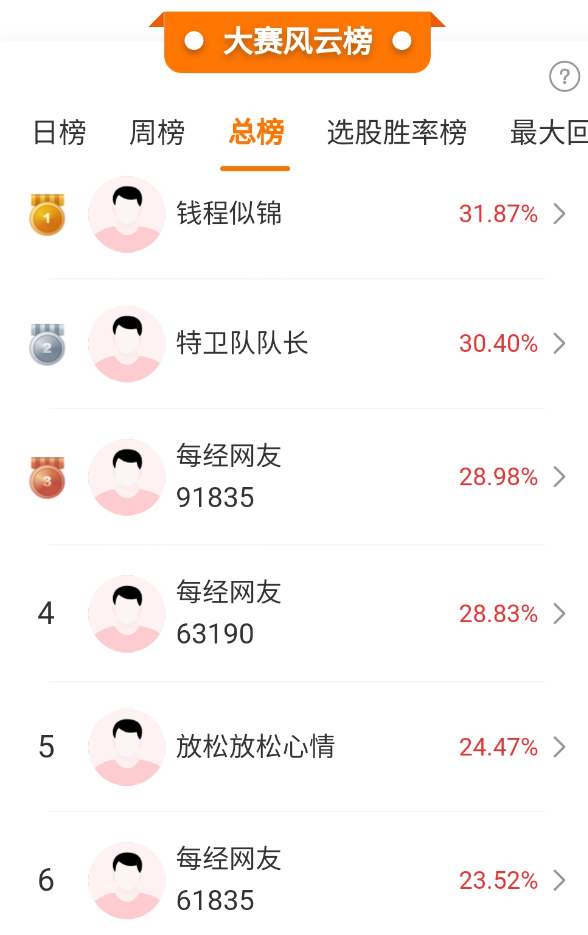
Group 1 - The core viewpoint of the news highlights the recent surge in brokerage and insurance stocks, indicating a strong intention from investors to buy, with the Shanghai Composite Index rising by 0.70% to close at 3902.81 points and a trading volume of 172.58 billion yuan, an increase of 176.8 billion yuan compared to the previous Thursday [1] - The Financial Regulatory Authority has issued a notice adjusting the risk factors for insurance companies' investments in specific indices, aiming to cultivate patient capital and support technological innovation [1] - The ongoing simulated stock trading competition, "掘金大赛," has attracted numerous participants since its start on December 1, with a total simulated capital of 500,000 yuan for each participant [1][3] Group 2 - The competition offers various cash rewards for participants, including 688 yuan for the first place and additional rewards for subsequent positions, with a total of 500 yuan to be shared among other profitable participants [3] - Market experts participating in the competition have noted signs of stabilization in the market, with potential for a new rally if the index breaks through previous gaps [3] - Some experts are optimistic about investment opportunities in sectors such as humanoid robots and interest rate-sensitive assets like gold [5]
指数下行“未结束”!内外盘要出现变化了,还有哪些投资机会?
Sou Hu Cai Jing· 2025-12-05 08:10
Group 1 - The A-share market is experiencing a rebound with reduced trading volume as expectations for a Federal Reserve rate cut in December rise, indicating a short-term recovery in market sentiment [1] - The main sectors attracting net inflows include military industry, photovoltaic, non-ferrous metals, new energy vehicles, and brokerage firms, suggesting a shift in investor focus towards these areas [1] - The AI sector shows a relatively low risk of crowding, with long-term opportunities still present, while short-term value styles may have an advantage due to institutional investors adopting defensive strategies as year-end approaches [3] Group 2 - The rapid development of AI large models and applications is driving the need for advanced computing infrastructure, with high-performance, high-bandwidth, and low-latency networks being crucial for performance upgrades [3][4] - The transition to "super-node" architecture in computing infrastructure is essential for domestic players to catch up with international standards, with significant growth opportunities in high-speed connectivity modules and related manufacturers [6][4] - The number of newly established index-enhanced funds has surged in 2023, driven by policy support and increasing investor demand, indicating a competitive landscape for public fund institutions [10]