
造纸

Search documents
纸浆早报-20251120
Yong An Qi Huo· 2025-11-20 01:42
Group 1: SP Main Contract Information - The closing price of the SP main contract on November 19, 2025, was 5396.00, with a change of -0.22189% from the previous day [3]. - The closing prices and related data from November 13 - 19, 2025, are presented, showing price fluctuations and changes in basis and dollar - converted prices [3]. Group 2: Import Profitability - With a 13% VAT calculation, the import profit for Canadian Golden Lion pulp is - 136.75, for Canadian Lion pulp is - 425.04, and for Chilean Silver Star pulp is 16.68 [4]. - The calculation is based on port dollar prices, Shandong region RMB prices, and the previous day's exchange rate of 7.11 [4]. Group 3: Pulp and Paper Price Averages - From November 13 - 19, 2025, the national and Shandong region average prices of different types of pulp (coniferous, broad - leaf, etc.) remained unchanged [4]. - The prices of cultural paper, packaging paper, and living paper also showed no change during this period [4]. Group 4: Profit Margin Estimates - The profit margin estimates for different types of paper (double - offset, double - copper, etc.) remained stable from November 14 - 19, 2025 [4]. Group 5: Price Spreads - The price spreads between different types of pulp (coniferous - broadleaf, coniferous -本色, etc.) are presented, with some showing minor changes from November 13 - 19, 2025 [4].
中信证券港股2026年度策略:将迎来第二轮估值修复+业绩触底反弹 把握五条主线
智通财经网· 2025-11-20 00:51
Core Viewpoint - The Hong Kong stock market is expected to benefit from internal "14th Five-Year Plan" catalysts and external "fiscal + monetary" easing policies from major economies, particularly the US and Japan, leading to a rebound in valuations and performance by 2026 [1] Group 1: Market Outlook - The Hong Kong stock market is projected to experience a second round of valuation recovery and performance resurgence by 2026, supported by a complete domestic AI industry chain and an influx of quality A-share companies listing in Hong Kong [1] - The Hang Seng Index is currently seen as a valuation low point among major global markets, with an estimated equity risk premium (ERP) of 5.7% [1] - The expected net profit growth for the Hang Seng Index and Hang Seng Tech in 2026 is 8.5% and 29.9%, respectively, indicating a positive outlook for earnings recovery [1][4] Group 2: Strategic Investment Directions - Five long-term investment directions are recommended: 1) Technology sector, including AI and consumer electronics; 2) Healthcare, particularly biotechnology; 3) Resource products benefiting from overseas inflation and de-dollarization; 4) Essential consumer goods expected to recover in valuation; 5) Paper and aviation sectors benefiting from RMB appreciation [1] - The "14th Five-Year Plan" emphasizes the construction of a modern industrial system and high-level technological self-reliance, which is expected to support strategic emerging industries such as new energy, new materials, and aerospace [2] Group 3: Emerging Industries - The solid-state battery industry is anticipated to reach a market value of 1.2 trillion yuan from 2024 to 2030, marking a new wave of electrification innovation [3] - The brain-computer interface sector is gaining government attention, with new policies expected to address clinical challenges [3] - The bio-manufacturing market is projected to reach a trillion-level scale, driven by continuous application expansion [3] Group 4: Performance Expectations - The market expects the performance growth of Hong Kong stocks to bottom out in 2025, with revenue and profit growth projected to reach 5.5% and 9.2% in 2026, respectively [4] - The earnings sentiment for Hong Kong stocks has begun to warm, with upward adjustments in profit forecasts since July 25 [4][5] Group 5: Capital Flows - Southbound capital inflows into Hong Kong stocks reached 1.26 trillion HKD from the beginning of the year to the end of October, becoming a core driver for the market [6] - The trend of passive management funds increasing their allocation to Hong Kong stocks is evident, with a significant rise in the proportion of passive funds in the Southbound Stock Connect [6] - Retail investors are expected to play a larger role in the market, with ETF inflows into Hong Kong stocks exceeding 270 billion HKD since June [6]

中信证券:港股市场明年或将迎来第二轮估值修复以及业绩进一步复苏行情
Mei Ri Jing Ji Xin Wen· 2025-11-20 00:21
Core Viewpoint - The report from CITIC Securities indicates that the Hong Kong stock market is expected to experience a second round of valuation recovery and further earnings revival by 2026, driven by a rebound in the fundamental outlook and significant valuation discounts [1] Long-term Investment Directions - Technology sector, including AI-related sub-sectors and consumer electronics [1] - Healthcare sector, particularly biotechnology [1] - Resource products benefiting from rising overseas inflation expectations and de-dollarization, including non-ferrous metals and rare earths [1] - Consumer staples sector, which is relatively stagnant and undervalued, is expected to see valuation recovery [1] - Paper and aviation sectors benefiting from the appreciation of the Renminbi [1]
中信证券港股2026年策略:港股市场将迎来第二轮估值修复与业绩复苏行情
Zheng Quan Shi Bao Wang· 2025-11-20 00:15
Core Viewpoint - The report from CITIC Securities indicates that the Hong Kong stock market is expected to experience a second round of valuation recovery and further earnings revival by 2026, driven by a rebound in the fundamental outlook and significant valuation discounts [1] Long-term Investment Directions - Technology sector, including AI-related sub-sectors and consumer electronics [1] - Healthcare sector, particularly biotechnology [1] - Resource products benefiting from rising overseas inflation expectations and de-dollarization, including non-ferrous metals and rare earths [1] - Essential consumer goods sector, which is relatively undervalued and expected to see valuation recovery as the domestic economy further recovers [1] - Paper and aviation sectors benefiting from the appreciation of the Renminbi [1]
三大行业将完成首次碳排放配额清缴
Ke Ji Ri Bao· 2025-11-19 23:26
Core Points - The Ministry of Ecology and Environment has released the "Quota Allocation Plan for National Carbon Emission Trading Market for Steel, Cement, and Aluminum Smelting Industries for 2024 and 2025," which outlines the allocation, clearing, and transfer of carbon emission quotas for these industries [1] - The plan continues the framework of free quota allocation based on carbon emission intensity control, linking the quota amount to actual carbon output, without setting an absolute cap on total emissions, thus ensuring necessary space for industry development [1] - The plan aims to incentivize carbon reduction by allowing companies with lower carbon emissions per unit product to have higher quota surplus rates [1] Industry Expansion - The Ministry has initiated preparatory work for expanding the carbon trading market to include industries such as chemicals, petrochemicals, civil aviation, and papermaking, with technical documents being drafted for quota allocation and reporting guidelines [2] - The expansion will follow the principle of "mature one, include one," based on industry development status, pollution reduction contributions, data quality, and carbon emission characteristics [2] - By 2027, the carbon trading market is expected to cover major emission industries in the industrial sector, with a gradual shift from intensity control to total control for industries with stable total emissions [2]
港通沃土,日照传统产业“新枝”繁茂
Zhong Guo Xin Wen Wang· 2025-11-19 10:27
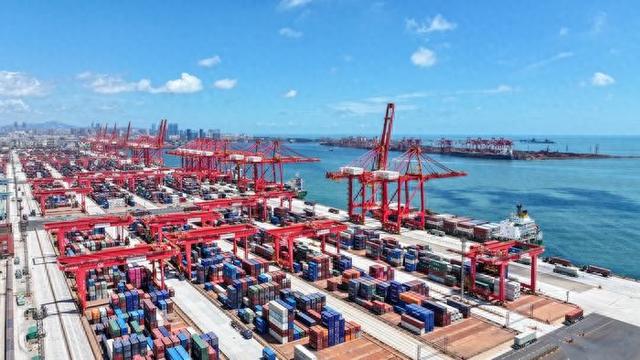
Core Viewpoint - The city of Rizhao is undergoing a profound transformation driven by technological innovation and the extension of industrial chains, moving from traditional industries to new, high-tech sectors. Group 1: Technological Empowerment - The Shandong Port Rizhao Port has launched the world's first fully automated container terminal, achieving complete automation in loading, horizontal transportation, and yard operations, enhancing single-machine efficiency by 50% and reducing overall costs by 70% [3][4]. - The port has developed a digital twin platform for grain unloading, with an annual grain import capacity exceeding 10 million tons, contributing to national food security [3][4]. Group 2: Industrial Chain Restructuring - Rizhao's strategic location near major steel companies and automotive manufacturers allows for efficient raw material acquisition and reduced logistics costs, fostering a competitive environment for local suppliers [7][8]. - Companies like Shandong Ruihang Technology Co., Ltd. and Shandong Temur Automotive Parts Co., Ltd. benefit from the "front port and back factory" model, enhancing their production capabilities and reducing logistics expenses [7][8]. Group 3: Green Upgrading - Rizhao Huatai Paper Industry Co., Ltd. is transitioning from traditional high-pollution practices to producing high-value specialty paper products, with a focus on environmentally friendly alternatives like paper tape [11]. - The paper industry in Rizhao has seen a 6.3% increase in value added, with the integrated pulp and paper industry cluster recognized as one of Shandong's top ten industries [11]. Group 4: Economic Growth - In the first three quarters of the year, Rizhao's industrial added value increased by 8.0%, with the steel industry growing by 5.9%, indicating robust economic resilience [9].

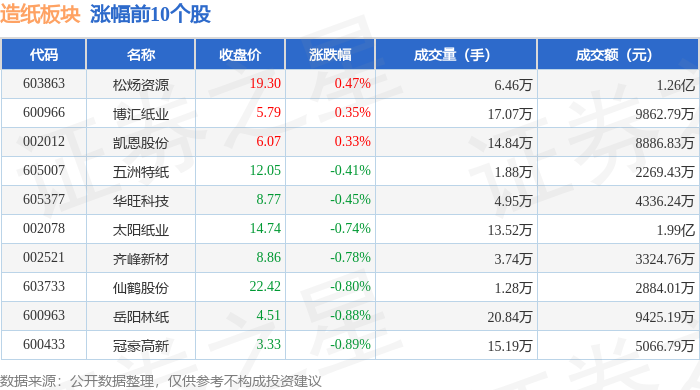
造纸板块11月19日跌1.4%,青山纸业领跌,主力资金净流出2.55亿元
Zheng Xing Xing Ye Ri Bao· 2025-11-19 08:52
Market Overview - The paper sector experienced a decline of 1.4% on November 19, with Qingshan Paper leading the drop [1] - The Shanghai Composite Index closed at 3946.74, up 0.18%, while the Shenzhen Component Index closed at 13080.09, down 0.0% [1] Individual Stock Performance - Qingshan Paper (600103) saw a significant drop of 6.57%, closing at 3.70, with a trading volume of 2.2241 million shares and a turnover of 834 million [2] - Other notable declines included Linlin Packaging (605500) down 3.48% and Annie Co. (002235) down 3.37% [2] - Conversely, Songyang Resources (603863) and Bohui Paper (600966) showed slight increases of 0.47% and 0.35% respectively [1] Capital Flow Analysis - The paper sector experienced a net outflow of 255 million from institutional investors, while retail investors saw a net inflow of 264 million [2] - The capital flow data indicates that institutional investors are pulling back, while retail investors are increasing their positions [2] Detailed Capital Flow by Stock - Yueyang Lin Paper (600963) had a net inflow of 7.9253 million from institutional investors, but a net outflow of 463.15 million from retail investors [3] - Qingshan Paper (600103) had a significant net outflow of 57.91 million from institutional investors, indicating a bearish sentiment [3] - Other stocks like Guanmeng High-tech (600433) and Wuzhou Special Paper (605007) also showed mixed capital flows, with varying degrees of institutional and retail investor activity [3]

生态环境部:已启动化工石化民航造纸等行业碳交易扩围准备工作
Di Yi Cai Jing· 2025-11-19 07:55
Core Viewpoint - The carbon emissions trading market in China is set to expand significantly by 2027, covering major high-emission industries such as chemicals, petrochemicals, civil aviation, and paper manufacturing, with a focus on improving data quality and regulatory capacity [1][2][4]. Group 1: Carbon Emissions Trading Market Expansion - By 2027, the carbon emissions trading market will primarily cover major industrial sectors [2]. - The Ministry of Ecology and Environment has initiated preparations to expand coverage to industries like chemicals, petrochemicals, civil aviation, and paper manufacturing [1][2]. - The carbon emissions reports from relevant industries since 2013 have been collected and verified to address data quality issues [1]. Group 2: Allocation and Management of Emission Quotas - The allocation plan for the steel, cement, and aluminum industries has been published, with a focus on free allocation based on carbon intensity control [4][5]. - The quota distribution will target the highest carbon-emitting enterprises, which account for over 98% of emissions in their respective sectors [5]. - The Ministry will issue pre-allocated quotas for 2025 to the steel, cement, and aluminum industries in the first half of next year [8]. Group 3: Data Quality and Regulatory Measures - The Ministry emphasizes the importance of carbon emissions data quality as foundational for the carbon market, with plans to enhance the monitoring, reporting, and verification (MRV) system [6][9]. - Advanced technologies such as blockchain, big data, and artificial intelligence will be utilized for comprehensive regulatory oversight [9]. - Companies are required to establish robust internal management systems for carbon emissions data to ensure compliance and accuracy [9].

民丰特纸:聘任韩继友为公司总经理
Mei Ri Jing Ji Xin Wen· 2025-11-19 07:55
Group 1 - The core point of the article is the resignation of the general manager of Minfeng Special Paper, Mr. Cao Jihua, due to work reasons, while he will continue to serve as a director and chairman of the board [1] - The board has approved the appointment of Mr. Han Jiyou as the new general manager following Mr. Cao's resignation [1] - For the year 2024, the revenue composition of Minfeng Special Paper is reported to be 99.17% from mechanical paper and 0.83% from other businesses [1] Group 2 - As of the report, the market capitalization of Minfeng Special Paper is 2.5 billion yuan [1]

恒丰纸业跌2.02%,成交额3020.64万元,主力资金净流出238.90万元
Xin Lang Zheng Quan· 2025-11-19 05:59
Core Viewpoint - Hengfeng Paper's stock price has experienced fluctuations, with a year-to-date increase of 22.77% but a recent decline in the last five and twenty trading days [1][2]. Company Overview - Hengfeng Paper, established on March 6, 1994, and listed on April 19, 2001, is located in Mudanjiang, Heilongjiang Province. The company specializes in the production and sale of specialty papers, including cigarette paper, filter rod paper, and aluminum foil lining paper [1]. - The revenue composition of Hengfeng Paper includes 65.48% from tobacco industrial paper, 15.50% from other paper types, 11.75% from mechanical gloss paper, 6.08% from thin printing paper, and 1.19% from other sources [1]. Financial Performance - As of September 30, 2025, Hengfeng Paper reported a revenue of 2.039 billion yuan, reflecting a year-on-year growth of 6.29%. The net profit attributable to shareholders was 148 million yuan, marking a significant increase of 34.76% compared to the previous year [2]. - The company has distributed a total of 680 million yuan in dividends since its A-share listing, with 115 million yuan distributed over the past three years [3]. Shareholder Information - As of September 30, 2025, the number of shareholders for Hengfeng Paper was 14,600, a decrease of 12.06% from the previous period. The average circulating shares per person increased by 13.71% to 20,445 shares [2]. - Notable new institutional shareholders include the Jiangyin State-owned Enterprise Reform Flexible Allocation Mixed A Fund, which holds 5.6999 million shares, and the招商量化精选股票发起式A Fund, holding 4.3094 million shares [3].
