潮玩

Search documents
港股周报:Agent生态加速落地,恒科财报季迎风险偏好修复窗口-20260311
Guolian Minsheng Securities· 2026-03-11 06:25
Market Overview - The Hang Seng Index fell by 3.28% and the Hang Seng Tech Index dropped by 3.70% during the week of March 2-6, 2026[5] - The Hang Seng Index's PE ratio decreased by 2.65% to 11.12X, while the PB ratio fell by 2.71% to 1.17X as of March 6, 2026[14] AI Industry Insights - China's AI industry is accelerating global expansion, with significant growth in model usage; MiniMax M2.5 remains the most used model despite a slight decline in overall usage[5] - The AI hardware infrastructure is expected to maintain high demand in 2026, benefiting companies like SMIC and Hua Hong Semiconductor[5] Investment Recommendations - Investment opportunities are suggested in platform-based internet companies with strong data and resource advantages, such as Tencent and Alibaba[5] - Focus on AI ecosystem companies with model capabilities, including Kuaishou and Bilibili, as well as autonomous driving firms like Xpeng and NIO[5] Risk Factors - Geopolitical risks, regulatory risks, and potential underperformance in consumer recovery are highlighted as significant concerns for the market[33]




泡泡玛特诉拓竹科技,相关情况公开
证券时报· 2026-03-09 09:20
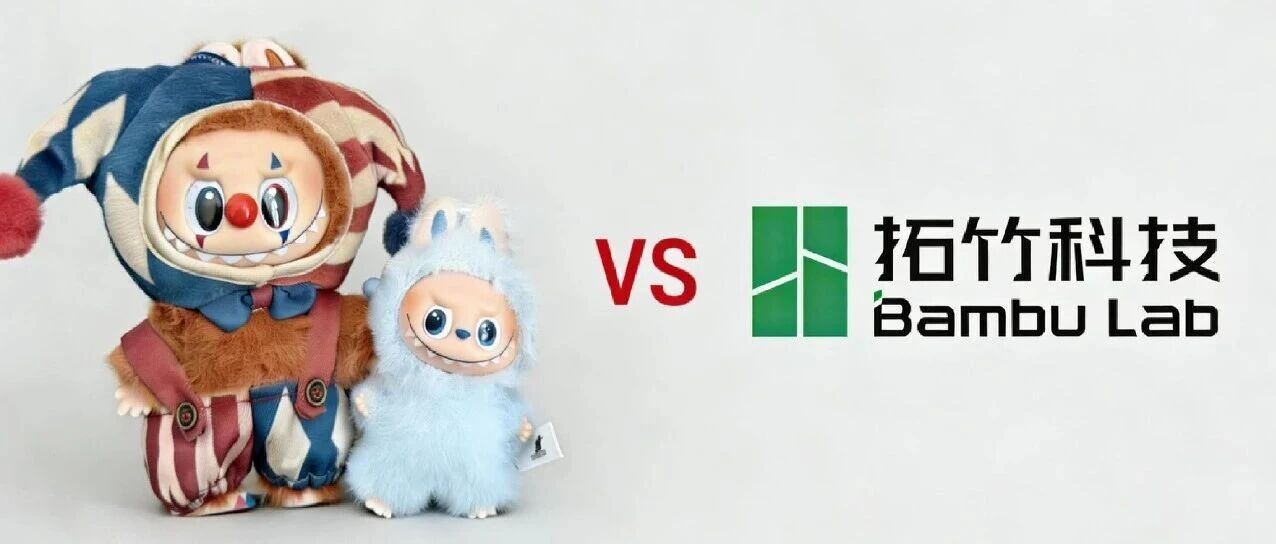
Core Viewpoint - The legal dispute between Pop Mart and Tuo Zhu Technology is centered around copyright infringement related to 3D printing models, with a court hearing scheduled for April 2, 2023 [1][2]. Group 1: Legal Proceedings - Pop Mart's legal team communicated with Tuo Zhu Technology regarding platform infringement issues in May and October 2025 before formally filing a lawsuit [2]. - Tuo Zhu Technology received legal documents regarding the lawsuit in late February 2023, without prior communication from Pop Mart [2]. - The lawsuit involves Pop Mart suing Tuo Zhu Technology and its subsidiaries for copyright ownership and infringement [2]. Group 2: Company Background - Tuo Zhu Technology, established in 2020 and based in Shenzhen, focuses on consumer-grade 3D printing equipment and has become a leading company in the domestic 3D printing industry [5]. - In 2025, Tuo Zhu Technology is projected to be the first company in China's 3D printing sector to achieve annual revenue exceeding 10 billion yuan, with a shipment volume surpassing one million units [5]. Group 3: Community and Model Availability - Tuo Zhu Technology operates a free open-source model community called MakerWorld, which claims to have a million high-quality 3D printing and laser cutting models [6]. - Currently, the MakerWorld community is unable to provide access to models related to Pop Mart's Labubu [6]. Group 4: Industry Insights - The consumer-grade 3D printing sector is experiencing rapid growth, with the global market expected to reach $4.1 billion by 2024 [9]. - According to Guojin Securities, the consumer-grade 3D printing industry is entering a phase of rapid technological iteration similar to that of the mobile phone industry from 2022 to 2025 [9].



拼豆让年轻人甘愿当“流水线工人”
创业邦· 2026-03-09 07:33
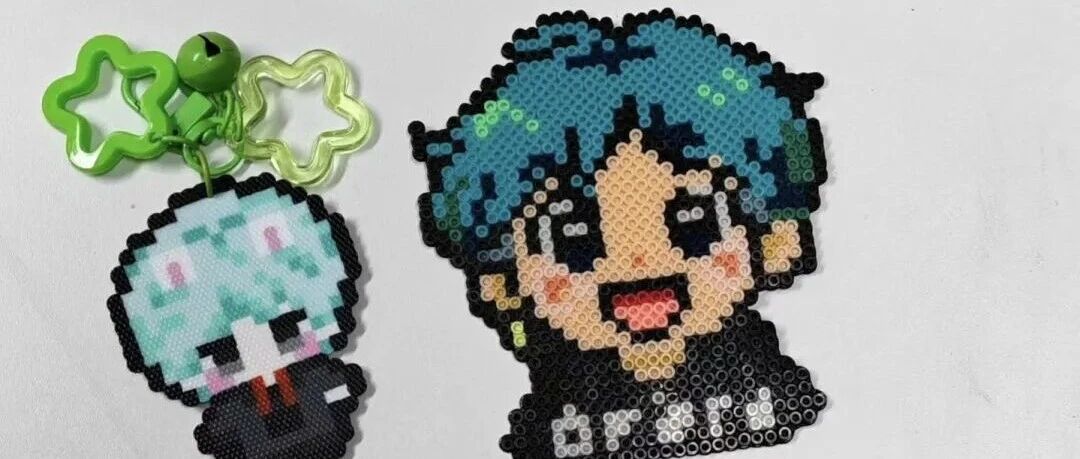
Core Viewpoint - The article highlights the rapid rise of bead art (拼豆) as a popular DIY activity among young people, particularly the "Z generation," showcasing its appeal as a new form of social gathering and creative expression [4][8][9]. Group 1: Market Trends - The demand for bead art has surged, with a reported 9018% year-on-year increase in group purchases on Douyin during the 2026 Spring Festival [8]. - Bead art stores are experiencing a boom, with many new locations opening across major cities in China, driven by low entry barriers and high consumer interest [11][16]. - The market for bead art materials is estimated to be around 1 billion yuan annually, with potential growth in related consumer electronics pushing the total market size to 5 billion yuan [20]. Group 2: Business Models - Entrepreneurs like Li Shikai have successfully opened multiple bead art stores, capitalizing on the high foot traffic and consumer interest, with monthly revenues reaching 150,000 yuan and profits of 72,000 yuan after expenses [15]. - Different business models are emerging, such as boutique stores focusing on customer experience and service, contrasting with the more traditional, high-capacity stores [15][16]. Group 3: Consumer Behavior - Young consumers are drawn to bead art for its low entry threshold and quick learning curve, providing a sense of achievement despite the repetitive nature of the activity [9][10]. - The immersive experience of bead art has led to high customer retention rates, with some stores reporting a 20% repeat purchase rate [14]. Group 4: Industry Dynamics - The bead art industry faces challenges from increasing competition and price wars, with some stores offering extremely low-priced packages to attract customers [16]. - The core competitive advantage in the bead art market is expected to shift towards service quality and customer experience rather than just pricing [16]. Group 5: Supply Chain and Equipment - The supply chain for bead art is straightforward, involving the production of plastic beads, heating machines, and other tools, with companies like Le Li Ke seeing significant growth in sales of their specialized equipment [18][19]. - The market for heating machines has seen a monthly growth rate of 80% to 150% since 2025, indicating strong demand for quality equipment in the DIY space [19].
泡泡玛特起诉拓竹,双方高层正在沟通
经济观察报· 2026-03-09 05:30
Core Viewpoint - The article discusses the legal dispute between Pop Mart and Tuo Zhu Technology regarding copyright infringement, highlighting the implications for users and the 3D printing community [1][3][11]. Group 1: Legal Dispute Overview - On February 28, Pop Mart filed a lawsuit against Tuo Zhu Technology for copyright infringement, leading to significant disruptions for Tuo Zhu users who rely on 3D printing models [2][3]. - Tuo Zhu's founder, Tao Ye, is in discussions with Pop Mart's founder, Wang Ning, to explore potential resolutions and collaborations regarding the infringement issues [1][3][4]. - The lawsuit involves multiple entities under Tuo Zhu Technology and is set to be heard in court on April 2 [3]. Group 2: User Reactions and Community Impact - Users of Tuo Zhu's MakerWorld community faced chaos as many Pop Mart-related models were taken down, prompting users to seek alternative sources for 3D printing files [2][6]. - A significant influx of users into 3D printing groups was noted, with many referring to these groups as "refugee camps" due to the sudden need for model files [6]. - The community has seen a rise in the sharing of popular IP models, with users uploading files to platforms like Quark and Baidu Netdisk for free distribution [2][6]. Group 3: Market Dynamics and User Sentiment - The article notes that 3D printing "farms" are emerging, where users produce and sell models like Labubu at competitive prices, impacting the market for Pop Mart's official products [7][11]. - Users expressed concerns about the quality of 3D printed models compared to official products, indicating a preference for the latter despite the lower price of 3D printed versions [7]. - Some users believe Tuo Zhu should negotiate with IP holders like Pop Mart to avoid infringing on copyrights and to foster a more sustainable ecosystem [8][11]. Group 4: Copyright and Legal Implications - The article outlines the legal challenges posed by 3D printing technology in relation to copyright, emphasizing that unauthorized uploads of 3D models can lead to infringement claims [13][14]. - Tuo Zhu may invoke the "safe harbor" principle to defend against liability for user-uploaded content, provided they act promptly to remove infringing material upon notification [14]. - The article highlights a precedent case where a defendant was ordered to pay damages for selling 3D printed infringing products, indicating the seriousness of copyright enforcement in the 3D printing sector [13].
一场疗愈上万元!妇女节新消费图鉴:不买包的年轻人,开始“买情绪”了?
新浪财经· 2026-03-08 10:09
Core Insights - The article highlights the rise of emotional consumption among women, particularly during the "3.8 Women's Day Promotion," where brands are capitalizing on the emotional economy and self-care trends [3][4][21]. Group 1: Emotional Consumption Trends - The "3.8 Women's Day Promotion" has seen a surge in emotional consumption, with products like Disney plush toys selling out rapidly during live streams, indicating a strong demand for emotional value products [6][8]. - The popularity of emotional value products has expanded beyond single brand hits to a variety of categories, including collaborations and multi-functional items that resonate with consumers [8][21]. Group 2: Crystal and Aromatherapy Market Growth - The crystal market, particularly in Jiangsu's Donghai County, reported a trading volume of 39 billion yuan from January to August 2025, reflecting a 27.8% year-on-year growth, with expectations to exceed 60 billion yuan for the year [12]. - The aromatherapy market in China is experiencing explosive growth, with a projected market size of 27.85 billion yuan in 2024, driven by a compound annual growth rate of 18.9% over the past five years, significantly outpacing the global average [13]. Group 3: Healing Spaces and Services - The healing economy in China has surpassed 10 trillion yuan, with 840 million users, predominantly young women aged 25-49, indicating a strong market for wellness and emotional support services [15][21]. - Healing salons are becoming increasingly popular, with prices for sessions often ranging from hundreds to thousands of yuan, reflecting a willingness among consumers to invest in emotional well-being [16][19]. Group 4: Market Dynamics and Consumer Behavior - The rise of emotional value products is attributed to a shift in consumer demand from material satisfaction to prioritizing emotional fulfillment, particularly among younger demographics facing anxiety [21][24]. - Despite the growth, the industry faces challenges such as consumer complaints regarding product authenticity and quality, highlighting the need for better regulation and industry standards [24].

耐用消费产业行业研究:要素成本上行冲击利润,Xiaomi Miclaw 开启封测,Al+消费链值得重视
SINOLINK SECURITIES· 2026-03-08 08:22
Investment Rating - The report maintains a "Buy" rating for the durable consumer goods industry [1] Core Insights - The report highlights the impact of rising cost factors on profits, the commencement of Xiaomi Miclaw's testing, and the importance of AI in the consumer chain [1] Segment Summaries Trend Tracking in Sub-sectors - **Trendy Toys**: Pop Mart is focusing on overseas market brand image building through collaborations with well-known IPs like Sanrio to enhance brand recognition among overseas consumers [9] - **New Tobacco**: There are concerns about air freight capacity for electronic cigarettes from China to Europe, and new product launches in Japan indicate a growing market [12] - **Home Furnishings**: The domestic real estate market shows a significant year-on-year decline in transaction volumes, while exports of furniture from China have decreased [13][14] - **Paper and Packaging**: Prices for various paper products have increased, and inventory levels are rising due to low operating rates in downstream paper mills [15][16] - **Personal Care + AI Glasses**: Rising raw material costs are expected to impact the personal care sector, while Huawei's AI glasses are set to launch soon [17][18] - **Pet Food**: The industry is seeing innovation in product formulations, with a focus on nutritional science, and there are calls for better regulation in the pet economy [23][24] - **AI + 3D Printing**: The industry is moving towards compliance and education, with significant investments in AI 3D technology [33][34] - **Two-Wheelers**: The industry is shifting towards a "product-oriented" strategy due to subsidy reductions, with new opportunities in high-end and electric motorcycle segments [6] Industry Sentiment Assessment - **Home Furnishings**: Stabilizing at the bottom - **New Tobacco**: Steady upward trend - **Paper**: Stabilizing at the bottom - **Packaging**: Steady upward trend - **Trendy Toys**: Turning point upwards - **Personal Care**: Slightly under pressure - **AI Glasses**: Steady upward trend - **Pet Food**: Slightly under pressure - **Pet Medical**: Turning point upwards - **AI + 3D Printing**: Turning point upwards - **Two-Wheelers**: Slightly under pressure [6]

三只娃娃,与泡泡玛特的三种命运
36氪· 2026-03-08 02:13
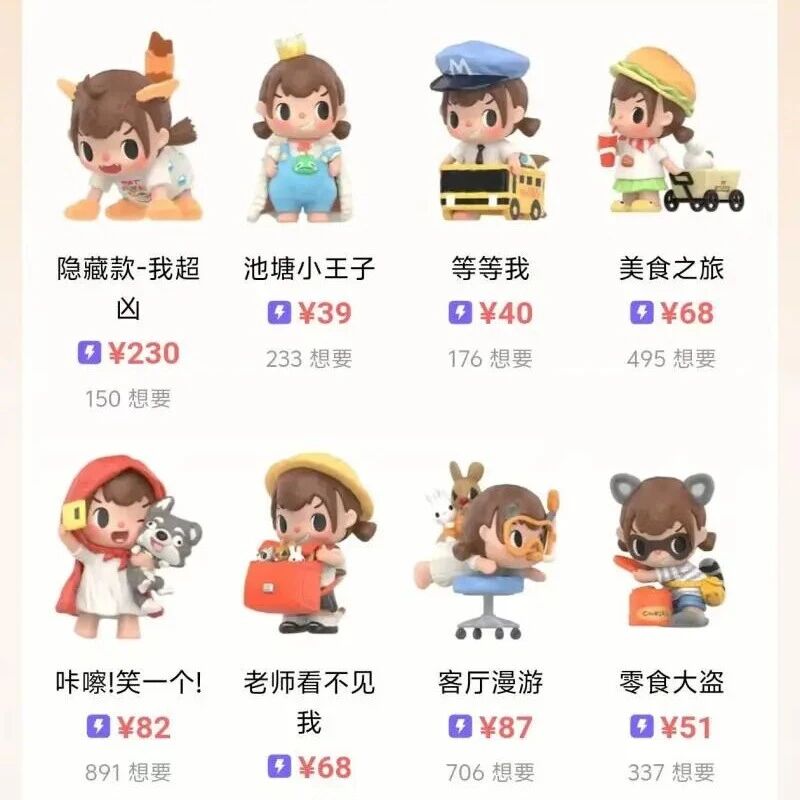
Core Viewpoint - Pop Mart is a company with significant valuation discrepancies, with opinions ranging from it being worth a trillion to being a scam, leading to volatile stock prices and a lack of a definitive valuation anchor [4][8]. Group 1: Company Overview - Pop Mart has faced unusual market conditions since its IPO, with 2023 being a recovery year after the global consumption disruptions in 2020 and 2022, making future growth rates uncertain [7]. - The company’s valuation is compared to a ship needing a reliable anchor, with its rapid growth creating a distorted valuation logic [7][8]. - The stock price has experienced extreme volatility, dropping from over 300 HKD to around 170 HKD and then rising back to 260 HKD, indicating significant market disagreement [9][12]. Group 2: Key Products and IP Analysis - The three key characters, Labubu, Molly, and Star People, represent different potential futures for Pop Mart, with Labubu being a standout success but difficult to replicate [5][16]. - Labubu accounts for 34.7% of the company's revenue, but its popularity is not guaranteed to last, raising concerns about the sustainability of other product lines [17][18]. - Molly, an older IP, has shown consistent growth, with revenue increasing in all periods except for a unique downturn in 2020, indicating a more stable revenue stream compared to newer products [22][25]. Group 3: Market Perception and Future Outlook - The market's perception of Pop Mart is influenced by historical fears of speculative bubbles, likening it to the tulip mania of the 17th century [19][21]. - Despite Molly's declining popularity, it has maintained double-digit growth, suggesting that established IP can still provide reliable revenue [26][30]. - The company has successfully launched multiple hit IPs over the years, indicating a potential systematic ability to create successful products, although the process remains uncertain [40][42].

新消费行业周报(2026.3.2-2026.3.6):政府工作报告提出实施消费专项行动;全球美妆 TOP10 中国区表现分化-20260307
Hua Yuan Zheng Quan· 2026-03-07 14:56
Investment Rating - The industry investment rating is "Positive" (maintained) [1] Core Insights - The 2026 Government Work Report emphasizes the implementation of special actions to boost consumption, aiming to stimulate internal consumption and promote sustainable growth through various measures [4] - The global beauty market shows a clear "one strong, one super" pattern, with significant performance differentiation in the Chinese market among the top beauty brands [4] - The report highlights the robust growth of emerging consumer goods, reflecting new consumption concepts among the younger generation [21] Summary by Sections Government Initiatives - The report outlines several initiatives to enhance consumer spending, including plans to increase income for low-income groups, promote consumption upgrades, and support personal consumption loans [4] Beauty Industry Performance - In 2025, the total sales of the top ten global beauty groups reached 1,086.2 billion, with a year-on-year growth of 0.8%. L'Oréal leads with over 350 billion in sales, while Procter & Gamble and Estée Lauder are in the third tier with around 100 billion [4] - Performance in China varies significantly among brands, with L'Oréal showing a recovery in sales growth, while Estée Lauder achieved a 13% organic sales growth in the last quarter of 2025 [4] Gold and Jewelry Market - The report notes a price adjustment for Lao Pu Gold, with an increase of approximately 20-30%, which is expected to maintain high profit margins [4] - The consumption volume of gold jewelry showed a year-on-year decline in 2025, indicating market challenges [19] Investment Recommendations - The report suggests focusing on high-quality domestic brands in beauty, such as Mao Ge Ping and Shangmei, and on popular gold brands among younger consumers like Lao Pu Gold and Chao Hong Ji [21][5] - In the collectible toy sector, companies with strong IP creation and operation experience, such as Pop Mart, are recommended [5] - For ready-to-drink tea, leading brands with strong brand power and wide coverage, like Mixue Group and Gu Ming, are highlighted [5]
泡泡玛特新IP遇冷?知情人士回应
证券时报· 2026-03-06 04:26
Core Viewpoint - The recent performance of new IPs from Pop Mart, including Supertutu and Merodi, has been underwhelming, with sales significantly lower than other popular IPs released during the same period. However, insiders suggest that the sales performance aligns with expectations, indicating a long-term cultivation approach is necessary for IP success rather than short-term hype [1][8]. Group 1: New IP Performance - The new IP Merodi, launched on February 26, had a lackluster market response, with only over 2,000 sales in its first week, and its secondary market prices showed depreciation [3][6]. - Supertutu, released on January 1, also experienced poor sales, with its secondary market prices nearly halving [6][8]. - The contrasting success of another new product, Angry Molly, which sold out quickly and saw some secondary prices soar above 2,000 yuan, highlights the variability in IP performance [6]. Group 2: Long-term IP Strategy - Industry experts emphasize that true super IPs require long-term development and cannot be judged solely on initial sales figures. Successful IPs are built on quality design, efficient operations, and sustained investment [4][8]. - Pop Mart is transitioning from a reliance on single IPs to a multi-IP ecosystem, which is seen as a necessary evolution for the company [1][8]. Group 3: Future Outlook and Expansion - Pop Mart is accelerating its new IP launches, with the announcement of a new IP "Key A" set for March 13, indicating a rapid increase in new product introductions [9]. - The company is also focusing on international expansion, with plans to establish a European headquarters in London and open multiple stores across the UK, aiming for significant overseas revenue growth by 2026 [10][11][13].
盲盒的天花板,被泡泡玛特自己摸到了
虎嗅APP· 2026-03-05 11:09
Core Viewpoint - The article discusses the transformation of the toy industry, particularly focusing on the shift from traditional collectible toys to AI-driven interactive toys, highlighting the need for a new narrative in the market as consumer preferences evolve [4][56]. Group 1: Market Performance and Trends - LABUBU has gained immense popularity, becoming a social currency, while the stock price of Pop Mart has significantly declined from a peak of 339 HKD in August 2025 to around 230 HKD by February [5][6]. - Despite strong financial performance, with revenue of 13.88 billion CNY and a net profit of 4.71 billion CNY in the first half of 2025, the stock price continues to drop, indicating market concerns about future growth potential [7][8]. Group 2: Industry Evolution - The toy industry has reached a turning point, transitioning from a collectible era (1990s-2010s) to a blind box era (2016-2025), where the focus shifted from scarcity to consumer engagement through surprise and social value [15][18]. - The current blind box model is losing its excitement as consumer demand evolves towards interactive and emotionally engaging experiences rather than mere collectibles [13][20]. Group 3: AI Toy Concept - AI toys represent a new category that emphasizes long-term emotional connections rather than short-term excitement, requiring a fundamental shift in the business model from instant gratification to sustained engagement [26][28]. - The AI toy market can rapidly develop new IPs, with examples like RAGUS being created in just three months, showcasing the potential for faster innovation compared to traditional toy development cycles [31][41]. Group 4: User Experience and Engagement - Traditional toys offer a fleeting experience centered around unboxing, while AI toys provide ongoing interaction and emotional growth, allowing users to form deeper connections with their toys [34][37]. - The business model for AI toys allows for continuous content updates and subscription services, fostering a long-term relationship with users rather than relying solely on new product releases [39][40]. Group 5: Investment and Future Outlook - The AI toy sector has attracted significant investment, with 19 funding events in 2025, indicating strong market interest and the potential for growth in this new category [42][41]. - Companies like Pop Mart are exploring AI integration but face challenges in balancing their existing business models with the new demands of AI-driven products [44][46].