
智能硬件

Search documents
明星出国也戴!从联名奢牌到合作金店、药厂,不少玩家还在“等风来”,智能眼镜何时迎来大爆发?
Mei Ri Jing Ji Xin Wen· 2025-07-31 04:24
Core Insights - The "2025 World Artificial Intelligence Conference" has highlighted the competitive landscape of emerging technologies, particularly smart glasses, which have not yet seen explosive growth despite initial hype [1] - Major players like Xiaomi and Alibaba are expected to lead the market, but many manufacturers are still cautious and waiting for market education from these giants [1][4] - The smart glasses market is projected to grow significantly, with IDC forecasting a shipment volume of 2.907 million units in China by 2025, representing a year-on-year increase of 121.1% [8] Group 1: Market Dynamics - Smart glasses are categorized into three main technology paths: AI glasses, AR glasses, and AI+AR glasses, with companies like Xiaomi and Meta focusing on the AI and photography segment [3] - The introduction of new products is cautious, with companies like Alibaba announcing their "Wow" glasses without offering hands-on experiences [3][4] - The market is currently characterized by a lack of aggressive product launches, as many companies are still assessing user acceptance and the best technological path [5][6] Group 2: Competitive Landscape - Zhao Zhongxia, a researcher, identifies three types of companies likely to gain an advantage in the smart glasses market: those with large models, those with AI application entry points, and those with hardware ecosystems [2][7] - The competition is expected to intensify as more companies enter the market, with a notable increase in product launches anticipated in the second half of the year [16] - The smart glasses industry is still in a cautious phase, with many traditional eyewear manufacturers preparing for AI glasses production but not yet launching significant products [4][5] Group 3: Consumer Engagement - Current applications of AI glasses are primarily focused on photography, recording, and translation, leading to a degree of product homogeneity [9] - The market is seeing innovative marketing strategies, such as collaborations between tech companies and luxury brands to attract consumers [1][14] - User feedback indicates a need for improvements in design, functionality, and overall user experience to drive wider acceptance of smart glasses [14][8]


WAIC观察 | 巨头围猎AI硬件,这家公司用「会议耳机」撬动AI助理的万亿级市场
Xi Niu Cai Jing· 2025-07-31 03:22
Core Insights - The 2025 WAIC (World Artificial Intelligence Conference) showcased over 800 companies, highlighting AI as a tangible product rather than just a concept [2] - AI hardware, particularly the iFlytek AI conference headphones Pro3 and Air2, demonstrated significant advancements in practical applications, moving beyond mere novelty [4][5] - The AI hardware market in China is projected to reach 1.102 trillion yuan in 2025, with a year-on-year growth of 13.4% and a compound annual growth rate of 18% over the next five years [5] - Future Intelligent's CEO emphasized that focusing on "vertical scenarios" is crucial for unlocking the value of AI hardware [6][9] Industry Trends - The AI hardware market is rapidly evolving, with significant competition from major players, making it essential for startups to differentiate their offerings [4][5] - The trend is shifting from generic AI hardware to specialized applications that address specific user needs, particularly in professional settings [9][10] - The concept of "Agentic AI" is emerging as a key trend, with the potential to create a multi-trillion-dollar market by enhancing collaboration among knowledge workers [21][23] Company Developments - Future Intelligent's AI headphones have gained over 1 million users across more than 50 industries and 180 countries, showcasing their practical utility [9][10] - The company plans to evolve its offerings from AI headphones to a comprehensive "Agentic AI" office assistant, integrating hardware and software for enhanced productivity [10][20] - The recent product launches of Pro3 and Air2 are seen as a significant step towards commercializing Agentic AI capabilities, moving beyond traditional hardware limitations [13][26] Market Dynamics - The global AI headphone market is expected to grow from $320 million in 2020 to approximately $1.05 billion by 2024, reflecting a compound annual growth rate of 140% [21] - Major tech companies are increasingly investing in AI hardware, indicating a competitive landscape where innovation and user-centric design will be critical for success [14][25] - Future Intelligent's strategy focuses on leveraging private data and understanding specific industry needs to create a competitive edge in the AI hardware market [16][18]
小米集团-W(01810)下跌2.01%,报53.65元/股
Jin Rong Jie· 2025-07-31 02:19
Core Viewpoint - Xiaomi Group is experiencing a decline in stock price, reflecting market volatility and investor sentiment towards the company's performance and upcoming financial disclosures [1]. Group 1: Company Overview - Xiaomi Group is primarily an internet company focused on smartphones, smart hardware, and IoT platforms, with a product range that includes smartphones, IoT and lifestyle consumer products, and internet services [1]. - The company's business model is built on three interrelated pillars: innovative and high-quality hardware, efficient new retail, and a rich array of internet services, aimed at reducing operational costs and enhancing efficiency [1]. Group 2: Financial Performance - As of the first quarter of 2025, Xiaomi Group reported total revenue of 111.29 billion yuan and a net profit of 10.92 billion yuan [1]. - The company is set to disclose its mid-year financial report for the fiscal year 2025 on August 19 [1].

WAIC现场,消费企业成 AI 落地 “显眼包”
虎嗅APP· 2025-07-30 15:00
Core Viewpoint - The integration of AI into consumer products is evolving from a technical novelty to a part of daily life, but the journey remains challenging and superficial in many areas [3][8][22]. Group 1: AI in Fast-Moving Consumer Goods (FMCG) - Major FMCG companies are showcasing AI innovations, such as Yili's real-time AI supply chain system and Feihe's AI-driven safety and nutrition enhancements for infant formula [6][5]. - Unilever launched the "AI for Science" platform, which includes six AI models for product development and ingredient selection [6]. - PepsiCo's booth featured humanoid robots that engage with visitors, highlighting the entertainment aspect of AI in consumer interactions [6][8]. Group 2: Smart Glasses and Fashion - The AI glasses segment is gaining popularity, with products shifting towards lightweight and personalized designs to appeal to younger consumers [10][12]. - Alibaba's Quark AI glasses integrate various services, such as navigation and payment, enhancing user convenience [12]. - Despite the excitement, no domestic AI/AR glasses brand has achieved significant market success yet, indicating that the market is still in its infancy [16][22]. Group 3: AI in Sports and Fitness - AI fitness devices, like the "AI personal trainer mirror," are gaining traction, providing real-time feedback on exercise form [19]. - The introduction of consumer-grade exoskeletons, such as the VIATRIX, marks a significant step into the civilian market for AI-assisted physical activities [20]. - The beauty industry is also leveraging AI for personalized skincare solutions, as demonstrated by the AI skin analysis robot [20]. Group 4: AI in Content Creation and Office Efficiency - AI tools are enhancing workplace productivity, with features like automatic video editing and real-time translation [21]. - The "Giant AI Super Intelligent Entity" from Botao Technology is designed to interact with tourists, showcasing the potential of AI in the tourism sector [21]. Group 5: Future of AI in Consumer Experience - The relationship between AI and consumers is evolving beyond mere product purchases to include experiences, emotional value, and engagement [22]. - The 2025 WAIC event highlighted the ongoing transformation of AI from a background technology to a central element in consumer lifestyles [22].
WAIC现场,消费企业成 AI 落地 “显眼包”
Hu Xiu· 2025-07-30 13:36
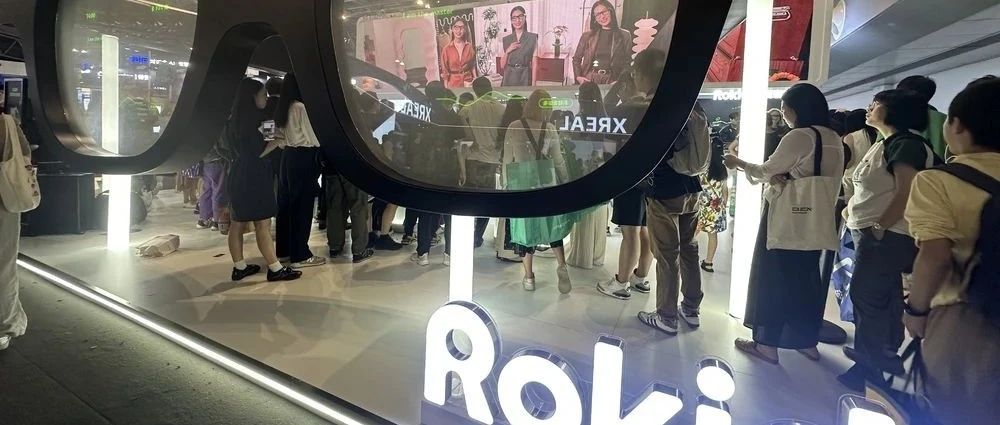
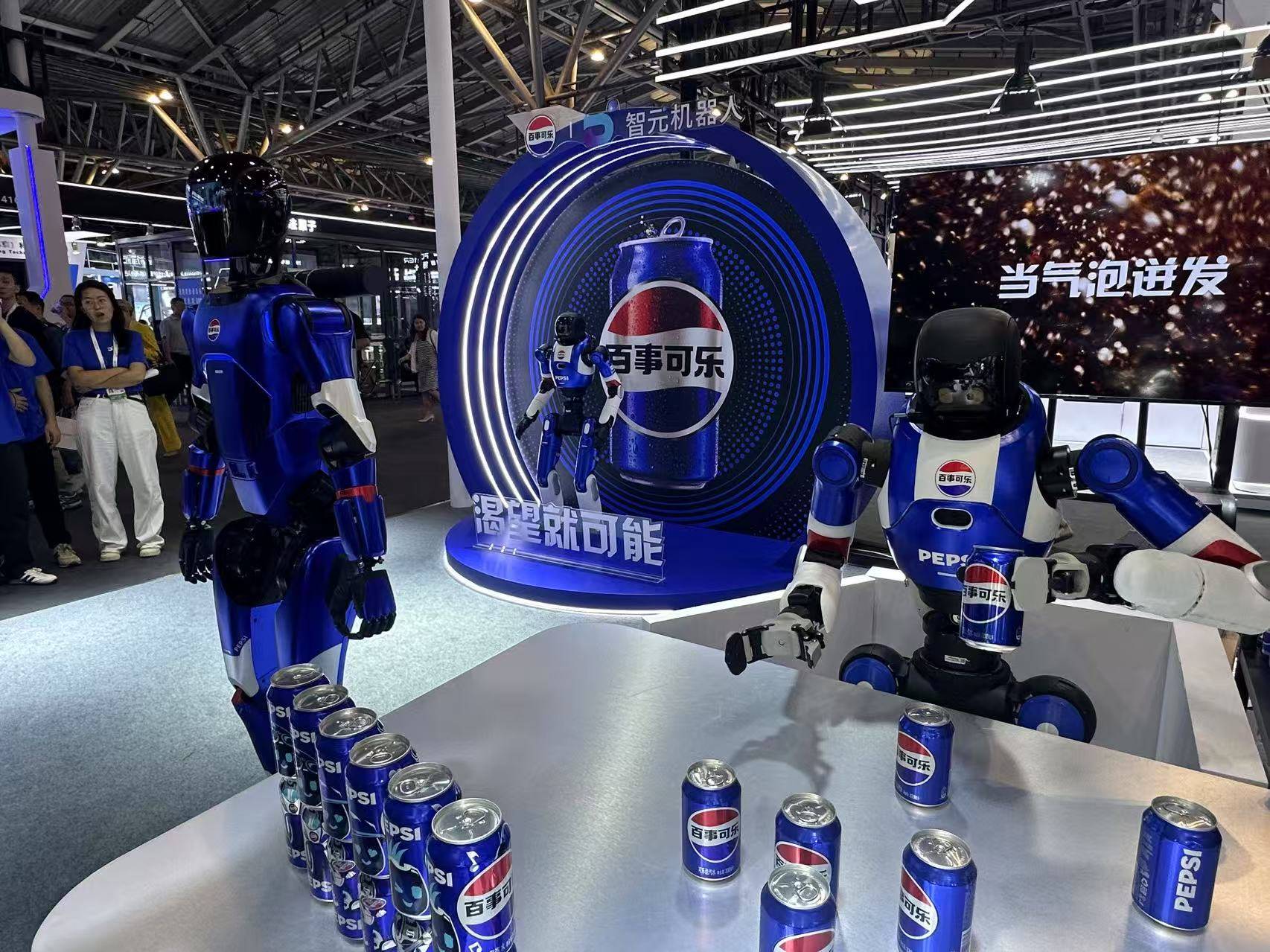
Core Insights - The integration of AI into consumer products is evolving from a technical concept to a part of daily life, with various brands showcasing their innovations at the WAIC 2025 [1][22] - Despite the excitement surrounding AI, many applications in the consumer goods sector remain superficial, lacking strong connections to the products themselves [5][22] Group 1: Consumer Goods and AI Integration - Major consumer brands are leveraging AI to enhance their product offerings and supply chain efficiency, as seen with companies like Yili and Feihe showcasing AI-driven supply chain systems and health monitoring for dairy cows [2][3] - Unilever introduced the "AI for Science" platform, which includes six AI models for product development, indicating a shift towards data-driven innovation in consumer goods [3] - PepsiCo's interactive humanoid robots at their booth highlight the trend of using AI for consumer engagement and brand interaction [3] Group 2: AI in Fashion and Wearables - The AI eyewear segment is gaining traction, with products focusing on lightweight and personalized designs to appeal to younger consumers, as demonstrated by Halliday Glasses and Alibaba's Quark AI glasses [6][8] - The trend of "de-teching" smart glasses aims to make them more fashionable and integrated into daily life, moving away from the perception of being purely technical devices [8][16] Group 3: AI in Fitness and Outdoor Activities - AI fitness devices, such as the "AI personal training mirror," are becoming popular, providing real-time feedback on exercise form and promoting a more interactive fitness experience [18] - The introduction of consumer-grade exoskeletons like VIATRIX indicates a growing interest in AI applications beyond traditional fitness settings, targeting outdoor enthusiasts [19] Group 4: AI in Beauty and Personal Care - The beauty industry is focusing on personalized solutions, with AI skin detection robots offering tailored skincare recommendations based on individual assessments [21] - AI innovations in office productivity tools aim to enhance efficiency, addressing common workplace challenges through smart features [21] Group 5: Future of AI in Consumer Experience - The overall trend indicates that AI is not just about technology but about enhancing consumer experiences, emotional engagement, and participation in the brand narrative [22][23] - The journey of integrating AI into everyday life is just beginning, with significant potential for future developments in various sectors [23]
智微智能发布上半年业绩,归母净利润1.02亿元,同比增长80.08%
智通财经网· 2025-07-30 13:21
Core Viewpoint - The company, Zhimi Intelligent, reported a significant increase in revenue and net profit for the first half of 2025, driven by its focus on technology and innovation in various AI+ sectors [1] Financial Performance - The company achieved operating revenue of 1.947 billion yuan, representing a year-on-year growth of 15.29% [1] - The net profit attributable to shareholders reached 102 million yuan, marking an impressive year-on-year increase of 80.08% [1] - The net profit attributable to shareholders after deducting non-recurring gains and losses was 87.7163 million yuan, up 77.18% year-on-year [1] - Basic earnings per share stood at 0.41 yuan [1] Business Strategy - The company adheres to a dual-driven strategy of ODM (Original Design Manufacturer) and OBM (Original Brand Manufacturer), focusing on customer-oriented standard products and customized services in the industry terminal and ICT infrastructure sectors [1] - In the industrial IoT sector, the company launched a full range of industrial products under the "Zhimi Industrial" brand, providing proprietary brand industrial control products and solutions [1] - In the intelligent computing field, the company offers high-performance infrastructure products and services related to AI computing power planning, design, equipment delivery, operation optimization, computing power scheduling management, and equipment maintenance and replacement [1]
九号公司发生5笔大宗交易 合计成交3302.40万元
Zheng Quan Shi Bao Wang· 2025-07-30 11:26
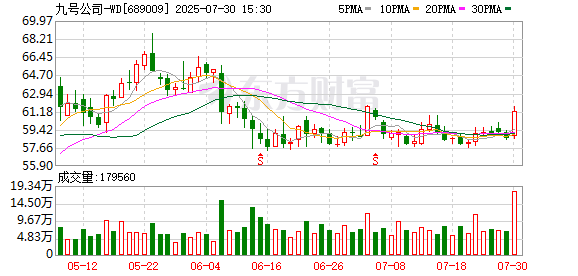
进一步统计,近3个月内该股累计发生42笔大宗交易,合计成交金额为2.37亿元。 证券时报·数据宝统计显示,九号公司今日收盘价为61.16元,上涨4.40%,日换手率为3.23%,成交额为 10.84亿元,全天主力资金净流入1.39亿元,近5日该股累计上涨3.57%,近5日资金合计净流入1.27亿 元。 九号公司7月30日大宗交易平台共发生5笔成交,合计成交量60.00万股,成交金额3302.40万元。成交价 格均为55.04元,相对今日收盘价折价10.01%。从参与大宗交易营业部来看,机构专用席位共出现在4笔 成交的买方或卖方营业部中,合计成交金额为2752.00万元,净买入1926.40万元。 | 成交量 | 成交金额 | 成交价 | 相对当日收盘折 | | | | --- | --- | --- | --- | --- | --- | | (万 | (万元) | 格 | 溢价(%) | 买方营业部 | 卖方营业部 | | 股) | | (元) | | | | | 15.00 | 825.60 | 55.04 | -10.01 | 机构专用 | 国投证券股份有限 | | | | | | | 公司江苏分公司 ...
Meta这款AI眼镜火了
3 6 Ke· 2025-07-30 03:55
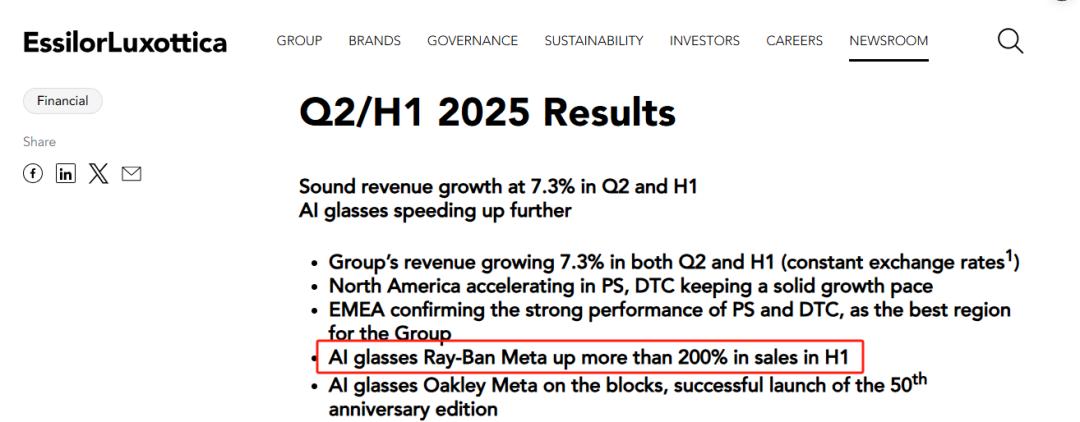
Core Viewpoint - The global AI eyewear market is expected to experience rapid growth driven by the launch of multiple new AI glasses, with Essilor Luxottica reporting significant sales increases in its smart eyewear segment, particularly with the Ray-Ban Meta collaboration with Meta [1][4]. Company Overview - Essilor Luxottica, formed from the merger of Italian eyewear giant Luxottica and French lens maker Essilor in 2018, holds a dominant position in the traditional eyewear market, managing the entire supply chain from design to distribution [4]. - The company operates over 18,000 retail stores in more than 150 countries and owns well-known brands such as Ray-Ban, Oakley, Vogue Eyewear, and Persol, as well as luxury eyewear lines for brands like Chanel, Prada, and Tiffany & Co. [4]. Financial Performance - In the first half of the year, Essilor Luxottica reported total sales of €14.02 billion (approximately $16.25 billion), reflecting a year-on-year growth of 7.3% [1]. Product Launches and Collaborations - The second-generation Ray-Ban Meta smart glasses are set to launch at the end of 2023, priced between $300 and $379, and are considered a flagship product in the AI eyewear category [5]. - After a five-year partnership, Meta has renewed its long-term collaboration with Essilor Luxottica to develop multiple generations of smart eyewear over the next decade [5]. - New Oakley Meta smart glasses were launched in collaboration with Meta's Facebook, with prices ranging from $399 to $499 for limited editions [5]. Market Trends and Future Outlook - The rise of AI technology is driving innovation in terminal devices, with AI glasses seen as one of the best hardware carriers for edge AI [6]. - Analysts predict a surge in new AI eyewear releases by 2025, as the market shifts from novelty to practicality, with features like translation, photography, and AI voice assistance becoming common in daily use [6]. - The upcoming releases of products like Oakley Meta HSTN and Xiaomi AI glasses are expected to significantly boost global AI eyewear shipments [6].

国泰海通晨报-20250730
Haitong Securities· 2025-07-30 03:55
Group 1: Key Insights on Childcare Subsidy Policy - The national childcare subsidy policy was officially announced, with an estimated annual subsidy of approximately 100 billion yuan, expected to boost demand in related sectors [3][4][24] - The subsidy will be distributed annually starting from January 1, 2025, at a base rate of 3,600 yuan per child per year for eligible children under three years old [3][25] - The policy emphasizes fairness, efficiency in distribution, and tax exemption for the subsidies, reflecting the government's commitment to addressing fertility and population issues [3][25][26] Group 2: Impact on Dairy Industry - The implementation of the childcare subsidy is anticipated to significantly increase consumption of dairy products, particularly infant formula, thereby enhancing the overall market sentiment in the dairy sector [4][27] - The estimated total subsidy of around 100 billion yuan is substantial compared to the 2024 sales total of 510.5 billion yuan for large-scale dairy enterprises, indicating a potential multiplier effect on consumption [4][26] - The report suggests that the subsidy could lead to additional local government initiatives to further increase the subsidy amounts, enhancing the overall impact on the dairy market [4][26] Group 3: Military Industry Insights - The military sector is experiencing a long-term positive trend due to increasing geopolitical tensions, with a focus on enhancing national defense capabilities [7][28] - Recent military activities, including joint patrols and the introduction of new military technologies, highlight the ongoing commitment to strengthening defense [8][29] - The report indicates that the military industry is expected to benefit from increased government spending and strategic focus on defense in response to evolving international security dynamics [7][31]
AI狂飙!仕佳光子等四巨头半年狂揽超千亿,中国AI产业10年将破1.7万亿
Jin Rong Jie· 2025-07-29 23:48
Group 1: Company Performance - Shijia Photon reported a revenue increase of 121.12% year-on-year to 993 million yuan and a net profit surge of 1712% to 217 million yuan, setting a record in the A-share technology sector [1] - The company's optical chip and device orders increased by 237%, indoor optical cable business grew by 189%, and high polymer materials business rose by 145% [1] - Weigao's net profit is expected to grow by 12.55%-30.87% year-on-year, with the second quarter showing a turnaround from loss to profit [2] - Industrial Fulian's net profit is projected to reach 11.958-12.158 billion yuan for the first half of the year, with the second quarter alone expected to exceed the entire profit of 2024 [3] Group 2: Industry Trends - The AI technology wave is reshaping global industry patterns, with the Chinese AI industry expected to reach 398.5 billion yuan by 2025 and surpass one trillion yuan by 2030 [4] - The demand for AI servers is driving exponential growth in the PCB sector, with Weigao's 32-layer ultra-thick copper board meeting the power supply needs of Nvidia's GB200 super chip [2] - The AI server business of Industrial Fulian has reached a revenue share of 43%, an increase of 28 percentage points from 2024 [3] - The AI revolution is expected to surpass the depth of the mobile internet era, with significant increases in demand for computing power, storage, and transmission [4] Group 3: Market Position - Shijia Photon's 800G optical module holds a 23% share of the global market, while Huaqin Technology's AI PC shipments account for 17% globally [4] - Industrial Fulian's AI server market share has surpassed 15%, closely following Supermicro [4] - The Chinese AI chip shipment volume increased by 243% year-on-year in the first half of 2025, with the smart computing power scale accounting for 38% of the global market, up 9 percentage points from 2024 [4]


