
云计算

Search documents
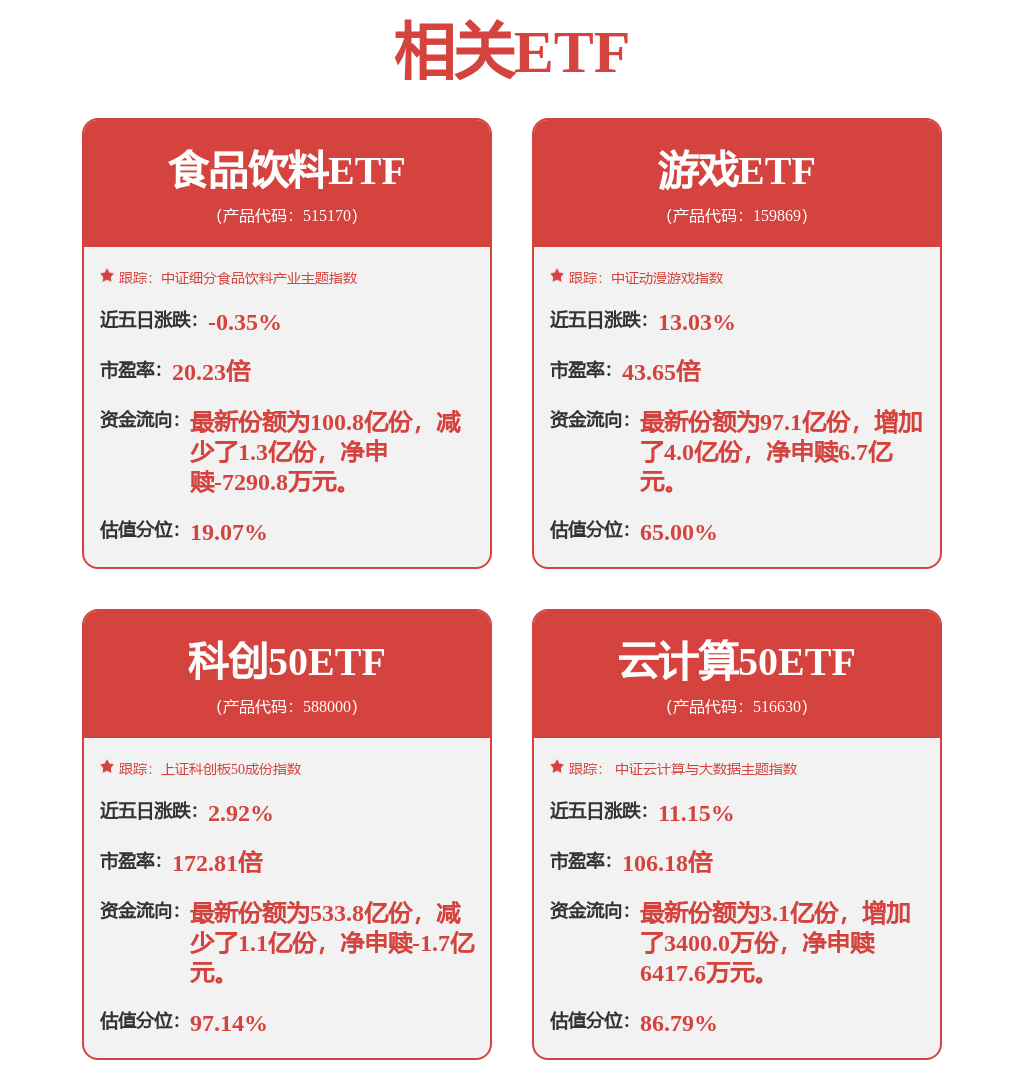
低费率云计算ETF华夏(516630)持仓股数据港、石基信息涨停!“智谱+华为”联合打造首个国产芯片训练多模态SOTA模型
Xin Lang Cai Jing· 2026-01-14 06:39
Group 1 - The technology sector experienced a narrowing of gains, with the cloud computing ETF Huaxia (516630) seeing its increase shrink to 3.01%, while stocks Data Harbor and Shiji Information hit the daily limit up [1] - The AI-focused cloud computing ETF Huaxia (516630) tracks an index with a high AI computing power content, covering popular concepts such as optical modules, computing leasing, data centers, AI servers, and liquid cooling [3] - The launch of the GLM-Image model by Zhipu in collaboration with Huawei marks a significant advancement, being the first state-of-the-art multimodal model trained entirely on domestic chips, with a cost of generating an image at only 0.1 yuan [1] Group 2 - The joint issuance of the "AI + Manufacturing" implementation opinions by eight national departments aims to promote the deep integration of AI and manufacturing, which is expected to accelerate AI application penetration in the B-end market [2] - Major internet companies in China are rapidly expanding their C-end applications, leveraging their large user bases and mature AI model technology to embed intelligent systems into existing products and business frameworks [2] - The Huaxia Entrepreneurial AI ETF (159381) tracks the entrepreneurial board AI index, focusing on companies with AI as their main business, with significant weight in optical modules and a high elasticity in performance [3]

行业迎来密集催化!大数据ETF、大数据ETF华夏、云计算ETF广发、云计算ETF易方达涨超4%
Ge Long Hui· 2026-01-14 06:26
Core Viewpoint - The A-share market is experiencing increased volatility, with AI-related sectors leading the gains [1] Group 1: ETF Performance - As of the report, various ETFs such as Big Data ETF, Financial Technology ETF, and Cloud Computing ETFs have risen over 4% [2] - The Cloud Computing ETF from Huaxia focuses on domestic AI software and hardware capabilities, with a combined weight of computer software, cloud services, and computer equipment reaching 83.7%, and deep learning applications exceeding 40% [2] - The Big Data ETF tracks the CSI Big Data Industry Index, heavily investing in sectors like data centers and cloud computing, with major holdings in leading companies such as Inspur, iFlytek, and China Software [2] Group 2: Industry Catalysts - The industry is witnessing a series of catalysts, including DeepSeek's recent paper on conditional memory modules for large models, which is expected to be a core modeling primitive for the next generation of sparse large models [3] - Speculation arises regarding DeepSeek's next-generation model V4, anticipated to be released around the Spring Festival, based on recent research developments [4] Group 3: Company Developments - On January 8, Zhipu AI became the first global large model company to list on the Hong Kong Stock Exchange, followed by MiniMax on January 9, marking a competitive rush in the sector [5] - Alibaba's total capital expenditure for FY2026 Q2 reached 31.501 billion yuan, a year-on-year increase of 80.10%, with Alibaba Cloud planning to further invest in AI cloud computing infrastructure [6] Group 4: Market Dynamics - The demand for computing power is expected to grow significantly due to the AI wave, with domestic AI development striving to catch up [6] - The domestic AIDC (Artificial Intelligence Data Center) is rapidly developing, with the total number of operational computing center racks reaching 10.85 million and intelligent computing capacity at 788 EFLOPS (FP16) by June 2025 [6] - Supply-side constraints are evident, with high-end chip shortages persisting due to geopolitical factors, leading to a mismatch between supply and demand [7] Group 5: Trends and Future Outlook - The AI development is driving an increase in chip power consumption, with supernode deployment becoming a significant trend, and the demand for computing power leasing is surging amid US-China tensions [8] - The leasing market for computing power is thriving, with significant orders being secured by related companies, and the resale value of high-performance servers remains robust [8]

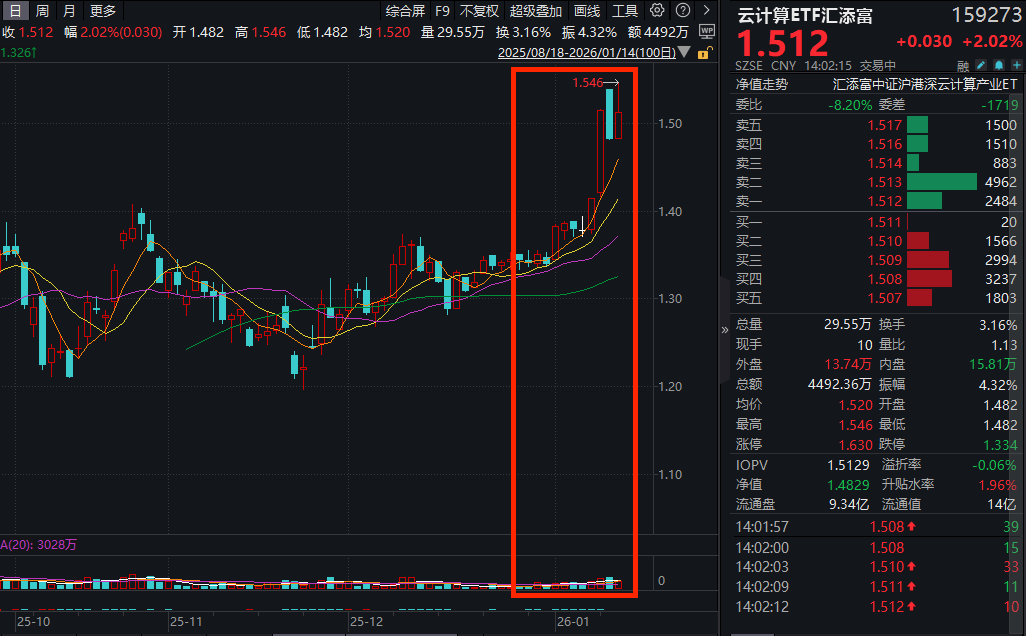
中美AI技术差距在缩小?云计算ETF汇添富(159273)放量涨超2%创历史新高!从“算力竞赛”到“应用落地”,聚焦下半场AI行情!
Sou Hu Cai Jing· 2026-01-14 06:19
Core Viewpoint - The AI computing sector is experiencing strong momentum, with the cloud computing ETF Huatai (159273) seeing a significant increase of over 2%, reaching a historical high in trading volume of nearly 500 million yuan [1][4]. Group 1: Market Performance - The cloud computing ETF Huatai (159273) has seen most of its weighted index stocks perform positively, with notable increases such as Runze Technology rising over 7% and Hengsheng Electronics increasing over 5% [4]. - Alibaba's stock (9988) has a weight of 9.37% in the ETF and has risen by 3.94%, with a market capitalization of 315.11 billion yuan [5]. Group 2: Industry Insights - Jefferies highlights that Chinese AI stocks have further upside potential due to increased capital expenditure, improved AI model performance, and favorable policy signals, with the monetization maturity of China's AI industry still lagging behind that of the U.S. [3]. - The performance gap between leading AI models in China and the U.S. has narrowed from 8% to approximately 6%, attributed to new products like Zhiyu's GLM-4.7 model [3]. - The IDC market is undergoing a supply-demand shift driven by marginal improvements in chip supply and an explosion in demand for domestic AI applications [9]. Group 3: Future Trends - The AI industry is transitioning from a "computing power competition" phase to one focused on "application landing," indicating a maturation of business models in the AI sector [6]. - The market is expected to see a resurgence in IDC orders and performance as major companies like ByteDance restart data center bidding due to improved chip supply conditions [9][10]. - The domestic AI model's continuous iteration is creating real and sustained demand for computing power, which is expected to drive the construction and bidding for IDC infrastructure [10].
数据中心供配电设备行业跟踪:台积电2025Q4营收创新高,DRAM涨价趋势延续
Shanghai Aijian Securities· 2026-01-14 05:05
Investment Rating - The report assigns an "Outperform" rating for the industry, indicating a positive outlook compared to the broader market [2]. Core Insights - The data center industry has become a core growth area for the power equipment sector, driving demand and technological advancements. However, the capital expenditure characteristics of the data center industry, including large scale and long return periods, necessitate a multi-dimensional approach to accurately gauge demand for power distribution equipment [2][5]. - The report emphasizes the importance of integrating AI industry indicators to support investment decisions in the data center power distribution equipment sector, focusing on demand, supply chain, and AI application metrics [2][5]. Summary by Sections 1. Demand Side: Sustained High Growth in Capital Expenditure - In Q3 2025, overseas cloud companies' capital expenditure reached $99.617 billion, a year-on-year increase of 80.39% and a quarter-on-quarter increase of 9.54% [7]. - Alibaba's capital expenditure in Q3 2025 was CNY 31.5 billion, up 80.10% year-on-year but down 18.55% quarter-on-quarter. Tencent's capital expenditure was CNY 13 billion, down 24.05% year-on-year and 32.05% quarter-on-quarter [12][13]. 2. Supply Chain: Revenue Growth for Key Players - NVIDIA's total revenue in Q3 2025 was $57.006 billion, with data center product revenue reaching $51.215 billion, marking a historical peak and a year-on-year increase of 66.44% [19]. - TSMC's revenue in December 2025 was NT$335 billion, a year-on-year increase of 20.4% [24]. - The DRAM spot price surged from $17.25 on October 27, 2025, to $59.75 on January 9, 2026, reflecting a growth of over 246% [27]. 3. Application Side: Steady Growth in AI Models and Usage - The report notes a decrease in API call volume, with a total of 5.39 trillion tokens called from January 5 to January 12, 2026, down 16.17% from the previous period [33]. - The price of tokens for models scoring over 40 on the Artificial Analysis Intelligence Index dropped by over 50% in Q3 2025 [45].
阿里大涨超5%,据报阿里云2026年目标是拿下中国AI云市场增量的80%
Ge Long Hui· 2026-01-14 04:30
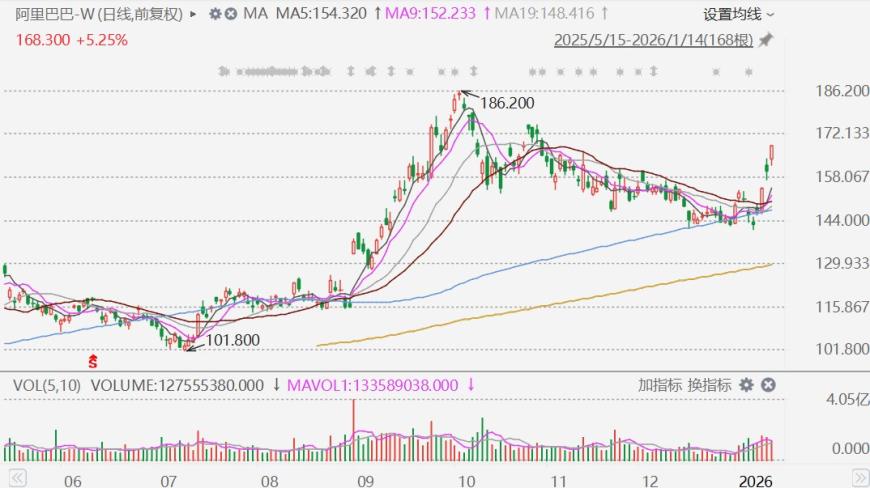
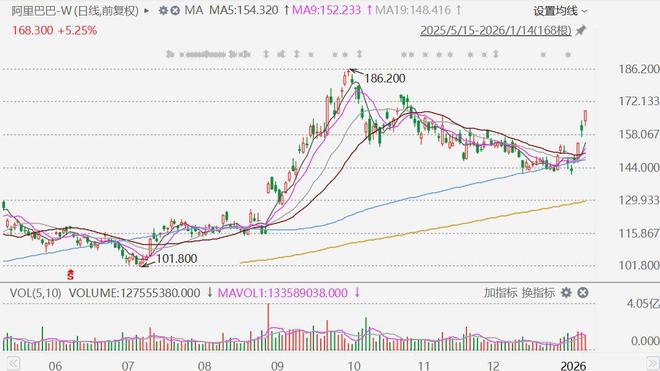
1月14日,入选了格隆汇2026年"下注中国"十大核心资产名单的阿里巴巴(9988.HK)盘中涨幅扩大至超5%,报168.4港元,为 连续第四日上涨,股价创逾2个月新高。 有分析认为,阿里巴巴近日的持续大涨,除了近期AI概念的整体大涨带动外,或与阿里云收入增长将在未来几个季度持续 加速有关。摩根士丹利近日发布研报预计,阿里云的营收增长将保持强劲势头,同比增速有望加速至35%以上,不仅高于上 一季度的34%,而且未来在2027财年甚至有进一步加速至40%的潜力。摩根士丹利认为,这一增长趋势强化了阿里巴巴作 为"中国最佳AI赋能者"的投资逻辑。 另外,有媒体称,"阿里云的目标是拿下2026年中国AI云市场增量的80%。" 阿里云智能集团资深副总裁、公共云事业部总 裁刘伟光说,但是下一年增量的10%都会大于上一年的全量。所以过去取得了什么成绩并不重要,变化才刚刚开始。 港股频道更多独家策划、专家专栏,免费查阅>> 责任编辑:栎树 ...
午报创业板指半日涨超2%,全市场超4700股飘红,AI应用持续爆发
Xin Lang Cai Jing· 2026-01-14 04:21
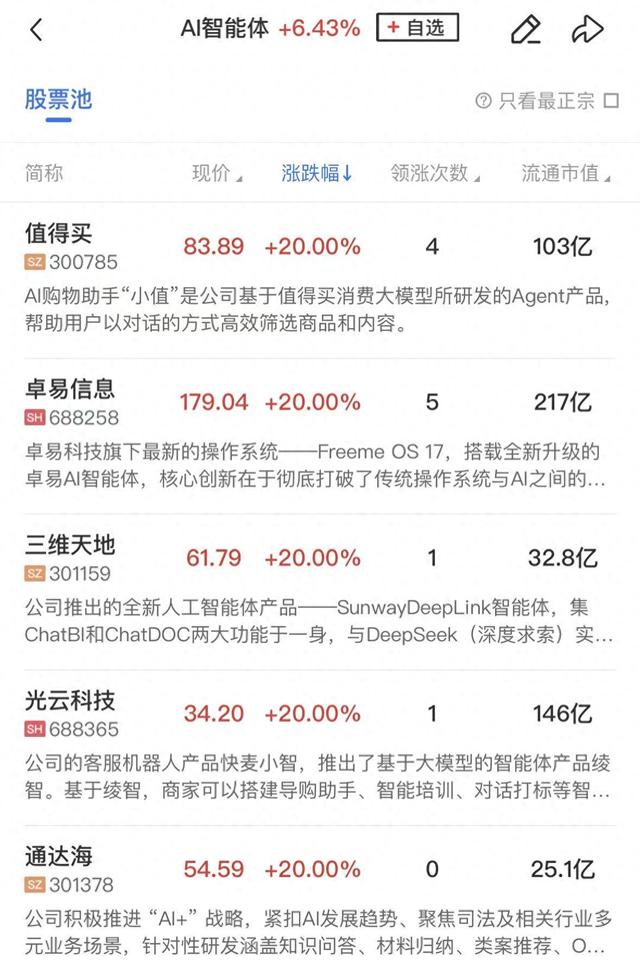
Market Overview - The market experienced a collective rebound in early trading, with the Shanghai Composite Index rising over 1% and the ChiNext Index increasing by over 2% [1] - The total trading volume in the Shanghai and Shenzhen markets reached 2.22 trillion yuan, a decrease of 215.5 billion yuan compared to the previous trading day [1] - Over 4,700 stocks rose, with more than 100 stocks hitting the daily limit [1] Sector Performance - The AI application sector saw a significant surge, with over twenty constituent stocks hitting the daily limit, including Liou Co., which achieved six consecutive limit-ups in nine days [1] - The semiconductor sector also performed well, with stocks like Yaxin Integrated Circuit hitting the daily limit and reaching a historical high [1][6] - The commercial aerospace sector remained active, with Haige Communication achieving three consecutive limit-ups and new highs [1][7] Company Highlights - Alibaba Cloud's concept stocks, including Hangang Co. and Data Port, saw limit-up performances, indicating strong market interest [3] - The monthly active users (MAU) of Alibaba's Qianwen C-end exceeded 100 million within two months of launch, showing rapid growth among students and white-collar workers [5] - Alibaba Cloud's revenue is projected to grow at a compound annual growth rate (CAGR) of over 30% over the next three years, supported by increased capital expenditure and self-developed core hardware [5] Investment Opportunities - The AI marketing and GEO concepts led the market gains, with stocks like Zhiwen Interactive and Tax Friend hitting the daily limit [1] - The semiconductor supply chain showed strong performance, particularly in storage chips and semiconductor equipment [9] - The commercial aerospace sector is expected to attract further investment, with the International Telecommunication Union applying for an additional 200,000 satellites, indicating growth potential in this area [8]

港股异动丨阿里大涨超5%,据报阿里云2026年目标是拿下中国AI云市场增量的80%
Ge Long Hui· 2026-01-14 04:20
Core Viewpoint - Alibaba (9988.HK) has been included in the "Top 10 Core Assets to Bet on China" list by Gelonghui for 2026, leading to a stock price increase of over 5% to HKD 168.4, marking the fourth consecutive day of gains and reaching a two-month high [1] Group 1: Stock Performance - Alibaba's stock has seen a continuous rise, attributed to the overall surge in AI concepts and the anticipated acceleration in Alibaba Cloud's revenue growth in the coming quarters [1] - The stock price increase reflects strong market sentiment and investor confidence in Alibaba's future performance [1] Group 2: Revenue Growth Projections - Morgan Stanley's recent report predicts that Alibaba Cloud's revenue growth will maintain a strong momentum, with a year-on-year growth rate expected to accelerate to over 35%, surpassing the previous quarter's 34% [1] - There is potential for further acceleration in revenue growth to 40% in the fiscal year 2027, reinforcing Alibaba's position as a leading "AI enabler in China" [1] Group 3: Market Ambitions - Reports indicate that Alibaba Cloud aims to capture 80% of the incremental growth in China's AI cloud market by 2026 [1] - Liu Weiguang, Senior Vice President of Alibaba Cloud Intelligent Group, emphasized that the upcoming year's incremental growth will exceed the total growth of the previous year, indicating a significant shift in the market landscape [1]
突发!美立法锁定远程 GPU 使用 无许可即成违法行为
是说芯语· 2026-01-14 03:51
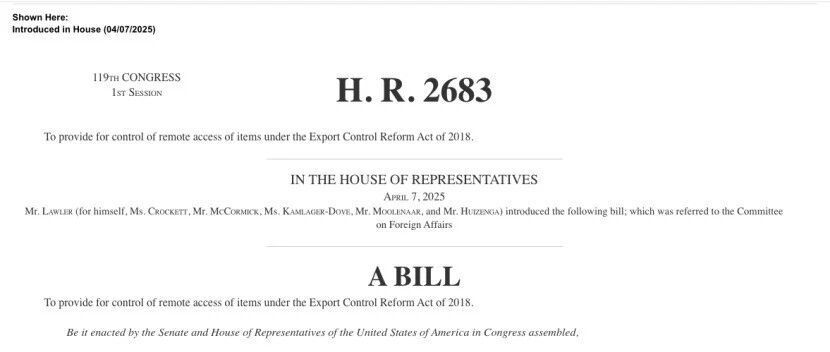
Core Viewpoint - The article discusses the passage of the Remote Access Security Act (H.R.2683) by the U.S. House of Representatives, aimed at modernizing the U.S. export control system to address vulnerabilities related to remote access of controlled technologies, particularly AI chips, by foreign entities [1][3]. Summary by Sections Legislative Overview - The Remote Access Security Act was passed with bipartisan support, receiving 369 votes in favor and 22 against, and it updates the Export Control Reform Act of 2018 to include remote access to controlled technologies [1][2]. Definition and Scope - The act defines "remote access" as access to U.S. controlled items by foreign persons through network connections, including the internet or cloud computing services, from locations other than where the items are physically located [2][3]. Regulatory Implications - The act expands regulatory authority to include digital services, requiring compliance for activities such as cloud-based AI chip usage and remote computing training, thus shifting U.S. export controls from physical entities to digital behaviors [4][5]. Examples of Regulatory Scenarios - Foreign companies using U.S. controlled technologies via cloud services without government permission may be violating the law, even if the technology is not physically exported [5]. - U.S. cloud providers offering controlled computing resources to foreign clients without adhering to export control obligations may also face legal repercussions [6]. - Remote operation of controlled technologies by foreign individuals or companies, regardless of the physical location of the equipment, can be deemed illegal [7]. - Circumventing regulations through overseas subsidiaries or shell companies does not exempt foreign entities from compliance under the new law [8]. Conclusion - The Remote Access Security Act aims to clarify and tighten the boundaries of what constitutes illegal remote access to U.S. controlled technologies, emphasizing that the location of the technology is less relevant than who is using it and how [9].
阿里云 2026 年目标:拿下中国 AI 云市场增量的 80%
晚点LatePost· 2026-01-14 03:42
Core Viewpoint - The article emphasizes that AI infrastructure is fundamentally about cloud computing itself, suggesting that the integration of AI into business processes will drive significant productivity improvements, similar to the historical impact of electricity on industrial production [2][3]. Group 1: AI Integration in Business - Companies are not just looking for single AI models or cloud capabilities; they seek a comprehensive experience that allows for lower-cost access to more powerful models integrated into their business processes [2]. - The first batch of AI users will categorize their applications into different tiers, utilizing internal data for fine-tuning or even training models from scratch [3]. - A survey of 146 industry clients revealed that the quality of AI tokens is more important than quantity, as businesses prioritize efficiency and impactful decision-making over casual use [4]. Group 2: Industry-Specific Applications - Traditional industries are leveraging AI to enhance efficiency by utilizing accumulated data for specific applications, such as automotive diagnostics and investment strategies [5]. - Companies in agriculture are using AI to monitor livestock health and behavior, while lighting companies are developing AI to interpret user commands more naturally [5]. - The recruitment industry is increasingly adopting AI for resume screening and interview automation, leading to new workflows that integrate AI into daily operations [5]. Group 3: Market Growth and Future Potential - The enterprise market for AI is expected to grow continuously, with many applications yet to be unlocked, indicating a transformative potential for various sectors [6]. - The Chinese AI cloud market is projected to reach 22.3 billion yuan by mid-2025, with Alibaba Cloud holding a 35.8% market share, surpassing the combined share of its closest competitors [8][9]. - Alibaba plans to invest over 380 billion yuan in cloud and AI infrastructure over the next three years, significantly increasing its capital expenditure compared to the previous decade [9]. Group 4: Infrastructure and Service Models - Alibaba Cloud aims to build a comprehensive AI infrastructure that goes beyond merely providing API services, focusing on enhancing efficiency and offering tailored solutions for different industries [8]. - The company categorizes its services into MaaS (Model as a Service), PaaS (Platform as a Service), and IaaS (Infrastructure as a Service), allowing businesses to access AI capabilities in a flexible manner [10]. - The infrastructure being developed is designed to support a wide range of AI applications, ensuring that companies can effectively utilize AI in their operations [11]. Group 5: Competitive Landscape - The competition in the AI cloud market is shifting towards a "soft and hard integration" capability, where hardware and software work together to optimize AI model performance and deployment [13]. - Alibaba Cloud's goal is to capture 80% of the incremental growth in the Chinese AI cloud market by 2026, indicating a strong ambition to lead in this rapidly evolving sector [13].


阿里云概念持续走高 杭钢股份、数据港双双涨停
Mei Ri Jing Ji Xin Wen· 2026-01-14 03:06
Core Viewpoint - Alibaba Cloud concept stocks experienced a significant rise, indicating positive market sentiment towards cloud computing and related technologies [1] Group 1: Company Performance - Hangzhou Steel (杭钢股份, 600126) reached the daily limit increase [1] - Data Port (数据港, 603881) also hit the daily limit increase [1] - Rongxin Culture (荣信文化, 301231) saw an increase of over 10% [1] - Zhejiang Shuzhi Culture (浙数文化, 600633), Runze Technology (润泽科技, 300442), Runjian Shares (润建股份, 002929), and Zhejiang University Network New (浙大网新, 600797) all experienced upward movement in their stock prices [1]
