半导体制造

Search documents
汽车早餐 | 京东11月9日将发布新车;小马智行、文远知行港股IPO获证监会备案;全国机动车保有量达4.6亿辆
Zhong Guo Qi Che Bao Wang· 2025-10-15 01:23
Domestic News - The Ministry of Public Security reported that the total number of motor vehicles in China reached 460 million by the end of September 2025, with 360 million being cars and 550 million drivers, making it the largest in the world in terms of total and incremental numbers [2] - The State Administration for Market Regulation unconditionally approved several mergers and acquisitions, including Mitsubishi Motors' acquisition of GAC Mitsubishi's equity [3] - The China Semiconductor Industry Association expressed serious concerns regarding the intervention of the Dutch government in Nexperia, a subsidiary of Wingtech Technology, emphasizing support for fair business practices and opposing discriminatory measures against Chinese companies [4] - The China Automotive Power Battery Industry Innovation Alliance reported that the total production of power and other batteries in September was 151.2 GWh, a year-on-year increase of 35.4%, with cumulative production from January to September reaching 1,121.9 GWh, up 51.4% year-on-year [5] International News - The Abu Dhabi Investment Authority signed a strategic cooperation agreement with Stellantis to develop an integrated automotive ecosystem in the UAE [6] - Germany's Federal Statistical Office reported a 10.4% year-on-year increase in the number of companies filing for bankruptcy in September [7] - South Korea's semiconductor exports in September reached $16.62 billion, a year-on-year increase of 21.9% [8] - South Korea's ICT product exports in September totaled $25.43 billion, a 14% year-on-year increase, with a trade surplus of $11.65 billion [9] Corporate News - Honda reported a total of 54,544 vehicles sold in China in September 2025, with cumulative sales from January to September reaching 467,867 vehicles [10] - CATL and Dongfeng Commercial Vehicle established a new five-year strategic cooperation agreement focusing on product development and industry standards [11] - Pony.ai and WeRide received approval from the China Securities Regulatory Commission for their respective IPOs in Hong Kong [12] - JD.com announced a new car launch in collaboration with GAC and CATL, set for November 9, focusing on consumer insights and sales without direct involvement in manufacturing [13] - Bohai Automotive received approval from the Beijing State-owned Assets Supervision and Administration Commission for a major asset restructuring plan [14] - ZTE announced that its automotive-grade chip, Han域 M1, has been shipped by the end of September 2025, designed for next-generation automotive electronic architectures [15]


早报|大疆就诉美国防部判决结果提起上诉;80名韩国公民被柬拘留拒绝回国;2026年国考报考年龄放宽;京东回应下场造车
虎嗅APP· 2025-10-15 00:01
Group 1 - 80 South Korean citizens are currently detained by the Cambodian immigration authorities, and they refuse to return to South Korea despite contact from officials [2][3][5] - An semiconductor company, Anshi Semiconductor, appointed its CFO Stefan Tilger as interim CEO after the previous CEO was suspended by a Dutch court [6] - Goldman Sachs plans to conduct another round of layoffs to further cut costs, although the total number of employees is expected to grow by the end of the year [7] Group 2 - Walmart announced a partnership with OpenAI to allow customers to use ChatGPT for instant checkout of Walmart products [8] - The Chinese Embassy in Thailand issued a warning regarding a tourist being threatened to shop, confirming that the involved guide lacked proper qualifications [9][10][11] - DJI has appealed a US court decision that maintained its listing as a "Chinese military enterprise," asserting its commitment to preventing the misuse of its products for military purposes [12] Group 3 - Ele.me is trialing a new service score system to replace the previous penalty system for delivery riders, aiming for a more positive incentive approach [13] - The 2026 national civil service examination will recruit 38,100 candidates, with age limits adjusted for applicants [14] - The total number of vehicle trade-ins is expected to exceed 12 million this year, significantly boosting new car sales [15][17] Group 4 - Nvidia's CEO personally delivered the first DGX Spark AI supercomputers to Elon Musk, highlighting advancements in AI computing capabilities [18] - JD.com is collaborating with CATL and GAC Group to launch a new car, clarifying that JD's role is primarily in consumer insights and sales, not manufacturing [21] - Apple CEO Tim Cook's visit to China coincided with reports of activation issues with the iPhone series, attributed to server problems [23] Group 5 - Ant Group reported a surge in interest for its gold accumulation product, with over a million visits on the day international gold prices hit a record high [24] - Songcheng Performance announced it is not involved in the IPO project of Xibei and has no plans to enter the prepared food industry [25][28] - The photovoltaic industry association clarified that its upcoming meetings are routine monthly meetings, amidst speculation of significant policy announcements [29][30] Group 6 - The central bank is set to conduct a 600 billion yuan reverse repurchase operation to maintain liquidity in the banking system [34] - Elon Musk indicated that his company xAI will focus on video games, driven by personal interest rather than profit [35]

连续两个跌停,闻泰科技市值蒸发超百亿元!律师:一旦“荷兰模式”被复制,将显著增加中资不确定性
Mei Ri Jing Ji Xin Wen· 2025-10-14 16:33
去年底以来,闻泰科技持续推进出售集成业务资产,并全面聚焦半导体业务。而在今年七八月份,公司管理层刚刚经历了一轮"换血",来自安世半导体的 多名管理层进入闻泰科技决策层,其中包括现任董事长杨沐。 颇具戏剧性的是,早在2022年11月,闻泰科技实控人张学政还曾与安世半导体多位外籍高管共同阐述发展战略。而如今,其中一位当时参与的外籍高管, 却成为此次"发难"的当事人之一。 截至10月14日收盘,闻泰科技股价连续两日跌停,市值蒸发超百亿元。 闻泰科技(SH600745,股价37.65元,市值468.60亿元)核心子公司——安世半导体遭遇荷兰当地政府干预事件持续升级。 10月13日,外交部发言人在例行记者会上就此回应;10月14日,中国半导体行业协会官微发布声明声援闻泰科技;10月14日,安世半导体官网发布声明 称,4日,中国商务部发布出口管制通知,禁止公司及其分包商出口在中国制造的特定成品和组件。 合作伙伴时隔三年反目 此次风波的核心正是安世半导体。2019年,闻泰科技先取得对安世半导体的控制权;至2020年,进一步完成剩余股权的收购,最终实现对安世半导体 100%控股。 随后,闻泰科技逐步介入安世半导体的治理架构。 ...


法庭文件曝光:美国曾施压荷兰,想要豁免中国籍CEO必须换
Guan Cha Zhe Wang· 2025-10-14 15:45
【文/观察者网 王一】在中美博弈之际,荷兰政府近日突然下令,要求中国半导体领军企业闻泰科技 (维权)旗下子公司安世半导体控股有限公司自9月30日起,一年内不得进行任何涉及资产、知识产 权、业务及人员的调整。随后,荷兰企业法庭裁决将指派一位外籍人士拥有对安世半导体的决定性投票 权。 鉴于荷兰政府采取行动就在美国发布出口管制穿透性规则后一天,美国彭博社、英国《金融时报》等外 媒纷纷猜测,荷兰此举背后是美国在"指点"。但这种猜测迅速被荷兰经济事务部的一名发言人否认,称 美国并未参与荷兰针对安世半导体的决策,行动时机"纯属巧合"。 然而,阿姆斯特丹上诉法院14日公开的法庭文件显示,早在今年6月,美国官员就已向荷兰表明立场 ——若安世半导体想从美国新变化的"实体清单"中获得豁免,其中国籍首席执行官(CEO)"必须被替 换"。 美国《华尔街日报》报道称,他们获取的一份会议录音显示,闻泰科技一名高管曾在12日与投资者的电 话会议中直言,荷兰政府的指令是以美国新规为借口,实则是为了夺取控制权。这名高管当时对投资者 说,"荷兰经济事务部显然是跟在美国政府身后的一只温顺绵羊"。 面对法庭文件的实锤,荷兰负责外贸的国务秘书奥克耶· ...
安世半导体遇荷兰罕见“夺权”风暴,闻泰科技转型“命脉”遭重创
Tai Mei Ti A P P· 2025-10-14 13:24
Core Viewpoint - Wentech Technology's core asset, Anshi Semiconductor, faces severe control issues due to unprecedented administrative and judicial measures from the Netherlands, leading to significant market volatility and a loss of over 10 billion yuan in market value within two days [2][16]. Group 1: Control Changes - Anshi Semiconductor is experiencing a "black swan" event that threatens its control structure, marking the first time since Wentech's acquisition of the company that its control is directly challenged [3]. - The Chinese CEO of Anshi, Zhang Xuezheng, has been temporarily suspended, and a foreign individual will be appointed to lead the company, effectively removing core decision-making power from Wentech [3][11]. - Anshi and its global subsidiaries are under a one-year operational freeze, preventing any adjustments to assets, intellectual property, or personnel [3][11]. Group 2: Political and Legal Context - Wentech has publicly condemned the Dutch government's actions as excessive interference based on geopolitical bias rather than factual risk assessment [4][8]. - The Dutch government invoked the 1952 Materials Supply Act, a rare legal tool, citing governance deficiencies within Anshi that pose risks to the economic security of the Netherlands and Europe [11][12]. - The timing of the Dutch government's actions coincides with the EU's signing of the Semiconductor Alliance Declaration, indicating a strategic response to geopolitical tensions in the semiconductor industry [12][13]. Group 3: Strategic Implications - Anshi Semiconductor is a key player in the European automotive chip supply chain, with significant revenue contributions to Wentech's semiconductor business, making the control issue critical for the company's transformation strategy [13][14]. - Wentech is currently in a pivotal transition phase, divesting from traditional mobile product integration to focus entirely on semiconductor operations, making the stability of Anshi's control vital for future profitability [14][16]. - The company has faced geopolitical challenges before, having previously divested its ODM business to mitigate risks from U.S. sanctions, highlighting the ongoing pressures in the semiconductor sector [15][16].

【财闻联播】“硬刚”!大疆再次起诉美国国防部!京东回应下场造车
券商中国· 2025-10-14 11:29
Macro Dynamics - The People's Bank of China will conduct a 600 billion yuan reverse repurchase operation on October 15, 2025, with a term of 6 months [2] Industry Developments - Shanghai's Economic and Information Commission has issued an action plan for the high-quality development of the smart terminal industry (2026-2027), focusing on the layout of core chips such as SoC and CPU, covering X86, ARM, and RISC-V technology routes [3] - The World Steel Association forecasts that global steel demand will reach approximately 1.75 billion tons in 2025, remaining stable compared to 2024, with a mild rebound of 1.3% expected in 2026 [5] Company News - Goldman Sachs has upgraded the rating of Tigermed's A-shares from "Neutral" to "Buy," raising the target price from 62.1 yuan to 77.1 yuan, citing attractive entry points and expected growth in new orders [7] - DJI has filed an appeal against the U.S. Department of Defense regarding its designation as a "Chinese military enterprise," asserting its commitment to preventing the misuse of its products for military purposes [13] - JD.com announced a collaboration with CATL and GAC Group to launch a new car on November 9, clarifying that JD will not be directly involved in manufacturing [14] - G-bits expects a net profit increase of 57% to 86% year-on-year for the first three quarters of 2025, driven by new game launches [15] - Grand Materials announced that its chairman has been placed under detention, but the company's operations remain normal [16] - Shenghe Resources anticipates a net profit increase of 696.82% to 782.96% for the first three quarters of 2025, attributed to favorable market conditions for rare earth products [18] - Shandong Gold expects a net profit increase of 83.9% to 98.5% for the first three quarters of 2025, driven by improved operational efficiency and rising gold prices [19] - Longbai Group has filed a lawsuit for 1.3105 billion yuan due to the infringement of trade secrets [20]





闻泰抢救半导体资产
第一财经· 2025-10-14 11:06
Core Viewpoint - The Dutch government's freezing of semiconductor assets from Wintech Technology represents a significant setback for the company's transformation efforts, which were focused on enhancing profitability through its semiconductor business, particularly with Nexperia [3][4]. Group 1: Impact of Dutch Government Actions - The Dutch Ministry of Economic Affairs issued a directive on September 30, 2025, restricting Nexperia's operations outside mainland China, requiring the company to maintain its current asset and personnel structure for one year [5]. - Wintech believes that the directive is an unreasonable external takeover disguised as a national security measure [4]. - Wintech has engaged international legal counsel to challenge the Dutch government's directive through administrative review and litigation [4]. Group 2: Internal Management Challenges - Nexperia's foreign executives formed a crisis management committee to comply with the Dutch directive, leading to the suspension of CEO Zhang Xuezheng and the appointment of a temporary "custodian" by the Dutch court [5]. - Wintech's operational decision-making authority has been temporarily suspended, with only one share of Nexperia retained for management purposes [5]. Group 3: U.S. Export Controls and Market Position - Wintech was placed on the U.S. Entity List in December 2024, requiring licenses for purchasing U.S.-controlled technology, which has now extended to subsidiaries holding over 50% ownership [6]. - Wintech's acquisition of Nexperia cost over 30 billion yuan, and the new U.S. rules will also affect Nexperia, which is fully owned by Wintech [6]. - The Chinese government and semiconductor industry associations have expressed opposition to the politicization of trade issues and the discriminatory practices against Chinese companies [6][7]. Group 4: Nexperia's Global Operations - Nexperia operates globally, with its headquarters in the Netherlands and significant manufacturing facilities in Germany and the UK, producing billions of semiconductor units annually [9][10][11]. - The company has a major testing and packaging base in Dongguan, China, which is crucial for its operations, with 80% of its end products shipped to mainland China [12][13]. Group 5: Strategic Responses and Future Outlook - Wintech aims to stabilize its Chinese assets and business while exploring opportunities for overseas expansion [17]. - The company has initiated preparations to mitigate supply chain risks, including domestic replacements and ensuring the stability of its operations in China [17]. - Wintech's investment in a 12-inch wafer fabrication plant in Shanghai is seen as a buffer against external sanctions, with a total investment exceeding 12 billion yuan [19][20].
中国稀土牌刚出,荷兰主动跳出来,明抢中国资产,欧洲从此信誉扫地
Sou Hu Cai Jing· 2025-10-14 10:59
Core Viewpoint - Recent actions by China regarding rare earth exports and technology controls have sparked global attention, indicating a significant shift in international trade rules and geopolitical dynamics [1][3] Group 1: China's Position in Rare Earth Market - China is the largest producer of rare earth elements, controlling approximately 90% of high-purity rare earth production capacity, which underscores its substantial influence in the market [1] - The recent export control measures by China encompass raw materials, technology, and equipment across multiple segments of the industry, even affecting products processed in third countries, leading to a comprehensive "blockade" strategy [1] Group 2: Netherlands' Actions and Implications - The Dutch government has taken measures against China's Wingtech Technology, freezing assets of its subsidiary, ASML, in 30 global entities, signaling a provocative stance against China and a violation of international trade norms [3] - The actions taken by the Netherlands are seen as a response to the broader U.S.-EU strategy to curb China's technological advancements, indicating a shift in how commercial issues are being politicized [3][5] Group 3: Impact on International Investment Environment - The intertwining of commercial and political issues is reshaping the international investment landscape, potentially leading to increased "political risks" for Chinese companies' overseas assets [5] - The current global economic recovery phase makes the protection of Chinese assets abroad a pressing concern for both political and business leaders, especially in high-tech sectors [5] Group 4: China's Strategic Response - China is expected to utilize legal, diplomatic, and public opinion strategies to defend its rights, challenging arbitrary actions taken under the guise of "national security" [7] - Emphasizing technological independence and internal development of the supply chain is crucial for China to counter Western technological blockades [7] - China should actively participate in reshaping international rules to ensure fair and equitable development for all nations, moving away from historically unfavorable multilateral trade rules [7]

大摩:首予英诺赛科(02577)目标价95港元 受益于多项长期增长驱动因素
Zhi Tong Cai Jing· 2025-10-14 10:17
Group 1: Company Overview - Morgan Stanley initiates coverage on InnoPhase (02577) with an Equal Weight rating and a target price of HKD 95, noting that the stock price has nearly doubled since the announcement of its partnership with NVIDIA in July 2025, while the Hang Seng Index rose by 8% during the same period [1] - InnoPhase is expected to benefit from long-term growth drivers such as AI data centers, humanoid robots, and electric vehicles, although the current stock price reflects much of the growth potential already [1][3] Group 2: Market Potential - The GaN (Gallium Nitride) market is projected to reach a total potential market size of USD 346 million in 2024, within the broader semiconductor industry valued at USD 631 billion, with a forecasted compound annual growth rate (CAGR) of 49% from 2024 to 2029 [2] - Key growth factors for the GaN market include the adoption of 800V high-voltage DC power conversion in data centers, increased use of servomotors in humanoid robots, applications in electric vehicles (such as onboard chargers and LiDAR), and the demand for fast charging in consumer electronics [2] Group 3: Competitive Landscape - InnoPhase's vertical integration manufacturing model provides advantages in technology synchronization, stable production capacity, and cost efficiency, leading to an expected growth rate that surpasses the overall market [3] - Strategic partnerships with leading clients, including NVIDIA for AI data centers, Hesai Technology and Supcon for electric vehicles, and Zhiyuan Robotics for humanoid robots, highlight InnoPhase's technological leadership and strong growth potential [3] Group 4: Industry Challenges - The global GaN production capacity is projected to increase from 100,000 wafers per month in 2024 to 345,000 wafers per month by 2029, indicating potential oversupply in the market [4] - Despite an anticipated increase in capacity utilization, the overall utilization rate is expected to remain below 60% over the next five years, which may pressure pricing and profitability in the GaN market [4] - InnoPhase's gross margin is expected to improve moderately by 2026/27, reflecting the ongoing competitive pressures and potential for overcapacity [4]
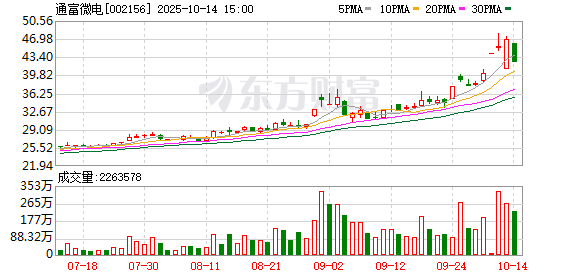
通富微电今日跌9.99% 有3家机构专用席位净卖出2.76亿元
Mei Ri Jing Ji Xin Wen· 2025-10-14 08:39
(文章来源:每日经济新闻) 每经AI快讯,通富微电今日跌9.99%,成交额100.00亿元,换手率14.92%,盘后龙虎榜数据显示,深股 通专用席位买入4.79亿元并卖出7.43亿元,有3家机构专用席位净卖出2.76亿元。 ...