半导体制造

Search documents
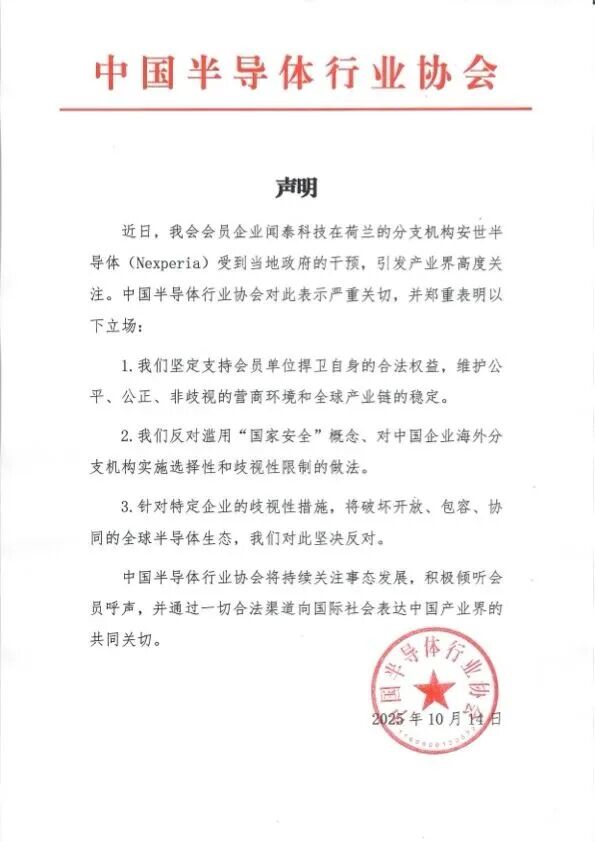
中国半导体行业协会声援闻泰科技维权 反对滥用“国家安全”概念
Zheng Quan Shi Bao Wang· 2025-10-14 04:25
Core Viewpoint - The Chinese semiconductor industry association expresses strong support for its member company, Wintech Technology, in response to the Dutch government's intervention with its subsidiary, Nexperia, and opposes discriminatory measures against specific enterprises [1][2][4]. Group 1: Company Response - Wintech Technology's stock experienced a significant decline, hitting the limit down on October 13 and again on October 14, closing at 37.65 yuan per share [2]. - The company announced that Nexperia is still operating normally but faces challenges such as changes in decision-making processes and reduced resource flexibility due to the Dutch government's orders [5][6]. - Wintech is actively communicating with suppliers and customers to maintain stability in its workforce, production, and sales channels, while also exploring legal remedies to protect its rights [6]. Group 2: Industry Reaction - The Chinese semiconductor industry association emphasizes the need for a fair and non-discriminatory business environment and expresses serious concern over the intervention in Nexperia's operations [2][4]. - The association firmly opposes the misuse of "national security" concepts to impose selective restrictions on Chinese enterprises operating abroad [3][4]. - The association plans to continue monitoring the situation and will communicate the industry's collective concerns to the international community through legal channels [4].

A股,突变!发生了什么?
券商中国· 2025-10-14 04:09
Market Style Shift - The market style has shifted, with a notable performance from dividend stocks, particularly Agricultural Bank of China, which became the largest support for the Shanghai Composite Index [1][3] - Traditional blue-chip stocks like Kweichow Moutai, Industrial and Commercial Bank of China, China Life, and China Ping An have emerged as the main contributors to market gains [1][3] Semiconductor Industry Response - The China Semiconductor Industry Association issued a statement on October 14, opposing the misuse of "national security" concepts and discriminatory restrictions on Chinese companies' overseas branches, specifically referencing Nexperia, a subsidiary of Wentai Technology [3][4] - The association emphasized the need for a fair and non-discriminatory business environment to maintain the stability of the global semiconductor supply chain [3][4] Market Performance Overview - On October 10, the ChiNext and STAR Market experienced significant adjustments, with the STAR Market becoming a support force on October 13, but both markets faced declines again on October 14, with the STAR Market dropping nearly 3% by midday [3][4] - The Hang Seng Tech Index also saw a decline, with notable drops in stocks like Huahong Semiconductor and SMIC, which fell by 7% and 3.6% respectively [3][4] Contribution to Shanghai Composite Index - Key contributors to the Shanghai Composite Index's rise included: - Agricultural Bank of China: 2.63 points - Industrial and Commercial Bank of China: 2.05 points - Kweichow Moutai: 1.99 points - Other significant contributors included China Merchants Bank, China Life, and China Ping An [4] Economic Outlook and Investment Strategy - Analysts suggest that the current market environment may favor large-cap dividend stocks as a response to market volatility and capital flow pressures [6][8] - There is a potential for a renewed focus on domestic demand sectors such as food and beverage, aviation, and real estate, as well as non-bank financials benefiting from a recovery in overall capital returns [8]








光伏概念爆发,闻泰科技再度跌停,黄金涨破4160美元
21世纪经济报道· 2025-10-14 04:06
Market Overview - On October 14, major indices opened higher but showed divergence, with the Shanghai Composite Index briefly returning to 3900 points, while the ChiNext Index fell over 2% after an initial rise of over 1% [1] - By the end of the trading day, the Shanghai Composite Index rose by 0.21%, the Shenzhen Component Index fell by 1.02%, and the ChiNext Index decreased by 2.24% [2] Sector Performance - The market's half-day trading volume reached 1.68 trillion yuan, with the photovoltaic sector experiencing a surge, particularly Longi Green Energy hitting the daily limit [3] - The liquor sector also showed strength, while the coal sector performed robustly, with Dayou Energy achieving two consecutive limit-ups [3] - Conversely, the semiconductor sector weakened, with Wentai Technology hitting the daily limit down [3] Photovoltaic Sector - The photovoltaic concept rebounded, with stocks like Longi Green Energy and Yao Pi Glass hitting the daily limit, and several other companies such as JA Solar and JinkoSolar also seeing gains [4] - Recent reports indicate that Chinese photovoltaic companies have secured nearly 25 GW of overseas orders since September, showcasing strong international performance [6] - There are expectations of significant policy announcements aimed at regulating photovoltaic production capacity, indicating potential industry changes [6] Semiconductor Sector - Wentai Technology faced consecutive daily limit downs due to government intervention in its subsidiary Nexperia in the Netherlands, raising concerns within the semiconductor industry [8] - The China Semiconductor Industry Association expressed serious concerns regarding the situation and emphasized the need for a fair and non-discriminatory business environment [8][9] Gold Market - On October 14, gold concept stocks opened strongly, with Huayu Mining hitting the daily limit and several other stocks like Western Gold and Hunan Gold also rising [13] - Domestic gold jewelry prices surged, with multiple brands exceeding 1200 yuan per gram, reflecting international market fluctuations [11][12]


连续两日跌停!刚刚,中国半导体行业协会声明!
Zheng Quan Shi Bao· 2025-10-14 02:18
Core Viewpoint - The China Semiconductor Industry Association expresses serious concern over the intervention by the Dutch government affecting its member company, Wingtech Technology's subsidiary Nexperia, emphasizing the need for a fair and non-discriminatory business environment [1][2][3][4]. Group 1 - The association firmly supports its member companies in defending their legitimate rights and maintaining a stable global supply chain [1]. - It opposes the misuse of "national security" concepts to impose selective and discriminatory restrictions on Chinese companies' overseas branches [2]. - Discriminatory measures against specific companies are seen as detrimental to an open and collaborative global semiconductor ecosystem [3]. Group 2 - Wingtech Technology announced that its core semiconductor asset, Nexperia, faced dual restrictions from the Dutch government and courts, including a one-year freeze on operations and management changes [6]. - Following these developments, Wingtech's stock price experienced a significant drop, hitting the daily limit down on October 13 and again on the following trading day [6]. - The Chinese Ministry of Foreign Affairs reiterated its opposition to the politicization of trade issues and emphasized the need for adherence to market principles [8].
东芯半导体股份有限公司关于2025年第三次临时股东会变更会议地址公告
Shang Hai Zheng Quan Bao· 2025-10-13 19:59
Group 1 - The company has announced a change in the location for the 2025 Third Extraordinary General Meeting of Shareholders, which will now be held at Shanghai Hongqiao Greenland Platinum Hotel [2][3] - The meeting is scheduled for October 16, 2025, at 14:00 [3] - The original date for the meeting remains unchanged, and the equity registration date is also the same as previously announced [4] Group 2 - The company has conducted an inquiry for a share transfer, with a preliminary transfer price set at 82.50 yuan per share based on inquiries from institutional investors [9][11] - A total of 13 institutional investors participated in the inquiry, including fund management companies and qualified foreign institutional investors [11] - The total number of shares to be transferred is 13,267,492, with 12 institutional investors identified as the preliminary buyers [11]

安世半导体控制权生变,闻泰科技转型何去何从?
Sou Hu Cai Jing· 2025-10-13 15:20
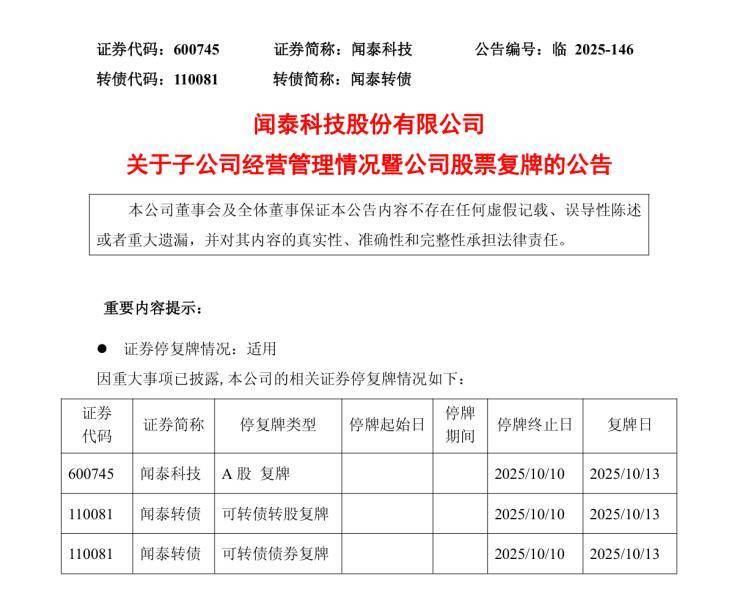
Core Viewpoint - The recent asset freeze and control change imposed by the Dutch government on the semiconductor subsidiary of Wentech Technology has raised significant concerns about systemic discrimination against Chinese enterprises acquiring European semiconductor assets, highlighting a deviation from the EU's non-discrimination principles [2][3]. Company Summary - Wentech Technology's stock hit the daily limit down on October 13, following an announcement on October 12 regarding the Dutch government's directive to freeze assets and operations of its subsidiary, Nexperia, for one year [1][2]. - The Dutch Ministry of Economic Affairs issued an order on September 30, 2025, to freeze related assets of Nexperia, leading to immediate legal actions by the company's management to challenge this directive [3][4]. - The court ruling on October 7 resulted in the suspension of key executives and the appointment of an independent director with decisive voting rights, significantly altering the governance structure of Nexperia [3][4]. Industry Summary - The incident underscores the challenges faced by Chinese semiconductor companies in the global market, particularly regarding political pressures and regulatory scrutiny [7][12]. - Wentech Technology has been transitioning from an ODM company to a semiconductor leader, with Nexperia being a crucial part of this strategy. The company aims to focus entirely on its semiconductor business by divesting its original product integration operations [11]. - Despite achieving significant revenue growth in its semiconductor business, Wentech Technology reported a net loss for the first time since 2016, indicating the financial strain caused by the recent developments [11].
A股晚间热点 | 外交部回应美方关税威胁 黄金再创历史新高 后市如何走?
智通财经网· 2025-10-13 14:55
Group 1 - The U.S. plans to impose a 100% tariff on Chinese goods starting November 1, in response to China's export controls on rare earths, with China firmly opposing these measures and indicating it will take corresponding actions to protect its interests [1] Group 2 - Gold prices have surged, with COMEX December contracts breaking $4100 per ounce, marking a 2.5% increase, while spot gold reached $4082.09 per ounce, up 1.6%. Silver also saw a significant rise of over 5% [2] - Bank of America has raised its price forecasts for gold and silver for next year to $5000 per ounce and $65 per ounce, respectively, citing extreme imbalances in the physical silver market [2] Group 3 - Advanced Semiconductor Manufacturing Co., a subsidiary of Wintech, has lost control due to dual regulatory actions from the Dutch government and courts, leading to a significant drop in the company's stock price [3] - Wintech's semiconductor business relies heavily on China, with nearly 80% of its production capacity and about half of its revenue generated in the mainland [3] Group 4 - Sichuan province is accelerating the development of its AI industry, aiming to establish over 10 leading enterprises and 20 high-level projects by 2027, along with creating 50 benchmark application scenarios across various sectors [4] Group 5 - Northern Rare Earth and its affiliate Baolan Environmental Protection Company received regulatory warnings for failing to disclose non-operating fund occupation issues, leading to a surge in rare earth stocks on the A-share market [5] Group 6 - Notable investor Duan Yongping publicly expressed his continued confidence in Kweichow Moutai by purchasing shares, reinforcing his positive outlook on the leading liquor brand [6] Group 7 - The U.S. Department of Defense plans to invest $1 billion in the procurement of critical minerals, including cobalt and antimony, to enhance its strategic resource capabilities [8] Group 8 - Saudi Aramco's CEO projected that by 2030, data centers could consume three times the electricity of the global electric vehicle fleet, highlighting the growing demand for energy in the tech sector [10]

甬矽电子子公司拟参与竞拍宁波宇昌100%股权
Zhi Tong Cai Jing· 2025-10-13 14:44
Core Viewpoint - Yongxi Electronics (688362.SH) announced that Yao City Changhai Construction Development Co., Ltd. is publicly offering for sale its 100% stake in Ningbo Yuchang Construction Development Co., Ltd. with a transfer base price of 486 million yuan [1] Group 1 - The company's subsidiary, Yongxi Semiconductor (Ningbo) Co., Ltd., intends to participate in the bidding for the stake held by Yao City Changhai [1] - If the bidding is successful, Ningbo Yuchang will become a wholly-owned subsidiary of the company's controlling subsidiary, thus being included in the company's consolidated financial statements [1] - The controlling subsidiary, Yongxi Semiconductor, will no longer need to lease factory space for daily operations, resulting in savings on long-term rental expenses for the Ningbo Yuchang factory [1]

甬矽电子(688362.SH)子公司拟参与竞拍宁波宇昌100%股权
智通财经网· 2025-10-13 14:42
Core Viewpoint - Yongxi Electronics (688362.SH) announced the public auction of 100% equity in Ningbo Yuchang Construction Development Co., Ltd. by Yuyou Changhai, with a base transfer price of 486 million yuan [1] Group 1: Company Actions - Yongxi Semiconductor (Ningbo) Co., Ltd. plans to participate in the bidding for the equity held by Yuyou Changhai [1] - If the bidding is successful, Ningbo Yuchang will become a wholly-owned subsidiary of Yongxi Semiconductor and will be included in the company's consolidated financial statements [1] Group 2: Financial Implications - The acquisition will allow Yongxi Semiconductor to avoid leasing factory space for daily operations, resulting in savings on long-term rental expenses for the Ningbo Yuchang factory [1]
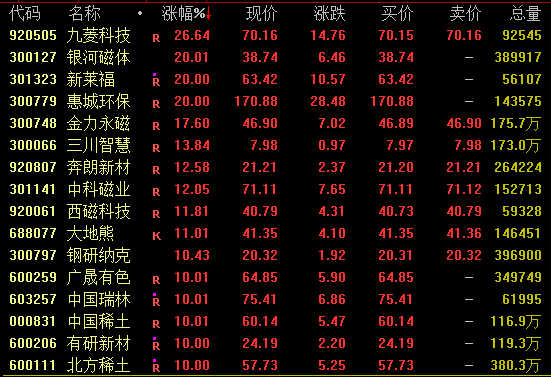
A股大反弹,多股尾盘涨停
Zheng Quan Shi Bao· 2025-10-13 10:39
Market Overview - A-shares experienced a significant decline in the morning session but rebounded in the afternoon, with the Sci-Tech Innovation 50 Index showing strength [1] - The Shanghai Composite Index closed down 0.19% at 3889.5 points, the Shenzhen Component Index fell 0.93% to 13231.47 points, and the ChiNext Index decreased by 1.11% to 3078.76 points [1] - The total trading volume in the Shanghai and Shenzhen markets was 23,745 billion yuan, a decrease of 1,600 billion yuan compared to the previous trading day [1] Sector Performance - Over 3,600 stocks in the market were in the red, with declines in sectors such as automotive, oil, liquor, and pharmaceuticals [1] - The rare earth sector saw a resurgence, with stocks like China Rare Earth and Northern Rare Earth hitting the daily limit [3][4] - The banking sector experienced gains, with China Construction Bank rising over 5% [1] - The semiconductor sector rebounded, with Huahong Semiconductor hitting the daily limit and SMIC rising nearly 7% [1][7] Rare Earth Sector - The rare earth sector exploded again, with stocks like Jiuling Technology rising nearly 27% and several others hitting the daily limit [3][4] - The Ministry of Commerce announced new export controls on rare earth-related items, expanding the scope to include technologies and equipment related to rare earth recycling [5] - Citic Securities indicated that the security of rare earth resources has become a core aspect of national security, suggesting a positive outlook for the rare earth industry [5] Semiconductor Sector - The semiconductor sector rebounded after a significant pullback, with stocks like Ruvi Optoelectronics and Huahong Semiconductor both hitting the daily limit [7][8] - The market is closely monitoring potential export controls from the U.S. on key software types, which could impact the semiconductor industry [8] Hong Kong Market - Yao Cai Securities surged nearly 40% during trading, closing up 34.5% with a trading volume of 2.06 billion HKD [10] - The stock received approval from the Hong Kong Securities and Futures Commission for an acquisition by Ant Group, which is currently in the process of completing necessary approvals [10]