
茶饮

Search documents
古茗收入增速最快,蜜雪冰城开店最多
Nan Fang Du Shi Bao· 2025-09-04 23:07
Core Insights - The tea beverage industry is experiencing significant changes in revenue and store expansion, with brands like Mixue Ice City leading in revenue growth while Nayuki is facing declines in both revenue and store count [3][12][14]. Revenue Performance - Mixue Ice City reported the highest revenue at 14.875 billion yuan, with a year-on-year growth of 39.3% [12]. - The fastest revenue growth was seen in Gu Ming, which achieved a 41.2% increase, reaching 5.663 billion yuan [12]. - Nayuki is the only brand with a revenue decline, reporting 2.178 billion yuan, down 14.4% year-on-year [12]. Profitability - Mixue Ice City also leads in net profit, achieving 2.693 billion yuan, a 42.9% increase [13]. - Gu Ming's net profit grew by 121.5% to 1.625 billion yuan, while Nayuki reported a net loss of 118 million yuan, although this was a 73.1% improvement from the previous year [6][13]. Store Expansion - Mixue Ice City added 6,534 stores, bringing its total to 53,014, while Gu Ming increased its store count by 1,265 to 11,179 [14][15]. - Nayuki, however, closed 160 stores, resulting in a total of 1,638 stores [15]. Store Closure Rates - The highest closure rate was observed in Hu Shang A Yi at 7.05%, while Mixue Ice City had the lowest at 2.55% [16]. Average Store Revenue - Nayuki reported the highest average monthly revenue per store at 22.98 million yuan, while Hu Shang A Yi had the lowest at 3.26 million yuan [9][18]. - Gu Ming's average monthly revenue per store increased by 23.96% to 8.95 million yuan [17]. New Product Launches - Hu Shang A Yi launched 136 new products in the first half of the year, while Gu Ming introduced 52 new products [19][20]. - Mixue Ice City also released several new products, although its top-selling items were existing products [20]. Impact of Delivery Wars - The ongoing delivery wars have positively impacted revenue for several brands, with Nayuki seeing a 7.6% increase in delivery revenue [21]. - However, the delivery wars have also created operational challenges, increasing workload and affecting service quality [21][22]. Strategic Responses - Brands like Ba Wang Cha Ji are focusing on maintaining quality and avoiding price wars, emphasizing long-term brand loyalty over short-term discounts [23][24].


调整不足一年 立顿再换CEO
Bei Jing Shang Bao· 2025-09-04 16:11
Core Viewpoint - Lipton has appointed Mark Bousquet as CEO effective October 1, following a series of leadership changes, indicating potential growth challenges amid competition from local tea brands and new tea beverage trends in China [1][3] Company Overview - Lipton, founded in 1890, is the world's largest tea brand and was acquired by Unilever in 1973. It entered the Chinese market in 1992 and quickly became the leading brand in the tea bag segment [3] - In 2021, Unilever sold Lipton's global tea business for €4.5 billion to CVC Capital Partners, leading to a decline in Lipton's performance [3] - In 2023, Lipton reported revenues of €1.74 billion and profits of €580 million, significantly lower than the €2 billion reported by Unilever in 2020 [3] Market Dynamics - Consumer preferences in China have shifted, with a growing demand for diverse and health-oriented tea products, challenging Lipton's traditional image as a "broken leaf tea" brand [4][5] - Local brands and new tea beverage companies are gaining market share by offering innovative products and experiences that resonate with younger consumers [5][6] Strategic Initiatives - Lipton is investing in the Chinese market, including a ¥50 million project to build a central warehouse aimed at improving logistics and supply chain management by 2027 [6] - The company plans to launch new products, including the "Louis Bousquet Tea," to better align with market trends, although similar products already exist from local competitors [6] - A global brand upgrade has been initiated, emphasizing the health benefits of tea and introducing new packaging and product lines [6] Competitive Landscape - The tea market is facing increased competition from the growing coffee market, which is impacting tea's market share [5] - Analysts express skepticism about Lipton's ability to innovate and connect with younger consumers, given its current product and marketing strategies [7] - Local brands are leveraging unique flavors and attractive packaging to capture the attention of younger demographics, further squeezing Lipton's market space [5][7]

古茗将在A股二次上市?知情人士称系“误读”丨咖啡茶饮龙门阵
2 1 Shi Ji Jing Ji Bao Dao· 2025-09-04 13:52
从新增的1265家门店的层级分布来看,古茗进一步深化市场布局,80%门店位于二线及以下的市场。孟 海陵在业绩会上透露,截至目前,古茗门店数已超12000家,今年迄今净开店已超2100家,两万店目 标"大概率在后年(2027年)达成"。 21世纪经济报道记者 易佳颖 关于古茗进入上海市场的时间有过多次传闻,近期似乎有了更为确定的时间。 近日,古茗CFO孟海陵在香港接受媒体采访时表示,公司可能于2026年在上海上市。引发市场对于古茗 A股二次上市的猜测,但相关知情人士对这一说予以否认,"是翻译表述导致的误解,是2026年可能在 上海开店,而非二次上市。" 早在今年2月,由于古茗在上海的招聘信息,就引发过一波猜测。据古茗最新财报显示,截至2025年6月 30日,古茗经营门店数11179家,成为继蜜雪集团之后第二个破万店的新茶饮公司。 即便门店已破万家,对于在上海、北京、南京等核心城市开店,古茗一如既往,认为时候未到。与此同 时,古茗上半年实现营收56.63亿元,实现净利润约16.25亿元,同比大增121.5%,超过2024年全年净利 润。 而对于古茗的动态,业内同样关注,某新茶饮品牌负责人曾表示,与古茗的差异化就在 ...
“秋天的第一杯奶茶”,流行到海外了
创业邦· 2025-09-04 10:43
Core Viewpoint - The article discusses the globalization of new tea beverage brands, highlighting their strategies to adapt to local markets while maintaining their unique identity. The success of these brands is attributed to innovative product offerings, effective supply chain management, and cultural integration with local preferences [5][27][35]. Group 1: Product Innovation and Market Adaptation - The introduction of unique products like "抹云椰蓝" and "三倍厚抹" demonstrates how brands are leveraging local ingredients and preferences to create appealing offerings in international markets [5][7][14]. - New tea beverage brands are not merely replicating their domestic menus abroad but are instead creating localized versions that resonate with local tastes, such as using local fruits and flavors [9][10][12]. - The success of limited-time offerings and seasonal flavors has been noted, with brands like 喜茶 and 蜜雪冰城 effectively utilizing these strategies to attract consumers [9][10][22]. Group 2: Supply Chain and Operational Efficiency - The article emphasizes the challenges of establishing a supply chain in unfamiliar markets, including compliance with local regulations and sourcing quality ingredients [19][21]. - Companies are increasingly adopting digital tools and refined processes to enhance their product development and supply chain efficiency, significantly reducing the time required to launch new products [21][22]. - The establishment of local warehouses and logistics centers by brands like 喜茶 ensures consistent product quality across different regions [22][24]. Group 3: Cultural Integration and Marketing Strategies - The integration of local culture into product offerings and marketing strategies is crucial for success in international markets, as seen with 喜茶's culturally inspired products [27][29][33]. - Collaborations with local influencers and cultural figures help brands build a connection with consumers, enhancing their market presence [33][34]. - The article highlights the importance of visual appeal and social media engagement in attracting younger consumers, particularly the Z generation, who value aesthetic and shareable experiences [17][35]. Group 4: Market Growth and Future Prospects - The global ready-to-drink beverage market is experiencing significant growth, with projections indicating a compound annual growth rate of 7.2% from 2023 to 2028 [28]. - The article notes the regional differentiation in market opportunities, with Southeast Asia presenting unique challenges and opportunities due to its demographic and climatic characteristics [28][29]. - The ongoing cultural exchange facilitated by these brands is reshaping consumer habits and preferences, indicating a shift towards a more integrated global beverage culture [35].

三棵树(603737):社区店vs茶饮店,如何理解涂料新消费
SINOLINK SECURITIES· 2025-09-04 09:49
Investment Rating - The report maintains a "Buy" rating for the company, indicating a positive outlook for future performance [4][22]. Core Insights - The company is positioned in a growth phase with improved profitability and high growth potential in new business models. The net profit forecasts for 2025 and 2026 have been raised to 1.0 billion and 1.4 billion RMB, respectively, reflecting optimism about the company's expansion and profit recovery [4][22]. - The "马上住" community store model is compared to the tea beverage industry, highlighting similarities in brand standardization and service enhancement to address consumer trust issues. The tea beverage sector has reached a mature stage, while "马上住" is still in the growth phase, indicating significant market potential [2][10][21]. Summary by Sections Company Overview - The company has launched the "马上住" one-stop service system since 2016, with strategic upgrades leading to a comprehensive service ecosystem. The goal is to provide a seamless home renovation experience, with plans to expand the number of community stores significantly by 2026 [9][21]. Financial Projections - Revenue projections for the company are as follows: 12,476 million RMB in 2023, with a growth rate of 10.03%, and expected to reach 16,212 million RMB by 2027. The net profit is projected to grow from 174 million RMB in 2023 to 1,759 million RMB by 2027, indicating a robust growth trajectory [8][22]. Market Comparison - The initial investment for a "马上住" store is approximately 100,000 RMB, significantly lower than the average costs for tea beverage stores, which range from 170,000 to 800,000 RMB. The average payback period for "马上住" stores is around 6 months, suggesting a favorable investment environment [3][16]. Competitive Landscape - The report emphasizes the importance of establishing a strong supply chain and human resource management to support rapid expansion. The company aims to leverage its existing brand recognition and operational standards to create a competitive edge in the home renovation market [21][22].

半年仅新增260家店,沪上阿姨上市后“变脸”?
Xin Lang Cai Jing· 2025-09-04 08:53
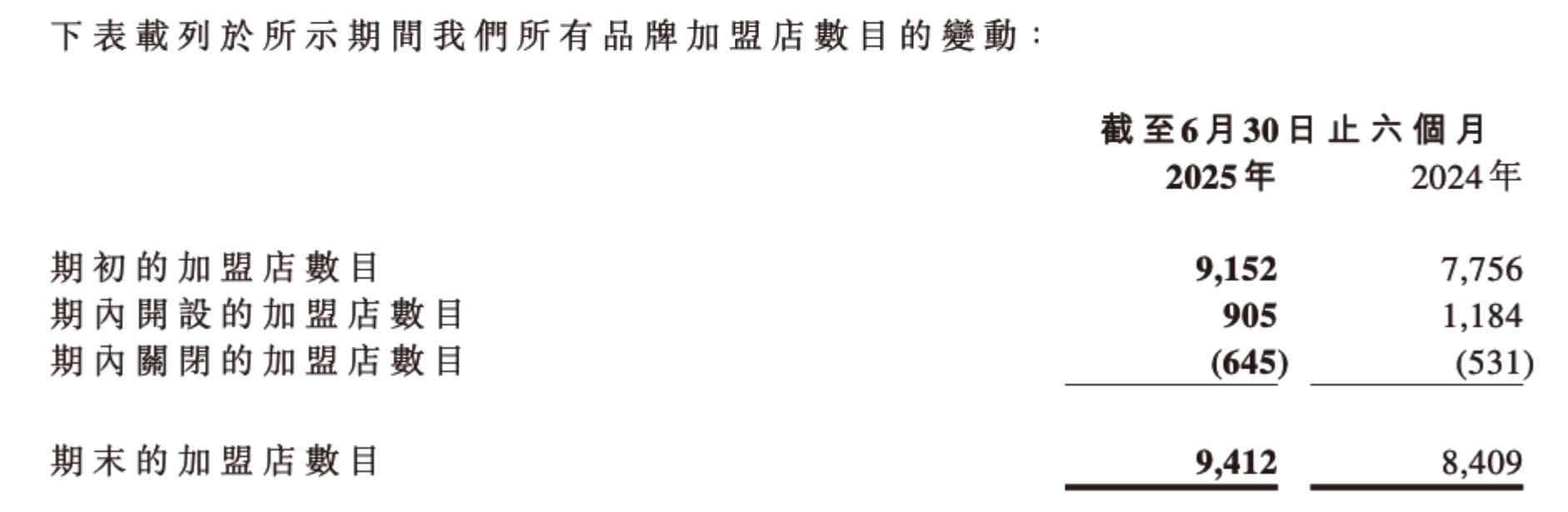
Core Insights - The company, Hu Shang A Yi, aims to expand its store count to 10,000 but currently has 9,436 stores, falling short of its target [1][5] - In the first half of the year, Hu Shang A Yi reported revenue of 1.818 billion yuan, a year-on-year increase of 9.7%, and a net profit of 203 million yuan, up 20.9% [1] - The new tea beverage industry is highly competitive, with Hu Shang A Yi lagging behind competitors like Gu Ming and Mi Xue Group in terms of store expansion [1][5] Store Expansion and Financial Performance - Hu Shang A Yi added only 260 new stores in the first half of the year, with 905 new openings and 645 closures, indicating a slowdown in expansion [5][19] - In comparison, Gu Ming added 1,265 stores, reaching a total of 11,179, while Mi Xue Group opened 6,535 stores, totaling 53,014 [1][5] - The company has reduced franchise fees and offered subsidies to attract new franchisees, but this has not resulted in the expected growth [6][19] Franchisee Relations and Challenges - Franchisees have reported increasing tensions with the company, citing forced inventory purchases and aggressive promotional strategies that reduce their actual revenue [2][12] - Many franchisees claim that their actual revenue is only 60-65% of their sales, leading to dissatisfaction and some considering leaving the brand [12][13] - The company has been criticized for high material costs and a lack of responsiveness to franchisee feedback, which has contributed to store closures [15][20] Market Context and Competitive Landscape - The tea beverage market is experiencing significant competition, with a total of 429,000 tea beverage stores in China, and a decline in the number of stores over the past year [15] - Hu Shang A Yi's financial metrics, including a net profit margin of only 10% and a significant drop in cash reserves, indicate challenges in maintaining competitiveness [16][19] - The company has tightened its franchise policies and reduced subsidies, reflecting a strong pressure to improve performance in a competitive market [16][19]
茶百道(2555.HK):运营效率环比提升 下半年展店有望提速
Ge Long Hui· 2025-09-04 08:24
Core Viewpoint - The company reported a revenue of 2.5 billion CNY in H1 2025, reflecting a 4.3% year-on-year increase, while the net profit attributable to shareholders rose by 37.5% to 326 million CNY, indicating strong financial performance despite a decline in adjusted net profit [1] Group 1: Financial Performance - In H1 2025, the company achieved a revenue of 2.5 billion CNY, up 4.3% year-on-year, and a net profit of 326 million CNY, up 37.5% [1] - Adjusted net profit was 340 million CNY, down 13.8%, with an adjusted net profit margin of 13.6%, a decrease of 2.9 percentage points [1] - The company proposed a mid-term dividend of 266 million CNY, translating to 0.18 CNY per share, with a payout ratio of 80% [1] Group 2: Product Innovation and Sales Growth - The company launched 55 new products and upgraded 9 existing products in H1 2025, with popular items like Lychee Ice Milk driving sales [1] - The sales revenue from products, equipment, franchise fees, and other income were 2.309 billion CNY, 48 million CNY, 101 million CNY, and 41 million CNY respectively, with year-on-year changes of +7.8%, -62.1%, +2.4%, and +52.0% [1] - Estimated single-store product sales revenue was approximately 270,000 CNY, reflecting a 3.7% increase [1] Group 3: Store Expansion and Quality Improvement - The company added 49 new domestic stores in H1 2025, bringing the total to 8,444, focusing on improving operational quality [1] - Store additions in various city tiers included a net decrease of 6 in first-tier cities, an increase of 6 in new first-tier cities, and a net increase of 62 in lower-tier cities [1] - The company also expanded its overseas presence, adding 7 new stores in H1 2025, totaling 21 stores across countries including South Korea, Malaysia, Thailand, Australia, Hong Kong, Macau, and Spain [1] Group 4: Cost Management and Efficiency - The company improved its gross margin to 32.6%, an increase of 0.9 percentage points year-on-year and 1.9 percentage points quarter-on-quarter [1] - Sales expense ratio, management expense ratio, and R&D expense ratio were 6.0%, 10.3%, and 0.6%, with year-on-year changes of +1.6 percentage points, +1.2 percentage points, and flat, respectively [1] - The company achieved a quarter-on-quarter improvement in cost ratios, with sales expenses down by 5.5%, management expenses down by 1.3%, and R&D expenses down by 0.2% [1] Group 5: Investment Outlook - Based on the mid-term performance, the company adjusted its revenue forecasts for 2025-2027 to 5.747 billion CNY, 6.267 billion CNY, and 6.866 billion CNY, respectively [1] - The net profit forecasts for the same period were adjusted to 872 million CNY, 1.002 billion CNY, and 1.132 billion CNY [1] - The latest stock price corresponds to a price-to-earnings ratio of 13, 12, and 10 times for the years 2025, 2026, and 2027, respectively, maintaining a "buy" rating [1]
茶百道今年上半年业绩复苏 副总易瑞34岁已跳槽过5次?
Xin Lang Cai Jing· 2025-09-04 06:14
来源:运营商财经网 运营商财经网 实习生周颖/文 近日,茶百道公布2025年中期业绩报告,报告显示,茶百道今年上半年实现营收和利润的双双增长,表 现十分亮眼,扭转了茶百道去年业绩下滑的态势,茶百道由此注意到了副总经理易瑞。 2024年4月茶百道正式在港交所主板挂牌上市,这也意味着茶百道为登陆港交所的"加盟制茶饮第一 股",而茶百道也不负众望,今年上半年业绩表现亮眼。据茶百道2025年中期业绩报告,公司上半年实 现总营收25亿元,同比微增4%,期内利润增至3.33亿元,同比增长40%,毛利率提升0.9个百分点至 32.6%,营收和利润双双增长,提升了公司的盈利能力。 从门店规模来看,今年上半年,茶百道全国门店数增至8444家,去年同期为8385家,半年净增59家门 店。同时,茶百道注册会员数达1.6亿,同比增长超40%。 | | 截至6月30日止六個月 | | | --- | --- | --- | | | 2025年 | 2024年 | | | 人民幣千元 | 人民幣千元 | | 收入 | 2,499,550 | 2.395.829 | | 毛利 | 814,762 | 760.056 | | 税前利潤 | ...

茶百道中期业绩会:下半年深耕东南亚,15家海外门店正筹建
Xin Lang Cai Jing· 2025-09-04 02:31
Core Insights - Tea Baidao held a mid-term performance conference for 2025, revealing significant achievements in various areas [1] - The company plans to deepen its market presence in Korea and Southeast Asia while also entering the US and France [2] Store Performance - In Q2, Tea Baidao's average daily GMV per store reached its highest level in a year, increasing approximately 15% compared to Q1 [1] - The company has opened 21 stores in seven overseas markets, including 11 in South Korea and 4 in Malaysia, with a total of 30 overseas stores operational and 15 under construction [1] Product Development - In Q2, new product sales accounted for 28% of total sales volume, indicating a strong product innovation strategy [1] - The company has established a dedicated overseas product team to quickly respond to regional market demands and customize products based on local consumption habits [2] Strategic Expansion - Tea Baidao aims to develop multiple business models for overseas markets, including single stores, key accounts, agents, joint ventures, and national companies [2] - The long-term goal is to establish a representative group of overseas market stores within three to five years [2]
茶百道中期业绩会:收入增长运营提效,业绩迎来向上拐点
Xin Lang Cai Jing· 2025-09-04 02:28
Core Insights - The company reported significant improvements in store performance, with average daily GMV per store reaching the highest level in nearly a year, up approximately 15% quarter-over-quarter [1][2] - The company achieved revenue and profit growth in the first half of the year, with total revenue of 2.5 billion yuan, a year-on-year increase of 4%, and a profit of 333 million yuan, up 40% year-on-year [1] - The company launched 55 new products in the first half of 2025, with the "True Fresh Ice Milk" series selling nearly 20 million cups [1] Store Network and Performance - The number of stores increased to 8,444, with franchise partners reaching 5,833 and total registered members exceeding 160 million [1] - The company has optimized its store network, with a notable improvement in the operating conditions of franchise partners, reducing the average payback period by 1-2 months [2] - The company has tailored product offerings for specific regions, such as Shanghai, and plans to replicate successful strategies in other areas [2] Supply Chain and Product Development - The company is focusing on centralized and standardized production for more SKUs, enhancing supply chain capabilities [1] - The number of national warehousing centers has increased to 26, covering an area of 220,000 square meters [1] - The shift in product development strategy has moved from supply chain-driven innovation to consumer demand-driven development [2] Market Coverage - The company's store distribution spans first to fourth-tier cities, with the proportion of stores in fourth-tier and below cities increasing by 9% year-on-year [1]