电子

Search documents
中际旭创,登顶公募第一重仓股!AI硬件成焦点
Zheng Quan Shi Bao· 2026-01-22 22:55
数据显示,公募基金2025年四季度仓位聚焦电子、电力设备等核心赛道,光模块龙头中际旭创和新易 盛,超越宁德时代和腾讯控股,成为主动权益基金前两大重仓股。 公募基金2025年四季报披露收官。 中际旭创登顶主动权益基金头号重仓股 天相投顾数据显示,截至2025年四季度末,中际旭创登顶主动权益基金头号重仓股,位列第二到第十大 重仓股的分别是新易盛、宁德时代、腾讯控股、紫金矿业、阿里巴巴-W、寒武纪-U、立讯精密、贵州 茅台、东山精密,覆盖AI、新能源、互联网、消费、电子等方向。 多股获基金锁定20%以上的流通筹码 从基金持仓集中度来看,据Wind数据,宁德时代、中际旭创、紫金矿业、新易盛、中国平安、腾讯控 股、寒武纪-U、贵州茅台、美的集团等个股最受公募青睐,均获超千只基金持有。从持股锁定程度来 看,2025年四季度末,中际旭创、新易盛、东山精密、浙江荣泰、海思科、斯菱智驱、恒勃股份等个 股,基金持股数量占流通A股比例均超20%,筹码集中效应显著。 板块配置上,公募基金对成长板块的偏好持续升温。2025年四季度末,基金持股市值占科创板、创业板 流通市值的比例均超5%,位居各板块前列。相较于三季度末,基金对创业板的仓 ...


公募主动权益重仓股出炉 中际旭创登顶
Zheng Quan Shi Bao· 2026-01-22 18:17
Core Insights - Public funds in Q4 2025 focused on core sectors such as electronics and power equipment, with leading stocks like Zhongji Xuchuang and Xinyi Sheng surpassing Ningde Times and Tencent to become the top two holdings in active equity funds [1][2] Group 1: Fund Holdings - Zhongji Xuchuang emerged as the top stock held by active equity funds, followed by Xinyi Sheng, Ningde Times, Tencent, Zijin Mining, Alibaba-W, Hanwha Techwin-U, Luxshare Precision, Kweichow Moutai, and Dongshan Precision, covering sectors like AI, new energy, internet, consumption, and electronics [2] - Over 600 new stocks were added to public fund portfolios by the end of Q4 2025, with stocks like Litong Technology, Xingtum Measurement and Control, Chaojie Co., Dafeng Industrial, Lixing Co., and Dayilong seeing fund holdings exceeding 4% of their circulating A-shares [2] Group 2: Industry Focus - The electronics, pharmaceutical biology, and machinery equipment sectors were the most concentrated in terms of stock numbers, each with over 250 stocks held by public funds [3] - The electronics sector accounted for approximately 20% of the total market value of public fund holdings, with Hanwha Techwin-U being the largest individual stock in this sector, held by over a thousand funds [3] - The power equipment sector followed, with a market value share exceeding 10%, and stocks like Tianci Materials and Tianhua New Energy seeing significant increases in fund holdings [3] Group 3: Fund Concentration and Performance - Stocks like Ningde Times, Zhongji Xuchuang, Zijin Mining, Xinyi Sheng, China Ping An, Tencent, Hanwha Techwin-U, Kweichow Moutai, and Midea Group were favored by public funds, each held by over a thousand funds [4] - By the end of Q4 2025, stocks such as Zhongji Xuchuang, Xinyi Sheng, Dongshan Precision, Zhejiang Rongtai, Haishi Ke, Siling Zhichu, and Hengbo Co. had over 20% of their circulating A-shares held by funds, indicating significant concentration [4] - Public funds showed a preference for growth sectors, with holdings in the Sci-Tech Innovation Board and ChiNext exceeding 5% of their circulating market value, reflecting an increase in allocation to ChiNext compared to Q3 2025 [4] - Companies like Zhongtai Co., Shanghai Yizhong, Nanfang Precision, and Jin'an Guoji projected net profit growth rates exceeding 500% for 2025, supported by institutional backing [4]


科创50ETF刷新近一个月高点
Mei Ri Jing Ji Xin Wen· 2026-01-22 15:58
科创50ETF(588000)追踪科创50指数,指数持仓电子行业超70%,与当前人工智能、机器人等前 沿产业的发展方向高度契合。同时涉及半导体、医疗器械、软件开发、光伏设备等多个细分领域,硬科 技含量高,看好中国硬科技长期发展前景的投资者建议持续关注。 相关ETF:科创50ETF(588000)。 每日经济新闻 (责任编辑:张晓波 ) 截至2026年1月22日 10点43分,科创50指数上涨0.43%,成分股龙芯中科上涨7.91%,中国通号上涨 5.11%,澜起科技上涨4.99%,天合光能上涨4.30%,西部超导上涨4.04%。科创50ETF(5880000)上涨 0.43%,最新价报1.62元,刷新近一个月高点,近1周累计上涨2.34%。 流动性方面,科创50ETF盘中换手3.31%,成交27.69亿元。近1月日均成交48.94亿元,居可比基金 第一。 财通证券认为,台积电CAPEX与业绩双超预期 先进制程封装加速增长,台积电作为全球半导体行 业的领导者,其持续投入先进制造技术和产能扩展表明,行业在技术革新和生产能力方面正在加速发 展。随着半导体需求的不断增长,相关领域的投资也将迎来新的机遇。基于这一背景, ...
中际旭创,登顶公募第一重仓股!AI硬件成焦点!
券商中国· 2026-01-22 15:05
数据显示,公募基金2025年四季度仓位聚焦电子、电力设备等核心赛道,光模块龙头中际旭创和新易盛,超越 宁德时代和腾讯控股,成为主动权益基金前两大重仓股。 中际旭创登顶主动权益基金头号重仓股 天相投顾数据显示,截至2025年四季度末,中际旭创登顶主动权益基金头号重仓股,位列第二到第十大重仓股 的分别是新易盛、宁德时代、腾讯控股、紫金矿业、阿里巴巴-W、寒武纪-U、立讯精密、贵州茅台、东山精 密,覆盖AI、新能源、互联网、消费、电子等方向。 与2025年三季度末相比,光模块龙头中际旭创和新易盛,超越宁德时代和腾讯控股,成为主动权益基金前两大 重仓股。寒武纪-U、东山精密新进前十大重仓股,工业富联、中芯国际退出前十大重仓股。 从公募基金的全市场统计口径来看,个股层面,据Wind数据,公募基金2025年四季度末新进个股超600只,利 通科技、星图测控、超捷股份、大丰实业、力星股份、达意隆等个股,基金持股总量占流通A股比例均超 4%,其中星图测控、超捷股份1月以来股价涨幅均超两成,成为新进标的中的亮点。 增持与减持阵营均呈现规模化特征,四季度基金增持个股超1300只,恒勃股份、迈为股份、天华新能、普蕊 斯、斯菱智驱等个 ...



雪浪环境:建设银行宣布近7500万元贷款立即到期;小米宣布:拟最高回购25亿港元股份|公告精选
Mei Ri Jing Ji Xin Wen· 2026-01-22 14:37
每经记者|陈晴 每经编辑|程鹏 魏官红 并购重组 正裕工业:拟4406.30万元购买参股子公司机器设备等资产 正裕工业公告称,公司拟以自有资金4406.30万元(不含增值税)向参股子公司台州玉信购买机器设备等资产,用于生产汽车悬架系统减震器所需的活塞 杆。公司持有台州玉信20%股权。 业绩披露 深南电A:预计2025年归母净利润同比增长584.66%~721.59% 深南电A公告,预计2025年度归母净利润为1.5亿元~1.8亿元,同比增长584.66%~721.59%。报告期内,公司控股子公司深南电(中山)电力有限公司完成 土地收储及机组停退后发电机组设备及相关资产的挂牌转让,B地块实现土地收储移交,相应确认资产处置损益约2.8亿元~2.9亿元。该事项属于非经常性 损益项目,系本期归属于上市公司股东的净利润同比增长的主要因素之一。 南京银行:2025年归母净利润218.07亿元,同比增长8.08% 南京银行发布业绩快报,2025年度实现营业收入555.4亿元,同比增长10.48%;归母净利润218.07亿元,同比增长8.08%。 东风股份:预计2025年净亏损3.9亿元至4.8亿元 东风股份公告称,经初步测 ...


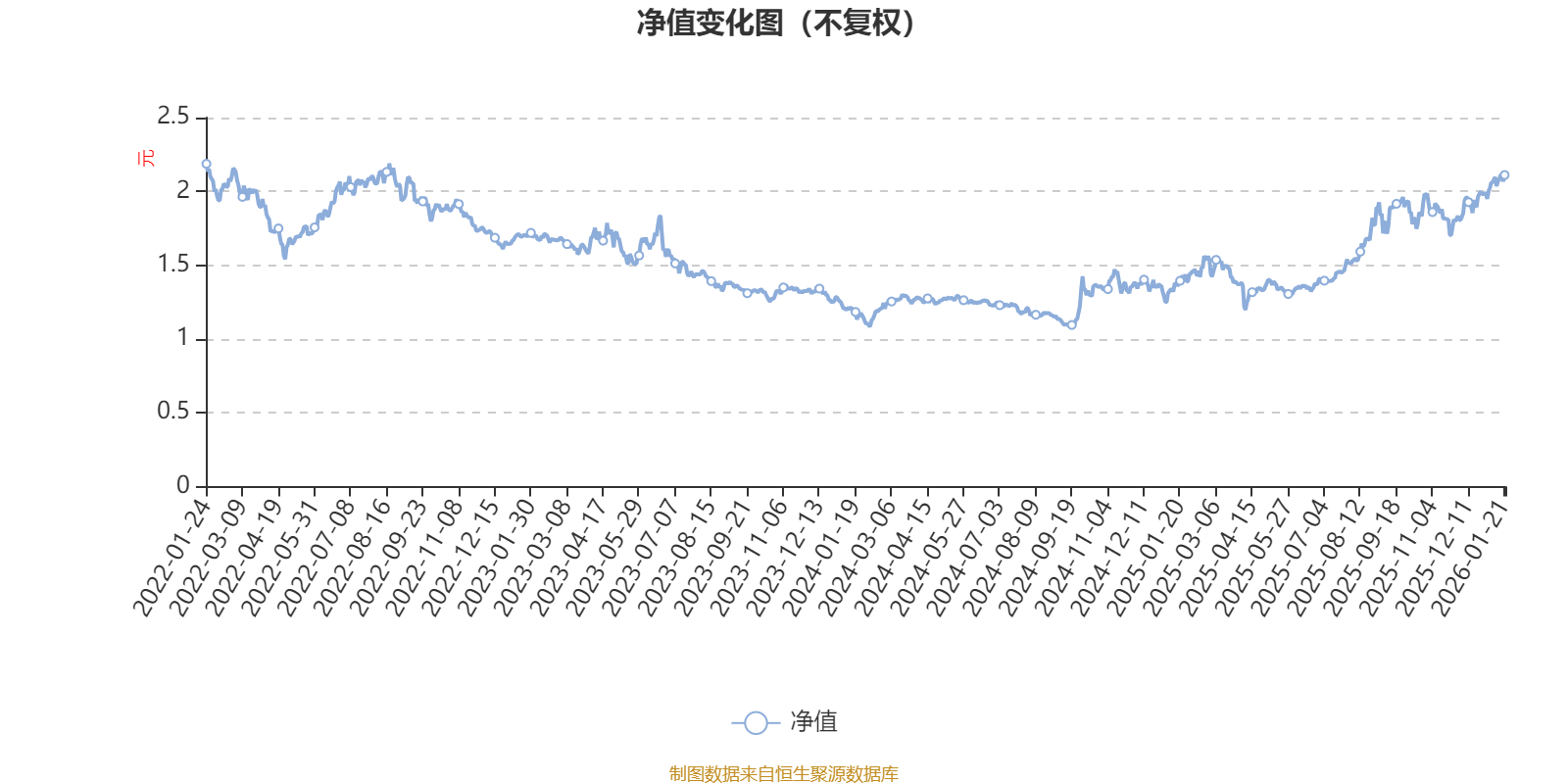
招商中国机遇股票A:2025年第四季度利润284.14万元 净值增长率1.04%
Sou Hu Cai Jing· 2026-01-22 12:21
Core Insights - The AI Fund China Opportunity Stock A (001749) reported a profit of 2.8414 million yuan for Q4 2025, with a weighted average profit per fund share of 0.0198 yuan. The fund's net value growth rate for the reporting period was 1.04%, and the fund size reached 291 million yuan by the end of Q4 2025 [3][17]. Fund Performance - As of January 21, the fund's unit net value was 2.111 yuan. Over the past year, the fund achieved a cumulative net value growth rate of 48.66%, the highest among the two funds managed by the fund manager Li Huajian, who has maintained positive returns across both funds [3]. - The fund's performance rankings among comparable funds are as follows: 13.74% growth over the last three months (46/167), 44.99% over the last six months (22/167), and 22.95% over the last three years (81/156) [4]. Investment Strategy - The fund maintained a relatively high position during the reporting period, with an average stock position of 88.52% over the last three years, slightly above the industry average of 88.27%. The highest position reached was 93.14% in mid-2025, while the lowest was 79.84% in mid-2024 [15]. - The fund's investment focus includes sectors such as telecommunications, semiconductors, and electronics, while reducing exposure to media and pharmaceutical stocks. There is an increased allocation towards non-ferrous metals, power equipment, and commercial aerospace [3]. Market Outlook - The fund manager anticipates that the market will continue to experience an upward trend, with technology innovation being the core theme of the current bull market. The telecommunications sector is expected to benefit from the rapid development of the global AI industry, while the domestic semiconductor industry is poised to gain from favorable factors such as AI computing power and domestic production [3]. Top Holdings - As of Q4 2025, the fund's top ten holdings include companies such as Cambricon Technologies, Newyea, Zhongji Xuchuang, and others, indicating a strong focus on technology and innovation [20].
大厂AI应用高频催化,增量资金持续进场,港股互联网ETF(513770)密集吸金13.6亿元
Xin Lang Cai Jing· 2026-01-22 12:17
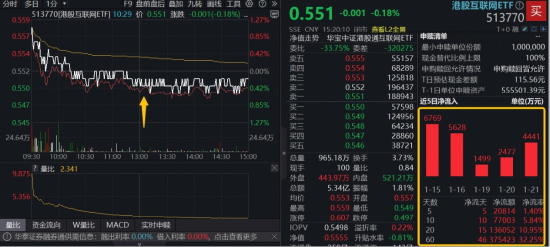
Market Overview - On January 22, Hong Kong stocks opened high but closed lower, continuing to fluctuate, with the Hang Seng Index and Hang Seng Tech Index slightly up [1][8] - The Hong Kong Internet ETF (513770) experienced a slight decline of 0.18% despite showing a wide premium throughout the day, indicating positive buying sentiment [1][8] - Over the past 20 days, the Hong Kong Internet ETF has seen a net inflow of 1.361 billion yuan, suggesting ongoing capital entry [1][8] AI Sector Developments - The commercialization of AI applications is accelerating, with Hong Kong Internet stocks as key beneficiaries [3][10] - Alibaba's Qianwen has integrated into the Taobao ecosystem to create a one-stop AI service application [3][10] - Kuaishou's AI model has achieved over 12 million monthly active users, while Meituan has upgraded its app to enhance local search functionalities [3][10] Capital Inflows and Stock Performance - Southbound funds are actively buying leading internet stocks, with Alibaba-W receiving a significant net purchase of 1.078 billion HKD on the latest trading day, marking its eighth consecutive day of increased holdings [3][10] - In the past week, Alibaba-W topped the net purchase list with 5.63 billion HKD, followed by Tencent Holdings, Xiaomi Group-W, and Kuaishou-W among the top ten [3][10] ETF Composition and Strategy - The Hong Kong Internet ETF (513770) tracks the CSI Hong Kong Internet Index, with Alibaba-W as the largest weight at 14.71%, and the top ten stocks collectively accounting for nearly 77% of the index [4][11] - For investors seeking to reduce volatility while maintaining exposure to technology, the Hong Kong Large Cap 30 ETF (520560) is recommended, combining high-growth tech stocks with stable dividend-paying companies [12]
主力资金丨机器人概念热门股尾盘遭主力大幅砸盘
Zheng Quan Shi Bao Wang· 2026-01-22 12:16
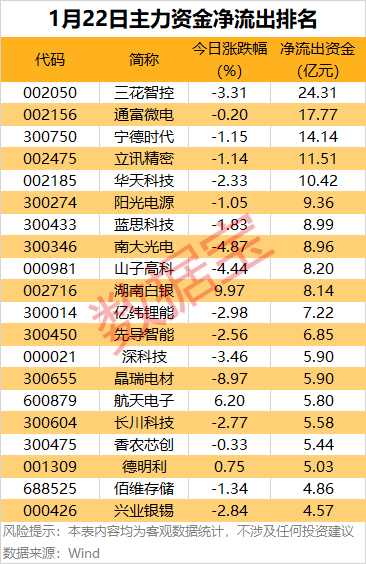
Market Overview - On January 22, A-shares saw all three major indices rise collectively, with significant gains in sectors such as aerospace, mining, shipbuilding, glass fiber, gas, oil, photovoltaic equipment, coal, and cement [1] - The main funds in the Shanghai and Shenzhen markets experienced a net outflow of 10.442 billion yuan, while 14 industries saw net inflows [1] Sector Performance - The telecommunications, defense, and non-bank financial sectors had the highest net inflows, amounting to 7.884 billion yuan, 2.916 billion yuan, and 1.371 billion yuan respectively [1] - In contrast, the electronics, power equipment, non-ferrous metals, and basic chemicals sectors faced the largest net outflows, totaling 7.979 billion yuan, 5.42 billion yuan, 2.773 billion yuan, and 2.077 billion yuan respectively [1] Individual Stock Highlights - A total of 51 stocks received net inflows exceeding 200 million yuan, with nine stocks seeing inflows over 600 million yuan [1] - The top three stocks attracting main fund inflows were New Yisheng, Zhongji Xuchuang, and Tianfu Communication, with net inflows of 2.193 billion yuan, 2.188 billion yuan, and 1.337 billion yuan respectively [1] Earnings Forecast - Tianfu Communication announced an earnings forecast for 2025, expecting a net profit attributable to shareholders of approximately 1.881 billion to 2.15 billion yuan, representing a year-on-year growth of 40% to 60% [2] Tail-End Fund Movements - In the tail-end trading session, the main funds saw a net inflow of 1.797 billion yuan, with the telecommunications sector leading with over 1 billion yuan in inflows [5] - Notable stocks with significant tail-end inflows included China Great Wall, New Yisheng, and Industrial Fulian, each exceeding 200 million yuan [5] Notable Outflows - The robot concept stock Sanhua Intelligent Control experienced a net outflow exceeding 400 million yuan, while other companies like Ningde Times and Tongfu Microelectronics also saw significant outflows [7]




风险月报 | 多维度指标分化持续缓和,聚焦估值业绩匹配度
中泰证券资管· 2026-01-22 11:33
Core Viewpoint - The overall market risk preference has improved, with the risk scoring system indicating a recovery in valuation, expectations, and sentiment, leading to a more stable market environment [2][3]. Market Risk Scoring - The risk score for the CSI 300 Index is 60.35, up from 54.89 last month, indicating a significant recovery [2]. - The valuation score for the CSI 300 has slightly increased to 65.54 from 61.54, remaining at a near one-year high [2]. - There is a persistent valuation divergence among industries, with sectors like chemicals, steel, electronics, and real estate showing valuations above the historical 60th percentile, while agriculture, food and beverage, and non-bank financials remain below the 10th percentile [2]. Market Expectations - The market expectation score has risen to 60.00 from 50.00, reflecting a more optimistic outlook despite a projected decline in GDP growth for Q4 2025 [2]. - The government is expected to implement proactive macroeconomic policies in 2026, with a focus on coordinated monetary and fiscal measures, including an anticipated reduction in reserve requirements [2]. Market Sentiment - Market sentiment has continued to recover, with a score of 55.33, moving from a "neutral" to a "slightly positive" range [3]. - Margin financing scores have reached recent highs, indicating increased enthusiasm for leveraged investments [3]. - The willingness of long-term funds to enter the market remains stable, while volatility is at historical lows [3]. Economic Data Insights - December economic data showed weakness in fixed asset investment, real estate investment, and retail sales, but had limited impact on the bond market [8]. - The overall fixed asset investment for 2025 is projected to decline by 3.8%, primarily due to a significant drop in real estate development investment [8]. - Exports in December increased by 6.6% year-on-year, while imports rose by 5.7%, indicating strong global competitiveness despite geopolitical pressures [8]. Liquidity and Credit Conditions - In December, the total social financing increased by 2.21 trillion yuan, with a cumulative annual increase of 35.6 trillion yuan, reflecting a stable credit environment [10]. - The M2 money supply grew by 8.5% year-on-year, while M1 growth slowed, indicating a potential issue with funds not effectively flowing into the real economy [11]. Bond Market Overview - The bond market remains generally stable, with the central bank maintaining a moderately loose monetary policy [12]. - Despite supportive fundamentals and loose monetary policy, the bond market has shown average performance, with concerns about future supply pressures [12].

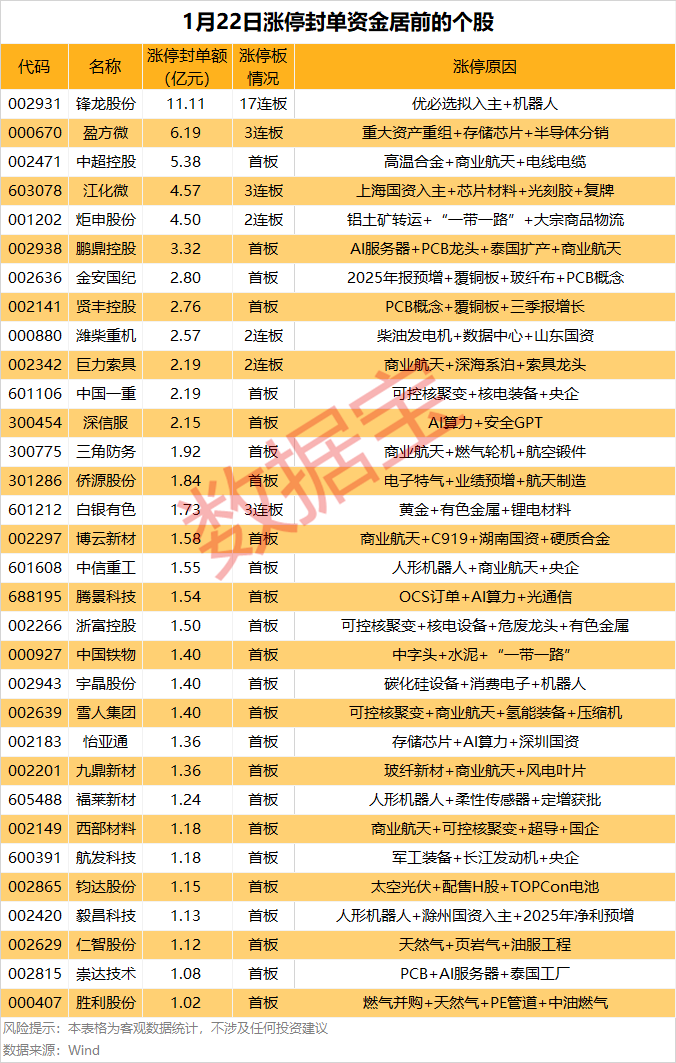
揭秘涨停丨3股封单资金均超5亿元
Zheng Quan Shi Bao Wang· 2026-01-22 11:24
Market Overview - As of January 22, the Shanghai Composite Index closed at 4122.58 points, up 0.14%, while the Shenzhen Component Index closed at 14327.05 points, up 0.5%. The ChiNext Index rose by 1.01%, and the STAR Market 50 Index increased by 0.41% [1]. Stock Performance - Over 3500 stocks rose today, accounting for over 65% of the tradable A-shares, while 1777 stocks declined. There were 92 stocks that hit the daily limit up, and 5 stocks that hit the limit down [1]. - The industries with the most stocks hitting the limit up included machinery equipment (12 stocks), electronics (11 stocks), and defense industry (7 stocks) [1]. Notable Stocks - Among the stocks that hit the limit up, *ST Guohua and ST Huawen were among 19 ST stocks. Fenglong Co., Ltd. achieved the highest consecutive limit up with 17 days [1]. - In terms of closing limit up orders, Zhongchao Holdings received the most attention with 69.19 million shares, followed by Xianfeng Holdings and Yingfangwei with 65.98 million shares and 60.20 million shares, respectively [1]. Fund Flow - The top stocks by limit up order amount included Fenglong Co., Ltd. with 1.11 billion yuan, Yingfangwei with 619 million yuan, and Zhongchao Holdings with 538 million yuan [2].